
ACQ Search & Retrieval
nclawson4/acq_search_retrieval
Busca inteligente em vídeos long-form com 900x menos latência e 25k menos custo
Ver no GitHubSistema de busca e recuperação multidimensional para bibliotecas de vídeos long-form, utilizando embeddings vetoriais, filtros estruturados e re-ranking com LLM. Exposto como portal web, API JSON e MCP server para agents de IA processarem queries em linguagem natural e retornarem clipes timestampados de forma instantânea.
Instalação
npx convez-ai nclawson4/acq_search_retrieval1 comando no terminal: detecta o formato do repositório (marketplace ou plugin avulso) e instala via Claude Code. Requer Node 18+ e o Claude Code instalado.
Métricas
Casos de uso
- Edição de conteúdo multimídia com busca por atributos estruturados
- Recuperação de trechos de vídeo específicos a partir de queries em linguagem natural
- Indexação e tagging automático de sessões de workshop com Claude
Veredito

Solução robusta de produção que combina processamento de áudio, vector search e LLM ranking para resolver um problema real de estúdios de conteúdo. Reduz significativamente labor e custos operacionais, mas requer infraestrutura Qdrant, Postgres e integração com OpenAI/Anthropic.
README
A tradução para o português deste README ainda está na fila.
Search and Retrieval Tool Long-Form Content Library
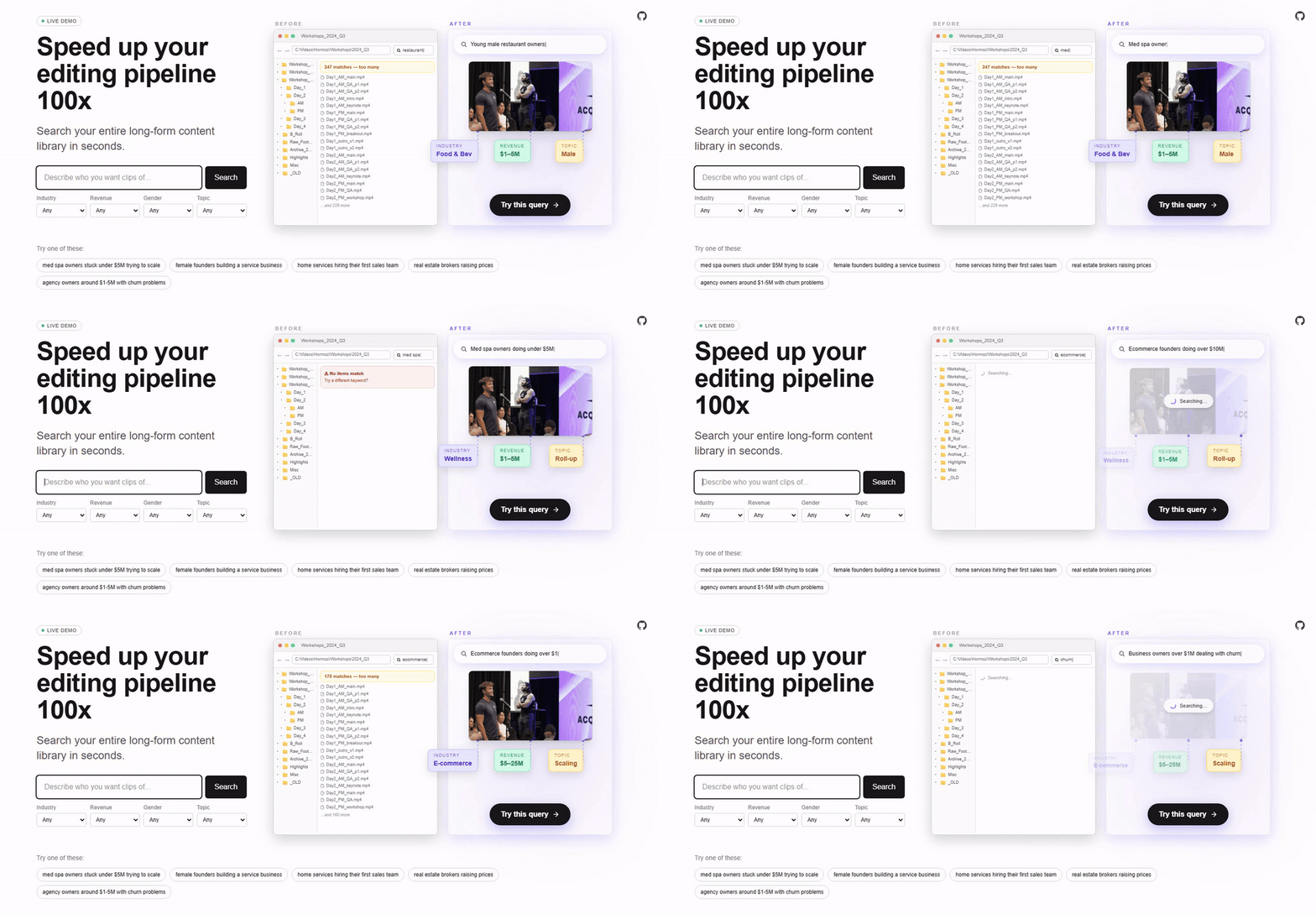
A production-grade AI-native search and retrieval system over a 500+ minute long-form Q&A workshop library. A non-technical editor types something like "med spa owners under $5M trying to scale" and the system returns ranked, timestamped attendee sessions ready to drop into an edit.
The same retrieval surface is exposed three ways: a web portal for editors, a JSON API for internal tooling, and an MCP server for AI agents.
What it costs to find one clip
| Manual editor scrubbing | This system | |
|---|---|---|
| Time per clip | 30 to 60 minutes | 2 to 3 seconds |
| Cost per clip | $25 to $80 (1 hr × $50 to $80 senior-editor rate) | $0.0018 (less than two-tenths of a cent) |
| Scales linearly with corpus | Yes (3x footage = 3x time) | No (10x footage = same latency) |
| Repeatable for a different ICP | Start the search from scratch | Same query in seconds |
Concrete per-month numbers for a studio finding 100 clips:
| Editor scrubbing only | With this system | |
|---|---|---|
| Search labor | 75 hours | 5 minutes |
| Labor cost at $60/hr | $4,500 | $5 |
| OpenAI inference cost | $0 | $0.18 |
| Total | $4,500 | ~$5 |
That is roughly a 900x latency reduction per clip and a 25,000x cost reduction per query, before counting opportunity cost of the editor's time on the work that actually requires a human.
Per-query cost breakdown
At OpenAI list pricing:
| Stage | Model | Tokens (typical) | Cost |
|---|---|---|---|
| Filter extraction | gpt-4o-mini | 530 in / 100 out | $0.000140 |
| Query embedding | text-embedding-3-small | ~30 | $0.0000006 |
| LLM judge re-rank | gpt-4o-mini | ~250 in / 30 out × 30 candidates | $0.001665 |
| Total per query | ~$0.0018 |
Vector search (Qdrant) and Postgres reads add no marginal cost. Per-query cost is logged to query_log in Postgres; a rolling 24-hour sum drives the DAILY_COST_CEILING_USD circuit breaker on /api/search/sessions.
| Item | One-time cost (per session) |
|---|---|
| Ingest tagger + audit (Claude Sonnet 4.6) | ~$0.005 |
| Session embedding | ~$0.000005 |
Full re-ingest of the current ~71-session corpus is about $0.40 in inference plus Deepgram transcription minutes.
What it does
The corpus is a library of long-form workshop videos where one host fields questions from a rotating cast of business owners. Each video contains multiple attendee Q&A sessions back-to-back, with no chapter markers.
The system:
- Splits each video into individual attendee sessions using voice fingerprinting plus speaker-cluster boundary detection.
- Tags each session with structured attributes the host team actually filters on (industry, revenue band, attendee gender, conversation topics, summary, audit-verified quote).
- Indexes every session into Qdrant with an OpenAI text embedding plus the structured filters as payload.
- Serves a hybrid retrieval surface: natural-language filter extraction, dense vector retrieval, structured-filter intersection, and a final LLM re-ranker.
The editor never sees the pipeline. They type a query, get back a list of clips, click play, YouTube opens at the right second.
Architecture
                       +--------------------------------------+
                       |           Web (Next.js 16)           |
                       |  - / homepage (server component)     |
                       |  - Mobile + desktop animated demos   |
                       |  - IP-count gate (5 free per 24h)    |
                       |  - Login (cookie-based bypass)       |
                       |  - /api/mcp (MCP server, token-gated)|
                       +------------------+-------------------+
                                          |
                            +-------------+-------------+
                            v                           v
              +-------------------------+   +-------------------------+
              |     Search pipeline     |   |        MCP tools        |
              |     (lib/sessions.ts)   |   |      (lib/search.ts)    |
              +------------+------------+   +------------+------------+
                           |                              |
            +--------------+---------------+              |
            v              v               v              v
       +---------+   +----------+   +----------+   +----------+
       | OpenAI  |   |  Qdrant  |   |   Neon   |   | Upstash  |
       | embed + |   |  vector  |   | Postgres |   |  Redis   |
       | judge   |   |  search  |   | (truth)  |   | (rate)   |
       +---------+   +----------+   +----------+   +----------+
                           ^
                           |
              +------------+------------+
              |     Ingest pipeline     |
              |       (Python)          |
              |  yt-dlp -> Deepgram ->  |
              |  Resemblyzer -> session |
              |  boundaries -> Claude   |
              |  tagger -> audit gate   |
              |  -> embed -> upsert     |
              +-------------------------+
Ingest pipeline
ingest/ is a Python pipeline organized as discrete stages so each can be re-run independently.
| Stage | Module | Output |
|---|---|---|
| Fetch | stages/fetch.py | Raw audio + video metadata via yt-dlp |
| Transcribe | stages/transcribe.py | Deepgram nova-3 word-level timestamps + speaker clusters |
| Voice fingerprint | stages/diarize.py | Resemblyzer compares each cluster to a reference clip of the host. Voice-match band widened so split host clusters both score as host |
| Session boundaries | stages/sessions.py | Per-video session start/end derived from cluster transitions, with hand-verified boundary_overrides.py for the 4 long-form videos |
| Frame extraction | stages/frames.py | One representative frame per session at start_s + 200/23.976s |
| Tag | stages/tag_session_v2.py | Claude Sonnet 4.6 emits industry, revenue, gender, topics, summary, plus a verbatim supporting quote |
| Audit | stages/tag_session_v2.py | Separate Claude call judges whether the quote supports each tag. Failed tags fall back to other |
| Embed | vectors.py | OpenAI text-embedding-3-small over the residual session text + summary |
| Upsert | vectors.py | Qdrant points keyed by session_id with structured payload |
| Dedupe | scripts/dedupe_sessions.py | Cross-video summary-embedding similarity clusters near-duplicate sessions into dup_group_id |
The ingest pipeline writes ground-truth metadata to Neon Postgres and vector embeddings to Qdrant Cloud. Postgres is the source of truth for filters and metadata; Qdrant is the dense retrieval index.
Search pipeline
web/lib/sessions.ts orchestrates the runtime search.
NL query
   |
   v
[1] extractFilters (gpt-4o-mini, structured-output JSON schema)
   | {industry, revenueBands[], gender, topics[], residualText}
   v
[2] embed (text-embedding-3-small over residualText OR raw query)
   |
   v
[3] Qdrant search with hard payload filter on revenue/gender. Industry and
   | topics are SOFT — the extractor's guesses no longer gate the candidate
   | pool, only an editor's explicit UI dropdown pick does. This keeps
   | general queries ("service-based businesses") from being silently
   | hard-filtered down to one of 20 industry slugs.
   | topK = 30 candidates
   v
[4] LLM judge pass (gpt-4o-mini) scores each candidate 0..1
   | for "is this what the editor asked for"
   v
[5] Collapse: same-video same-cluster, then cross-video dup_group_id
   |
   v
[6] Render: timestamped session cards with YouTube deep-link (?t=start_s-1)
Evaluation and monitoring
- Golden set lives at
eval/golden_queries.yaml. Each query lists expected(video_id, t_min, t_max)tuples that any reasonable retrieval should surface. scripts/eval.tsruns the golden set plus 30 random paraphrased queries and reports recall@5, recall@10, and MRR. The latest report is written toweb/public/eval-latest.jsonand rendered at/eval(dev-only, gated byENABLE_DEV_ROUTES).- Per-query cost telemetry is logged to
query_login Postgres. A rolling 24h sum feeds theDAILY_COST_CEILING_USDcircuit breaker on/api/search/sessions. - Rate limiting: Upstash sliding-window 30 req/min per IP and fixed 10k/day global, enforced in
proxy.ts. - IP-count free tier: anonymous IPs get 5 free searches per 24h (
lib/searchGate.ts) before being redirected to/login. The password unlocks unlimited searches via a 30-day cookie.
Stack
Ingest pipeline (Python 3.11)
yt-dlp,ffmpeg, Deepgram nova-3- Resemblyzer for speaker fingerprinting
- Anthropic Claude Sonnet 4.6 (tagger + audit)
- OpenAI
text-embedding-3-small(vector index)
Web (Next.js 16, React 19, Tailwind v4)
- Server components for the home page and result rendering
- Client components for the animated hero and progress UI
- Liquid-glass search animation with phased state machine (
requestAnimationFrame)
Storage
- Neon Postgres (sessions, videos, query_log, eval_queries, eval_labels)
- Qdrant Cloud (dense vector index, structured payload filters)
- Vercel Blob (extracted frames)
- Upstash KV / Vercel KV (rate limiting + IP-count gate)
Inference
- OpenAI
gpt-4o-minifor filter extraction, LLM judge, residual paraphrasing - OpenAI
text-embedding-3-smallfor retrieval embeddings - Anthropic Claude Sonnet 4.6 for the ingest-time tagger + audit (one-time per session)
Agent interface
@modelcontextprotocol/sdkserver at/api/mcpexposessearch_sessionsandsearch_momentstools. Bearer-token gated byMCP_TOKEN(required, fails closed).
Security model
- No secrets in the repo.
.env*is gitignored;.env.exampledocuments every required variable. - Prompt injection mitigation at
web/lib/extract.ts: the editor's free-text query is passed inside<query>XML tags with explicit instructions to treat its contents as data, never as instructions. The structured output schema acts as a second containment layer. - Constant-time password compare in the login API (
web/app/api/login/route.ts) to avoid timing-leak signal on a single-credential demo. - Cookie flags:
httpOnly,sameSite=lax,securewhen HTTPS. 30-day rolling expiry. - Internal routes (
/eval,/v/[id],/api/eval/*,/api/search*) are gated server-side byENABLE_DEV_ROUTES. The home page does not depend on any of them. - Rate limits at the proxy layer (
web/proxy.ts): 30 req/min per IP, 10k/day global. Anonymous search count is per-IP, per-day, stored in Redis with a 24-hour TTL. - Client IP source: trusts Vercel's
x-real-ipfirst, thenx-vercel-forwarded-for. The user-controllable leading entry ofx-forwarded-foris never used as the rate-limit key. - Fail-closed posture: when Redis is unreachable, both the per-request rate limit and the IP-count free-tier gate refuse the request rather than letting it through unmetered.
- MCP endpoint requires
MCP_TOKEN; an unset token blocks every request.
Project structure
acq_search_retrieval/
├── ingest/                  # Python pipeline (offline)
│   ├── pipeline.py          # Top-level orchestrator
│   ├── stages/              # fetch, transcribe, diarize, sessions, frames, tag
│   ├── scripts/             # populate_sessions, retag_sessions, dedupe
│   ├── boundary_overrides.py
│   └── schema.sql           # Neon Postgres schema
│
├── web/                     # Next.js 16 app
│   ├── app/
│   │   ├── page.tsx         # Home (server component, IP-gated search)
│   │   ├── login/           # Cookie-based password unlock
│   │   ├── eval/            # Golden-set dashboard (dev-only)
│   │   ├── v/[id]/          # Per-video moments debug (dev-only)
│   │   └── api/
│   │       ├── mcp/         # MCP server (search_sessions, search_moments)
│   │       ├── search*/     # JSON search endpoints (dev-only)
│   │       ├── login/       # Auth cookie issuer
│   │       └── status/      # Health check
│   ├── components/
│   │   ├── HeroAnimation.tsx        # Desktop animated demo
│   │   ├── MobileHeroAnimation.tsx  # Mobile cross-fade demo
│   │   └── SearchProgressBar.tsx    # Stage-by-stage progress overlay
│   ├── lib/
│   │   ├── sessions.ts      # Main search pipeline
│   │   ├── search.ts        # Per-moment search (used by MCP)
│   │   ├── extract.ts       # NL filter extraction
│   │   ├── searchGate.ts    # IP-count free tier
│   │   ├── env.ts           # Typed env access + devRoutesEnabled()
│   │   └── taxonomy.ts      # Industry / revenue / topic / gender enums
│   ├── proxy.ts             # Next.js 16 middleware (rate limit)
│   └── scripts/
│       ├── eval.ts          # Golden-set + paraphrase eval harness
│       ├── hero_queries.ts  # Helper that runs the demo queries
│       └── record_demo.ts   # Generates docs/demo.gif from the live site
│
├── eval/
│   └── golden_queries.yaml  # Hand-labeled retrieval ground truth
│
├── docs/
│   └── demo.gif             # Hero animation (regenerate via record_demo.ts)
│
└── .env.example
License
MIT.