
Research Orchestrator
HaochenSHI66/research-orchestrator
Orquestrador de pesquisa que mantém conversas longas navegáveis via delegação
Ver no GitHubUma skill Claude Code que executa projetos de pesquisa mantendo a thread principal limpa através de delegação a subagentes. O orquestrador apenas planeja, despacha, verifica e registra decisões, enquanto todo trabalho de pesquisa é executado por subagentes que persistem resultados em disco e retornam resumos compactos.
Instalação
npx convez-ai HaochenSHI66/research-orchestrator1 comando no terminal: detecta o formato do repositório (marketplace ou plugin avulso) e instala via Claude Code. Requer Node 18+ e o Claude Code instalado.
Métricas
Casos de uso
- Projetos de pesquisa acadêmica de longa duração
- Análise competitiva e varredura de inteligência
- Geração de papers com verificação de citações PDF e padrões de venue
Veredito

Skill maduro e bem-arquitetado para pesquisa de escala acadêmica. Implementa padrões sólidos (evidence-gating, human gates, persistent state) mas exige disciplina do usuário e infraestrutura de Claude Code estabelecida.
README
A tradução para o português deste README ainda está na fila.
research-orchestrator
A Claude Code skill that runs research projects as a lean orchestrator.
The main thread only plans, dispatches, verifies, and records — never does research work itself.
All work is delegated to subagents that write to disk and return compact summaries, so your
conversation stays navigable months into a project.



Contents
- The problem
- Install
- How it works
- What it does
- Design principles
- Workspace
- Academic skills
- Requirements
- Repo layout
- Limitations
- License
The problem
Long research projects break single-conversation LLM sessions: context fills with irrelevant detail, and 30 steps in you've lost the thread.
research-orchestrator fixes this by keeping the main thread plan-only. Every task dispatches to a subagent that writes full output to disk and returns only a ≤200-word summary.
Install
git clone https://github.com/HaochenSHI66/research-orchestrator \
  ~/.claude/skills/research-orchestrator
Then, inside any research project:
/research-orchestrator
The skill reads .research/STATE.md, picks up where you left off, and keeps moving.
How it works
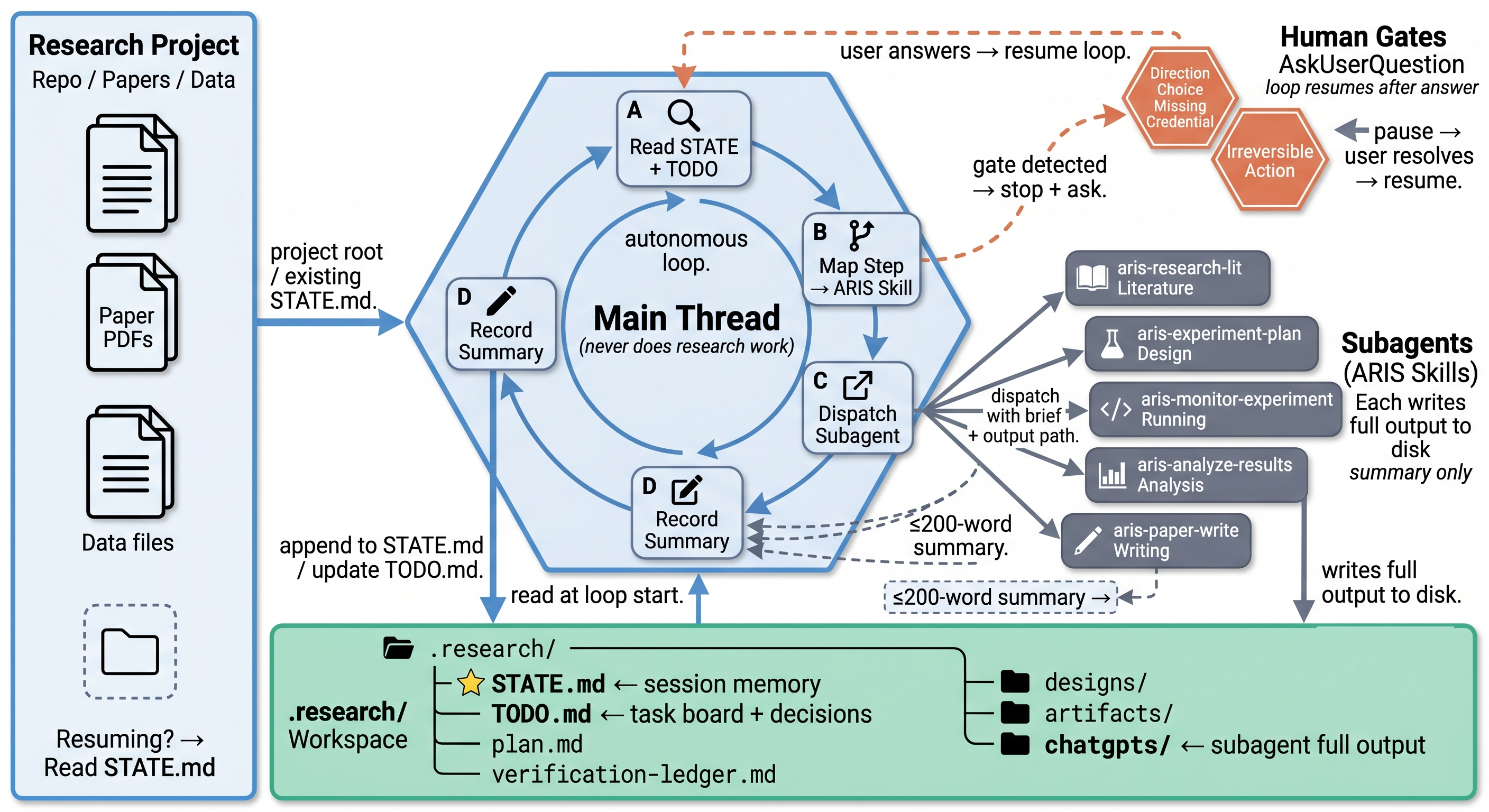
The orchestrator never does research work itself. It decides what happens next, briefs a subagent, and records the outcome. That's the entire job.
The dispatch contract
Every subagent gets a self-contained brief:
Context: <2–3 sentences — the subagent can't see the main conversation>
Task: <specific, bounded unit of work>
Skill: invoke `aris-xxx` for this
Output path: .research/artifacts/xxx.md
Return ONLY:
  1. ≤200-word summary
  2. Artifact path(s)
  3. Evidence for each load-bearing claim [verified] / [sourced] / [assumption]
  4. Skills/tools actually used
  5. Any decision the orchestrator now needs
  6. Confidence / risk flag
This contract is what keeps the main thread clean. A subagent's full notes, code, logs, and drafts stay on disk. Only the summary comes back.
What it does
| Autonomous loop | Runs through ordinary work without stopping. Pauses only at genuine human gates: direction choices, missing credentials, interactive logins, irreversible actions. |
| Persistent workspace | Plans, designs, and decisions — including options that lost — are all kept under .research/. Every session reads STATE.md first. |
| Running TODO | TODO.md is updated every loop iteration with status, locked decisions, and open questions — single source of truth for the whole project. |
| Stage → skill mapping | Each research stage auto-maps to the matching ARIS academic skill. Ideation, literature, experiments, writing, review, rebuttal — all covered. |
| ChatGPT cross-analysis | Required (not optional) for any soundness claim — novel? sound? claim follows from results? Runs via codex MCP at xhigh reasoning, saved to .research/chatgpt/. |
| Competitive sweep | Before any new direction, fans out parallel subagents to map existing literature and surface direct overlap, competitive risk, and open gaps. |
Design principles
Every concern below is enforced at runtime — gates block progress, loops update state, and the workspace records everything. Click the reference link to read the full specification.
Evidence-gating — nothing enters STATE as fact without proof
The most common failure in AI-assisted research: a subagent asserts something, the orchestrator records it, and the error propagates invisibly for 10 more steps. This skill treats every subagent summary as a claim, not proof.
- All load-bearing claims tagged
[verified: file:line],[sourced: url], or[assumption: model-prior] - Every claim tracked in
verification-ledger.md; status staysunverifieduntil evidence is supplied - Hard no-pass gate: no expensive or irreversible action (compute, push, submit) proceeds while any claim it depends on is unverified or refuted
- An
[assumption]may never be silently promoted to fact — it becomes a human gate
→ SKILL.md § The second rule: evidence over assertion · SKILL.md § The verification ledger and the no-pass gate
Citation PDF verification — every reference is downloaded and checked
Most tools trust abstracts or metadata. This skill runs a four-gate pipeline on every citation before it can appear in a draft.
- Resolve via DOI / arXiv / Semantic Scholar to canonical paper
- Fuzzy-match title, authors, year for metadata integrity
- Download the actual PDF (via Unpaywall or open-access sources)
- Extract text and confirm the specific claim the citation is meant to support
- Five outcomes:
VERIFIED,EXISTS-BUT-UNCHECKED,METADATA-MISMATCH,CLAIM-UNSUPPORTED,NOT-FOUND— a draft never ships with anything other thanVERIFIED
→ SKILL.md § References: download and verify · references/citation-verification.md
ChatGPT cross-analysis — adversarial second opinion for high-stakes decisions
For decisions where a wrong answer costs weeks (is this novel? is this design sound? does this claim follow from the results?), a second independent model is more valuable than another pass from the same one.
- Runs via the codex MCP server inside a subagent — exchange never lands in the main thread
- Model:
gpt-5.5, reasoning effort:xhigh— strongest available reviewer, not a quick sanity check - Prompted to refute, not praise — disagreement is the signal, not a problem to resolve away
- Required (not optional) for any soundness claim: design, formula, experimental protocol, novelty assertion
- Method/design choices need both an independent refutation subagent AND this codex cross-analysis to pass
→ SKILL.md § ChatGPT cross-analysis · SKILL.md § Design / experiments / formulas: both must confirm
Human gates — autonomous loop with hard stops at irreversible decisions
The skill loops without interruption through ordinary work. It stops only when a wrong guess cannot be corrected cheaply.
| Gate | Trigger |
|---|---|
| Direction choice | Multiple viable directions; choice changes everything downstream |
| Benchmark protocol | No existing benchmark measures the claimed contribution |
| Missing credential | API key, dataset token, cluster login, codex MCP auth |
| Interactive auth | Browser or terminal login required (OAuth, 2FA, gcloud auth login) |
| Irreversible action | Delete, push, submit, spend — any action that can't be undone |
| Unverified claim | Ledger has an open item a planned step depends on |
Multiple visible gates are batched into one question. Session state is written clean before every stop so the next turn or session can resume exactly.
→ SKILL.md § Human gates — the only reasons to stop
Clean main thread — the orchestrator never does the work
The main conversation handles one thing: deciding what happens next. Every execution task is a subagent.
- Each subagent gets a self-contained brief with context, task, ARIS skill to invoke, and output path
- Subagent returns ≤200-word summary + artifact paths + evidence; full output stays on disk in
artifacts/ - Independent tasks fan out in a single message (parallel dispatch); dependent tasks run sequentially
- Research stages map to ARIS skills automatically via
stage-skill-map.md— the orchestrator follows the map, not ad-hoc choices
→ SKILL.md § The one rule that makes this work · SKILL.md § Dispatching a subagent — template · references/stage-skill-map.md
Persistent workspace + running TODO — single source of truth across all sessions
Every session starts by reading state, not by asking the user what's going on.
STATE.md— reconciled againstgit logand disk on every session start; disagreements surfaced before any work beginsTODO.md— updated every loop iteration with[x]/[~]/[ ]/ 🚪 status, locked decisions with rationale, and open questions for the user- Superseded decisions are struck through and annotated, never deleted — the history of what was tried and rejected is part of the record
- Design docs versioned by filename (
v1.md,v2.md) and never overwritten in place decisions/holds one entry per human-gate decision: the options considered, the choice made, and why
→ SKILL.md § Todolist · SKILL.md § Recording designs and decisions · references/workspace-layout.md
Competitive intelligence sweep — no direction chosen blind
Before committing to any research direction (or after a topic pivot), the skill runs a mandatory literature sweep and presents a positioning map.
- Identifies top 2–3 venues for the area
- Fans out 3–5 parallel subagents across keyword angles using
aris-semantic-scholar,aris-openalex,aris-arxiv; each downloads PDFs - One subagent per paper extracts contribution, method, benchmarks, results, limitations
- Synthesis subagent builds a contribution-space table with an explicit verdict: direct overlap / competitive risk / gap filler / novel axis
- Direction choice is always a human gate — positioning map presented first, never picked silently
- Benchmark decision flows from the map: existing benchmarks reused by default; deviation requires documented justification
→ SKILL.md § Competitive intelligence sweep — mandatory before any direction gate
Venue-standard quality + figure discipline — held to NeurIPS/ICML/CVPR/ACL bar
Every project is held to the submission standards of a top CS venue. These are gates, not aspirations.
- Every design constant needs a derivation, or a sensitivity sweep + ablation; if neither exists, that's a finding, not a detail
- Gains attributed to tuning or compute (not the idea) are flagged and separated
- Single-run results, weak baselines, data leakage, missing closest prior work, and overclaiming are all caught by the reviewer-attack checklist before the writing stage
- All figures produced via the
paper-plot-from-dataskill for consistent style and palette across the paper - Every paper targets a diverse set of figure types: schematic, quantitative, ablation, qualitative/failure, convergence — not repetitive
- Tables follow the LaTeX template in
figure-discipline.md: booktabs, no vertical rules,\rowcolorfor proposed method, captions above
→ SKILL.md § Held to top CS-venue standards · references/reviewer-attack-checklist.md · references/figure-discipline.md
Workspace
Bootstrapped on first run:
.research/
├── STATE.md               ← current-state snapshot; first thing every session reads
├── TODO.md                ← running task board + locked decisions + open questions
├── plan.md                ← living master plan (high-level milestones)
├── verification-ledger.md ← status of every load-bearing claim
├── designs/               ← design docs, versioned, never overwritten
├── decisions/             ← one entry per human-gate decision (options, choice, rationale)
├── competitive-sweep/     ← positioning map + per-paper analyses
├── artifacts/             ← subagent working outputs
└── chatgpt/               ← ChatGPT cross-analysis exchanges
TODO.md is the project's single source of truth — it tracks tasks, records locked decisions with rationale, and lists open questions for the user. It's updated every loop iteration so it always reflects reality.
designs/ is versioned by filename (exp-design-v1.md, v2.md) and never overwritten. Old versions stay — the history of what was tried and rejected is part of the project record.
Academic skills
The stage → skill map targets the ARIS family (aris-*). Falls back to scholar-* / arl-* / phd-* if ARIS isn't installed — orchestration still works either way.
| Stage | Skills |
|---|---|
| Ideation | aris-idea-discovery, aris-idea-creator, aris-novelty-check |
| Literature | aris-research-lit, aris-openalex, aris-semantic-scholar, aris-arxiv |
| Experiment design | aris-experiment-plan, aris-ablation-planner |
| Running & monitoring | aris-monitor-experiment |
| Analysis | aris-analyze-results, aris-result-to-claim |
| Writing | aris-paper-write, aris-paper-plan, aris-paper-figure |
| Review & audit | aris-citation-audit, aris-paper-claim-audit, aris-auto-review-loop |
| Rebuttal | aris-rebuttal, aris-resubmit-pipeline |
The orchestrator never invokes these itself — it tells each dispatched subagent which skill to run. The subagent runs it in its own context. See references/stage-skill-map.md for the full mapping.
Requirements
- Claude Code with the
Agenttool — required; without subagent support the skill is non-functional - ARIS skills — recommended; without them falls back to
scholar-*/arl-*/phd-*or generic subagents; literature depth and review quality degrade - codex MCP server — required for autonomous soundness decisions; without it every novelty/design-validity check becomes a human gate the loop cannot pass autonomously
- Network + PDF access — required for citation verification, arXiv/Semantic Scholar sweeps, and Unpaywall downloads; air-gapped environments will trigger gate pauses
Repo layout
research-orchestrator/
├── SKILL.md                         ← the skill (orchestrator logic)
├── references/
│   ├── stage-skill-map.md           ← research stage → ARIS skill mapping
│   ├── workspace-layout.md          ← .research/ structure + file templates
│   ├── reviewer-attack-checklist.md ← what top-venue reviewers attack
│   ├── figure-discipline.md         ← figure/table standards
│   └── citation-verification.md     ← citation verification protocol
└── README.md
Limitations
- Token cost: the competitive sweep fans out 3–5 parallel subagents each downloading and parsing PDFs; a full direction sweep can cost $5–20 in API tokens. Complex stages (review loop, ablation planning) with many concurrent subagents can push a full session past $50.
- codex MCP is a hard dependency for soundness: without it, any soundness-critical decision (novelty, design validity, claim follows from results) becomes a human gate — the loop cannot proceed autonomously past it.
- Subagent summaries are not guaranteed accurate: if a subagent hallucinates or misreads a paper, the error propagates unless evidence-gating catches it. The ledger and provenance tags reduce this risk but do not eliminate it.
- Network and PDF access required: citation verification, literature sweeps, and Unpaywall downloads all require outbound internet; paywalled papers fall back to
EXISTS-BUT-UNCHECKEDstatus. - Long projects accumulate state: after many sessions,
.research/can grow large; periodic manual archiving ofartifacts/and completed decisions is recommended. - No automatic rollback: the workspace records everything but does not version-control it automatically; corrupted
STATE.mdor design docs require manual recovery.
License
MIT — see LICENSE.