
Enterprise Knowledge Assistant
daniella-mv/enterprise-knowledge-assistant
QA com RAG para documentos corporativos internos com citações verificáveis
Ver no GitHubSistema de pergunta-resposta com recuperação aumentada para documentos internos. Permite upload de PDFs, Word e Markdown, consulta em linguagem natural com respostas ancoradas em citações rastreáveis. Mantém documentos privados em ambiente controlado usando busca híbrida (vetorial + keyword) e abstém-se explicitamente quando não tem resposta.
Instalação
npx convez-ai daniella-mv/enterprise-knowledge-assistant1 comando no terminal: detecta o formato do repositório (marketplace ou plugin avulso) e instala via Claude Code. Requer Node 18+ e o Claude Code instalado.
Métricas
Casos de uso
- Consulta de políticas internas e manuais de procedimento
- Busca em bases de conhecimento distribuídas (SharePoint, Confluence, drives)
- Automação de suporte técnico com respostas rastreáveis
Veredito

Solução robusta de RAG orientada a produção com stack moderno (FastAPI, pgvector, Bedrock). Prioriza fidelidade sobre alucinação com mecanismo de abstinência explícita e citações numeradas verificáveis — ideal para ambientes corporativos que precisam rastreabilidade total.
README
A tradução para o português deste README ainda está na fila.
Enterprise Knowledge Assistant
A retrieval-augmented question-answering system for internal documents. Upload PDFs, Word docs, or markdown; ask questions in natural language; get grounded answers with inline citations back to the source page.
The problem
Internal documents — HR policies, security guidelines, runbooks, SOPs — live across SharePoint, Confluence, shared drives, and PDFs. People lose meaningful time every day searching for information that's already been written down. Generic LLMs can't see private content and hallucinate confidently when they don't know the answer.
This project closes that gap: documents stay inside a controlled environment, every answer is grounded in retrieved chunks, and every claim is traceable back to a specific source and page. When the system doesn't have the answer, it abstains explicitly instead of making something up.
What it does
- Upload PDFs, DOCX, TXT, or Markdown documents through a web UI
- Async-style ingestion pipeline: parse, chunk (token-counted with overlap), embed, index
- Hybrid retrieval combining dense vector similarity (pgvector) and BM25-style keyword search (Postgres tsvector), fused via Reciprocal Rank Fusion
- Streaming chat with Server-Sent Events; tokens appear as the model generates them
- Inline numbered citations rendered as clickable chips, with a side panel showing source filename, page number, and a snippet
- Strict abstention behavior when retrieved context is insufficient
- A repeatable evaluation harness with 20 hand-written golden questions and measured metrics on faithfulness, citation correctness, and abstention precision
Architecture
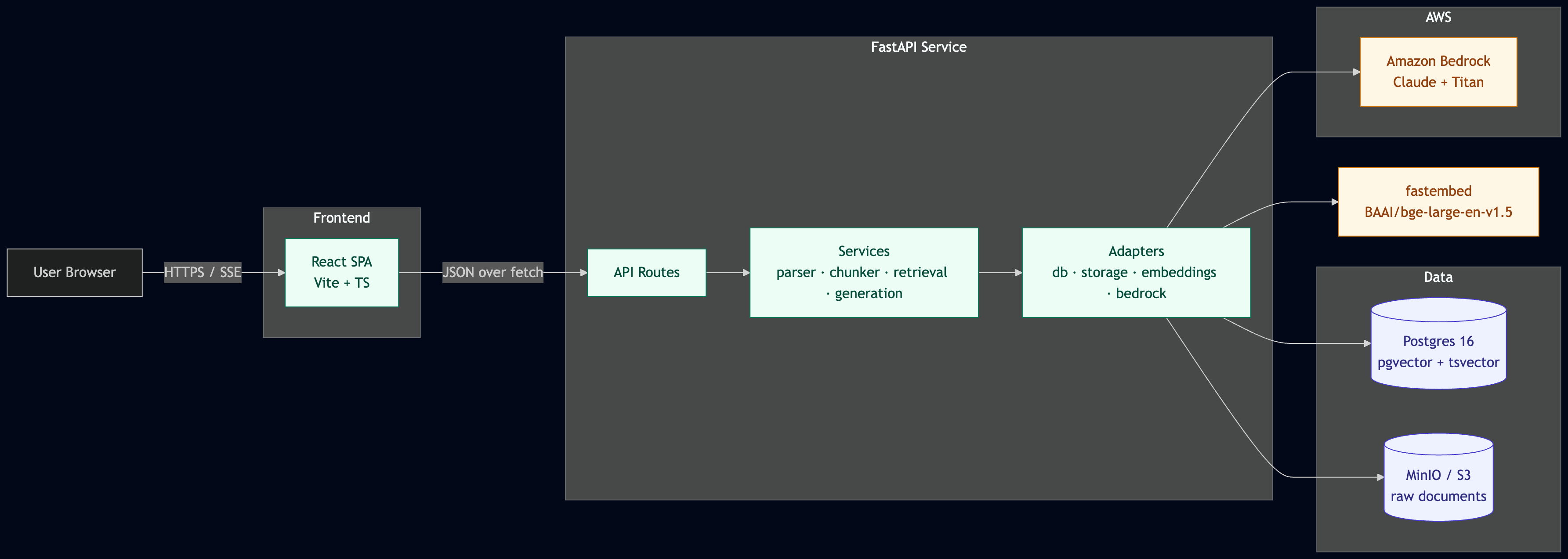
┌────────┐   HTTPS   ┌───────────┐   internal     ┌────────────┐
│ React  │──────────▶│  FastAPI  │───────────────▶│  Postgres  │
│  (SPA) │◀──── SSE──│   API     │                │ + pgvector │
└────────┘           └─────┬─────┘                └────────────┘
                           │
                           ├─▶ MinIO / S3   (raw document storage)
                           ├─▶ fastembed    (local embeddings, BAAI/bge-large-en-v1.5)
                           └─▶ Bedrock      (Claude Haiku/Sonnet, Titan Embeddings)
Three deployable surfaces: a React SPA, a FastAPI backend, and Postgres with the pgvector extension. Object storage is S3-compatible; locally that's MinIO, in production it's AWS S3. Embeddings can run locally on CPU via fastembed or remotely via Amazon Bedrock — one config flag picks which. The chat LLM is Anthropic Claude on Bedrock.
Detailed system, ingestion, and query diagrams in docs/architecture.md.
Tech stack
| Layer | Choices |
|---|---|
| Frontend | React 18, Vite, TypeScript, Tailwind, react-router-dom |
| Backend | Python 3.12, FastAPI, Pydantic v2, structlog, SQLAlchemy 2 async |
| Database | Postgres 16 with pgvector and tsvector GIN indexing |
| Storage | MinIO locally, AWS S3 in production (boto3 with endpoint_url swap) |
| Embeddings | BAAI/bge-large-en-v1.5 via fastembed (local), or Titan v2 via Bedrock |
| LLM | Anthropic Claude Haiku 4.5 / Sonnet on Amazon Bedrock |
| Migrations | Alembic, async-aware |
| Eval | Custom harness with golden Q&A set |
| Local dev | Docker Compose |
Quickstart
Prerequisites: Docker Desktop. AWS credentials with Bedrock model access for the chat features.
git clone <this-repo> enterprise-knowledge-assistant
cd enterprise-knowledge-assistant
cp .env.example .env
# Add AWS_ACCESS_KEY_ID and AWS_SECRET_ACCESS_KEY to .env

make up           # build images + start db, minio, api, frontend
make migrate      # apply database schema
Then open:
| Service | URL |
|---|---|
| Frontend | http://localhost:5173 |
| API docs | http://localhost:8000/docs |
| MinIO console | http://localhost:9001 |
Upload a document on the Documents page, then ask a question on the Chat page. Tokens stream in; citations populate the side panel.
A complete list of make commands is in the Makefile (make help).
Sample workflow
# Seed the database with three sample policy documents
make eval-seed

# Smoke-test Bedrock connectivity end-to-end
make smoke

# Try a chat from the command line (bypasses the browser)
make chat-smoke Q="What is the PTO policy?"
Evaluation
The system ships with a 20-question evaluation harness. Run:
make eval LABEL=baseline
The harness measures, on a fresh corpus of three sample documents:
| Metric | Result |
|---|---|
| Cited expected source | 100.0% |
| Avg keyword recall | 97.8% |
| Abstention precision | 100.0% |
| Latency p50 / p95 | 1.2s / 2.0s |
Methodology, comparison runs, and full per-question results are in docs/evaluation.md and evals/reports/.
Project structure
backend/         FastAPI service + Alembic migrations
frontend/        React SPA
sample_docs/     Three corpus documents used by the eval harness
evals/           Golden Q&A set, eval runner, and reports
docs/            Architecture, design decisions, deployment, security, cost
infra/           (placeholder for Terraform — not part of this build)
scripts/         DB initialization
Security and governance
- All ingested files stored in encrypted-at-rest object storage
- Per-user
owner_idfiltering on every retrieval query (foundation for multi-tenancy) - Structured audit logs with request IDs propagated through the call stack
- Citation enforcement at the prompt level prevents ungrounded claims
- TLS expected at the API gateway in deployed environments
Threat model and detailed mitigations in docs/security.md.
Cost
At local-dev scale this project costs nothing beyond electricity. With Bedrock enabled and Haiku 4.5 as the chat model, ~100 questions per day costs less than US $1/month. Detailed breakdown in docs/cost.md.
Limitations
- DOCX page numbers collapse to "page 1" —
.docxis a paragraph-flow format and doesn't have reliable page coordinates without rendering - Scanned/image PDFs aren't OCR'd in the current pipeline; pypdf returns empty text for image-only pages
- No authentication yet — the API uses a single
local-useridentity. Auth scaffolding via Cognito or Auth0 is the next step - Async ingestion in the current build is synchronous-from-the-API-perspective; the architectural shape for S3 → SQS → Lambda is documented in docs/architecture.md but not deployed
- Eval corpus is three documents; results don't generalize to large multi-thousand-document corpora without re-running the harness
License
MIT — see LICENSE.