
loongcli
wxloong08/loongcli
loongcli — 通用 AI Agent 运行时(参考 Claude Code 架构)
Instalação
npx convez-ai wxloong08/loongcli1 comando no terminal: detecta o formato do repositório (marketplace ou plugin avulso) e instala via Claude Code. Requer Node 18+ e o Claude Code instalado.
Métricas
README
A tradução para o português deste README ainda está na fila.
loongcli
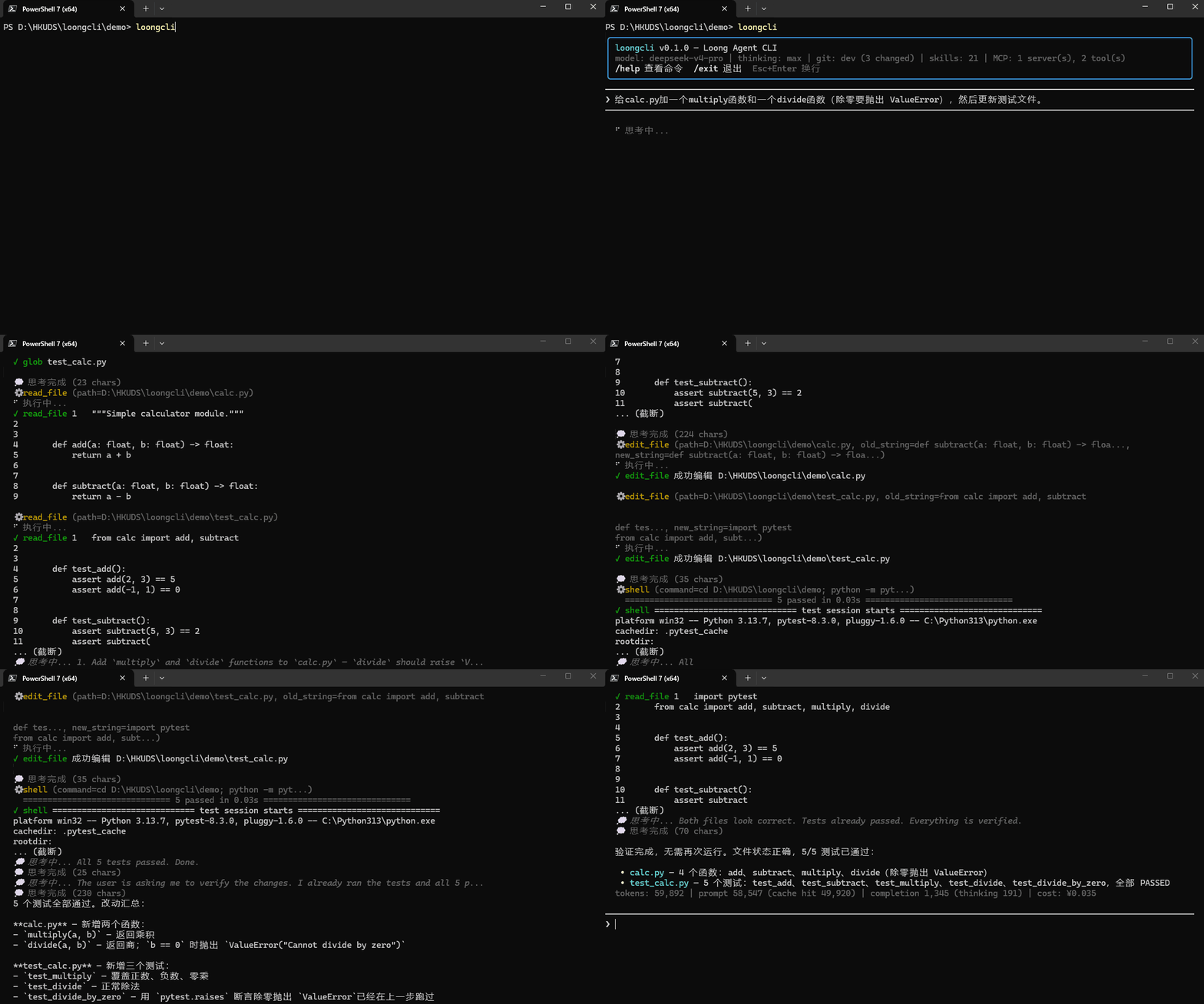
A general-purpose AI Agent CLI built from scratch, inspired by Claude Code's architecture. Independently implemented with streaming agent loop, multi-agent orchestration, LSP code navigation, 5-layer context management, and plan-driven execution.
Architecture
┌──────────────────────────────────────────────────────┐
│                      TUI Layer                       │
│  Rich streaming · Session resume · 14 slash commands │
├──────────────────────────────────────────────────────┤
│                     Agent Loop                       │
│  ReAct cycle · Plan Mode state machine · Verify loop │
├──────────┬───────────┬───────────────────────────────┤
│  Tools   │ Security  │     SubAgent System           │
│ Registry │ 3-layer   │  Delegate · Batch · Coordinator│
│ + Router │ + learning│  Message-passing · Semaphore  │
├──────────┴───────────┴───────────────────────────────┤
│    LSP Navigation    │   MCP Integration             │
│  5 tools · 13 langs  │  Stdio + HTTP transport       │
│  JSON-RPC · AutoDetect│  Tool schema merge           │
├──────────────────────┴───────────────────────────────┤
│           Context Management (5-layer)               │
│  Collapse · Truncate · Compact · Auto-compact · Snip │
├──────────────────────────────────────────────────────┤
│  Plan/Goal  │  Memory System   │  Skills  │  Hooks   │
│  CRUD+Steps │  Markdown store  │  Registry│  4 events│
│  Approval   │  Recall + Auto   │  AutoLoad│  Intercept│
└─────────────┴──────────────────┴──────────┴──────────┘
Key Systems
Agent Loop (loongcli/core/agent.py)
Streaming ReAct loop with tool calling:
- Token-by-token streaming via async generators
- Plan Mode state machine — agent voluntarily downgrades to read-only tools, creates structured plan, submits for user approval, then executes with step tracking
- Verify loop — after file modifications, auto-runs tests and self-repairs (up to 3 rounds)
- Loop detection — identical tool calls repeated 3+ times trigger a warning
- Per-turn tool call cap — prevents runaway tool usage
Tool System (loongcli/tools/)
Pluggable tool registry with role-based access control:
- 24 built-in tools: ReadFile, WriteFile, EditFile, Glob, Grep, Shell, Plan, Memorize, Recall, Skill, Delegate, BatchDelegate, SendMessage, TaskStatus, WaitTasks, StopTask, EnterPlanMode, ExitPlanMode, and 5 LSP tools (GotoDefinition, FindReferences, SymbolSearch, Hover, Diagnostics)
- Role-based routing — 4 roles (Main, Coordinator, SubAgent, Background) with blacklist/whitelist per role
- Permission learning — approved tool patterns are remembered for the session
LSP Semantic Code Navigation (loongcli/lsp/)
Language Server Protocol integration for precise code understanding:
- 5 tools: definition jump, reference search, workspace symbol search, hover type info, diagnostics
- 13 languages: Python, TypeScript/JS, Go, Rust, C/C++, Java, Ruby, PHP, C#, Lua, Zig
- Self-implemented JSON-RPC 2.0 client over stdio (no external dependency)
- Auto-detection — detects project language from file extensions, lazily starts servers
- Graceful degradation — missing server? Returns install suggestion. Unsupported language? Falls back to grep
SubAgent System (loongcli/tools/agent_tool.py)
Multi-agent orchestration with isolation:
- Single delegation (
delegate) and fan-out/fan-in (batch_delegate) - Message passing —
send_message/task_statusfor inter-agent communication - Coordinator mode — 4-phase pipeline with concurrency semaphore and depth limits
- Auto-background — long-running sub-agents promoted to background tasks
wait_tasks/stop_task— aggregate results from async tasks, cancel runaway workers
Plan Mode (loongcli/core/agent.py)
State machine for structured planning:
- Enter — Agent calls
enter_plan_mode, tools downgraded to read-only (read_file, glob, grep, LSP tools) - Research — Agent explores codebase with restricted tools
- Plan — Creates structured plan via
plantool (title + concrete steps) - Approve — Calls
exit_plan_mode, user sees plan and approves / rejects / gives feedback - Execute — Full tools restored, agent follows plan with step-by-step progress tracking
Context Window Management
5-layer compression pyramid:
| Layer | Mechanism | Cost |
|---|---|---|
| 1. Context Collapse | Read-time projection (no message mutation) | Zero |
| 2. Tool Result Truncation | Cap per-result (8K) and per-turn (30K) | Zero |
| 3. Compact | LLM summarization with attachment preservation | 1 API call |
| 4. Auto-compact | Threshold-triggered, rebuilds system prompt | Automatic |
| 5. Snip | Delete oldest messages entirely | Zero |
Circuit breaker stops compaction after 3 consecutive failures.
Three-Layer Permission System (loongcli/security/)
Safety Floor (hardcoded) → Rule Engine (configurable) → User Confirm (interactive)
- Session learning — approved patterns (e.g., write to
src/) auto-allowed for rest of session - Tiered model — reads auto-pass, writes learn on approval, dangerous operations always confirm
- Common dangerous patterns (rm -rf, format, etc.) blocked at baseline level
Memory System (loongcli/memory/)
Markdown-based persistent memory:
- Per-memory files with YAML frontmatter (type, name, description)
- 4 types: user, feedback, project, reference
- MEMORY.md index auto-injected into system prompt (200 lines / 25KB cap)
- Recall engine — LLM-powered semantic recall (top-5 relevant memories per query)
- Auto-extraction — fire-and-forget LLM extraction of memorable facts after each turn
- Dedup + aging — Jaccard overlap merge, 90-day hiding for project/reference types
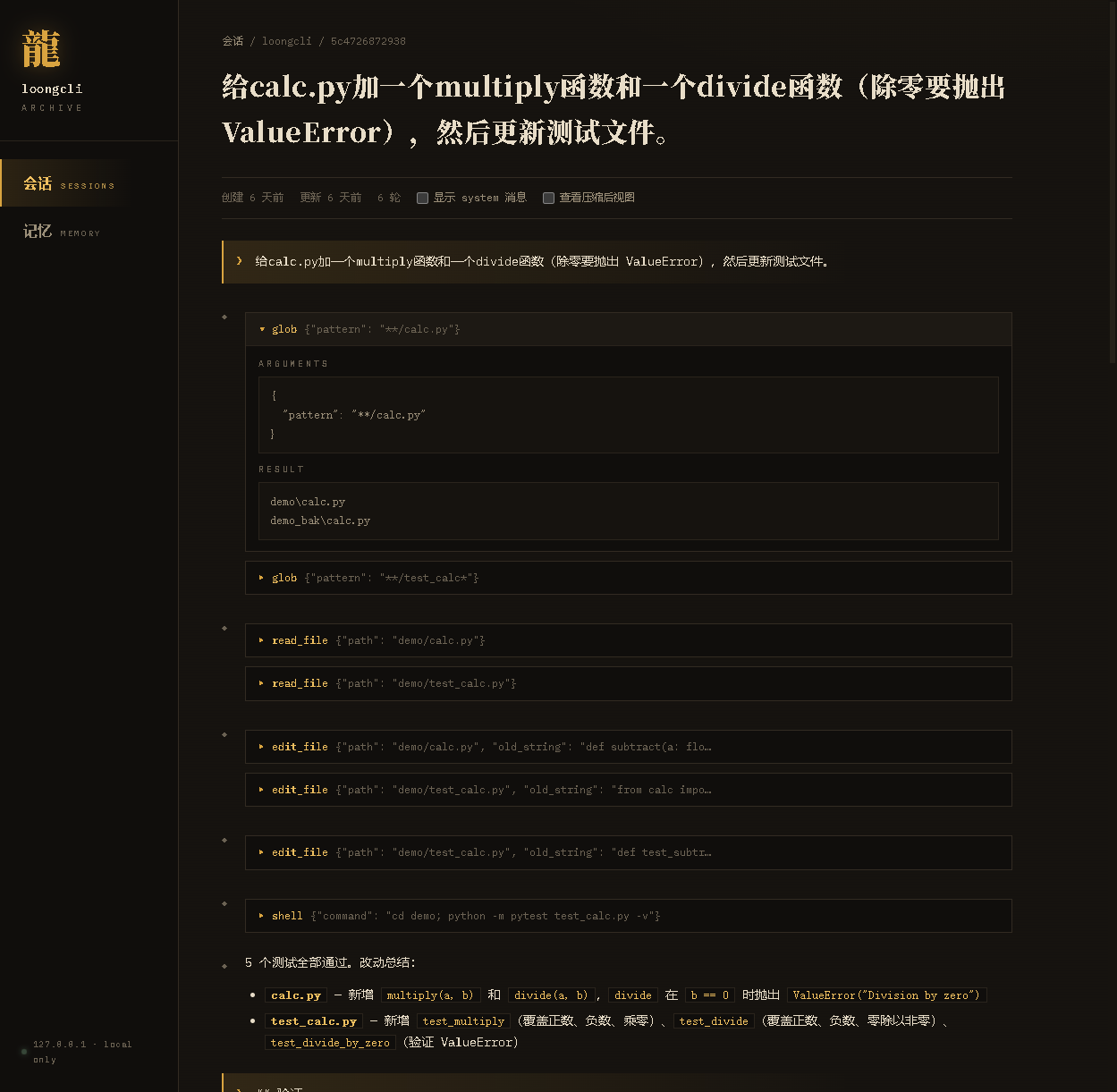
Web UI (loongcli/web/)
Local browser interface for archives — zero new dependencies (stdlib http.server):
- Session browser — read-only view of full conversation history across all projects, with collapsible tool calls and markdown rendering. Read-only is enforced at the routing layer (only GET handlers exist).
- Memory manager — full CRUD over the markdown memory store, with type filtering and dedup-merge feedback
- Two entry points —
/webslash command (daemon thread + auto-open browser) or standaloneloongcli web - Localhost only — binds 127.0.0.1, path-traversal guarded, tested
Multi-Provider Support (loongcli/core/provider.py)
- Unified interface for DeepSeek, OpenAI, Claude, Ollama
- 3-role routing — main, sub, utility each configurable to different provider/model
- Token cost tracking — per-role pricing with built-in rate table,
/usagecommand
Setup
pip install -e .
loongcli
On first run, ~/.loongcli/ and a default config.json are created automatically. Set your API key:
# Option 1: Edit config file
# Open ~/.loongcli/config.json and fill in "api_key"

# Option 2: Environment variable
export DEEPSEEK_API_KEY="sk-..."
Slash Commands
/help      — Show all commands          /plan [desc]  — Enter plan mode
/model     — Switch model/profile       /goal <desc>  — Autonomous execution
/compact   — Manual compaction          /think [level] — Toggle thinking mode
/usage     — Token usage & cost         /fast /pro     — Quick model switch
/remember  — Save memory               /init          — Generate LOONG.md
/web       — Open Web UI (sessions + memory)
Testing
pip install pytest pytest-asyncio
python -m pytest tests/ -q
1110 unit tests covering agent loop, tool execution, LSP integration, plan mode, sub-agents, permissions, compaction, memory, web API, onboarding, and TUI.
Project Structure
loongcli/
├── core/           # Agent loop, LLM client, compaction, config, events, provider
├── tools/          # Tool registry, 24 built-in tools, role routing
├── lsp/            # LSP client, server manager, 5 navigation tools
├── tui/            # Terminal UI, session management, 14 commands
├── security/       # Permission checker, safety floor, session learning
├── mcp/            # MCP client (stdio + HTTP)
├── memory/         # Markdown store, recall engine, auto-extraction
├── plan/           # Plan store, step tracking
├── skills/         # Skill registry, auto-activation
├── hooks/          # Lifecycle hook system (4 events)
└── web/            # Local Web UI: session browser (read-only) + memory CRUD
tests/              # 1110 unit tests
License
MIT