
Agent Memory Vault
wuzishu3-web/agent-memory-vault
Memória durável e indexada para agentes IA que não esquecem
Ver no GitHubSistema de memória persistente e compartilhada para agentes IA, construído sobre um vault Markdown/Obsidian. Automatiza a manutenção de uma base de conhecimento estruturada com cross-linking, deduplicação e indexação, transformando RAG estático em um wiki vivo e mantido continuamente.
Instalação
npx convez-ai wuzishu3-web/agent-memory-vault1 comando no terminal: detecta o formato do repositório (marketplace ou plugin avulso) e instala via Claude Code. Requer Node 18+ e o Claude Code instalado.
Métricas
Casos de uso
- Manter contexto persistente entre sessões de agentes de coding
- Construir bases de conhecimento auto-mantidas com deduplicação automática
- Ingerir fontes externas (artigos, vídeos, repositórios) como notas interligadas
- Hybrid retrieval (vector + keyword + graph) para consultas de contexto
Veredito

Ferramenta sólida e bem-pensada que resolve um problema real: RAG estático que joga fora conhecimento a cada sessão. A pipeline de ingest automático + hot cache + relações zero-LLM é prática. Depende só de PyYAML e endpoints OpenAI-compatíveis, o que reduz fricção. Exige engenharia de prompts e integração própria com agentes (não é plug-and-play).
README
A tradução para o português deste README ainda está na fila.
agent-memory-vault
Stop letting your AI agents forget. A shared, persistent memory + knowledge-ingest engine over a plain Markdown vault.



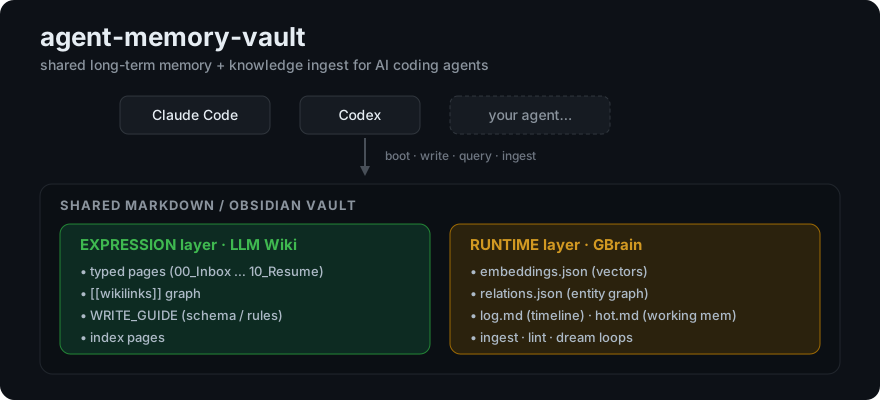
A persistent, shared long-term memory + knowledge-ingest system for AI coding agents (Claude Code, Codex, and friends), built on a plain Markdown / Obsidian-compatible vault.
Your agents stop forgetting. Instead of re-retrieving raw files on every query (classic RAG), they compile knowledge into a maintained vault of structured notes — and keep it cross-linked, deduplicated, and indexed automatically.
Inspired by Andrej Karpathy's LLM Wiki Pattern (knowledge expression layer) and the GBrain idea of a continuously-running knowledge system (knowledge runtime layer). This project is both: a writable wiki of pages plus the engine that keeps it alive.
The problem it solves
Most "give the AI a knowledge base" setups are just temporary retrieval: you dump PDFs/notes in, the system grabs a few chunks, the model stitches an answer — then it's gone. Ask twice, get two answers. New material doesn't reorganize old knowledge. Nothing accumulates.
agent-memory-vault flips it: knowledge is written down once, as durable structured pages, then maintained. The tedious part of a knowledge base isn't reading or thinking — it's the bookkeeping (cross-references, dedup, indexes, consistency). That's exactly what agents do reliably, so this system automates it.
Key features
| Capability | Script | What it does |
|---|---|---|
| 🚀 Boot context | agent_memory_boot.py | One command prints the hot cache + recent log + task-relevant hits, so any agent starts a session already oriented. |
| ✍️ Structured write | agent_memory.py | Write a typed note (decision / knowledge / project / source / …) with frontmatter; auto-appends the log and the section index. |
| 🔥 Hot cache | update_hot.py | A ~500-word "where are we right now" snapshot every agent reads first. Overwrite-on-change, file-locked for concurrent agents. |
| 🔎 Hybrid retrieval | query_vault.py | Vector (cosine) + keyword search fused with RRF, plus a one-hop lookup over the relation graph. |
| 🧮 Vector index | build_embeddings.py | Incremental embeddings (content-hash based) via any OpenAI-compatible embedding endpoint. |
| 🕸️ Relation graph | extract_relations.py | Zero-LLM, regex + whitelist relation extraction (works_at / reports_to / founded / …). |
| ⭐ Ingest pipeline | ingest.py | Turn any external source (article / video / repo / transcript) into a page + bidirectional cross-references to the most similar existing notes + a quality gate + index rebuild. The piece classic RAG and plain note-taking both skip. |
| 🛡️ Auto-ingest hook | ingest_stop_hook.py | A Claude Code Stop hook: if a session processed an external source but never ingested it, it reminds the agent (once) to file it — using the agent's own analysis, never a cheap auto-summary. |
| 🧹 Lint | vault_health_check.py | Finds stale inbox drafts, overdue 待核验 notes, orphan pages, incomplete frontmatter. |
| 🌙 Consolidation | dream_cycle.py | Periodic "dreaming" pass that reorganizes/promotes knowledge. |
| 📓 Session beats | stop_hook_beat.py | Conservative Stop hook that records what a session touched (redacts secrets). |
The star: the ingest pipeline
python3 scripts/ingest.py --agent claude-code \
  --title "LLM Wiki Pattern vs GBrain" \
  --summary "<your high-quality summary, written by the agent>" \
  --body-file notes.md \
  --url "https://example.com/article" \
  --source-type article
What happens, deterministically:
- Dedup — checks the source dir by URL / title; updates instead of duplicating.
- Quality gate — if the summary/body is too thin, the source is quarantined to the inbox with
status: 待核验and never pollutes your source folder. No half-baked pages, ever. - Write page — a structured
sourcenote with frontmatter, appended to the log and source index. - Bidirectional cross-references — embeds the new page, finds the top-K most semantically similar existing notes (cosine ≥ threshold), and writes
[[links]]both ways — into the new page and back into each old page. This is the "bookkeeping" that keeps a wiki from rotting. - Re-index — incremental embeddings + relation extraction.
Design principle: understanding vs bookkeeping are separated. The summary must come from a capable agent in-context (high quality); the script only does the mechanical filing. That's why it can be fully automatic without producing junk.
Demo
Ingesting a source automatically threads it into your existing knowledge:
$ python3 scripts/ingest.py --agent claude-code \
    --title "Hybrid Retrieval Explained" \
    --summary "Vector cosine + keyword via RRF, plus a relation-graph one-hop lookup." \
    --url "https://example.com/hybrid" --source-type article

# → writes  08_Sources/2026-…-Hybrid-Retrieval-Explained.md   (quality gate: passed)
# → finds the most similar existing note (cosine 0.752) and links it BOTH ways:
#     new page  ──▶  04_Knowledge/…-Vector-retrieval-deep-dive.md
#     that note ──▶  back to the new page          ← the bookkeeping a wiki usually rots without
# → rebuilds the embedding + relation indexes (incremental)
If the embedding endpoint is offline, the page is still written and logged — only the cross-references and re-index are skipped (and the page is flagged for later).
How it works (architecture)
        ┌─────────────────────────── your agents ───────────────────────────┐
        │   Claude Code        Codex          (your own agent)               │
        └───────────┬───────────────┬───────────────┬───────────────────────┘
                    │ boot / write / query / ingest  │
        ┌───────────▼────────────────────────────────▼───────────────────────┐
        │                      shared Markdown vault                          │
        │                                                                     │
        │  EXPRESSION layer (LLM Wiki)        RUNTIME layer (GBrain)           │
        │  • typed pages (00..10)             • embeddings.json (vectors)      │
        │  • [[wikilinks]] graph              • relations.json (entities)      │
        │  • WRITE_GUIDE (schema/rules)       • log.md (timeline)              │
        │  • index pages                      • hot.md (working memory)        │
        │                                     • ingest + lint + dream loops    │
        └─────────────────────────────────────────────────────────────────────┘
Vault layout
your-vault/
├── index.md                      # home / catalog
├── AGENTS.md                     # operating rules agents read
├── 00_Inbox/                     # unsorted + quarantined drafts
├── 01_User/profile.md            # stable user preferences & background
├── 02_Agents/                    # one profile per agent
├── 03_Projects/  04_Knowledge/  05_Daily/
├── 06_Decisions/ 07_Playbooks/  08_Sources/   # ← ingest writes here
├── 09_Archive/   10_Resume/
└── _system/
    ├── WRITE_GUIDE.md            # the single authority: what goes where
    ├── AGENT_MEMORY_PROTOCOL.md  # the protocol all agents follow
    ├── hot.md  log.md            # working memory + timeline
    ├── embeddings.json relations.json   # generated indexes (gitignored)
    └── scripts/ → (this repo's scripts/)
What this is — and isn't
Agent memory is a crowded space, and several mature projects beat this one on raw capability. Saying so plainly is the point: it helps you tell whether this is the right tool for you rather than the "best" one in the abstract.
This is for you if you:
- run multiple, heterogeneous CLI / coding agents (Claude Code, Codex, …) and want them to share one brain;
- want memory to be plain Markdown files you own — greppable, hand-editable, git-versionable, openable in Obsidian — not rows in a vector DB;
- prefer local-first, zero-service, tiny-dependency (one library + an embedding endpoint) over a framework or a hosted API;
- like the "compile knowledge into maintained, cross-linked pages" stance over "retrieve raw chunks on every query".
Look elsewhere if you:
- need to scale to millions of memories — brute-force cosine over a JSON file won't cut it;
- want autonomous, self-managing memory or sophisticated temporal/graph retrieval out of the box;
- are embedding memory into a product/app and want a maintained SDK + integrations.
How it compares
| design center | memory lives in | shines when | |
|---|---|---|---|
| agent-memory-vault (this) | files you own, shared by a fleet of CLI agents | a Markdown / Obsidian vault | local power user · multi-agent · human-readable knowledge |
| Mem0 | a memory layer/SDK for LLM apps | vector + graph store | auto-extracting memory into your own app |
| Letta / MemGPT | stateful agents with self-editing memory | agent server + DB | autonomous, self-managing agent memory |
| Zep / Graphiti | a production memory backend | temporal knowledge graph | scale + sophisticated temporal retrieval |
| claude-mem | a zero-config Claude Code plugin | local store | automatic capture inside Claude Code, no setup |
None of these is "better" in the abstract — they target different users. This project's wedge is file-ownership + multi-agent sharing + a compile-not-retrieve stance, with almost no moving parts. If you need scale, autonomy, or a polished SDK, one of the others is very likely the right call.
Install
git clone https://github.com/wuzishu3-web/agent-memory-vault.git
cd agent-memory-vault

# 1. Point an env var at where your vault will live (OUTSIDE this repo)
export AGENT_MEMORY_VAULT="$HOME/my-vault"

# 2. Scaffold a fresh vault from the template
python3 scripts/init_vault.py

# 3. Dependencies
pip install pyyaml          # required by extract_relations.py
# (embeddings/ingest also need an OpenAI-compatible embedding endpoint — see Config)
Add export AGENT_MEMORY_VAULT=... to your shell profile so every agent sees it.
As a Claude Code skill
Symlink or copy this repo into your skills directory and the bundled SKILL.md makes it invocable:
ln -s "$(pwd)" ~/.claude/skills/agent-memory-vault
Usage
# Start a session already oriented
python3 scripts/agent_memory_boot.py --agent claude-code --task "refactor the auth module"

# Write a durable note
python3 scripts/agent_memory.py --type decision --agent claude-code \
  --title "Why we switched to X" --summary "..." --body "..."

# Ingest an external source (see "the star" above)
python3 scripts/ingest.py --agent claude-code --title "..." --summary "..." --url "..." --source-type article

# Search
python3 scripts/query_vault.py "how did we handle rate limiting"

# Update the hot cache at the end of a session
python3 scripts/update_hot.py --agent claude-code --last "..." --active "..." --dont "..."

# Lint the vault
python3 scripts/vault_health_check.py
Configuration
| Env var | Default | Purpose |
|---|---|---|
AGENT_MEMORY_VAULT | ~/agent-memory-vault | Path to your vault. |
Embedding endpoint (used by build_embeddings.py, query_vault.py, ingest.py) defaults to an OpenAI-compatible server at http://127.0.0.1:1234/v1/embeddings (e.g. LM Studio running text-embedding-nomic-embed-text-v1.5). Override with --url / --model. If the endpoint is down, ingest still writes pages — it just skips cross-references and re-indexing and marks the page for later indexing. Vectors are never a hard dependency for capturing knowledge.
Multi-agent setup
The whole point is that several agents share one vault. Each agent:
- runs
agent_memory_boot.py --agent <name>at the start, - writes durable facts via
agent_memory.py/ingest.py, - overwrites
hot.mdviaupdate_hot.pyat the end.
WRITE_GUIDE.md is the single authority that maps content → where it goes, so three agents don't each invent their own filing scheme. Add new agents by dropping a profile in 02_Agents/ and a key in AGENT_FILES (in agent_memory_boot.py / agent_memory.py).
中文简介
给 AI 编程 agent(Claude Code、Codex…)用的共享长期记忆 + 知识入库系统,底座是纯 Markdown / Obsidian 笔记库。
不再是传统 RAG 的"临时检索",而是把知识编译成持续维护的结构化页面,并自动完成最累的"记账"——交叉引用、去重、索引、一致性。核心亮点是 ingest.py 入库管道:把任意外部源变成一篇页面,自动双向连上语义最近的旧笔记 + 质量闸门(不达标的隔离进 Inbox,正式区永不出半成品)+ 增量重建索引。理念是"理解归 agent、记账归脚本",所以能全自动又不产生垃圾。灵感来自 Karpathy 的 LLM Wiki Pattern(知识表达层)与 GBrain(知识运行层),本项目把两层合一。
安装见上方 Install;用法见 Usage。
Credits
- Andrej Karpathy — the LLM Wiki Pattern that frames the expression layer.
- GBrain — the framing of a continuously-running knowledge runtime.
License
MIT © 2026 wuzishu3-web