
Konsylium
witczakm/konsylium
Painel cego de IA advisors para validar decisões custosas antes de executá-las
Ver no GitHubUm painel de conselheiros IA que avaliam decisões de múltiplos ângulos de forma independente, preservando discordâncias. Skill para Claude Code, Codex e app Claude que fornece um veredito único mostrando exatamente onde os advisors discordaram e o que ainda é desconhecido.
Instalação
npx convez-ai witczakm/konsylium1 comando no terminal: detecta o formato do repositório (marketplace ou plugin avulso) e instala via Claude Code. Requer Node 18+ e o Claude Code instalado.
Métricas
Casos de uso
- Validar decisões arquiteturais (monolito vs microserviços, design de banco de dados)
- Avaliar mudanças de preço ou estratégia de negócio antes de implementar
- Obter múltiplas perspectivas (compliance, segurança, pragmatismo) em decisões irreversíveis
Veredito

Skill sólido e bem arquitetado para decisões de alto impacto. Resolve um problema real (confirmação independente antes de agir) com implementação limpa em shell, suportando múltiplas plataformas Claude e preservando dissensão genuína — não é uma mera agregação de respostas.
README
A tradução para o português deste README ainda está na fila.
konsylium
English · Polski
A panel of AI advisors instead of one confident answer. One command convenes 3–6 advisors who judge your decision from different angles — independently — then return a single verdict that shows exactly where they disagreed and what's still unknown.
For people using Claude Code, Codex or the Claude app who face a decision that is costly to get wrong. Advisors answer without seeing each other (a blind panel), their disagreements stay in the verdict (honest dissent), and it informs your decision before you make it (a pre-check) — it never approves or blocks anything for you.





- Quick start
- See an example
- Why?
- How it works
- Is this for you?
- Install
- Also from the terminal
- Privacy & safety
- Honestly: what it does NOT do
- Does it actually work?
- What it builds on (credits)
- Contributing & license
Quick start
git clone https://github.com/witczakm/konsylium.git && cd konsylium
sh install.sh                  # preview without changes: add --dry-run
Then, in a new Claude Code session, ask a real question — e.g.:
/konsylium monolith or microservices for a small team?
/konsylium raise prices 30% now, or wait?
/konsylium one table for customer data, or split it?
…or anything of your own: /konsylium <your decision>.
You get one verdict in a fixed shape:
Recommendation: monolith — one team, one deploy; microservices add operational
  cost you won't earn back yet.
Where they differed: Architect vs Pragmatist — module boundaries (a value
  tension, not an error).
What we don't know: [TO CHECK] projected traffic and SLA targets.
Next step: record it as an ADR; if the call is irreversible → Mode B.
Codex and the desktop app are covered below.
See an example
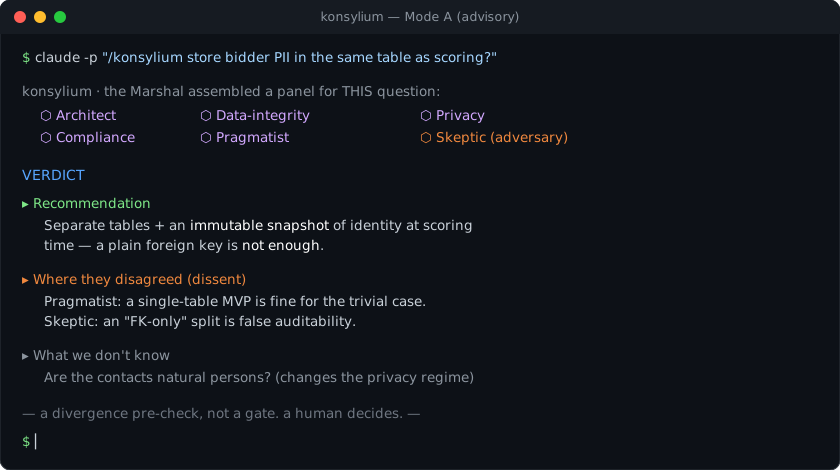
Someone asked how to design a database (where to keep customer data). Instead of a single answer, konsylium assembled advisors for privacy, compliance and data integrity — and two of them independently caught something a plain answer would miss:
Recommendation: split the data into separate tables and store a "snapshot" of the data as it was at decision time — because a later name correction must not rewrite the history of an earlier decision. Where they differed: one advisor allowed a simpler start; another pushed back hard on it. What we don't know: whether these are personal data (then GDPR applies)…
Full verdict and three more decisions → examples/.
Why?
The worst decisions look great — right up until it's too late. It's rarely bad code; it's building the wrong thing. A second opinion would help, but who wants to hand-prompt three models and stitch the answers together? konsylium does it in one command — and flags the weak spots before you walk into them.
How it works
The rhythm is simple — one question fans out to several independent advisors and comes back as a single verdict:
              Your question
                    │
                  Chair               → picks 3–6 advisors to fit the question
                    │
        ┌─────┬─────┼─────┬─────┐     ↓ FAN-OUT — each one alone (blind),
        ▼     ▼     ▼     ▼     ▼        in its own clean context
     architect skeptic data cost …
        └─────┴─────┼─────┴─────┘     ↑ FAN-IN — synthesis, no names
                    ▼
              Verdict
     recommendation · where they differed · what we don't know
                    │
                    ▼
              You decide
Step by step:
- Pick the panel. A "chair" reads your question and assembles 3–6 advisors that actually fit it (e.g. an architect, a skeptic, a data specialist). There's always someone playing devil's advocate.
- Independent opinions. Each advisor answers on their own, without seeing the others — so they don't copy or defer to one another.
- No names. Opinions go into the summary anonymously, so the argument counts, not "who said it".
- The verdict. You get one recommendation, a clear "where they differed", an honest "what we don't know", and a next step.
It's a decision aid, not a verdict — the final call is always yours.
Two modes
| Mode | When | What you get |
|---|---|---|
| A — advisory (default) | most decisions | 3–6 advisors in one session, blind, one verdict — fast |
| B — gate (an independent check before you commit) | important / irreversible | routes to AI models from different vendors for genuine independence |
A panel from a single provider isn't the same as a second opinion from an independent one — so high-stakes calls escalate to Mode B.
Is this for you?
✅ Yes, if: the decision is hard to reverse or costly · you're choosing between 2–3 options and it isn't obvious · you have an idea and want it honestly challenged · you're locking an important doc/plan and want other angles first.
❌ Probably not, if: the question is simple and obvious — one answer is plenty.
Install
What you need: Claude Code or Codex (or the Claude app). The repo ships two language editions —
English and Polish; both register the /konsylium command.
sh install.sh --dry-run     # preview — writes nothing
sh install.sh               # install (English) into Claude Code + Codex
An existing install is backed up, never silently overwritten. Then start a new session.
- Polish edition:
sh install.sh --lang pl - One tool only: add
--claude-onlyor--codex-only - Claude / Cowork desktop app (it imports a ZIP, it doesn't read the folders):
Customize → Skills → "+" → Create skill → upload
dist/konsylium-en.zip(or-pl) → toggle ON.
Also from the terminal
You don't have to be in a chat — it works as a one-liner too (handy for automation, e.g. in CI):
claude -p "/konsylium one table to start, or split the data?"
codex exec "use the konsylium skill: monolith or microservices for a small team?"
Pipe the result to a file (> verdict.md) and drop it into your notes, a PR description, or a decision log.
Privacy & safety
- The skill itself sends nothing to the internet and collects no data — it's plain text instructions;
the only script (
install.sh) just copies files locally. - Your question goes only to the AI tool you already use; it reaches other vendors' models only when you deliberately use Mode B.
- Don't paste secrets or sensitive data into a question.
Details and how to report issues → SECURITY.md.
Honestly: what it does NOT do
No miracle claims:
- It's a thinking aid, not an oracle. For a simple question, don't use it — one answer is enough.
- The same question can give a slightly different panel and a different answer. In regular mode that's on purpose — the point is varied angles (need repeatability? → Mode B).
- Advisors can sound different yet think alike. We make sure each looks from a different angle, but we don't measure that.
- It costs a bit more than one question (it runs several opinions at once). Use it for decisions that matter — still cheaper than building the wrong thing.
- No endless arguing. Research shows forcing AI through many rounds of debate doesn't improve quality (and sometimes hurts), so we keep it to one round.
Does it actually work?
No promises that it always does. I ran a small, honest test on 5 real decisions: it helped in 4 (clearly once, moderately three times) and not at all once (simple questions don't need a panel). Details: EVALS.md. Treat it as a way to get a broader view, not an infallible oracle.
What it builds on (credits)
The "AI panel" idea isn't new — a nod to: karpathy/llm-council, council-review, council-of-high-intelligence, llm-consortium, Anthropic's Agent Skills.
What konsylium adds: a panel chosen for the question (not a fixed roster), one package across several tools, and a clear split between "advising" and "independent scrutiny". The specific borrowed ideas and their licenses are in THIRD-PARTY-NOTICES.md.
- It's a skill (Markdown instructions the AI runs) — not a server; nothing to launch or maintain.
- Each advisor runs in its own clean context; only the summary returns to the main conversation.
- Skills don't sync across tools — install separately in each (Claude Code, Codex, the app).
- Mode B routes the question to a multi-model consensus tool (e.g.
llm-consortium) so a different model evaluates than the one that generated — and always before, never instead of, the human's call.
Contributing & license
PRs welcome — see CONTRIBUTING.md. History: CHANGELOG.md.
MIT © 2026 Michał Witczak. Use it freely.