
tend
varmabudharaju/tend
Context hygiene for Claude Code — fail-open hooks that file away oversized outputs, externalize session state to STATE.md, pin the goal to every prompt, and turn compaction into a curated, well-timed event. Stays sharp deep into long sessions.
Instalação
npx convez-ai varmabudharaju/tend1 comando no terminal: detecta o formato do repositório (marketplace ou plugin avulso) e instala via Claude Code. Requer Node 18+ e o Claude Code instalado.
Métricas
README
A tradução para o português deste README ainda está na fila.
tend


Keep Claude Code sharp in long sessions.
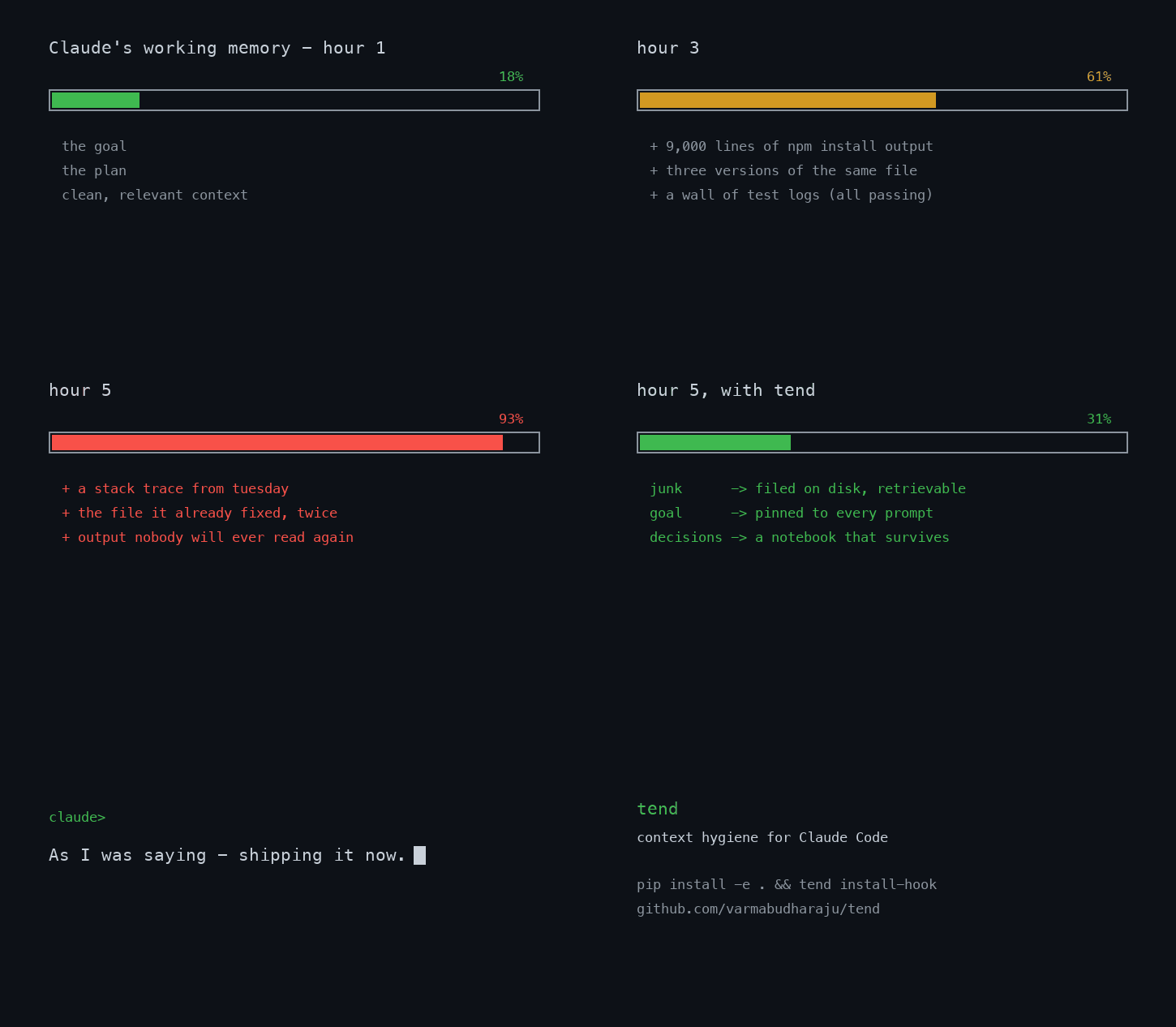
tend is a small, invisible helper that rides along with Claude Code and keeps its limited "working memory" clean — so the assistant stays smart ten hours into a big task instead of slowly losing the plot.
pip install -e . && tend install-hook # 30 seconds, fully reversible, no daemon
flowchart LR
    S["Your Claude Code session"] -->|every event| T{"tend<br/>(8 tiny hooks)"}
    T --> O["Files away huge outputs<br/>to disk"]
    T --> N["Maintains a shared notebook<br/>STATE.md"]
    T --> A["Pins the goal + health<br/>to every prompt"]
    T --> C["Times memory cleanup<br/>so nothing is lost"]
The problem, in plain words
An AI assistant has a fixed amount of working memory, called the context window. Think of it as a desk. Every file it reads, every command output, every conversation turn is another sheet of paper on that desk.
On long tasks the desk fills up with old papers: a 5,000-line log it needed once, three versions of a file it already fixed, dead-end experiments. Two things go wrong:
- The assistant gets dumber. The important stuff (what are we building? what did we decide?) is buried under junk.
- Eventually the desk overflows. The assistant has to sweep papers into a box ("compaction") — and without supervision it sometimes sweeps away the notes that mattered.
tend is the colleague who quietly keeps the desk tidy.
flowchart TB
    subgraph without ["Without tend"]
        direction TB
        a1["Desk fills with old papers"] --> a2["Important notes get buried"]
        a2 --> a3["Desk overflows"]
        a3 --> a4["Cleanup sweeps away<br/>decisions and lessons learned"]
        a4 --> a5["Assistant repeats old mistakes"]
    end
    subgraph withtend ["With tend"]
        direction TB
        b1["Big papers filed in drawers"] --> b2["Goal pinned on top,<br/>always visible"]
        b2 --> b3["Cleanup happens between tasks,<br/>never mid-thought"]
        b3 --> b4["Notebook survives everything"]
        b4 --> b5["Assistant stays sharp"]
    end
What tend does — four habits
| Habit | In plain words | In Claude Code terms |
|---|---|---|
| File it, don't pile it | A 10-page printout gets filed in a drawer; a sticky note on the desk says which drawer. | Oversized tool outputs are replaced with a head+tail excerpt; the full text is saved to disk with its path, retrievable with a bounded Read. |
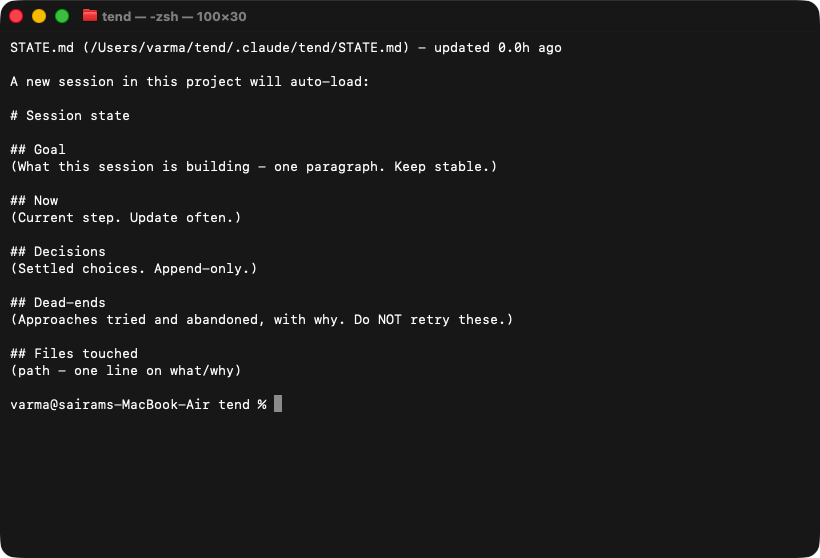
| Keep a notebook | Goals, decisions, and dead-ends live in a notebook that survives even if the desk is cleared. | Each project gets .claude/tend/STATE.md (Goal / Now / Decisions / Dead-ends). New sessions auto-load it, so /clear is a lossless handoff. |
| Sticky note with the goal | A note on the monitor: what we're doing, how full the desk is. | A ≤400-token anchor is injected with every prompt: goal, current step, context %, stale-result warnings, and a /compact recommendation when it's time. |
| Clean up at the right moment | Tidy between tasks — never mid-thought, never throwing out the notebook. | tend detects task boundaries, recommends curated compaction (keep goal/decisions, drop raw outputs), snapshots before every compaction, and blocks one stale auto-compact until the notebook is updated. |
And one bonus habit, added after watching real usage bills:
| Habit | In plain words | In Claude Code terms |
|---|---|---|
| Right-sized helpers | When the assistant hires a helper, a note suggests: this errand doesn't need the most expensive expert. | When a subagent is spawned without an explicit model, tend suggests the cheapest model tier that fits the job (see swarm for the full tiering system). |
The first habit, in one picture:
flowchart LR
    big["A tool returns 20,000 tokens<br/>of build logs"] --> tend{"tend"}
    tend -->|"stays in working memory"| ex["First lines + last lines<br/>+ a note naming the drawer"]
    tend -->|"goes to disk"| file["The full output, saved.<br/>Any slice readable later."]
And the notebook habit — why nothing important ever dies:
flowchart LR
    s1["Session 1 works,<br/>writing the notebook as it goes"] --> n["STATE.md<br/>Goal / Now / Decisions / Dead-ends"]
    n --> e{"Session ends:<br/>crash, /clear, or just Friday"}
    e --> s2["Session 2 auto-loads the notebook<br/>and picks up where 1 left off"]
See it
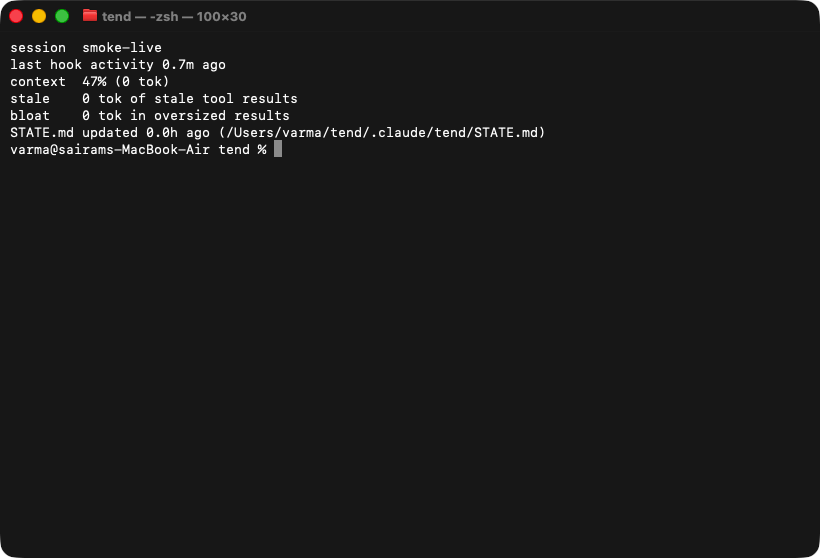
tend speaks to the model's context, not your chat — the conversation stays clean, while the transcript view (Ctrl+O) shows every injection verbatim. What's below is the rest of its visible surface. A 15-second tour, all real tool output:
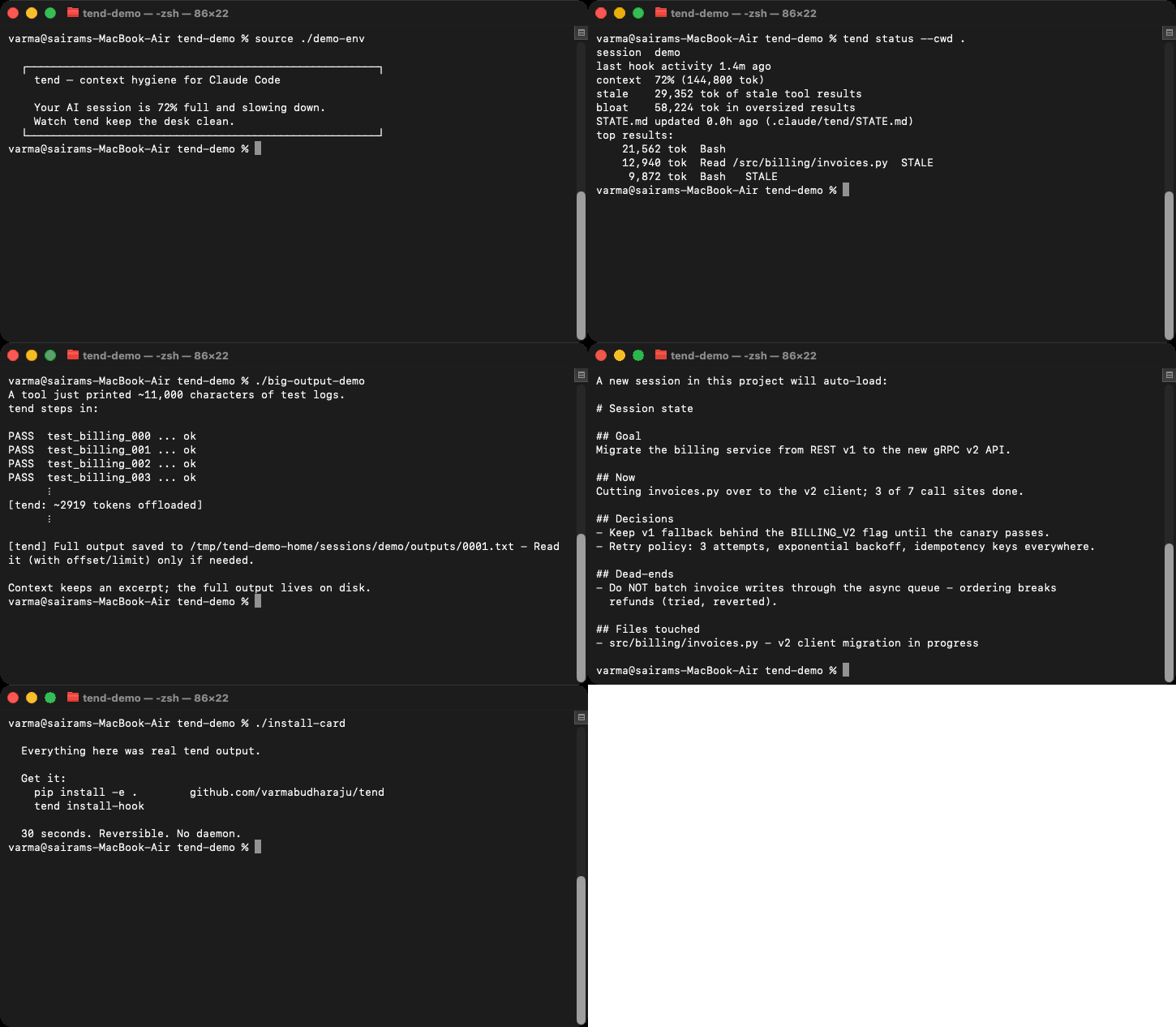
tend status | tend report | tend handoff |
|---|---|---|
 |  |  |
How it fits into a session
sequenceDiagram
    participant U as You
    participant CC as Claude Code
    participant T as tend

    U->>CC: new session
    T-->>CC: restore STATE.md (lossless handoff)
    U->>CC: prompt
    T-->>CC: anchor: goal, context health
    CC->>CC: runs a tool, output is huge
    T-->>CC: excerpt in context, full text filed on disk
    CC->>CC: context fills up
    T-->>CC: "task boundary + 60% full: good moment for a curated /compact"
    CC->>CC: compaction (tend snapshots first)
    Note over T: the notebook and the filed outputs survive
Install
As a Claude Code plugin (recommended):
/plugin marketplace add varmabudharaju/tend
/plugin install tend@tend
That's the whole thing — hooks register automatically and the tend CLI lands on your PATH. Optional: tend wrap-statusline adds the statusline tee (exact context % in anchors + the visible heartbeat); plugins can't wrap the statusline themselves.
Or via pip (gets hooks + statusline in one step):
python3 -m pip install --user -e .
tend install-hook        # merges hooks + statusline into ~/.claude/settings.json
# restart your Claude Code session
The installer is non-destructive and reversible: existing hooks and statusline are preserved and backed up (settings.json.bak-tend), and tend uninstall-hook puts everything back.
How you know it's working: your statusline grows a quiet | tend: 3 filed, 29k stale suffix (just tend: on when there's nothing to report), and each session opens with a one-line notice — tend: restored session state from STATE.md. Everything else stays out of the chat view — but nothing is hidden: open the transcript view (Ctrl+O) and you'll see every [tend anchor] and injection exactly as the model reads it. Out of your face, fully auditable.
Commands
| Command | Does |
|---|---|
tend status | Context %, totals, stale-result tokens, STATE.md freshness |
tend report | Full ledger: tool results by size, offloads, subagents |
tend handoff | Show what the next session will auto-load |
tend on / tend off | Global kill switch |
tend install-hook / tend uninstall-hook | Reversible settings.json setup |
Design principles
- Fail-open, always. A tend bug must never break your session. Every hook swallows its own errors (logged to
~/.claude/tend/tend.log, rotated at 1 MB) and Claude Code continues as if tend weren't there. - Nudge, never block. tend advises (read this file with a range; this spawn doesn't need the premium model; now is a good compact moment). The one narrow exception: it blocks a stale auto-compact exactly once, to protect the notebook.
- Exact numbers, not guesses. Context totals come from the session transcript's own token accounting; the context % comes from a statusline tee — tend measures, it doesn't estimate.
- Daemon-less. No background process. Eight tiny hook invocations that each read state from disk, act, and exit.
Configuration
~/.claude/tend/config.yaml, overridable per project in <project>/.claude/tend/config.yaml. Keys and defaults are in tend/config.py. Invalid values fall back to defaults rather than disabling tend.
Limitations
- MCP tools with an
outputSchema: Claude Code validates replacement outputs against the tool's schema and silently keeps the original when a plain-text excerpt doesn't match. tend therefore skips offloading formcp__*tools whose responses aren't plain strings. Built-in tools (Bash, Grep, Glob, WebFetch) are unaffected. state_stale_tokenscounts output tokens generated since STATE.md was last marked (monotonic across compaction), not context-window growth. Default: 3000.
Under the hood
System design — how tend plugs into Claude Code
No daemon, no background process: Claude Code fires an event, a tiny tend process wakes, reads its state from disk, acts, and exits. Everything durable lives in plain files.
flowchart TB
    subgraph cc ["Claude Code"]
        EV["8 hook events"]
        SL["statusline render"]
        TR["session transcript .jsonl"]
    end
    subgraph tendp ["tend - one short-lived process per event"]
        HK["hook.py dispatcher<br/>fail-open wrapper"]
        LG["ledger.py<br/>incremental token accounting"]
        HD["event handlers<br/>offload, readguard, agentguard,<br/>anchor, boundary, precompact, sessionstart"]
        SLW["statusline.py wrapper"]
    end
    subgraph disk ["state on disk - ~/.claude/tend/"]
        SUM["sessions/ID/summary.json<br/>ledger totals + cursor"]
        CTX["sessions/ID/ctx.json<br/>exact context metrics"]
        OUT["sessions/ID/outputs/NNNN.txt<br/>offloaded tool outputs"]
        FLG["sessions/ID/flags.json"]
    end
    ST["project/.claude/tend/STATE.md<br/>the notebook"]
    EV -->|"stdin JSON"| HK
    HK --> LG
    HK --> HD
    LG -->|"reads incrementally"| TR
    LG <--> SUM
    SL --> SLW
    SLW --> CTX
    HD <--> FLG
    HD --> OUT
    HD <--> ST
    HD -->|"stdout JSON: excerpt, anchor,<br/>restored state, or block"| EV
Component view — module layers
flowchart TB
    subgraph entry ["Entry points"]
        cli["cli.py"]
        hookpy["hook.py"]
        slpy["statusline.py"]
        inst["install.py"]
    end
    subgraph handlers ["Event handlers"]
        off["offload"]
        rg["readguard"]
        ag["agentguard"]
        an["anchor"]
        bd["boundary"]
        pc["precompact"]
        ss["sessionstart"]
    end
    subgraph core ["Core services"]
        led["ledger"]
        stm["state"]
        adv["advisor"]
        cm["ctxmetrics"]
        cfg["config"]
        flg["flags"]
        tk["tokens"]
    end
    subgraph infra ["Infrastructure"]
        io["hookio - fail-open, log rotation"]
        pa["paths - atomic JSON I/O"]
    end
    hookpy --> handlers
    cli --> core
    cli --> inst
    slpy --> infra
    handlers --> core
    core --> infra
Flow chart — when does tend recommend compaction?
The advisor runs on every prompt; this is its whole decision:
flowchart TD
    p["context % from ctx.json"] --> u{"at or above<br/>urge threshold? (70%)"}
    u -->|yes| now["anchor says:<br/>run now: /compact + curated instructions"]
    u -->|no| a{"at or above<br/>advise threshold? (55%)"}
    a -->|no| quiet["say nothing"]
    a -->|yes| b{"is this a task boundary?<br/>(STATE.md was just updated)"}
    b -->|yes| good["good moment for /compact"]
    b -->|no| later["at the next task boundary,<br/>run /compact"]
And the one time tend ever blocks anything:
flowchart TD
    ac["auto-compact about to fire"] --> home{"working in the<br/>home directory?"}
    home -->|yes| pass["allow"]
    home -->|no| stale{"is STATE.md stale?<br/>(notebook behind the work)"}
    stale -->|no| pass
    stale -->|yes| once{"already blocked once<br/>this session?"}
    once -->|yes| pass
    once -->|no| block["block ONCE:<br/>update the notebook, then compact"]
Modules
tend/
  hook.py          entry point: python3 -m tend.hook (all 8 events)
  hookio.py        stdin/stdout plumbing, fail-open wrapper, log rotation
  ledger.py        incremental transcript ledger: exact context totals,
                   tool-result sizes, staleness, crash-safe single-file cursor
  offload.py       pillar 1: oversized-output offloading
  readguard.py     pillar 1b: nudge unbounded Reads of large text files
  agentguard.py    pillar 1c: model-tier nudge for subagent spawns
  state.py         STATE.md template, parsing, atomic seeding
  sessionstart.py  pillar 4: state restore into fresh sessions
  anchor.py        pillar 3: per-prompt anchor (urgency-first truncation)
  boundary.py      Stop-event task-boundary + staleness detection
  precompact.py    pillar 4 safety net: snapshot + one-shot stale block
  advisor.py       when and how to recommend a curated /compact
  statusline.py    statusline wrapper: tees exact context metrics to disk
  config.py        defaults < global yaml < project yaml, validated
  install.py       reversible settings.json merge (backup, mode-preserving)
  cli.py           status / report / handoff / on / off / (un)install-hook
164 tests (python3 -m pytest). Every bug fixed in v0.2 carries a regression test written from the bug's reproduction.
Battle-tested by its sibling
tend v0.1 was adversarially reviewed by swarm — a 9-agent review (6 reviewers + 2 independent verifiers + synthesis) that reproduced every claim against the installed binary before reporting it. The verified report (33 confirmed findings, from a race that silently lost ledger records to a truncation bug that disabled the staleness net right after compaction) is in docs/swarm-review-2026-06-10.md; v0.2 fixed all of them, test-first.