
Swarm — Orquestrador de Agentes Claude em Paralelo
varmabudharaju/swarm
Despache times de agentes Claude para trabalhar em paralelo com checkpoints automáticos
Ver no GitHubUm supervisor que decompõe objetivos complexos em grafos de tarefas paralelas, executadas por múltiplos agentes Claude Code simultaneamente. Persiste resultados em disco, sobrevive a interrupções e retoma execuções sem perder trabalho concluído. Ideal para operações em larga escala como auditorias de código, migrações e análises.
Instalação
npx convez-ai varmabudharaju/swarm1 comando no terminal: detecta o formato do repositório (marketplace ou plugin avulso) e instala via Claude Code. Requer Node 18+ e o Claude Code instalado.
Métricas
Casos de uso
- Auditoria de codebases grandes em paralelo
- Migrações de API ou refatoração em massa
- Análise de múltiplos arquivos/componentes simultaneamente
- Tarefas de longa duração com recuperação de falhas
- Decomposição automática de objetivos complexos em subtarefas
Veredito

Swarm é uma solução robusta para orquestração de agentes em paralelo, com ênfase em confiabilidade via checkpoints e resumibilidade. Idealmente integrado ao fluxo de trabalho Claude Code, mas requer Python 3.11+ e familiaridade com grafos de dependências.
README
A tradução para o português deste README ainda está na fila.
swarm


A foreman for teams of AI agents.
Give Claude Code one big goal — "audit this codebase for bugs", "migrate every endpoint to the new API" — and swarm breaks it into a map of small jobs, hires a team of AI workers to run them in parallel, saves every finished job to disk, and survives any interruption. Close the laptop mid-run; resume tomorrow without redoing finished work.
pip install -e . && swarm install # then: /swarm <goal> inside Claude Code
flowchart LR
    G["One big goal"] --> D["Foreman decomposes it<br/>into a map of small jobs"]
    D --> W1["Worker"]
    D --> W2["Worker"]
    D --> W3["Worker"]
    D --> W4["Worker..."]
    W1 --> R["Every result<br/>saved to disk"]
    W2 --> R
    W3 --> R
    W4 --> R
    R --> S["Final answer,<br/>assembled from results"]
The idea, in plain words
One assistant doing a huge task alone is slow and forgetful — like one person reading a 60-file codebase cover to cover. swarm works the way a good team does:
-
Plan the work as a map, not a to-do list. Each job says exactly which other jobs it needs results from. Anything that can run in parallel does — 10 readers fan out across the codebase at once.
A to-do list runs one job at a time. A map runs everything whose ingredients are ready:
flowchart TB
    a["scan the routes<br/>(worker 1)"] --> v["verify the findings<br/>(worker 4)"]
    b["scan the auth code<br/>(worker 2)"] --> v
    c["scan the database layer<br/>(worker 3)"] --> v
    v --> s["write the final report"]
Workers 1, 2 and 3 run at the same time; the verifier starts the moment all three finish.
-
Give each worker a sealed envelope. Workers don't share a conversation; each gets a self-contained instruction packet. A stranger could pick up the envelope and do the job — that's the test.
-
Save every finished job immediately. A hook (not the worker itself) writes each result to disk the moment the worker stops. Crash, rate limit, closed laptop — finished work is never lost.
-
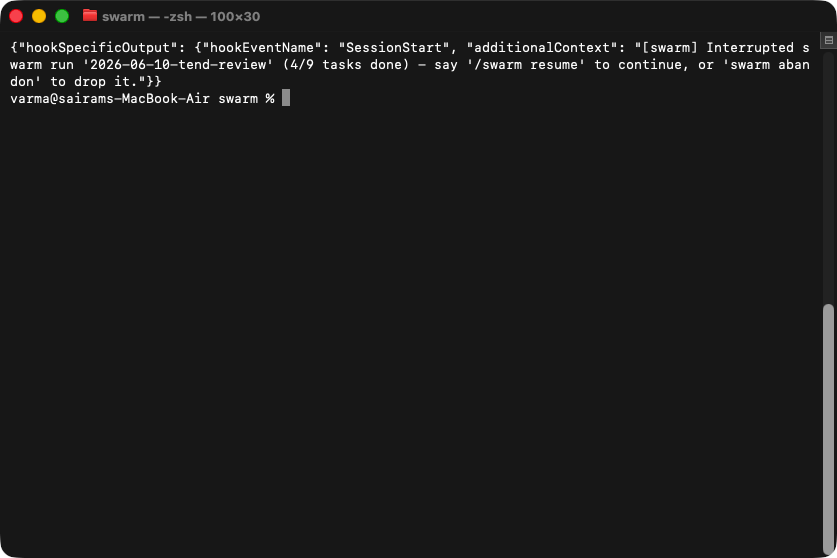
Resume by asking, never by guessing. The next session notices the unfinished run, reports exactly what's done and what remains, and re-runs only the missing jobs after you approve.
-
Right-size every brain. A mechanical check doesn't need the most expensive model. The foreman picks the cheapest model tier that fits each job (details below).
What a run looks like
sequenceDiagram
    participant U as You
    participant F as Foreman (your session)
    participant E as Executor (swarm-run workflow)
    participant W as Workers (parallel subagents)
    participant D as Disk (checkpoints)

    U->>F: /swarm audit this codebase
    F->>F: decompose into graph.json + one packet per job
    F->>F: validate + adversarial review of the plan
    F->>E: launch
    E->>W: every unblocked job, in parallel
    W-->>D: each finished result checkpointed by hook
    Note over E: interrupted? rate limit? crash?
    U->>F: /swarm resume (next session)
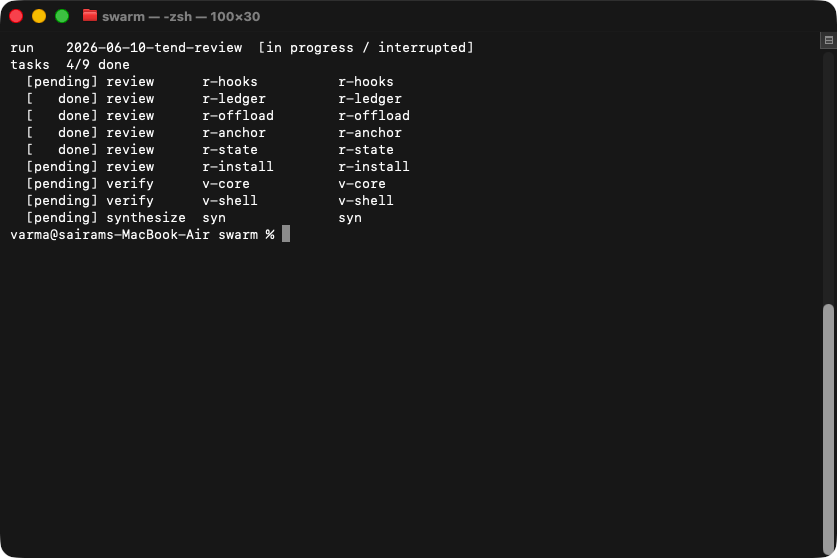
    F->>U: 4/9 done, 5 remain - re-run only those?
    U->>F: yes
    E->>W: only the missing jobs
    F->>U: final synthesis from all results
Right-sized brains (model tiering)
Every job in the graph carries a model tier — chosen by the foreman per job, weighing quality stakes, ambiguity, complexity, and token cost. Lowest tier that fits:
| Tier | Right for |
|---|---|
| top model (inherit) | decomposition, ambiguous goals, final synthesis |
opus | real coding: implementing, debugging, refactoring |
sonnet | clear-goal bounded work: scans, reviews, adversarial verification |
haiku | mechanical checks, extraction, formatting |
How the foreman picks, as a decision tree:
flowchart TD
    q1{"Is the job mechanical?<br/>checking outputs, extracting, formatting"} -->|yes| h["haiku — cheapest"]
    q1 -->|no| q2{"Crisp goal, bounded scope?<br/>scan, review, verify"}
    q2 -->|yes| so["sonnet"]
    q2 -->|no| q3{"Real coding?<br/>implement, debug, refactor"}
    q3 -->|yes| op["opus"]
    q3 -->|no| f["inherit the session model<br/>design, synthesis, judgment"]
Three safety layers behind the judgment call:
- Safety-net defaults — untagged jobs get a sensible tier by type, capped at the launching session's own tier (an opus session never silently escalates to the premium model).
- Failure fallback — if a tier is unavailable or keeps failing, the final retry runs on the session model (always available), and the run report names every job that didn't run on its intended tier (
design-api: fable->inherit). Loud, never silent. - Validation — unknown model names are rejected before launch.
What happens when a tier misbehaves:
flowchart LR
    t["Run the job<br/>on its assigned tier"] -->|works| d["Done"]
    t -->|fails| r["Retry, same tier"]
    r -->|works| d
    r -->|fails| fb["Final retry on the session model<br/>(always available)"]
    fb -->|works| rep["Done — and the run report says<br/>this job fell back"]
    fb -->|fails| x["Job marked failed, loudly"]
See it
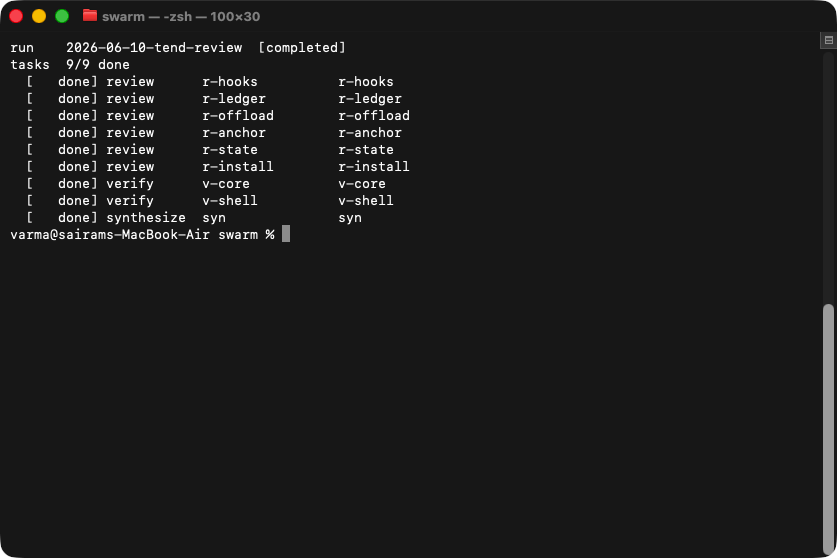
| Mid-run | Completed | Resume nag in a fresh session |
|---|---|---|
 |  |  |
Proven in the field
swarm's first production run reviewed its own sibling tool: a 9-agent adversarial audit of tend — 6 specialized reviewers, 2 independent verifiers that reproduced every claim against the installed binary, then synthesis. The run was deliberately interrupted at 4/9 tasks and resumed in a different session: the 4 finished tasks short-circuited, only the 5 missing ones ran. Output: 33 confirmed findings (2 high-severity), every one of which was fixed in tend v0.2. Evidence with screenshots: docs/test-evidence.md.
Install
python3 -m pip install --user -e .
swarm install        # hooks into settings.json; copies skill/workflow/agents
# restart your Claude Code session
Then in Claude Code: /swarm <goal> — or /swarm resume after an interruption.
Pieces
| Piece | Where it lands | Role |
|---|---|---|
swarm skill | ~/.claude/skills/swarm/ | decomposition + resume protocol |
swarm-run workflow | ~/.claude/workflows/swarm-run.js | pure DAG scheduler (generated) |
| worker agents | ~/.claude/agents/swarm-*.md | least-privilege reader/verifier/implementer, tiered models |
| hooks | settings.json (SubagentStop, SessionStart) | checkpoints + resume nag |
| run state | ~/.claude/swarm/runs/<project>/<run-id>/ | graph, packets, results, state |
CLI
swarm validate <graph.json> [--print-hash]
swarm args <graph.json> [--resume] [--session-model <tier>]
swarm status <run-dir>
swarm finish <run-dir> --status completed|paused_for_budget|failed-partial
swarm abandon <run-dir>
swarm install / swarm uninstall
Guardrails
- Graphs are validated before launch (unique ids, no cycles, fan-in caps, schema checks, model allow-list) and adversarially reviewed by a verifier agent that attacks the decomposition itself: missing tasks, fake parallelism, thin packets, over- or under-provisioned model tiers.
- Implement jobs are quarantined in isolated git worktrees on their own branches; the merge to your branch happens only in your session, only with your approval.
- Budget- and ceiling-aware: the executor pauses (resumably) instead of blowing through token budgets or agent ceilings.
- Tamper-evident state: results are bound to a content hash of the graph; editing the graph after results exist correctly refuses to resume.
Worker activity is audited machine-wide by agent-pd (hash-chained per-session logs in ~/.claude/pd/audit/).
Managed paths
swarm install owns these locations and will overwrite/delete them on reinstall/uninstall — do not hand-edit: ~/.claude/skills/swarm/, ~/.claude/agents/swarm-{reader,verifier,implementer}.md, ~/.claude/workflows/swarm-run.js (generated; edit sources in this repo).
Under the hood
System design — who talks to whom
flowchart TB
    subgraph foreman ["Planning session - the foreman"]
        SK["swarm skill<br/>decompose, validate, review, launch"]
        CLI2["swarm CLI<br/>validate / args / status / finish"]
    end
    subgraph engine ["Workflow engine"]
        WF["swarm-run.js<br/>pure DAG scheduler"]
    end
    subgraph team ["Worker subagents - parallel"]
        W1["swarm-reader<br/>sonnet"]
        W2["swarm-verifier<br/>sonnet"]
        W3["swarm-implementer<br/>opus, isolated worktree"]
    end
    subgraph rundir ["Durable run state on disk"]
        GJ["graph.json - content-hashed"]
        PK["packets/ID.md - sealed envelopes"]
        RS["results/ID.json - checkpoints"]
        LK["run-state.json + resume.lock"]
    end
    HK["SubagentStop hook<br/>the checkpointer"]
    NAG["SessionStart hook<br/>the resume nag"]
    SK --> CLI2
    SK -->|"writes"| GJ
    SK -->|"writes"| PK
    SK -->|"launch with session model tier"| WF
    WF -->|"spawn, right-sized model"| W1
    WF -->|"spawn"| W2
    WF -->|"spawn"| W3
    W1 -.->|"on finish, hook fires"| HK
    W2 -.-> HK
    W3 -.-> HK
    HK -->|"writes checkpoint"| RS
    NAG -->|"unfinished run found:<br/>offer /swarm resume"| SK
    CLI2 -->|"--resume: rebuilds completed map"| RS
The trick that makes runs unkillable: workers never save their own results. A hook outside the worker writes the checkpoint the moment each worker stops — so a crash can interrupt a job, but never lose a finished one.
Flow chart — the scheduler loop
What runGraph() does until the run is over:
flowchart TD
    s["start / resume"] --> r{"any job whose<br/>dependencies are all done?"}
    r -->|yes| g{"token budget and<br/>agent ceiling OK?"}
    g -->|yes| sp["spawn worker<br/>at its effective model tier"] --> r
    g -->|no| pz["pause - run stays resumable"]
    r -->|"no, but workers running"| w["wait for the next finish"]
    w --> rec["record result,<br/>or fallback, or failure;<br/>skip jobs downstream of failures"]
    rec --> r
    r -->|"no, and nothing running"| d["return completed / failed /<br/>skipped / fallbacks"]
State diagram — the life of a run
stateDiagram-v2
    [*] --> Planned: graph validated + adversarially reviewed
    Planned --> Running: launch
    Running --> Completed: every job done
    Running --> Paused: budget, ceiling, or interruption
    Paused --> Running: /swarm resume - user approves, only missing jobs re-run
    Running --> FailedPartial: some jobs failed after retries
    FailedPartial --> Running: resume retries the missing work
    Completed --> [*]: synthesis from full results
Modules
swarm_lib/        Python: CLI, graph validation/hashing, checkpoint hook,
                  run state, marker protocol, reversible installer
workflows/        run_graph.mjs - pure DAG scheduler (no runtime deps,
                  Node-testable, embedded into the installed workflow)
skill/            the /swarm skill + graph-format / packet / shape references
agents/           swarm-reader, swarm-verifier, swarm-implementer definitions
tests/            pytest suite + node:test scheduler suite
Tests: python3 -m pytest (Python; also drives the Node suite).
Sibling project: tend — context hygiene for the session that runs swarm; swarm reads tend's rate-limit tee to size launches.