
trip2g - Malha de Conhecimento Descentralizada com MCP
trip2g/trip2g
Segunda mente descentralizada para agentes e humanos
Ver no GitHubMCP server open-source que transforma sua base de conhecimento em um servidor vivo: auto-hospedável, acessível via Protocol de Contexto do Modelo (MCP) para agentes de IA, e federável com pares. Suporta wikilinks, busca híbrida, webhooks para automações e monetização nativa. Diferente de plataformas SaaS, você controla onde seus dados vivem.
Instalação
npx convez-ai trip2g/trip2g1 comando no terminal: detecta o formato do repositório (marketplace ou plugin avulso) e instala via Claude Code. Requer Node 18+ e o Claude Code instalado.
Métricas
Casos de uso
- Compartilhar base de conhecimento entre múltiplos agentes de IA
- Criar rede federada de bases conectadas com peers
- Auto-hospedar e monetizar conteúdo privado/público
- Sincronia bidirecional entre notas e agentes via webhooks
- Busca semântica + full-text em conhecimento distribuído
Veredito

Trip2g reinventa o conceito de second brain como protocolo federar, não plataforma. Para quem quer auto-hospedar conhecimento robusto e expô-lo a agentes IA com controle total—arquitetura sólida em Go, MCP nativo, e economia de tokens bem pensada.
README
A tradução para o português deste README ainda está na fila.
trip2g


Open-source MCP knowledge mesh. Self-host your knowledge bases, expose them to AI agents via MCP, and federate with peers — no SaaS in the middle.
Unlike Obsidian Publish or Quartz, trip2g is a live server: subscriptions, webhook agents, federation between hubs, and an MCP endpoint out of the box.
Try the public hub → · Self-host · Docs
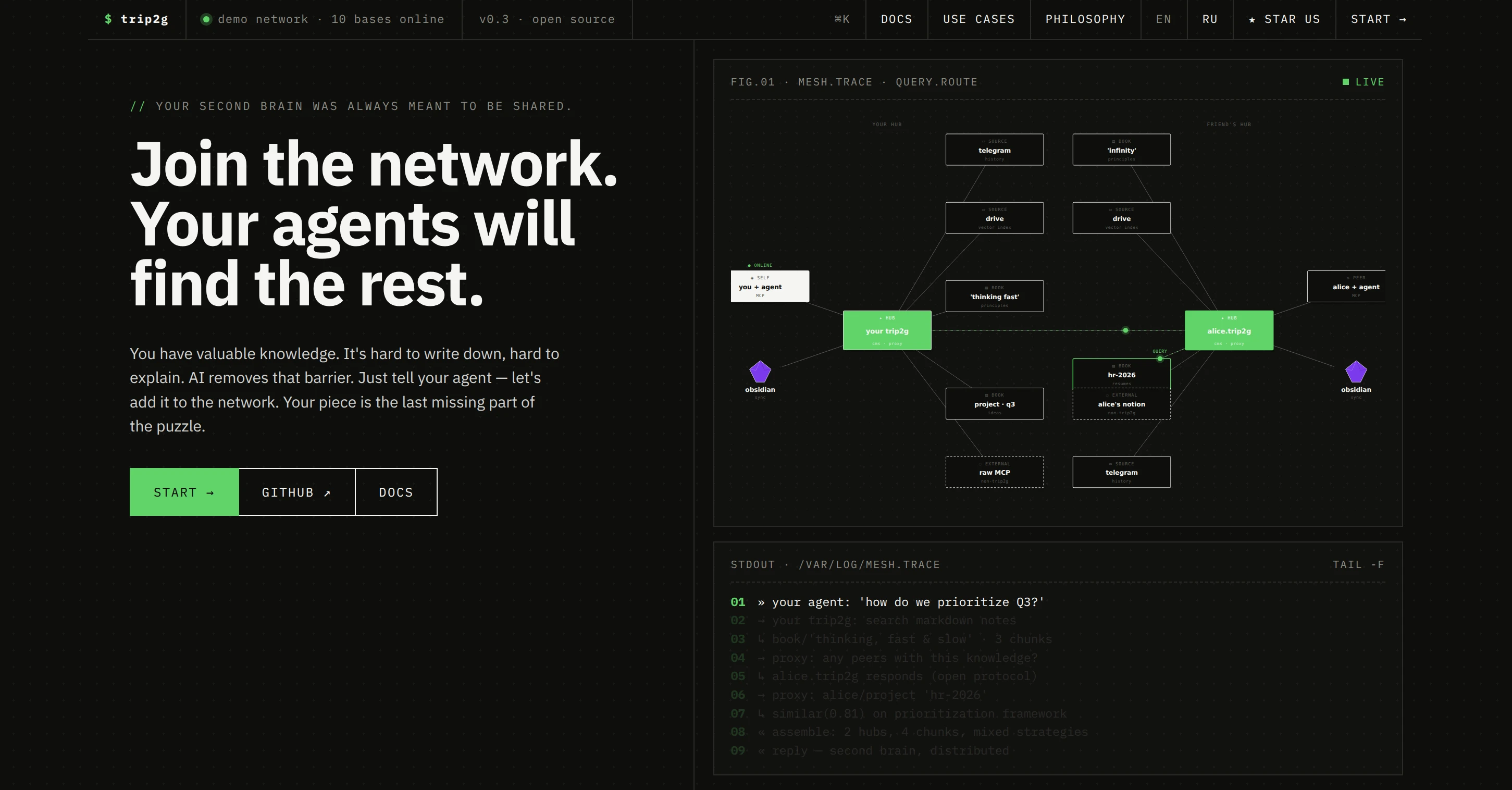
Second brain network for your agents
A second brain isn't one person's vault — it's the shared knowledge of people who think about the same things.
Each person runs a hub with their own notes. Agents reach into it directly via MCP. Hubs peer with each other, so one question fans out across the network — your bases plus the ones your trusted peers share with you.
   human A           human B           human C
      │                 │                 │
      ▼                 ▼                 ▼
   agent A           agent B           agent C
      │                 │                 │
      ▼                 ▼                 ▼
  ┌────────┐  MCP  ┌────────┐  MCP  ┌────────┐
  │ hub A  │ ◄───► │ hub B  │ ◄───► │ hub C  │
  └────────┘       └────────┘       └────────┘
       ▲                 ▲                 ▲
       └─── humans browse · agents query ──┘
Same hub serves the human (a website with subscriptions, RSS, Telegram) and the agent (MCP). Data lives where you put it. trip2g is a protocol, not a vendor.
Try it now
Add the public knowledge hub to your MCP client:
{
  "mcpServers": {
    "trip2g": {
      "url": "https://trip2g.com/_system/mcp"
    }
  }
}
Ask your agent anything. It searches all connected bases and returns answers with sources.
Want your own? Free cloud instance — no terminal needed.
Core capabilities
Markdown → website
- Wikilinks (
[[note]]), backlinks, outlinks — global resolution, just like Obsidian - Composable page layouts via frontmatter: sidebars, magazine grid, TOC, custom note embeds
- Hybrid search: bleve full-text + OpenAI embeddings, merged via reciprocal rank fusion
- Custom domains, multi-language with
hreflang, RSS output, sitemap
MCP server — built into every hub:
| Tool | Purpose |
|---|---|
search | Hybrid full-text + semantic search |
note_html | Read a note (or a section) by id, path, or match |
similar | Notes similar to a given note |
federated_search / federated_similar / federated_note_html | Same, fanned out to peer hubs |
instructions | Author-defined prompt for the agent |
Access is scoped to the caller's subscription. Custom tools can be defined in note frontmatter (mcp_method:).
Webhook agents
- Change webhooks — POST to an external agent on note create/update/remove. Agent writes notes back via API. Glob filtering, HMAC auth, depth tracking prevents recursion.
- Cron webhooks — run an agent on a schedule (
0 9 * * *). Sync or async. Optional instruction context.
Monetization
- Subgraph paywalls — group notes into paid products, free notes stay public
- Crypto payments (NowPayments), Patreon and Boosty integration
Obsidian plugin — one-click sync, hash-based diff, only changed files are uploaded.
Federation
graph LR
    O[Obsidian vault] --> H[your hub]
    T[Telegram]       --> H
    H <-->|MCP federation| H2[peer hub]
    H2 --> B[their bases]
    H -->|/_system/mcp| A[agent]
    H2 -->|/_system/mcp| A
Peer hubs with trusted people or orgs. Each hub controls access per base. One agent question reaches the union of all connected knowledge.
| Topology | Setup | Result |
|---|---|---|
| Solo | One hub, many bases | All your notes, books, courses — one query |
| Friends | Each person runs a hub, hubs peer | Union of everyone's knowledge |
| Company | Central hub + per-employee hubs | Tribal knowledge and docs — queryable |
| B2B | Two star topologies, one bridge | Shared knowledge without merging systems |
Sources
| Source | Status |
|---|---|
| Obsidian | ready — vault stays local, two-way sync |
| Telegram | ready — channel publish + history mirror |
| RSS output | ready — every base exposes feeds |
| Notion | planned |
| Google Drive | planned |
| Linear, Slack archive, RSS import | planned |
Template system
Two paths — pick one per knowledge base.
A. Default template (no code, frontmatter-only). Built-in trip2g layout. Compose pages from widgets and content blocks via frontmatter:
---
header: "[[Navigation]]"
left_sidebar: [TOC, inlinks]
content: [selfcontent, magazine]
magazine_include_files: "blog/**/*.md"
footer: "[[Footer]]"
---
Rendered through quicktemplate. Notes can also render as HTML, JSON, RSS via content_type frontmatter.
B. Custom Jet templates (full control). Drop your own .html files into a layouts folder and switch via layout: path/to/template. Templates have access to the markdown AST — iterate sections, render specific parts, customize layout down to HTML. Built on the Jet template engine.
Self-host
docker compose up
Full guide → · MIT · SQLite, no external dependencies required.
Tech stack
| Backend | Go, FastHTTP, gqlgen (GraphQL) |
| Database | SQLite + Litestream for streaming backup |
| Search | bleve (full-text) + OpenAI embeddings (semantic) |
| Markdown | Goldmark — wikilinks, frontmatter |
| Templates | quicktemplate (default) + Jet (custom) |
| Frontend | $mol, TypeScript, Tiptap |
| Assets | S3-compatible (MinIO for dev) |
License
MIT