
Codeworth
teterouge/codeworth
Estima o custo real de reconstruir qualquer codebase do zero
Ver no GitHubSkill Claude que analisa repositórios e estima o custo real, tempo humano e composição de equipe necessários para reconstruir um codebase do zero. Vai além de linhas de código, medindo dificuldade de rebuild em 5 dimensões: conhecimento de domínio, acoplamento de infraestrutura, profundidade do modelo de dados, superfície de integração e maturidade operacional.
Instalação
npx convez-ai teterouge/codeworth1 comando no terminal: detecta o formato do repositório (marketplace ou plugin avulso) e instala via Claude Code. Requer Node 18+ e o Claude Code instalado.
Métricas
Casos de uso
- Diligência técnica em aquisições ou rodadas de investimento
- Escopo de rewrite antes de comprometer em refatoração maior
- Estimativa de custo para clientes em projetos de consultoria
Veredito

Ferramenta sólida para quebrar o mito da simplicidade de repos pequenos e comunicar custo real de rebuild em termos técnicos e financeiros. Útil para lideranças de eng, diligência e scoping de rewrites, mas exige análise cuidadosa do repositório para resultados confiáveis.
README
A tradução para o português deste README ainda está na fila.
Codeworth
A Claude Code skill that analyzes software repositories and estimates the human time, team composition, and cost required to rebuild them from scratch.
AI-powered repository valuation and rebuild-effort estimation for technical diligence, rewrite scoping, and engineering cost analysis.
Codeworth is a Claude skill/plugin that analyzes a software repository and estimates the human time, team composition, and cost required to rebuild it from scratch.
Unlike naive estimators that rely on lines of code alone, Codeworth evaluates the hidden drivers of engineering effort: architecture, domain complexity, integrations, delivery artifacts, operational maturity, and product overhead.
Why this exists
Most repositories are judged badly.
People look at LOC, frameworks, or a quick skim of the folder tree and pretend they understand replacement cost. They usually don’t.
A small codebase can encode months of specialized security research, ugly integration workarounds, or domain knowledge that took real product and engineering effort to uncover.
Codeworth exists to answer a more useful question:
What would it actually take to rebuild this repo properly?
That makes it useful for:
- Technical diligence before an acquisition or investment
- Rewrite scoping before committing to a rebuild
- Freelance / consulting estimation for complex repos
- Engineering leadership communicating replacement cost in business terms
- AI PM portfolio review when assessing the substance of technical work
Architecture
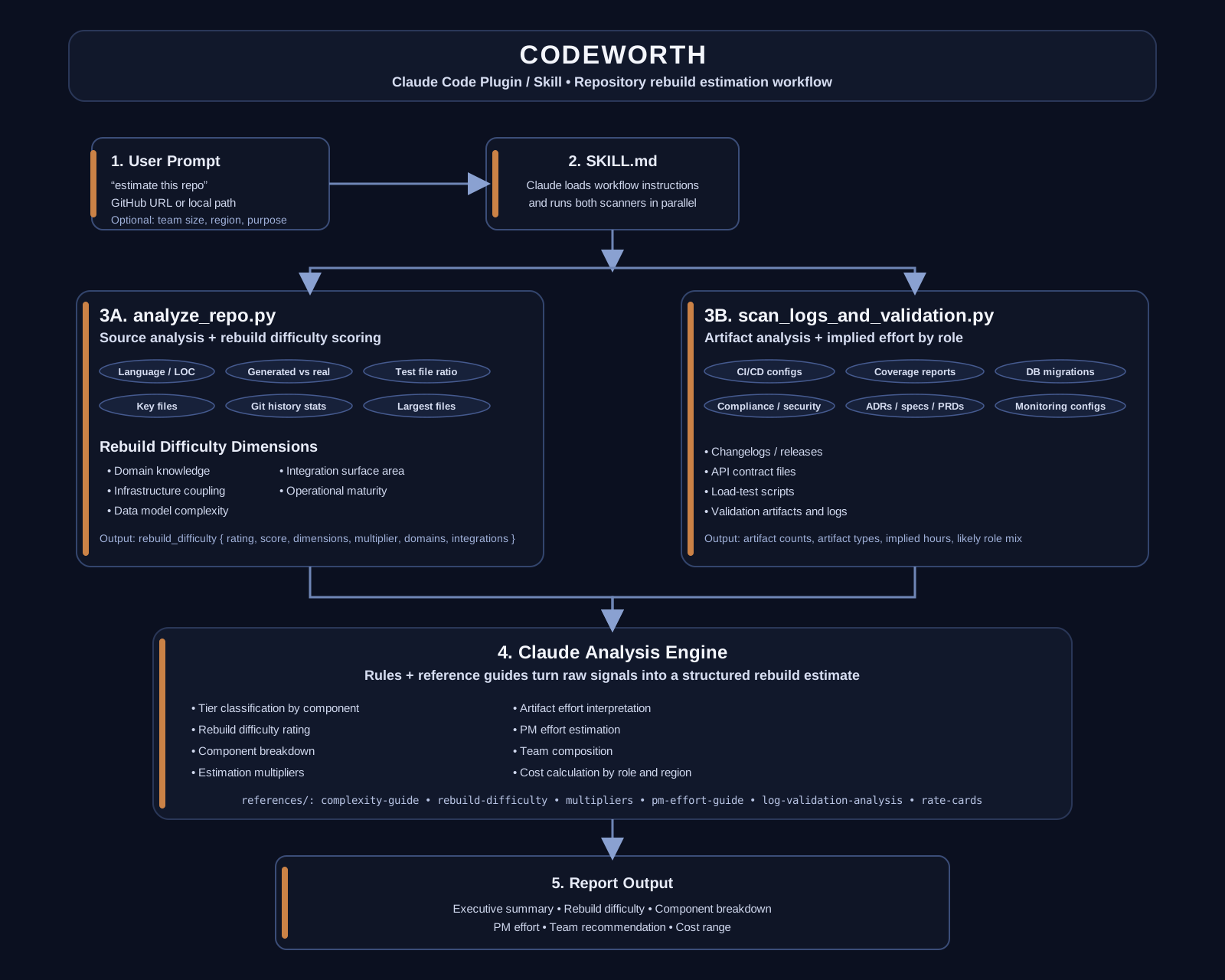
Codeworth runs two parallel scanners—source analysis and artifact analysis—then uses Claude plus reference guides to produce a rebuild-effort and cost estimate.
Example Output
Below is a sanitized excerpt from a real Codeworth analysis report. It shows the type of executive-facing estimate produced by the tool without exposing sensitive implementation details from the analyzed repository.
Example analysis: specialized Android security application
Estimated rebuild effort: 40–54 weeks
Estimated cost range: $350k–$640k USD
Confidence: Medium
Repository Overview
- Primary languages: Kotlin (Android), TypeScript (Next.js)
- Architecture pattern: multi-layered mobile application with supporting web surface
- Approximate size: ~22,000 LOC excluding generated/vendor code
- Product type: niche consumer security application
- Notable complexity: platform-level integrations and security-driven design constraints
Why the estimate was high
Although the codebase was modest in size, Codeworth identified several drivers of increased rebuild effort:
- specialized Android platform knowledge
- nonstandard security and privacy constraints
- multiple system integrations
- validation and documentation artifacts
- embedded threat-model reasoning
Recommended Team
Senior Android Engineer
Owns platform architecture and high-risk technical constraints.
Mid-Level Android / Full Stack Engineer
Handles UI flows, integrations, and supporting systems.
Product Manager / Security-Oriented PM
Responsible for threat-model translation, specifications, and release coordination.
Sample Cost Summary
| Scenario | Total Hours | Estimated Cost |
|---|---|---|
| Low | ~2,740 hrs | ~$350,000 |
| Mid | ~3,660 hrs | ~$480,000 |
| High | ~4,940 hrs | ~$640,000 |
Key Takeaway
The codebase appeared relatively small, but the replacement cost was driven by embedded domain knowledge, platform-specific engineering constraints, and product rigor, not raw code volume.
What makes Codeworth different
Rebuild cost is driven by hidden complexity, not just code volume.
Codeworth evaluates rebuild difficulty across five dimensions:
1. Domain Knowledge
Specialized domains like payments, healthcare, cryptography, robotics, distributed systems, trading, tax, ML, or security.
2. Infrastructure Coupling
Kubernetes, Terraform, Helm, service mesh, data platforms, deployment pipelines, and operational glue.
3. Data Model Complexity
Schema depth, ORM model count, migration volume, and underlying state complexity.
4. Integration Surface Area
External APIs, enterprise systems, billing/auth providers, and custom system interfaces.
5. Operational Maturity
SLOs, runbooks, load tests, canary deploys, tracing, compliance artifacts, and production readiness signals.
The result is not just hours. It is a structured estimate with reasoning.
What it produces
Running Codeworth generates a report containing:
- Executive summary with rebuild effort and cost range
- Repository overview and stack analysis
- Rebuild difficulty assessment
- Component breakdown by complexity tier
- Estimation adjustments for testing, docs, and coordination
- Artifact and validation analysis
- Product management effort estimate
- Recommended team composition
- Unified low / mid / high cost estimate
- Key complexity drivers and caveats
How it works
Codeworth combines two layers of analysis.
Repository source analysis
The scanner inspects:
- language mix and LOC
- generated vs real code
- test coverage signals
- architecture files
- git-history patterns
- complexity indicators
Artifact analysis
The artifact scanner detects:
- CI/CD configs
- migration history
- load test scripts
- ADRs and PRDs
- compliance documentation
- monitoring and observability configs
Claude then synthesizes these signals into a structured rebuild estimate.
Estimation methodology
Workflow:
- Analyze repository structure
- Analyze validation and documentation artifacts
- Classify components by complexity tier
- Score rebuild difficulty across five dimensions
- Decompose the system into engineering units
- Apply multipliers for rework, testing, and coordination
- Estimate PM effort where relevant
- Recommend team composition
- Convert hours to cost ranges
Complexity tiers
- Tier 1 — Boilerplate
- Tier 2 — Standard
- Tier 3 — Complex
- Tier 4 — Specialized
Difficulty ratings
- Low
- Moderate
- High
- Very High
- Extreme
- Exceptional
Repository structure
codeworth/
├── .claude-plugin/
│   └── plugin.json
├── SKILL.md
├── README.md
├── LICENSE
├── evals/
│   └── evals.json
├── references/
│   ├── complexity-guide.md
│   ├── rate-cards.md
│   ├── multipliers.md
│   ├── pm-effort-guide.md
│   ├── log-validation-analysis.md
│   └── rebuild-difficulty.md
└── scripts/
    ├── analyze_repo.py
    └── scan_logs_and_validation.py
Installation
Marketplace (coming soon)
Codeworth will be available through the pm-discipline Claude Code marketplace, which will aggregate several product-management-focused skills.
Once available:
/plugin marketplace add teterouge/pm-discipline
/plugin install codeworth
Manual installation (available now)
Clone the repository and load it into Claude Code:
git clone https://github.com/teterouge/codeworth.git
cd codeworth
Then add the skill to your Claude environment using your preferred plugin workflow.
Usage
Example prompts:
Estimate this repo
Estimate the cost to rebuild this repo from scratch: /path/to/repo
Estimate this GitHub repository for acquisition diligence: github.com/org/repo
Providing context such as team size, region, and purpose will improve results.
Built for AI PMs
This project demonstrates:
- AI workflow design
- architecture-aware estimation
- system decomposition
- heuristic modeling
- AI tooling productization
It is also useful for founders evaluating replacement cost or technical leverage.
Limitations
Codeworth analyzes visible repository artifacts and cannot see:
- deleted code
- undocumented knowledge
- internal decision history
- private production incidents
It provides estimates, not formal quotes.
Roadmap
Planned improvements:
- GitHub API enrichment
- contributor topology analysis
- repo comparison mode
- PDF/JSON export
- benchmark dataset vs human estimates
- expanded integration detection
License
MIT