
Agent Serve
tansohq/agent-serve
Audita e orienta como tornar seu produto self-serve para agentes de IA
Ver no GitHubSkill que audita sua aplicação para identificar barreiras que impedem agentes de IA de usar seu produto de forma autônoma. Fornece diagnóstico detalhado em seis áreas críticas (onboarding, autenticação, compra, monitoramento, auto-gerenciamento e prontidão para desenvolvimento) com recomendações concretas e esforço estimado para cada correção, baseado em padrões de empresas como Stripe e Cloudflare.
Instalação
npx convez-ai tansohq/agent-serve1 comando no terminal: detecta o formato do repositório (marketplace ou plugin avulso) e instala via Claude Code. Requer Node 18+ e o Claude Code instalado.
Métricas
Casos de uso
- Diagnosticar bloqueios que impedem agentes de IA de se cadastrar e usar sua aplicação
- Definir roadmap de APIs e endpoints necessários para viabilizar compra e uso programático
- Implementar padrões agent-ready em autenticação, billing e gerenciamento de conta
Veredito

Ferramenta valiosa para produtos SaaS que querem se preparar para o mercado de agentes de IA. O skill traduz insight estratégico em checklist técnico executável, economizando semanas de pesquisa sobre padrões.
README
A tradução para o português deste README ainda está na fila.
agent-serve
Make your product self-serve for AI agents.
Install
npx skills add tansohq/agent-serve
What this is
A skill that finds what's blocking agents from using your product and tells you exactly what to build to fix it.
Agents are becoming buyers. If they can't sign up, authenticate, pay, and use your product programmatically, they'll route spend to competitors that let them self-serve.
Usage
/agent-serve https://example.com    # Audit a live product
/agent-serve                        # Audit from codebase
One command audits all six areas: onboarding, auth, purchasing, usage monitoring, self-management, and dev readiness.
What you get
For each area, the skill tells you:
- What exists today — what the product already supports
- What blocks agents — the specific friction
- What to build — concrete fixes with effort estimates, referencing how companies like Stripe, Cloudflare, and Twilio solved each problem
Example output
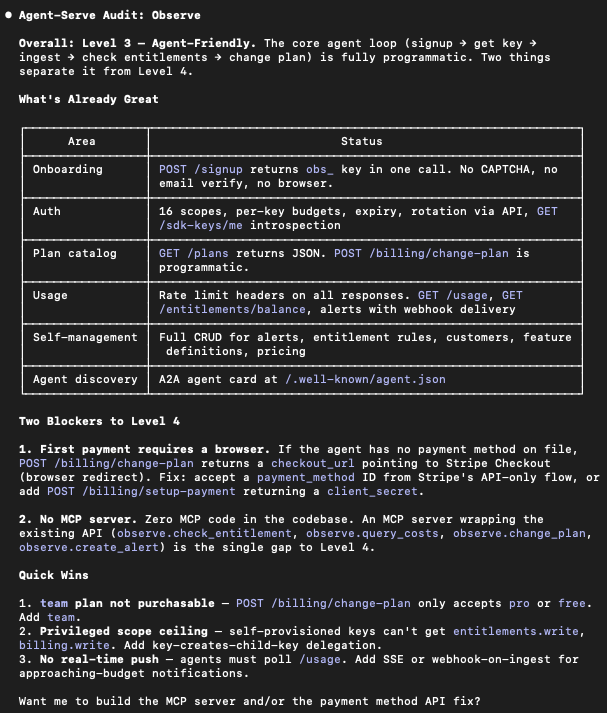
The patterns that matter
Onboarding: POST /v1/accounts returns account ID + API key in one call. No CAPTCHA, no email loop. Deploy-first-claim-later for dev tools.
Auth: OAuth Client Credentials for machine-to-machine. Scoped API keys with rotation endpoint. No magic links, no SMS OTP on programmatic paths.
Purchasing: Expose what Stripe already supports as API endpoints. Human saves a payment method once (Setup Intent), agent reuses it. GET /plans returns the catalog, POST /subscriptions creates one. No browser checkout required. Publish pricing.json for machine-readable pricing discovery.
Usage: Rate limit headers on every response. Dedicated usage endpoint with current-period data. Threshold webhooks so agents can self-throttle.
Management: Plan changes, cancellation, configuration — all via API. MCP server as the agent-facing interface for products that are ready.
Dev ready: Structured JSON errors with type, code, message, and failing parameter. Idempotency keys on mutating endpoints. Cursor-based pagination. API versioning with deprecation policy. OpenAPI spec published. Test mode with separate keys. llms.txt at domain root. Curated MCP server (10-15 tools, not full API dump). A2A Agent Card if exposing agent-to-agent capabilities.
Starting from zero: Pick one read endpoint and ship it. Then one write. Then usage visibility. Then programmatic signup. Four weeks from dashboard-only to agent-possible.
What blocks agents
- CAPTCHA / reCAPTCHA
- Email verification loops
- SMS OTP
- Browser-only OAuth consent
- "Contact sales" gates
- PDF-only documentation
- Dashboard-only configuration
What's next
Part 2: Is Your Site Ready for AI? — How agents find and evaluate your product, what they look for, and how to measure whether you're showing up.
Part 3: Onboarding Agents — The full agent-ready funnel: what onboarding, auth, purchasing, and account management actually require, where industry recommendations fall short, and what to build.
Author
Kat Laszlo — @katlaszlo