
Work Plan Toolkit
stylusnexus/work-plan-toolkit
Planejador de trabalho track-aware para devs com múltiplas sessões de IA
Ver no GitHubSistema de planejamento diário track-aware para desenvolvedores que executam sessões paralelas de IA (Claude Code, Codex, Cursor, GitHub Copilot) em múltiplas issues do GitHub. Combina CLI Python puro com skill bundle, mantendo contexto compartilhado e atualizado sem cache ou sincronização manual.
Instalação
npx convez-ai stylusnexus/work-plan-toolkit1 comando no terminal: detecta o formato do repositório (marketplace ou plugin avulso) e instala via Claude Code. Requer Node 18+ e o Claude Code instalado.
Métricas
Casos de uso
- Coordenar múltiplos agents de IA trabalhando em paralelo em diferentes issues
- Manter contexto compartilhado entre sessões sem re-explicar o que foi feito
- Rastrear progresso em tempo real baseado em Git e GitHub sem manutenção manual
- Integrar fluxo de trabalho com Claude Code, Codex ou GitHub Copilot
Veredito

Ferramenta bem pensada para o caso específico de desenvolvedores com múltiplos agents de IA em paralelo. Requer setup técnico (Python 3.9+, `gh`, `yq`), mas resolve um problema real: manter orientação e contexto compartilhado entre sessões sem cache ou sincronização manual. Recomendado para times que usam ativamente IA para desenvolvimento.
README
A tradução para o português deste README ainda está na fila.
work-plan toolkit




Track-aware daily work planning for developers running parallel Claude Code / Codex sessions across many GitHub issues.
What this is
A daily work-planning system for developers running parallel AI sessions across many GitHub issues. It's made of three things: a pure-Python stdlib CLI, a set of YAML-frontmattered markdown files ("tracks"), and a SKILL.md that tells your AI how to use the CLI. Together they give you and your agent a shared, live picture of what's in flight — without asking you to maintain it manually.
Installs as a plugin for Claude Code and Codex (see Quick install for the exact commands), as an npm global for any editor or terminal (npm install -g @stylusnexus/work-plan), and as a VS Code extension (search "Work Plan", publisher stylusnexus).
The system derives state live from GitHub (gh), git, and your track files on every run — nothing is mirrored or cached. AI sessions get a paste-ready context block; you stay oriented even when switching between a dozen parallel workstreams.
Why it exists: born from the frustration of building detailed plans that die the moment you open a new agent session and start over. Inspired by Andrej Karpathy's notes on vibe coding and the specific pain of doing enthusiastic work on the wrong thing.
What this is not
- Not a Jira / Linear / GitHub Projects replacement. It doesn't manage sprints, roadmaps, or capacity planning — it helps you and your AI agent stay oriented on GitHub issues you already have.
- Not a standalone issue tracker. GitHub is canonical;
work-planjust reads and references it. - Not zero-setup. Requires Python 3.9+, the
ghGitHub CLI (authenticated), andyq(the Go version, not the Python one). - Not a background service. No daemon, no cache, no sync loop —
git pullis the sync mechanism for shared tracks. - Not a replacement for reading your code. It tells you what to work on and where you left off — not what the code does.
Quick install
Claude Code (recommended):
/plugin marketplace add stylusnexus/agent-plugins
/plugin install work-plan@stylus-nexus
Codex: codex plugin marketplace add stylusnexus/agent-plugins → codex plugin add work-plan@stylus-nexus
npm (any editor / standalone CLI):
npm install -g @stylusnexus/work-plan
VS Code extension (the visual viewer): search "Work Plan" (publisher stylusnexus) in the Extensions view, or code --install-extension stylusnexus.work-plan-viewer. It drives the CLI above — see VS Code extension.
Cursor / Copilot / direct: clone + ./install.sh (see Install).
Full multi-agent guide: the agent-plugins marketplace README. See Install below for details, the npm path, and updating.
Command names: examples below use the standalone form
/work-plan <subcommand>(whatinstall.shgives you). Installed as a plugin, commands are namespaced —/work-plan brief→/work-plan:brief,/work-plan handoff→/work-plan:handoff, and the long tail is/work-plan:run <subcommand>. On Codex, invoke via@work-plan//skills.
The five essentials you'll use 80% of the time are:
| Command | When |
|---|---|
/work-plan brief | Morning. Multi-track snapshot — what's on your plate across every active track. Add --repo=<key> to scope to one project. |
/work-plan handoff <track> | End of a work block. Captures what you touched. Use --auto-next for an algorithmic priority-sorted next_up (no LLM), --set-next 1,2,3 for explicit numbers, or pair with Claude in chat for a curated pick. |
/work-plan orient <track> | Switching context. ~15-line paste-block of priority / last session / next pick / git state — drop into a fresh Claude Code terminal. |
/work-plan reconcile <track> | --all | --repo=<key> [--draft] | Track frontmatter membership drifted from GitHub labels. Use on label-driven tracks only — for hand-curated tracks, use refresh-md instead. --draft previews proposed ADDs/FLAGs without prompting or writing. --repo=<key> scopes the sweep to one repo. |
/work-plan hygiene [--repo=<key>] | Weekly all-in-one cleanup. Runs three steps: ① refresh-md --all (pull live GitHub state into every active track's status table), ② reconcile --all (sync frontmatter membership against GitHub labels), ③ duplicates (flag likely-duplicate issues). --repo=<key> scopes steps ① and ② to one repo; step ③ is skipped in scoped mode. |
A dozen more subcommands cover slotting new issues into tracks, closing tracks (shipped/abandoned/parked), and one-time priority-label backfill. Three capabilities worth calling out explicitly:
Shared tracks — track files can live inside your repo clone (.work-plan/<slug>.md) so teammates see the same planning state via git pull. The default is private (notes_root/<repo>/); register a local clone with init-repo --local=<path> to opt into shared mode. Pass --private to any write command to keep a specific track local. See Shared tracks.
AI-powered clustering (group) — hand a flat list of GitHub issues to your AI and get back thematic track files. Run group --milestone=X to fetch all issues in a milestone, get a clustering prompt, save the JSON answer, then group --apply creates the tracks. Pairs with auto-triage for ongoing maintenance: once tracks exist, auto-triage assigns newly-filed untracked issues back into them.
Coverage + auto-triage — coverage --repo=<key> reports how many open issues fall outside the track model (42% on a real production repo). auto-triage --repo=<key> then produces an AI prompt to assign those orphans to existing tracks. Run both periodically to keep the backlog visible.
Beyond issue tracking, plan-status answers a different question — which of your accumulated plan/spec docs actually shipped, half-shipped, or died. It correlates each plan's declared file-manifest (Create:/Modify:/Test: paths) against git and the filesystem rather than trusting checkboxes (which are routinely left unchecked even for shipped work). Read-only by default; optionally stamp the verdict into each doc (--stamp), get an AI verdict on prose/ambiguous docs (--llm), and act on the results behind confirmation gates (--archive dead plans, --issues for partial ones). See Plan & doc liveness.
How it works
The toolkit treats GitHub as the canonical source of issue state and never tries to mirror it. Track markdown files are lightweight references — they list issue numbers and a few pieces of derived metadata (priority, milestone, next_up, last session timestamp). The CLI re-derives everything else live from gh, git, and the markdown body.
flowchart TB
    subgraph sources["Data sources (canonical)"]
        direction LR
        gh["GitHub issues<br/>(via gh CLI)"]
        git["git state<br/>(branch, commits, modified files)"]
        md["Track markdown<br/>(YAML frontmatter + body)"]
    end

    subgraph cli["work-plan CLI (Python stdlib)"]
        direction LR
        brief["brief<br/><i>multi-track view</i>"]
        handoff["handoff<br/><i>capture session + algorithmic or LLM next_up</i>"]
        orient["orient<br/><i>paste-block context for new session</i>"]
        hygiene["hygiene<br/><i>weekly drift + dup sweep</i>"]
    end

    subgraph outputs["Outputs"]
        direction LR
        paste["Paste-ready blocks<br/>(relayed verbatim to chat)"]
        update["Updated frontmatter<br/>(next_up, session log, status table)"]
        sync["GitHub label sync<br/>(reconcile, refresh-md)"]
    end

    sources --> cli
    cli --> outputs
    update -.->|"next day"| md
Daily rhythm:
- Morning →
briefshows multi-track plate, thenorient <track>produces a ~15-line paste-block to drop into a fresh agent session. - End of work block →
handoff <track>captures what you touched. Three ways to setnext_upfor tomorrow:handoff <track> --auto-next— algorithmic (no LLM): top-3 by priority then most-recently-updated, blockers excluded. Interactive[Y/n/edit]prompt — accept, edit, or skip.handoff <track> --set-next 4167,4148— explicit numbers when you know exactly which issues are next.- Free-form via Claude in your agent session, which can review project memory and write a curated list back. The two
--*-nextflags are the no-LLM paths. - For tracks where you don't want to bother curating at all, set
next_up_auto: truein the track's frontmatter —briefwill then derive the list live each invocation, ignoring whatever's stored.
- Weekly →
hygienerunsrefresh-md --all+reconcile --all+duplicatesin sequence to keep status icons, GitHub labels, and dedup state honest.
When should I run
refresh-md? Any time you close or merge issues and want the track body to reflect the new state.handoffrewrites the status table for one track on every run, butbriefreads GitHub live without writing anything back — so a track you haven'thandoff'd recently stays stale on disk.refresh-md <track>(or Refresh Track Body in VS Code) fixes that on-demand;hygienesweeps all tracks weekly.
GitHub access is read-only. The toolkit never writes to GitHub. All issue data comes from read-only
ghCLI calls (gh issue list,gh issue view). Every write (frontmatter, status table, session log) goes to your local markdown files only.
Shared tracks
By default track files live under notes_root/<repo>/ — local only, never committed. Shared tracks live inside the repo clone itself (.work-plan/<slug>.md) and travel with the repo via git pull/git push. Teammates see the same planning state without a separate notes sync.
Set up shared tracks for a repo:
# Register the local clone path in your config
/work-plan init-repo myproject --github=org/myproject --local=/path/to/clone
Once local: is set and points to a valid git repo, all new tracks for that repo go into .work-plan/ automatically.
Syncing:
git pull                          # pull teammates' track changes
git add .work-plan/ && git commit && git push  # share your own
The CLI never auto-pushes. When you create or update a shared track, it prints a reminder:
↑ shared — commit + push to share with teammates.
Opt out per-command: pass --private to route a specific track to notes_root instead:
/work-plan group --milestone='v1.0' --private   # keep clusters local
/work-plan new-track myproject exploration       # --private for one-off tracks
Multi-repo disambiguation: if the same track slug exists in two repos, qualify with @<repo> or --repo=<key>:
/work-plan slot 4234 auth-flow@critforge
/work-plan close auth-flow --repo=critforge
Plan & doc liveness (plan-status)
The track commands above are about issues. plan-status is about documents — the plans, specs, and design docs that pile up in a repo (especially the ones planning workflows like Superpowers generate) and then quietly go to die. Months later, nobody can tell what actually got built, what's half-done, and what was abandoned.
The problem is specific and measurable: the checkboxes lie. A plan's - [ ] / - [x] boxes are supposed to track completion, but the agent executing the plan tracks progress in its own scratchpad and rarely edits the file. So boxes stay empty even when the whole feature shipped. On one real repo, 134 of 140 shipped plans showed fewer than 25% of their boxes checked — they looked abandoned; they were done.
plan-status ignores the checkboxes and reads a quieter, honest signal. A well-formed plan declares the exact files it will create, modify, and test — so every plan is really a manifest of files that should exist. The tool asks git and the filesystem: of the files this plan promised, how many now exist and were committed? That number is the real completion.
$ /work-plan plan-status --repo=myproject

# plan-status — /path/to/myproject
332 docs · 140 shipped · 20 partial · 172 manifest-less
lie-gap (shipped but <25% boxes checked): 134

## ✅ shipped (140)
  docs/plans/2026-03-16-idea-mode-ui.md
      9/9 declared files present (boxes stale)
  ...
## 🟡 partial (20)
  docs/plans/2026-05-01-v0.4.0-one-week-closeout.md
      19/40 declared files present
  ...
Each doc reaches one of these verdicts:
| Verdict | Meaning |
|---|---|
| ✅ shipped | (nearly) all declared files present — done, even if the boxes say otherwise |
| 🟡 partial | some files present — genuinely in progress; this is your to-do list |
| 💀 dead | no files, long untouched — an abandonment candidate |
| 👻 manifest-less | a prose doc with no file-manifest (e.g. a design spec) — needs a judgment call |
| 🧳 foreign | a misfiled plan whose declared files live in another repo — not this repo's work at all |
Judging the ambiguous ones (--llm). Prose specs (no manifest) and plans whose files look absent get a two-step AI pass: --llm gathers each candidate plus its git evidence and prints a prompt; you save the model's JSON verdicts to the cache; --llm --apply merges them in. The CLI never calls an LLM itself — same two-step contract as group/suggest-priorities.
Acting on the results (gated). Once you trust the verdicts:
--archivemoves 💀 dead plans intoarchive/abandoned/(history-preservinggit mv).--issuesopens a GitHub issue per 🟡 partial plan, listing its unsatisfied files.
Both are confirmation-gated and honor --draft (preview, zero side effects).
Stamping (--stamp). Add --stamp and the verdict is written into the doc itself as a small, idempotent header, so the truth lives next to the plan:
# Idea Mode UI — Implementation Plan

<!-- plan-status: BEGIN -->
> **Status:** ✅ shipped · 9/9 files · last touched 2026-03-20
<!-- plan-status: END -->
The block is derived entirely from evidence (no timestamp), so re-stamping unchanged docs produces zero diff — run it as often as you like. --draft previews exactly which docs would change and writes nothing.
Safety: read-only by default — it mutates nothing unless you pass --stamp, --archive, or --issues, and those last two prompt before acting. Git is the only local state it touches, so stamps and archives are reversible with git restore. Point it at a repo with --repo=<key> (from your config) or just run it from inside the repo. In a Claude session you don't need the flags — ask in plain language ("which plans in this repo are done vs unfinished?", "stamp the plan statuses", "archive the dead plans") and the skill maps it to the right command.
Requirements
The toolkit is a Python CLI that shells out to standard tools. You need all four installed before running install.sh / install.ps1:
| Tool | Min version | Why |
|---|---|---|
| Python | 3.9+ | The CLI itself. Uses PEP 585 generics (list[dict], dict[int, str]), no 3.10+ features, no third-party libraries (stdlib only — no pip install step). |
gh | recent | Live GitHub state queries (issues, milestones, labels). Must be authenticated: gh auth login once before first run. |
git | any 2.x | Detects current branch, ahead-of-upstream count, modified files. |
yq (mikefarah/yq, Go-based) | 4.x | Reads + edits YAML frontmatter and config. Note: Python yq (kislyuk/yq, the jq wrapper) won't work — install the Go version. |
Install per platform (one-liners):
# macOS (Homebrew)
brew install python@3 gh git yq

# Linux (Debian/Ubuntu)
sudo apt update && sudo apt install python3 git
# gh: https://github.com/cli/cli/blob/trunk/docs/install_linux.md
# yq: sudo wget -qO /usr/local/bin/yq https://github.com/mikefarah/yq/releases/download/v4.53.2/yq_linux_amd64 && sudo chmod +x /usr/local/bin/yq

# Linux (Arch)
sudo pacman -S python github-cli git go-yq

# Windows (PowerShell with winget)
winget install Python.Python.3 GitHub.cli Git.Git MikeFarah.yq
install.sh and install.ps1 both verify all four are on PATH before doing anything else, and print install hints if any are missing.
After installing, authenticate gh once:
gh auth login # follow the prompts; needs `repo` scope to read issues
Compatible tools
A skill has two distinct contracts: (1) the underlying CLI that does the work, and (2) the SKILL.md prompt-engineering that tells the LLM how to use it (when to relay output verbatim, how to pick next_up, etc.). The CLI is portable; the prompt-engineering is model-specific. Honest split:
| Layer | What it is | Claude Code | Codex | Cursor | GitHub Copilot |
|---|---|---|---|---|---|
| 1. Python CLI | work_plan.py + subcommands. Pure stdlib, shells out to gh/git/yq. | ✅ Proven | ✅ Proven | ✅ Direct invocation | ✅ Direct invocation |
| 2. Skill auto-discovery | LLM client reads SKILL.md frontmatter, surfaces skill on relevant prompts | ✅ Proven via ~/.claude/skills/ | ⚠️ Per spec via ~/.agents/skills/ — unverified | ❌ No native skill system; use the Cursor shim (see below) | ❌ No native skill system; use the Copilot shim (see below) |
| 3. Instruction compliance | Model follows prompt-engineered rules (verbatim relay, Claude-driven next_up flow, two-step AI subcommands) | ✅ Tested with Opus 4.x and Sonnet 4.x | ⚠️ Likely with GPT-4 class, may degrade with smaller models | ⚠️ Depends on which model Cursor is set to; less reliable than purpose-built skill systems | ⚠️ Copilot Chat models often ignore long context; basic CLI usage works, prompt-engineered behaviors don't |
Install per platform
| Tool | Install command | Then invoke as |
|---|---|---|
| npm (standalone CLI / any editor) | npm install -g @stylusnexus/work-plan (requires python3 + yq + gh already on PATH — the postinstall warns if any are missing). | work-plan <subcommand> |
| Claude Code | Plugin (recommended): /plugin marketplace add stylusnexus/agent-plugins → /plugin install work-plan@stylus-nexus. Or script: ./install.sh / .\install.ps1 | Plugin: /work-plan:brief … /work-plan:run <sub>. Script: bare /work-plan <subcommand> |
| Codex | Plugin: codex plugin marketplace add stylusnexus/agent-plugins → codex plugin add work-plan@stylus-nexus. Or script: ./install.sh --target=$HOME/.agents | Plugin: @work-plan / /skills. Script: direct CLI |
| Cursor | Skip installer. Clone repo + copy shims/cursor/work-plan.cursorrules into your project's .cursorrules (or merge it in) | python3 <toolkit>/skills/work-plan/work_plan.py <sub> — alias wp recommended |
| GitHub Copilot | Skip installer. Clone repo + copy shims/copilot/work-plan-copilot-instructions.md into your project's .github/copilot-instructions.md (merge if it already exists) | Direct CLI as above |
| Any other tool | Skip installer. Just git clone. | Direct CLI |
Shell rc alias for the direct-CLI cases:
# bash/zsh (~/.bashrc, ~/.zshrc)
alias wp="python3 /path/to/work-plan-toolkit/skills/work-plan/work_plan.py"

# PowerShell ($PROFILE)
function wp { python "C:\path\to\work-plan-toolkit\skills\work-plan\work_plan.py" @args }
To install for both Claude Code AND Codex, run the installer twice with different --target values.
VS Code extension
The Work Plan extension is the visual face of the CLI — a sidebar tree (repos → tracks), a Mermaid dependency graph, the Untracked bucket, and full read/write (slot/close/edit/new-track/…) with a public-repo confirm modal.
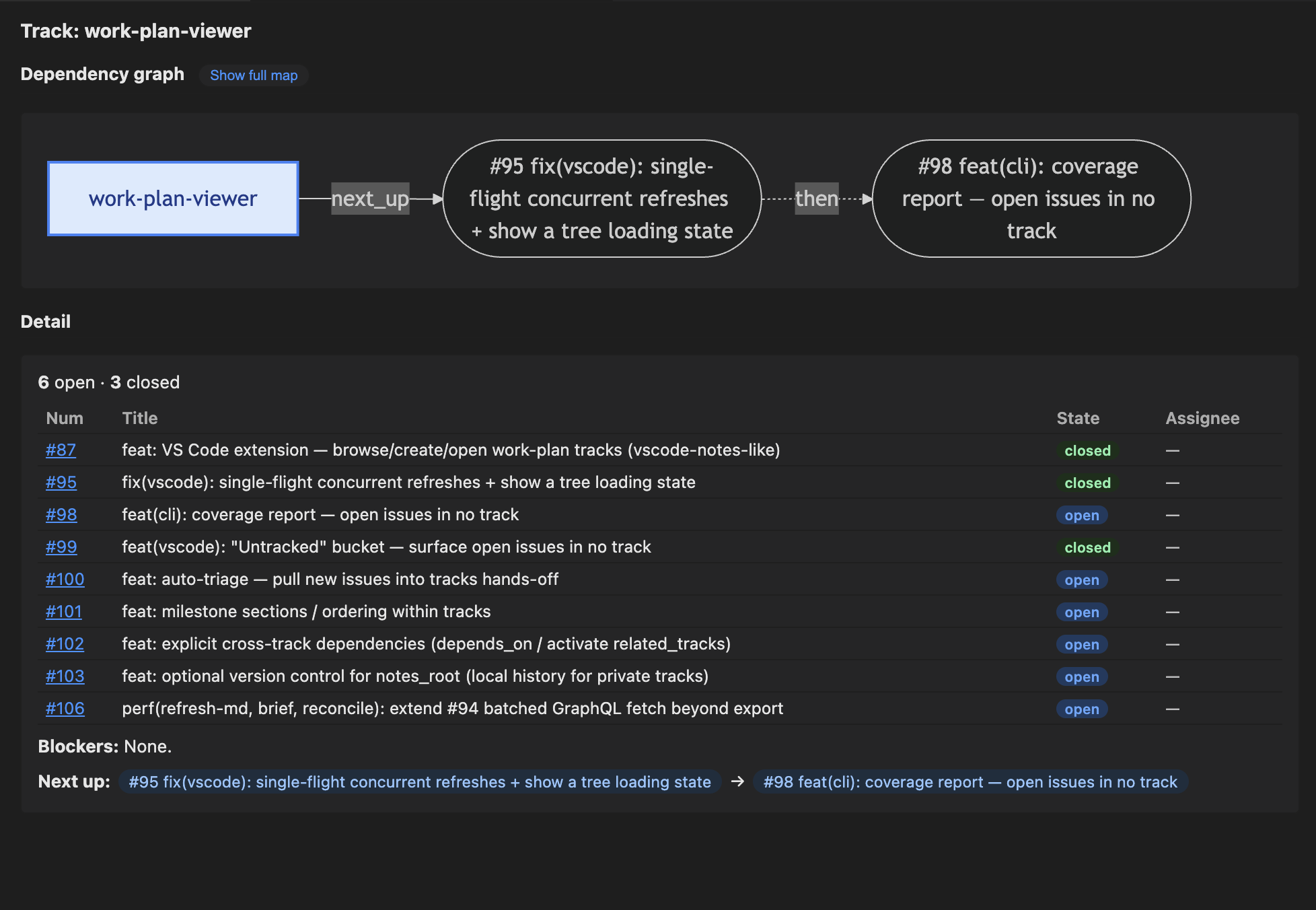
Install it from either registry:
- VS Code Marketplace: Extensions view → search "Work Plan" (publisher
stylusnexus), orcode --install-extension stylusnexus.work-plan-viewer. - Open VSX (VS Codium / Cursor / Windsurf): search "Work Plan", or
ovsx get stylusnexus.work-plan-viewer.
The extension shells out to the work-plan CLI, so install the CLI too (npm or any method above). If work-plan isn't on your editor's PATH — common when VS Code is launched from the Dock/Finder rather than a terminal — set workPlan.cliPath in Settings to an absolute launcher path (e.g. /path/to/work-plan-toolkit/bin/work-plan, or the npm global bin), then reload the window. Extensions auto-update from the registry.
Useful settings:
| Setting | Default | What it does |
|---|---|---|
workPlan.cliPath | "work-plan" | Absolute path to the CLI, if it's not on the editor's PATH |
workPlan.autoRefreshInterval | 0 (off) | Re-poll the CLI silently in the background (seconds). Set to 30, 60, 300, or 900 if teammates are pushing shared-track changes and you want the tree to stay current without manual refresh |
workPlan.expandReposByDefault | false | Expand all repo groups on load (single-repo workspaces always expand) |
Shared tracks show a shared tag in the tree description so you can tell at a glance which tracks travel via git push/pull and which are local-only.
Updating
| Installed via | Update with |
|---|---|
| npm | npm install -g @stylusnexus/work-plan@latest (or npm update -g @stylusnexus/work-plan) |
| Claude Code / Codex plugin | /plugin update work-plan@stylus-nexus (Codex: codex plugin update …) |
Script (install.sh) | git pull in the toolkit repo, then re-run ./install.sh (or .\install.ps1) |
| VS Code extension | Auto-updates; or Extensions view → update manually |
Check your version any time with work-plan --version.
What the shims do
For tools without a native skill system (Cursor, Copilot), shims/ contains drop-in files that give the LLM the same prompt-engineered behavior the SKILL.md provides on Claude Code: condensed CLI usage, when to relay verbatim, the two-step AI subcommand pattern, and a pointer to the full toolkit docs.
The shims are per-project — copy them into each repo where you want the work-plan tool surfaced to your agent. They don't auto-load globally.
Install
Pick the path for your tool. All three install the same CLI + skills.
Claude Code (recommended) — plugin, easy updates
/plugin marketplace add stylusnexus/agent-plugins
/plugin install work-plan@stylus-nexus
Commands are namespaced under the plugin: /work-plan:brief, /work-plan:handoff,
/work-plan:orient, /work-plan:hygiene, /work-plan:status, and
/work-plan:run <subcommand> for everything else. Update with
/plugin update work-plan@stylus-nexus. Works in the CLI and the VS Code / JetBrains extensions.
Codex — plugin
codex plugin marketplace add stylusnexus/agent-plugins
codex plugin add work-plan@stylus-nexus
Cursor / direct / other — script
git clone <this-repo> work-plan-toolkit
cd work-plan-toolkit && ./install.sh          # macOS / Linux / WSL
# or, on Windows native PowerShell:  .\install.ps1
# or, for Codex's skills dir:        ./install.sh --target=$HOME/.agents
Gives the single bare /work-plan <subcommand> (no namespace). Re-run after git pull to refresh
(the plugin paths above update themselves).
The installer:
- Copies (not symlinks — for Windows compatibility)
skills/work-planandskills/repo-activity-summaryinto~/.claude/skills/ - Installs the
work-planlauncher (bin/work-plan+bin/work-plan.cmdon Windows) and copies the standalone dispatcher (installer/work-plan.md) into~/.claude/commands/work-plan.md(the per-verb suite is plugin-only) - Self-seeds
~/.claude/work-plan/config.ymlon first run if absent (one config home for every install mode), withnotes_rootat~/.claude/work-plan/notes - Drops a
.installed-frommarker souninstallknows what's safe to remove
External dependencies (verified by the installer): gh, git, yq, python3.
Versioning: releases use CalVer (
YYYY.MM.DD+<sha>, auto-bumped on deploy and synced into the plugin manifests) — not SemVer.
What gets created
After clone, the toolkit looks like this:
work-plan-toolkit/
├── README.md
├── LICENSE
├── .gitignore
├── install.sh / install.ps1            # macOS+Linux+WSL / Windows
├── uninstall.sh / uninstall.ps1
├── skills/
│   ├── work-plan/
│   │   ├── SKILL.md
│   │   ├── work_plan.py                # CLI entry
│   │   ├── commands/                   # 16 subcommand modules
│   │   ├── lib/                        # config, frontmatter, gh, git, prompts, …
│   │   └── tests/                      # 234 unittest cases
│   └── repo-activity-summary/
│       └── SKILL.md                    # bundled companion skill
├── commands/
│   └── work-plan.md                    # Claude Code slash command alias
├── docs/
│   └── usage-examples.md
├── shims/                              # Drop-in instruction files for non-skill-aware tools
│   ├── README.md
│   ├── cursor/work-plan.cursorrules
│   └── copilot/work-plan-copilot-instructions.md
└── notes/
    └── README.md                       # default notes_root (empty until init-repo)
After running install.sh (or install.ps1), the installer creates this in your home directory:
~/.claude/
├── skills/
│   ├── work-plan/                      # copy of toolkit's skills/work-plan/
│   │   ├── SKILL.md
│   │   ├── work_plan.py
│   │   ├── commands/
│   │   ├── lib/
│   │   ├── tests/
│   │   └── .installed-from             # marker file (toolkit absolute path)
│   └── repo-activity-summary/
│       ├── SKILL.md
│       └── .installed-from             # marker file
├── commands/
│   └── work-plan.md                    # copy of toolkit's commands/work-plan.md
└── work-plan/
    └── config.yml                      # seeded from template, notes_root resolved
                                        # to absolute toolkit path (edit this one)
Then, when you run /work-plan init-repo myproject --github=your-org/myproject, the toolkit's notes/ folder gets a per-repo subdir (under whatever notes_root resolves to):
<notes_root>/
└── myproject/                          # created by init-repo
    ├── archive/
    │   ├── shipped/.gitkeep            # close mv's shipped tracks here
    │   └── abandoned/.gitkeep          # close mv's abandoned tracks here
    └── <track-slug>.md                 # active tracks live at top level
Configure
After install, bootstrap your first repo with the init-repo subcommand:
/work-plan init-repo myproject --github=your-org/myproject --local=/path/to/checkout
This creates <notes_root>/myproject/archive/{shipped,abandoned}/ and adds the repo block to your ~/.claude/work-plan/config.yml (idempotent; errors if the key already exists). Skip --github / --local to be prompted interactively.
You can also edit ~/.claude/work-plan/config.yml directly:
notes_root: /absolute/path/to/your/notes/    # or keep the bundled default
repos:
  myproject:
    github: your-org/myproject
    local: /path/to/local/checkout           # optional, enables in-progress detection
Where your config lives
The active config the skill reads is ~/.claude/work-plan/config.yml — created by install.sh (or install.ps1) on first run. There's no template file in the repo to confuse with the runtime config; install just writes the right two lines directly.
After a fresh install, it looks like:
# work-plan config — created by install.sh. Edit this file to customize.
# Run /work-plan init-repo <key> --github=<org/repo> to populate repos:.
notes_root: /absolute/path/to/work-plan-toolkit/notes
repos: {}
notes_root is the absolute path of the toolkit's bundled notes/ folder, so the default works out of the box. To change it (e.g., to ~/Documents/Project Notes/), edit this file.
The bundled notes/ folder stays empty until you run /work-plan init-repo <key>, which adds a per-repo subdir + writes the repo block back into this same config file via yq.
Security & data handling
- No credentials stored. All GitHub access goes through your existing
gh auth. This toolkit never reads, writes, or stores GitHub tokens. - Local-only writes. The skill writes to
~/.claude/skills/work-plan/,~/.claude/skills/repo-activity-summary/,~/.claude/commands/work-plan.md,~/.claude/work-plan/config.yml, and yournotes_root. The exceptions are theplan-statusaction flags, all confined to the repo you point it at and all opt-in:--stampwrites a status header into discovered plan docs;--archivegit mvs dead plans intoarchive/abandoned/;--issuesopens GitHub issues for partial plans (viagh). All honor--draft(preview, no writes) and the two mutating actions prompt for confirmation. Nothing else. - No telemetry, no network calls beyond
gh. All GitHub operations go throughgh(your authenticated session); no direct HTTP requests are made. - AI subcommands (
group,suggest-priorities) send issue titles to Claude via Claude Code's existing integration. Body content, code, and PR contents are NOT sent. If your repo is private and you're cautious about what reaches the model, skip these subcommands. init-repowrites to your config viayq -i. Inputs are JSON-encoded before being passed toyq, so a maliciously crafted--github=value can't break out of the YAML edit.install.sh/install.ps1only touch user-owned dirs. Nosudo, no system-wide changes, no privilege escalation.
For vulnerability reporting, threat model, and past advisories, see SECURITY.md.
Usage walkthrough
See docs/usage-examples.md for end-to-end scenarios (morning brief, mid-work handoff, fresh-session orient, weekly hygiene).
Subcommand reference
| Subcommand | What it does |
|---|---|
brief [--repo=<key>] | Multi-track snapshot of all active tracks across configured repos. --repo=<key> filters to one project (matches the folder name under notes_root or the org/repo GitHub slug; archived-reopen callouts are also scoped). |
handoff <track> [--auto-next | --set-next 1,2,3] | Wrap up a work block. Writes a ### Session — <ts> entry. --auto-next suggests a priority-sorted top-3 from open issues (interactive: apply / edit / skip). --set-next 1,2,3 is the explicit form. Without either flag, just captures the session summary and reads any pre-existing next_up. |
orient [track] (alias: where-was-i) | Read-only paste block. With a track name: ~15-line track summary (priority, last session, next pick, git state). With no track: cwd snapshot (branch, recent commits, modified files) for non-track work. Add --pick for the interactive track picker. |
slot <issue-num> [track] | A new GitHub issue should belong to a track — adds it to the track's github.issues list. Non-interactive flags: --move/--no-move (relocate the issue off its prior track, or leave it; default no-move), --confirm=<token> (public-repo gate, see below). |
close <track> [--state=shipped|parked|abandoned] [--note=<text>] | Mark track shipped, parked, or abandoned. Moves to archive/<state>/ for shipped/abandoned. Pass --state= (and an optional --note=) to run without prompts. |
refresh-md <track> | --all | --repo=<key> | Update issue STATE (open/closed, status labels) inside the track body's status table. Does NOT change track membership — this is the right tool for "refresh the work I just completed." --all sweeps every active track; --repo=<key> scopes the sweep to one repo. |
hygiene [--repo=<key>] | Weekly all-in-one: refresh-md + reconcile + duplicates. With --repo=<key>, steps 1 and 2 scope to that repo and the global duplicates step is skipped. |
list [--all] | List active tracks (or all including parked/archived). |
init <path> [--priority=P0..P3] [--milestone=<m>] | Add frontmatter to a brand-new track .md file (the file must already exist). Pass --priority=/--milestone= to skip the prompts. |
init-repo <key> --github=<slug> [--local=<path>] | Bootstrap a new repo: create <notes_root>/<key>/archive/{shipped,abandoned}/ and add the repo block to your config. --github is required; --local is optional. |
new-track <repo> <slug> [--priority=P0..P3] [--milestone=<m>] | One-shot, non-interactive: create a new track file under notes_root for <repo> (a config key or an org/repo slug) with frontmatter. Unlike init, it makes the file for you — the headless creation path the VS Code viewer uses. |
set-notes-root <path> | Relocate where your private track notes live (updates notes_root in config). Does not move existing tracks — it warns if any would be orphaned. |
suggest-priorities --repo=<key> | Two-step AI label backfill: CLI fetches unlabeled issues, Claude proposes priorities, --apply writes labels via gh. |
group [--milestone=X] [--label=Y] [--repo=Z] [--private] [--apply] | AI-cluster GitHub issues into thematic track files. Two-step: CLI prints prompt → you save JSON answer → --apply creates the tracks. --private routes to notes_root instead of .work-plan/. |
auto-triage [--repo=<key>] [--apply] | AI-assign untracked open issues to existing tracks. Two-step (same pattern as group). Run coverage first to measure the gap. |
coverage [--repo=<key>] [--list] [--limit=N] | Report how many open issues are not in any track. --list prints titles. Read-only. |
reconcile <track> | --all | --repo=<key> [--draft] | Update track MEMBERSHIP (the github.issues list in frontmatter) by syncing against a GitHub label. Read-only on GitHub. Default label is track/<slug>; override per-track via github.labels: [...] in frontmatter (OR semantics). --draft previews ADDs/FLAGs without prompting or writing. --repo=<key> scopes the sweep to one repo. NOT for hand-curated tracks (it'll propose dropping curated issues every run) — use refresh-md if you only want to update issue state. When >50% of frontmatter issues lack the label, reconcile prints a hint pointing to refresh-md. |
duplicates [--repo=<key>] | Find likely-duplicate issues by title similarity (stdlib difflib). Prints gh issue close consolidation commands. |
canonicalize <track> | Add a canonical issue table to a track file (so refresh-md knows where to update). |
plan-status [--repo=<key>] [--json] [--stamp [--draft]] [--llm [--apply]] [--archive | --issues] [--draft] | Reach a verdict on every plan/spec doc in a repo by correlating its declared file-manifest against git + the filesystem: ✅ shipped / 🟡 partial / 💀 dead / 👻 manifest-less / 🧳 foreign. Read-only by default. --stamp writes an idempotent status header into each doc (--draft previews); --llm runs a two-step AI verdict on prose/ambiguous docs; --archive moves dead plans to archive/abandoned/ and --issues opens issues for partial plans (both gated, both honor --draft); --json for machine output. |
Run python3 ~/.claude/skills/work-plan/work_plan.py --help for the full list with examples.
Non-interactive writes & the public-repo gate
Every write verb the VS Code extension drives runs without a TTY — explicit flags instead of prompts — and surfaces the public-repo heads-up as structured JSON instead of blocking on input. When a write targets a public repo (or one whose visibility gh can't determine), the command makes no change and prints {"needs_confirm": true, "reason": …, "token": …}; the caller re-invokes with --confirm=<token> to proceed. Private repos write straight through.
needs_confirm fails closed — unknown visibility prompts too. An all-private team can opt out of the unknown-visibility case (e.g. when a gh lookup flakes) by setting assume_private_when_unknown: true in ~/.claude/work-plan/config.yml; public repos always prompt regardless.
export --json is the viewer's read surface (schema 1): every frontmatter'd track plus an additive untracked list of open issues that no track references, per repo.
Version
python3 ~/.claude/skills/work-plan/work_plan.py --version
# work-plan 2026.04.30+a1b2c3d
The version is calver + git short SHA of the deploy commit on main. It's auto-bumped on every push to main by .github/workflows/version-bump.yml — there's no hand-maintained version constant. Re-running ./install.sh (or .\install.ps1) after a git pull refreshes the value in your installed copy. Include this string in any bug report so the maintainer knows exactly which commit you're on.
Composes with
/repo-activity-summary(bundled) — Global "what's open across the whole repo" view. Use when you need a wider lens than per-track.- For non-track-bound work (you're in a directory but no track exists yet for what you're doing), run
/work-plan orientwith no track arg — it falls through to a cwd snapshot of branch + recent commits + modified files. No external skill needed.
Philosophy
- Derive, don't duplicate. GitHub is canonical for issue state; markdown references issues by ID. The skill queries
ghlive and synthesizes the answer rather than caching whatghalready knows. - Session-bootstrap commands output paste blocks, not data dumps.
orientreturns ~15 lines you can drop into a fresh Claude Code terminal with full context. Never bury the suggested next move under historical noise. - Track files are durable across parallel sessions. Five Claude Code terminals open on five different tracks shouldn't conflict — each session reads/writes its own track file, and the frontmatter
last_handofftimestamp lets you tell which session last touched a track. - Heuristic priority backfill is one-shot, not continuous.
suggest-prioritiesis a migration tool; once issues are labeled, GitHub stays canonical. The skill doesn't reclassify on every run.
Testing
cd skills/work-plan
python3 -m unittest discover tests
234 tests, no external dependencies (mocks gh/git calls).
License
MIT — see LICENSE.
Maintainer
Stylus Nexus Holdings LLC · @stylusnexus