
Claude-LFE
StChiotis/Claude-LFE
Engenharia agnóstica confiável: agents Claude que mantêm intenção em produção
Ver no GitHubFramework de engenharia confiável para agents Claude que implementa princípios de confiabilidade de sistemas críticos (FMEA, RCM, poka-yoke) em software com IA. Mantém a intenção humana através de múltiplas sessões via documentação como fonte de verdade, inspeção mecanizada e checkpoint de estado.
Instalação
npx convez-ai StChiotis/Claude-LFE1 comando no terminal: detecta o formato do repositório (marketplace ou plugin avulso) e instala via Claude Code. Requer Node 18+ e o Claude Code instalado.
Métricas
Casos de uso
- Construir agents de longa duração que não perdem contexto ou objetivo entre sessões
- Implementar workflows automáticos críticos que precisam auditoria e rastreabilidade
- Estruturar código de IA com disciplina de engenharia confiável (FMEA, inspeção contínua)
Veredito

Solução arquitetural robusta para quem precisa levar agents Claude a produção sem degradação. Traz overhead deliberado em troca de confiabilidade mecanizada — não para protótipos rápidos, mas para sistemas que precisam manter intenção ao longo do tempo.
README
A tradução para o português deste README ainda está na fila.
Claude-LFE





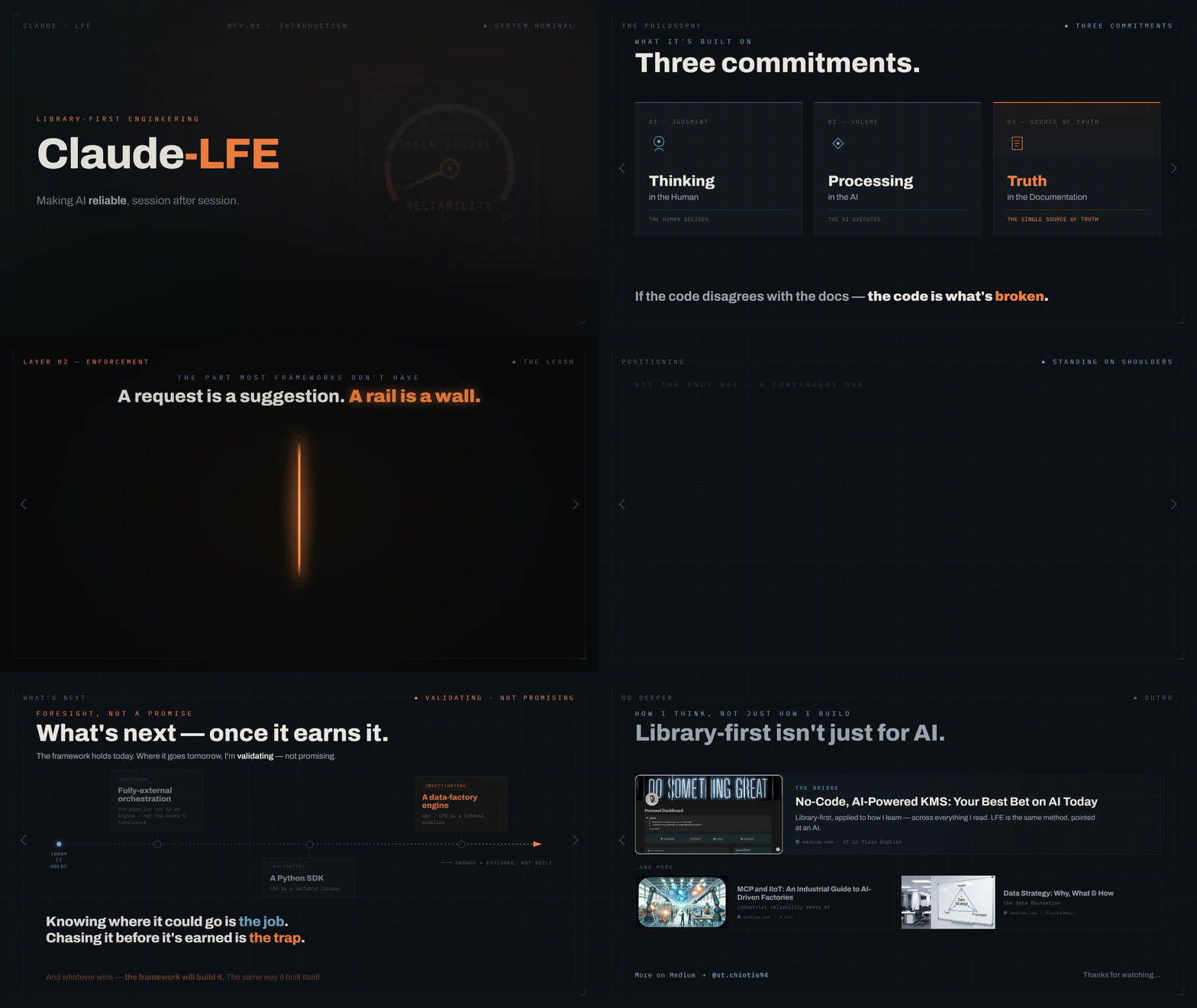
Want to see the full introduction deck? Visit stchiotis.github.io/Claude-LFE.intro
Making AI reliable, session after session.
The bottleneck in agentic software isn't capability — it's trust. A model that nails the prototype will, across dozens of sessions, lose intent, re-litigate settled decisions, and sprawl into spaghetti. Claude-LFE is a ready-to-clone Claude Code scaffold that keeps that from happening: the human stays on the wheel, documentation is the source of truth, and reliability is mechanically enforced and measured — not asserted.
It's deliberately slower. That's the trade: overhead you choose to pay so the work holds up in production, not just in the demo. The discipline is borrowed from reliability engineering in marine and biotech — FMEA, RCM, poka-yoke — ported onto AI.
Built on the Library-First Engineering framework.
📖 The long-form argument — this thesis is laid out in full in "The Bottleneck in Agentic Software Isn't Capability. It's Trust" (Towards AI, Jun 2026). The full text also ships in-repo as
MEDIUM ARTICLE.mdso the rationale travels with the template — for human readers and for any agent auditing the repo.
What's included
| Component | Location | Purpose |
|---|---|---|
| LFE skills | .agents/skills/ + .claude/skills/ mirror | Full LFE skill set covering bootstrap, planning, building, inspection, archival, hygiene, recovery, and navigation |
| Claude Code hooks | .claude/hooks/ | Persona-discipline + plan-critique write gates, coordination-file frontmatter validators (with sub-validators per file type), state-aware SessionStart reminder, checkpoint-flip state mutator |
| Inspector specialist skills | .agents/skills/lfe-*-check/ + lfe-dep-audit/ + lfe-mutation-verify/ | Security (OWASP Top-10), performance, complexity, dependency-audit, and mutation-reasoning passes the Inspector runs as in-chat skills |
| statusLine | .claude/statusline.mjs | Live pipeline state rendered below the Claude Code prompt |
| LFE protocol docs | .docs/protocol/ | PERSONAS, ASSEMBLY_LINE, GOVERNANCE, COORDINATION_FILES, LOOP_ARCHITECTURE |
| Sync tooling | scripts/ + .githooks/ | sync-claude-skills.mjs + pre-commit drift guard |
| Quality layer | .docs/quality/ | PROTOCOL_DEBT, RETENTION_RUNBOOK, inspector-config |
| Skill-accuracy harness | .agents/skills/_evals/ + .claude/lib/skill-eval*.mjs + /lfe-skill-eval | Measures whether the five defect-catching reasoning skills — security, performance, complexity, mutation-reasoning, and plan-critique (the checks whose job is to find a problem, not the ~18 workflow skills) — actually catch planted defects; renders .docs/quality/skill-eval-scorecard.md |
Getting started
# 1. Clone into your new project folder
git clone <this-repo> my-new-project
cd my-new-project

# 2. Activate the pre-commit drift guard
npm install

# 3. Open in Claude Code and bootstrap
/lfe-boot

# 4. Run the Day 0 domain extraction interview
/lfe-extract-domain
After /lfe-extract-domain completes, CONTEXT.md and .docs/domain/domain-knowledge.md will be populated with your project's domain language and then you're ready for your first mission.
Fresh-clone note:
CONTEXT.mdis intentionally absent in a fresh clone — it is not missing or broken./lfe-extract-domaincreates it from your Day-0 domain interview. Likewise,.docs/domain/ships with only a Shelf Index (.docs/domain/README.md) explaining what belongs there; the domain files are created on Day 0.
Key docs
| Document | Purpose |
|---|---|
LLM_AGENT_GUIDE.md | Canonical agent rules: workflow, skills, coordination layer, project bindings |
pipeline_status.md | Live session cursor — active persona, mission state, coordination file tracker |
.docs/protocol/ | LFE protocol: personas, assembly line, governance, coordination file schema |
CONTEXT.md | Domain vocabulary (populated by /lfe-extract-domain) |
.docs/README.md | Documentation floor map |
Framework philosophy
"Thinking in the Human · Processing in the AI · Truth in the Documentation"
See README.md on the public LFE repo for the full philosophy.
Author
Built by Stylianos Chiotis — reliability engineering (marine · biotech) ported onto AI. Connect or reach out: LinkedIn · intro deck · Writing: The Trust Bottleneck · Library-First Engineering.
License
MIT