
Stagentic XDD
stagentic/stagentic-xdd
TDD/BDD unificado com crítica agentica para desenvolvimento guiado por exemplos
Ver no GitHubSkill para Claude que implementa Example-Driven Development (TDD/BDD unificado) com suporte a testes comportamentais orientados por agentes. Combina loops externo (cenários do cliente) e interno (Red-Green-Refactor) para guiar desenvolvimento guiado por testes com validação agentica.
Instalação
npx convez-ai stagentic/stagentic-xdd1 comando no terminal: detecta o formato do repositório (marketplace ou plugin avulso) e instala via Claude Code. Requer Node 18+ e o Claude Code instalado.
Métricas
Casos de uso
- Desenvolver features com ciclo Red-Green-Refactor automatizado
- Validar comportamento de agentes IA através de testes executáveis
- Manter especificações vivas sincronizadas com código em produção
- Guiar Claude através de loops de desenvolvimento comportamental
Veredito

Projeto em evolução ativa focado no loop interno de TDD. Promissor para equipes que buscam testes comportamentais para agentes Claude, mas ainda em fase experimental — recomendado apenas para exploração técnica, não produção.
README
A tradução para o português deste README ainda está na fila.
stagentic:xdd
A planned Claude plugin for language-agnostic Behaviour-Driven Development (BDD) / Test-Driven Development (TDD).
A work in progress
One inner-loop scenario currently runs green against a fake agent, selectable against either a deterministic auditor or an agentic critic.
The critic wraps claude -p running a scorecard prompt over the
agent's transcript and resulting workspace state, judging each
characteristic without deterministic assertions.
The harness is designed so both sides grow via fixture configuration — without rewriting the test:
Agentis implemented but--agent=realis not yet wired into the fixtures — theagentfixture exposes onlyFakeAgentuntil the xdd skill has its first passing scenario.
For an illustrative sketch of the eventual fixture-config matrix
(real-Claude vs stubbed agent × auditor vs critic), see
experiments/agentic-screenplay-spike/screenplay/tests/test_scenarios.py
— a prototype shape, not a target architecture.
See NEXT.md for the current focus and
docs/architecture/decisions/ for the
architectural direction.
Why "XDD"
Both BDD and TDD, in their original form, encompass an outer loop (customer scenarios / customer tests) and an inner loop (Red-Green-Refactor). The mainstream diluted both — TDD to just the inner loop, BDD to just customer tests — but the underlying practice is the same.
For the longer argument, see What almost everyone gets wrong about TDD/BDD.
Whether you call it TDD, BDD, or eXample-Driven Development — substitute the X with T, B, or whatever you prefer — you can apply the same working practice. What you call it isn't important; doing it well is. This plugin is a skill that aims to help Claude do it well.
The outer and inner loops
The outer loop defines each new product behaviour as an executable customer scenario (or customer test), observes it fail, then evolves the guidance — skills, prompts, and checkpoints — until it passes reliably.
What accumulates is not just working code but a suite of living specifications that catch regressions whenever something changes.
The inner loop is the familiar Red-Green-Refactor loop: spec a new internal behaviour (write a failing unit test), make it pass with the minimum code change, then improve the structure without changing behaviour.
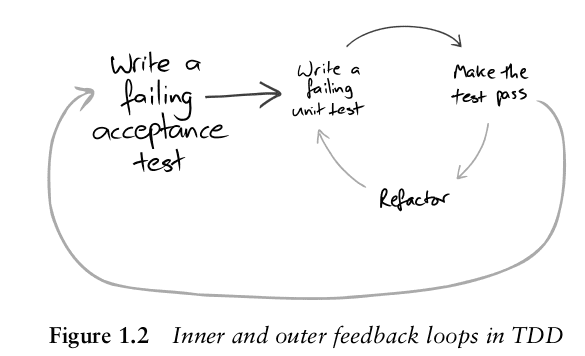
(From "Growing Object-Oriented Software, Guided by Tests" by Nat Pryce and Steve Freeman)
Scope
The initial focus is the inner loop, guiding an AI agent through a Red-Green-Refactor loop one behavioural increment at a time. Specifying and validating the skill itself via the outer loop is planned.
Out of scope for now is the outer loop.
Language adapters
Today, only Python is supported, because the code that facilitates the skill is written in Python. Beyond that, language support will be provided through adapters — the skill itself is language-agnostic. Adapters will provide build and test commands, with linters, mutation testing and customisable tool-chain integration.
Prerequisites
This project requires Claude Code CLI 2.1.150. Auto-updates are disabled by .claude/settings.json — do not run claude update without first validating the suite against the candidate version.
Check your current version:
claude --version
If you already have Claude Code installed, switch to the required version:
claude install 2.1.150
If you are installing Claude Code for the first time, install the required version directly via npm:
npm install -g @anthropic-ai/claude-code@2.1.150
Development
This plugin is being developed using a pattern created by Antony Marcano called TDAB — Test-Driven Agentic Behaviours. This is essentially BDD/TDD for agentic behaviours, driving new or improved agent behaviour one scenario at a time.
Each behaviour is specified as a scenario, with fixture code forming the basis of a small, scoped exercise, validated end-to-end in both the result and the approach to achieving it — before the guidance is considered done.
A key problem this pattern solves is that agent behaviours are non-deterministic and cannot be asserted using traditional methods. Instead, a rubric, or scorecard, is used to evaluate non-deterministic agent behaviours.
See COMMANDS.md for key development commands (test runners, linter).
License
See LICENSE.