
Intraday Trade Mentor
solidx86/intraday-trade
Coach IA para trading intraday com journal schema-versionado e validação determinística
Ver no GitHubSuite de coaching multimodal com três skills Claude coordenadas para trading intraday. Integra pesquisa pré-mercado, crítica baseada em visão de screenshots gráficos e revisão semanal, com dados organizados em journal versionado com validação em CI.
Instalação
npx convez-ai solidx86/intraday-trade1 comando no terminal: detecta o formato do repositório (marketplace ou plugin avulso) e instala via Claude Code. Requer Node 18+ e o Claude Code instalado.
Métricas
Casos de uso
- Análise pré-mercado e briefing antes da sessão de trading
- Crítica estruturada de trades via visão computacional de gráficos
- Rastreamento semanal de lições e padrões de erro repetitivo
Veredito

Projeto bem arquitetado que demonstra design robusto de skills: contrato de dados claro entre componentes, validação determinística em CI, e foco em processo sobre resultados. Relevante para traders que buscam rigor operacional, mas requer compreensão técnica avançada do ecossistema Claude.
README
A tradução para o português deste README ainda está na fila.
Intraday Trade Mentor
— multimodal LLM coaching suite

I trade US equities intraday from Malaysia. The work that actually compounds — pre-market research every evening, an honest post-mortem of every trade, a weekly look at the mistakes I keep repeating — is exactly the work that's easiest to skip after a losing day. So I built the coach that doesn't skip: three coordinated Claude skills that brief me before the session, grade every trade I take (from chart screenshots, via vision), and hold me accountable week over week. The interesting part isn't any single prompt — it's the data contract: the skills coordinate through a schema-versioned markdown journal, with one-way ownership rules and a deterministic validator suite enforcing the schema in CI.
How it flows
flowchart LR
    subgraph "before the session"
        PB["premarket-briefing\n(WebSearch + WebFetch + browser tape)"]
    end
    subgraph "after each trade"
        TM["intraday-trade-mentor\n(vision critique of chart screenshots)"]
    end
    subgraph "journal (data layer)"
        PM["daily/<date>/premarket.md"]
        TJ["daily/<date>/TICKER_dir_outcome.md"]
        IX["INDEX.md"]
        LL["LESSONS.md\n(lessons ledger)"]
    end
    subgraph "end of week"
        WR["weekly-trade-review\n(read-only aggregation)"]
        WK["weekly/YYYY-Www_weekly.md"]
    end
    PB -->|writes| PM
    TM -->|writes| TJ
    TM -->|appends| IX
    TM -->|proposes, user confirms| LL
    PM -.->|context| TM
    TJ -->|reads| WR
    IX -->|reads| WR
    LL -->|reads| WR
    WR -->|writes| WK
What's inside
- Three production skills (
*-skill/directories): each aSKILL.mdbehavior spec plusreferences/(rule books loaded at runtime),templates/, andevals/. - A journal schema designed for machine + human readers: per-trade files named
TICKER_<L|S|NT>_<W|L|BE|SKIP>.md, co-located with that day's pre-market briefing so context and execution live in one folder. - A 9-point grading rubric (
intraday-trade-mentor-skill/references/checklist.md): letter grades A–F derived from pass/fail checks, grading process, never P&L — a clean loss grades A, a sloppy win grades C. - A schema-versioned lessons ledger (
references/lessons-ledger-spec.md): every lesson is a state machine (active → internalized / retired) whose transitions only the user can trigger — the LLM proposes, the human confirms. Design rationale: docs/lessons-ledger.md. - One-way data ownership across skills: the mentor writes the journal and owns the theme-tag canon; the weekly review is read-only and consumes a mirrored canon. A CI test fails if the mirror drifts from the source.
- Anti-confabulation date logic (
premarket-briefing-skill/references/trading-day-logic.md): the US trading day is computed from Malaysia local time (MYT→ET), never assumed. - Eval suites per skill (
evals/evals.json) consumed by an external eval runner, plus the deterministic validator tests intests/. - A public engineering backlog (docs/tasks.md): tracked follow-up improvements — process notes, not the shipped behavior spec.
Sample output
Rendered from the synthetic sample journal in examples/sample-journal/ — never a real trade.
| Per-trade critique journal | Weekly review |
|---|---|
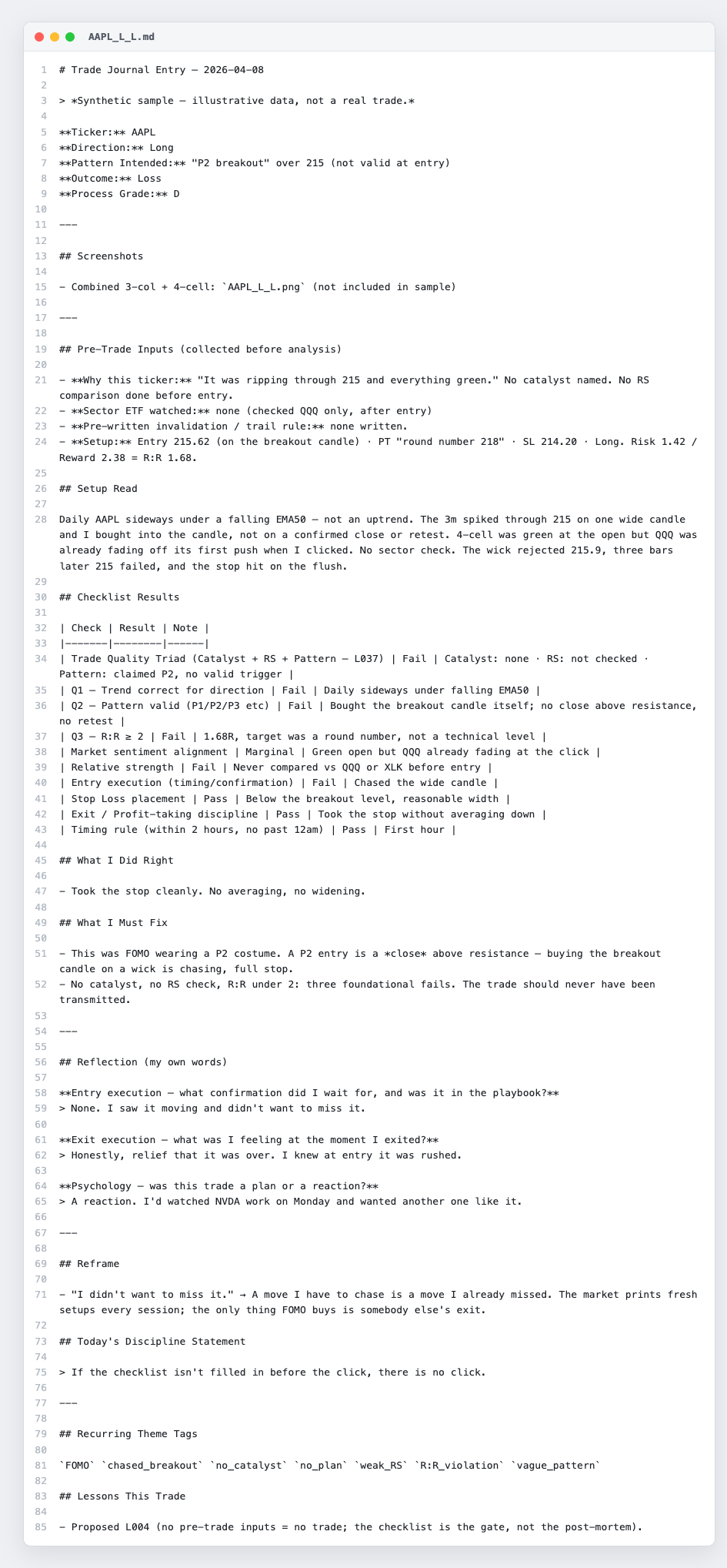 | 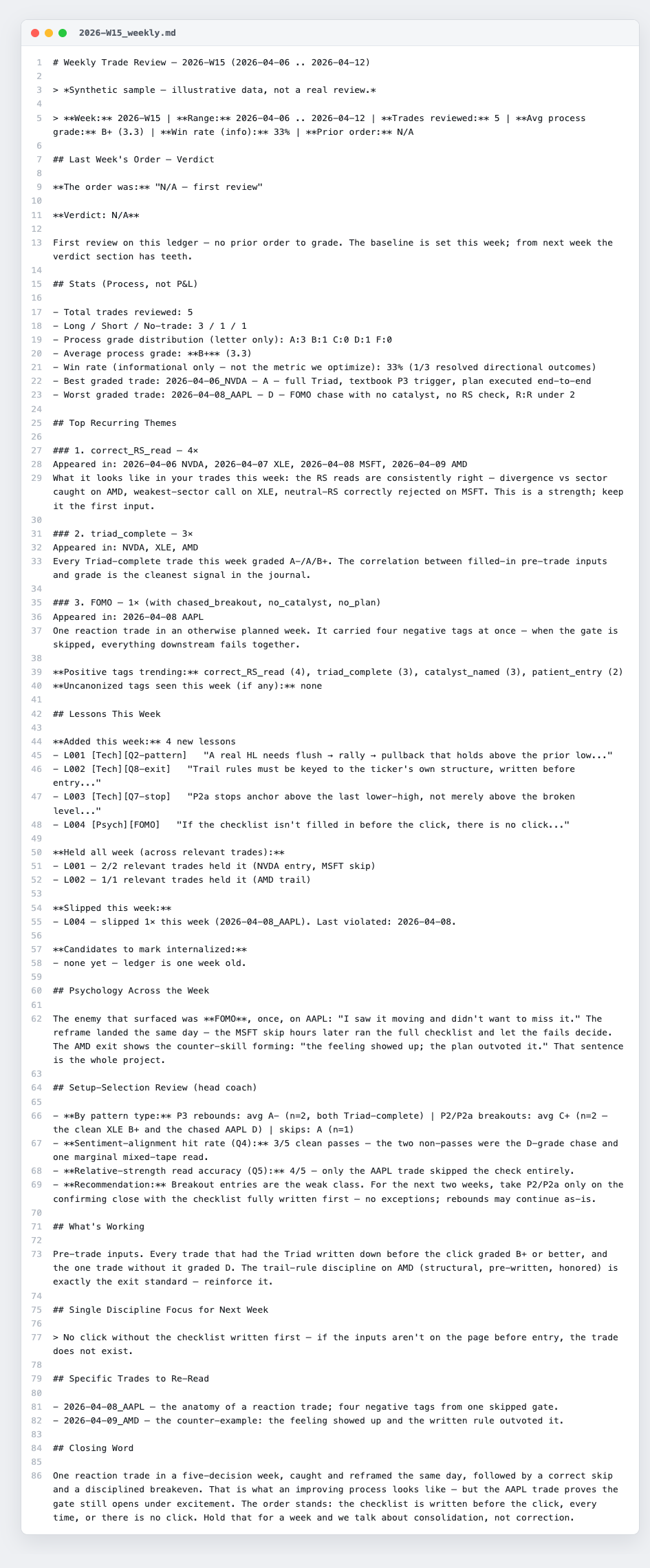 |
The eval layer
The skills emit markdown, so the test suite is a deterministic validator harness over tracked outputs (tests/, pytest, stdlib-only):
- per-trade journals: filename grammar, all 12 template sections in order, checklist row count, grades within rubric bounds, theme tags ⊆ canon
INDEX.md↔ per-trade files: every row resolves to a file, grades agree both ways- lessons ledger: frontmatter counters match the body, IDs unique and monotonic, statuses legal
- premarket briefings: validated by the skill's own structural validator (7 sections in order, risk verdict, impact-labeled calendar, required global indices)
- cross-skill drift: the weekly-review tag-canon mirror must match the mentor's canon exactly
CI runs the suite on every push.
Testing splits in two by design: CI validates outputs (deterministic, free, runs on every push), while generation quality — does the mentor grade a chase as a chase, does it refuse a critique with missing inputs — is covered by each skill's evals/evals.json, run against a live model via an external eval runner (skill-creator's iteration loop). LLM-in-the-loop evals are non-deterministic and cost tokens, so they gate skill iterations, not commits.
Stack at a glance
Claude Skills (markdown spec-driven agent design) · Claude vision (chart-screenshot critique) · WebSearch/WebFetch (live news harvest) · Playwright headless browser (bot-walled structured-data capture — CNBC tape, calendars) · Python + pytest (validator harness) · GitHub Actions (CI).
Data files & provenance
| Path | What it is | Written by | Read by | Provenance |
|---|---|---|---|---|
examples/sample-journal/daily/*/premarket.md | Pre-market briefings | premarket-briefing | trader, mentor | Synthetic |
examples/sample-journal/daily/*/TICKER_*.md | Per-trade critique journals | intraday-trade-mentor | weekly-trade-review | Synthetic |
examples/sample-journal/INDEX.md | One-row-per-trade index | intraday-trade-mentor | weekly-trade-review | Synthetic |
examples/sample-journal/LESSONS.md | Lessons ledger (state machine) | intraday-trade-mentor | both skills | Synthetic |
examples/sample-journal/weekly/*.md | Weekly review reports | weekly-trade-review | trader | Synthetic |
weekly-trade-review-skill/evals/fixtures/ | Eval fixture journals | hand-authored | eval runner, tests | Synthetic |
intraday-trade-mentor-skill/evals/assets/ | Chart screenshots for evals | TradingView captures | eval runner | Real charts, no account data |
data/trade-journal/ | The real journal (same schema as the sample) | premarket-briefing, intraday-trade-mentor | mentor, weekly-trade-review, trader | Private repo journal/ mount, gitignored — absent on a fresh clone |
data/framework/ | Full-parameter methodology | trader (by hand, private) | mentor | Private repo framework/ mount, gitignored — absent on a fresh clone |
The real trade journal — actual trades, psychology notes — and the full-parameter methodology are deliberately not published; both are mounted from a private repo (see Public / private split below). The synthetic sample week exists so the schema, and the validators over it, are fully reviewable.
Public / private split
This public repo ships the engineering: the three skills, the journal schema, the lessons-ledger state machine, and the validator suite. Two things stay private and are mounted in via gitignored symlinks:
- The trade journal (
data/trade-journal/) — real trades and psychology notes, personal data. - The methodology (
data/framework/) — the full-parameter grading rules. The public reference files are token-only; the operative parameters, pattern definitions, and breakout tell-set load from here when present, and the skill degrades gracefully when absent.
A fresh clone therefore runs the architecture but not the proprietary grading — the working showcase is the synthetic corpus in examples/sample-journal/. Both private pieces live in one private repo split into journal/ and framework/.
First-time setup (the private repo URL is fine to show — it's inaccessible to others):
git clone git@github.com:solidx86/intraday-trade.git         ~/Code/intraday-trade
git clone git@github.com:solidx86/intraday-trade-private.git ~/Code/intraday-trade-private

# two mounts into the private repo (both gitignored)
ln -s ~/Code/intraday-trade-private/journal   ~/Code/intraday-trade/data/trade-journal
ln -s ~/Code/intraday-trade-private/framework ~/Code/intraday-trade/data/framework

# skills live via ~/.claude/skills symlinks
ln -s ~/Code/intraday-trade/intraday-trade-mentor-skill ~/.claude/skills/intraday-trade-mentor
ln -s ~/Code/intraday-trade/premarket-briefing-skill    ~/.claude/skills/premarket-briefing
ln -s ~/Code/intraday-trade/weekly-trade-review-skill   ~/.claude/skills/weekly-trade-review
License & reuse
Source-available for portfolio review. All rights reserved — no open-source license is granted; please don't republish or reuse the skill content without permission. The trading methodology the mentor grades against derives from proprietary third-party training material. The public reference files are token-only by design: they carry the grading structure and opaque pattern labels (P1/P2/P3, grade letters) but no operative definitions, parameters, breakout tell-set, or source citations — those live only in a private supplement (see Public / private split above). No third-party material is included.
Disclaimer: personal tooling, shared as an engineering showcase. Nothing here is trading or financial advice.