
TriageDesk — Sistema de Triagem Multiagente para Suporte Bancário
smiley-icebox/triagedesk
Triagem bancária inteligente: classifica uma vez, roteia deterministicamente, LLM fora dos dados
Ver no GitHubUm workflow de triagem de mensagens de clientes que classifica consultas com uma única chamada LLM e roteia deterministicamente para o handler correto (feedback positivo, abertura de ticket, consulta de status, resposta FAQ ou escalação). Separa o trabalho fuzzy (classificação e redação) do trabalho factual (transações, lookups, audit), mantendo o modelo completamente fora do caminho crítico dos dados.
Instalação
npx convez-ai smiley-icebox/triagedesk1 comando no terminal: detecta o formato do repositório (marketplace ou plugin avulso) e instala via Claude Code. Requer Node 18+ e o Claude Code instalado.
Métricas
Casos de uso
- Classificação automática de mensagens de suporte com confiança e roteamento
- Abertura determinística de tickets com rastreamento e SLA em operações bancárias
- Escalação segura para humanos quando confiança é baixa ou injeção detectada
- Resposta a FAQs bancárias com RAG grounded, sem alucinação de dados
Veredito

Projeto maduro que escolheu workflow sobre agent swarm — a decisão correta para domínios transacionais. Arquitetura clara separa fuzzy language (LLM) de fatos e transações (código), tornando o sistema auditável e seguro para banking. Referência sólida para quem quer aprender padrão LangGraph responsável.
README
A tradução para o português deste README ainda está na fila.
TriageDesk — Banking Customer Support AI (multi-agent workflow)


A support-triage system that classifies an incoming customer message, then routes it to the right handler: thank the customer for positive feedback, open a tracked ticket for a complaint, look up a ticket's status for a query, answer a general banking question from a knowledge base, or hand off to a human when it isn't sure. Built for the Applied GenAI capstone, then extended toward a system you'd actually run.
The one idea worth taking away
This is a workflow, not an agent swarm — and that's the right call for a banking transaction flow, not a compromise.
- The LLM does the fuzzy-language work only it can do: classifying a message (with a confidence score) and drafting empathetic copy within guardrails.
- Everything factual or transactional is deterministic code: ticket creation, status lookups, status transitions, the customer's identity. The LLM never reports a ticket status, invents a ticket number, or states a fact from outside the data.
- Routing is done by code, not the model. The classifier writes a label to state;
a plain function (
route_by_label) picks the next node. Deterministic, auditable, unit-testable without an API call.
Compare this to the agent pattern: a typical LangGraph agent binds tools and lets
the LLM decide which to call inside a loop (tools_condition). Right for open-ended
Q&A; wrong here — you don't want a model improvising over customer account data.
Architecture
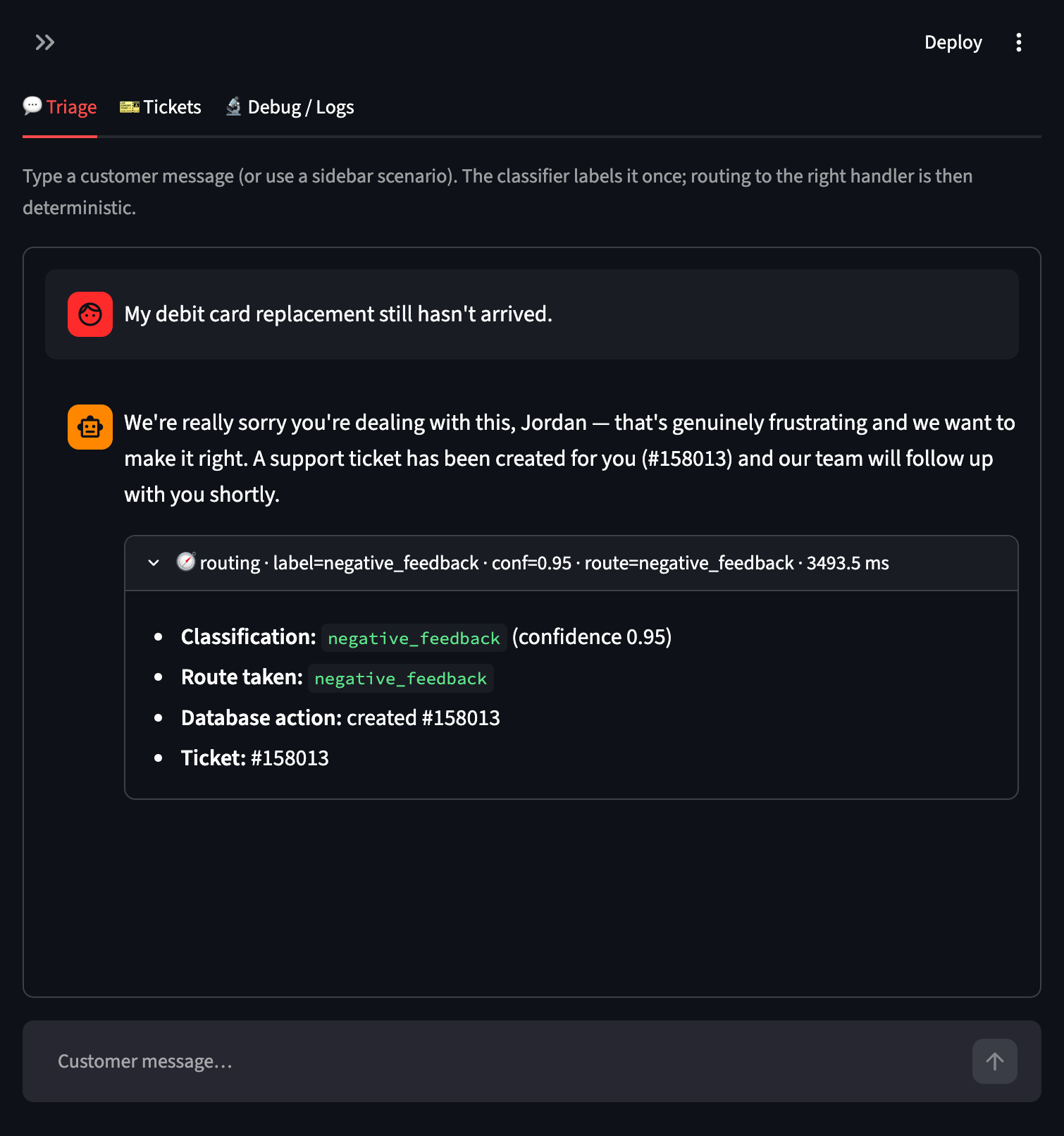
One LLM call classifies; code deterministically routes to one of five agent nodes. The LLM is fenced out of the data path entirely.
flowchart TD
M["Customer message"] --> C{"classify<br/>ONE LLM call → label + confidence"}
C -->|"injection detected"| H
C -->|"confidence < 0.60"| H["escalate → human"]
C -->|positive| P["positive<br/>LLM thank-you (guardrailed)"]
C -->|negative| N["negative<br/>open ticket · notify · SLA · audit"]
C -->|query| Q["query<br/>read status (scoped to customer)"]
C -->|general_query| G["general<br/>RAG over FAQ (grounded, or defer)"]
P --> T[("PII-masked JSONL trace + metrics")]
N --> T
Q --> T
G --> T
H --> T
route_by_label is a plain function reading a structured label — deterministic,
auditable, and unit-testable without an API call. Below-threshold confidence or a
detected injection routes to escalate (a human) rather than being forced down a
happy path; if the API is unreachable, classification degrades to a keyword fallback.
Module map (by layer)
Flat on disk (it's a small app); cleanly layered by responsibility:
| Layer | Modules |
|---|---|
| Foundation | config.py (model, thresholds, labels, templates, prompt), llm.py (Claude client factory + helpers) |
| Agents / routing | classifier.py, graph.py, handlers.py, responder.py, knowledge.py |
| Storage | repository.py (interface + SQLite impl), migrations.py, db.py (facade) |
| Services | auth.py, notifier.py, observability.py |
| Eval / data | evaluation.py, seed_data.py |
| UI | app.py (Streamlit) |
Data model
Two tables (migrations.py); the audit trail is the production-minded part:
support_tickets—ticket_id(6-digit PK),customer_id(owner; scopes all reads),customer_name,issue,status(enum),priority,created_at,updated_at,sla_due_at,sla_breached.ticket_events— an immutable audit row per change (created/status_change) withfrom_status→to_status,actor,note,created_at. Written in the same transaction as the ticket change, so the history can never drift from the data.
What's "real" here (beyond the brief)
- Auth (
auth.py) — identity comes from a verified login (PBKDF2 hashes, constant- time compare), not a UI text box. Lookups scope to the authenticatedcustomer_id, closing the IDOR hole. - Storage seam (
repository.py+migrations.py) — all DB access is behind aTicketRepositoryinterface with versioned migrations. SQLite today; a Postgres backend is a drop-in at the factory. Ticket creation is race-free (insert-retry, not check-then-insert). - Lifecycle + audit — tickets move Open → In Progress → Resolved, and every change
writes an immutable
ticket_eventsrow. SLA deadlines per priority, with a breach check. - Classifier hardening (
classifier.py) — retry/timeout, a deterministic keyword fallback when the API is down, and an injection guardrail. - LLM responses within guardrails (
responder.py) — warmth is LLM-drafted; the ticket number is code-supplied and verified to appear, or it falls back to a template. - RAG (
knowledge.py) — general questions are answered from a small FAQ via retrieve → grounded generate, and it defers to a human rather than guessing. - Multi-turn — follow-ups ("any update?") resolve a ticket id from earlier in the chat.
- Observability (
observability.py) — PII-redacted structured traces, aggregate metrics (route/source/escalation-rate/p95), opt-in LangSmith. - Notifications (
notifier.py) — ticket-created messages via a swappable notifier.
Files
| File | What it is |
|---|---|
config.py | Model, thresholds, labels/statuses, templates, the classifier prompt, SLA, flags. |
auth.py | Login + sessions (hashed passwords). Identity, derived not asserted. |
classifier.py | The one LLM call: structured {label, confidence} + guardrail + fallback. |
responder.py | LLM-drafted empathetic replies, guardrailed, template fallback. |
knowledge.py | RAG: FAQ retrieval + grounded answering for general questions. |
repository.py | TicketRepository interface + SQLite impl (Postgres-ready). |
migrations.py | Versioned, forward-only schema migrations. |
db.py | Thin facade over the repository (stable function API). |
handlers.py | The five deterministic response paths. No LLM facts below this line. |
graph.py | LangGraph wiring: classify → route_by_label → handler → END + respond(). |
notifier.py | Outbound notifications behind a swappable interface. |
observability.py | PII-redacted traces, metrics, LangSmith status. |
evaluation.py | Classification metrics + LLM-as-judge empathy/clarity scoring. |
seed_data.py | Sample tickets + the labeled evaluation set. |
app.py | Streamlit dashboard: login, triage (+ auto-scroll), tickets/lifecycle, debug. |
tests/ | 99 tests — DB, handlers, routing, auth, lifecycle, responder, RAG, eval, integration — no API key needed. |
Run it
python3 -m venv .venv
.venv/bin/pip install -r requirements.txt

cp .env.example .env        # then put your real key in it: ANTHROPIC_API_KEY=sk-ant-...

.venv/bin/python seed_data.py     # build the demo database
.venv/bin/streamlit run app.py    # launch the dashboard
Sign in (all password demo123): jordan / sam (customers — jordan owns the
sample tickets; query ticket 940011 as jordan to see read-scoping), or agent (a
support agent who sees all tickets and can drive their lifecycle). Use the sidebar
scenario buttons to exercise each route, including the RAG general-question path.
No Anthropic key? Set USE_LLM_RESPONSES=0 in .env and you can still run the
whole UI — replies fall back to approved templates and RAG answers extractively from
the FAQ, with no live LLM call. (Live triage classification still needs a key.)
Verify
.venv/bin/python -m pytest          # 99 tests, no API key needed
.venv/bin/python evaluation.py      # live: classification metrics + LLM-as-judge quality
Still documented, not built
A few things remain honestly out of scope (see WRITEUP.md): a real identity provider
behind auth.py, the actual Postgres implementation behind the repository seam, real
email/SMS adapters behind the notifier, and embeddings + a vector store behind the RAG
retriever. Each has its seam in place, so it's a drop-in, not a rewrite.