
InsightForge
smiley-icebox/insightforge
Assistente BI confiável que nunca inventa números
Ver no GitHubAssistente de BI alimentado por IA que garante precisão numérica: pandas computa todas as estatísticas, um filtro de ancoragem impede números fabricados, dual RAG (estatísticas computadas + fontes BI citadas) e interface Streamlit. O LLM nunca faz contas.
Instalação
npx convez-ai smiley-icebox/insightforge1 comando no terminal: detecta o formato do repositório (marketplace ou plugin avulso) e instala via Claude Code. Requer Node 18+ e o Claude Code instalado.
Métricas
Casos de uso
- Análise de desempenho de vendas com figuras exatas
- Consultas sobre dados de negócio em linguagem natural
- Recomendações fundamentadas em literatura BI e estatísticas verificadas
Veredito

Sistema robusto que resolve um problema real: impedir alucinações numéricas em ferramentas de IA sobre dados. Arquitetura bem pensada com dual RAG e grounding automático; requer setup de fontes BI próprias, mas funciona determinístico sem LLM. Prototipado em capstone, pronto para extensão.
README
A tradução para o português deste README ainda está na fila.
InsightForge — AI-Powered Business Intelligence Assistant


A business-intelligence assistant you can trust on numbers. Ask it about your sales data in plain English — best products, regional performance, trends, customer segments — and it answers with the exact figures, plus recommendations grounded in cited BI sources. Built for the Applied GenAI capstone, then extended toward a system you'd actually run.
The dataset is synthetic (
data/sales_data.csv, 2,500 records). Not financial advice. The qualitative layer reads BI PDFs fromdata/sources/— bring your own (the capstone's third-party papers aren't redistributed here; seedata/sources/README.md). The quantitative assistant works fully without them.
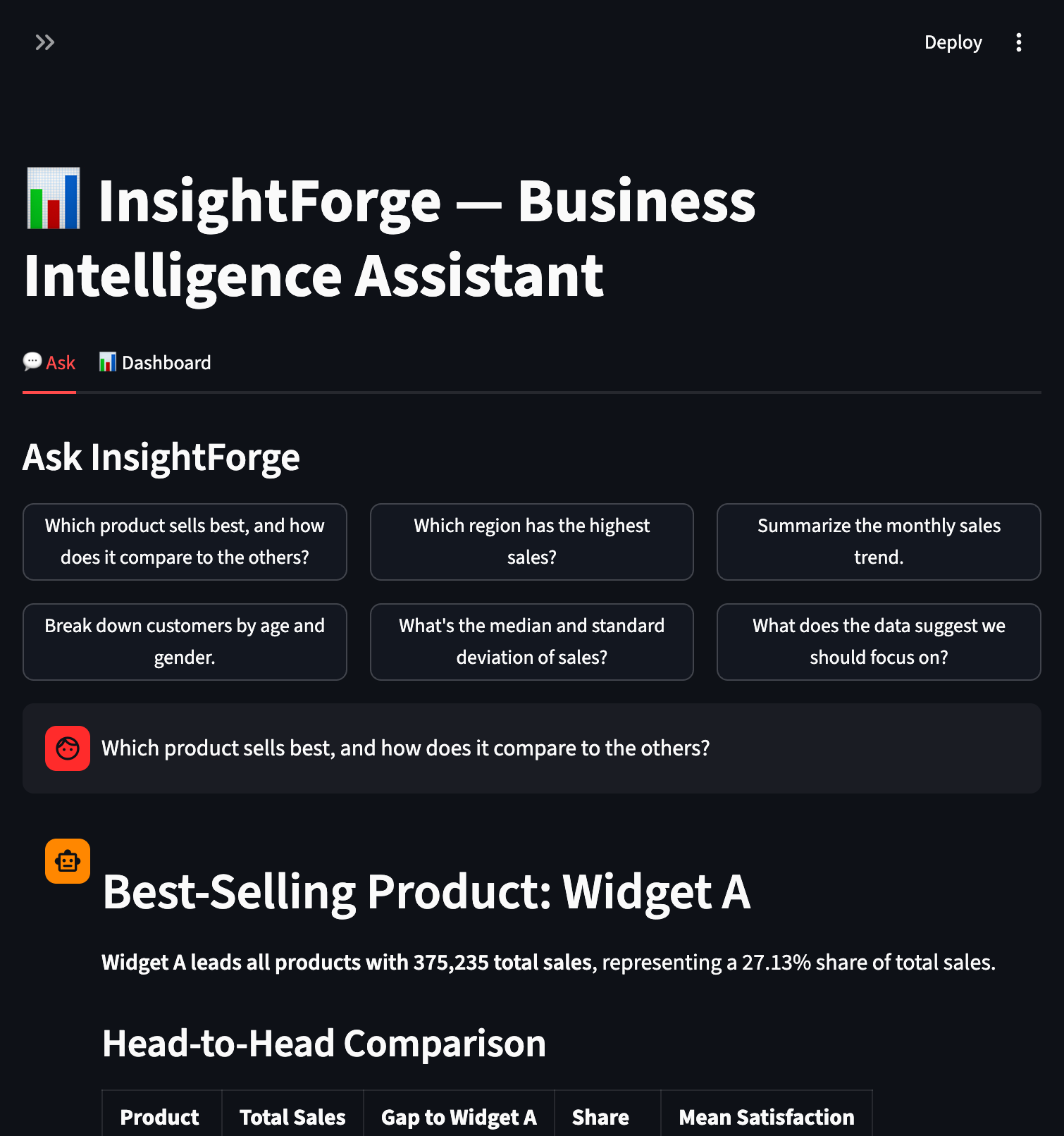
The one idea worth taking away
The LLM never does math. The #1 failure of "ask the LLM about your spreadsheet" tools is confident wrong numbers. InsightForge fences the model out of arithmetic entirely:
- pandas computes every statistic (
analytics.py) — totals, means, medians, std devs, shares, gaps — deterministically. - a custom retriever maps a question to the relevant computed stat blocks
(
retriever.py); the LLM only phrases them. - a numeric-grounding gate (
grounding.py) checks that every figure in the answer traces to a retrieved statistic (or a cited source); if not, it ships the deterministic answer instead. So a fabricated number can't reach the user.
The same discipline applies to the qualitative side: recommendations are grounded in, and cited from, the BI literature (a second RAG over the source PDFs) — the model can't invent a source either.
Architecture
Two grounded RAG layers — quantitative (computed stats) and qualitative (cited sources):
flowchart TD
    Q["Business question"] --> R1["StatsRetriever<br/>TF-IDF over computed stat blocks"]
    Q --> R2["DocRetriever<br/>TF-IDF + FAISS over BI source PDFs"]
    DATA[("sales_data.csv")] --> AN["analytics.py<br/>pandas: every number"]
    AN --> R1
    PDFS[("BI literature PDFs")] --> R2
    R1 --> S["synthesize (LLM phrases only)<br/>exact figures · cited recommendations"]
    R2 --> S
    MEM["conversation memory"] --> S
    S --> G{"numeric-grounding gate"}
    G -->|grounded| A["answer + citations"]
    G -->|a number not in the stats| D["deterministic answer (stats verbatim)"]
With USE_LLM=0 the deterministic path runs end-to-end (no API key) — answers are the
computed statistics rendered directly, grounded by construction.
Module map
| Module | Responsibility |
|---|---|
config.py | model, flags (USE_LLM, USE_DOC_RAG), paths, guardrail wording |
data.py | load + structure the CSV (schema-validated, derived time/age columns) |
analytics.py | deterministic stats engine — the only place numbers are computed |
retriever.py | StatsRetriever (quantitative) + DocRetriever (qualitative, cited) |
grounding.py | numeric-grounding gate (no fabricated figures) |
rag.py | dual retrieval → chained prompt → grounded synthesis → citations |
memory.py | conversation memory across turns |
insights.py | deterministic, grounded "key insights" for the landing screen |
viz.py | the four required charts (trend, product, region, demographics) |
evaluation.py | QAEvalChain + deterministic gates over a versioned, computed-reference set |
app.py | Streamlit: chat with answer-linked charts + provenance, landing insights, dashboard |
Rubric coverage — every item, several exceeded
| Brief | Where |
|---|---|
| Data preparation · knowledge base | data.py (load/structure pre-cleaned CSV) |
| Advanced summary: time / product / region / demographics / median+std | analytics.py |
| RAG: pandas · custom retriever for statistics · prompt engineering | analytics.py + retriever.py + rag.py |
| Chain prompts | rag.py (_SYSTEM + structured context) |
| RAG system | rag.py (dual retrieval) |
| Memory integration | memory.py |
| QAEvalChain evaluation | evaluation.py |
| Visualizations (4 required) | viz.py |
| Streamlit UI | app.py |
| Exceeds | numeric-grounding gate · second cited RAG over BI literature · versioned computed-reference eval set · lint+CI · 37 offline tests |
Run it
python3 -m venv .venv
.venv/bin/pip install -r requirements.txt

cp .env.example .env        # then put your key in it: ANTHROPIC_API_KEY=sk-ant-...
.venv/bin/streamlit run app.py
No Anthropic key? Set USE_LLM=0 in .env — the whole app runs, answering with the
computed statistics directly (and the dashboard is fully offline regardless).
Verify
.venv/bin/python -m pytest          # 37 tests, no API key needed (fully offline)
.venv/bin/python evaluation.py      # deterministic gates only (offline)
USE_LLM=1 .venv/bin/python evaluation.py   # + QAEvalChain correctness
The eval is a versioned set whose gold answers are computed from the data (so they
can't drift), scored on retrieval hit-rate@k + numeric grounding (deterministic) and
LangChain QAEvalChain accuracy (with a key).
Documented, not built
Honest scope (see SECURITY.md): TF-IDF retrieval rather than semantic embeddings (deterministic + CI-friendly; production would use an embedding model + managed vector store), a single in-process CSV rather than a warehouse connector, and an in-process conversation memory rather than persisted per-user history.