
Assistente de Saúde com Agentes Seguros
smiley-icebox/agentic-healthcare-assistant
Agente de saúde com gates de segurança determinísticas entre plano e execução
Ver no GitHubUm agente multi-etapas para assistência em saúde que planeja e executa tarefas (agendamentos, consulta de registros, informações médicas) envolvido em camadas de segurança determinísticas. Usa LangGraph com gates de emergência, controle de acesso a dados de saúde (PHI), validação de planos contra allowlist, e RAG offline com FAISS.
Instalação
npx convez-ai smiley-icebox/agentic-healthcare-assistant1 comando no terminal: detecta o formato do repositório (marketplace ou plugin avulso) e instala via Claude Code. Requer Node 18+ e o Claude Code instalado.
Métricas
Casos de uso
- Assistência ao paciente com proteção de dados sensíveis
- Agendamento seguro de consultas validando identidade
- Busca em documentação médica confiável com rastreabilidade
Veredito

Projeto robusto que demonstra como sandwichear um LLM entre gates determinísticas para preservar segurança em aplicações críticas. A abordagem de nunca confiar o plano do modelo e manter identidade no contexto é padrão para produção em healthcare.
README
A tradução para o português deste README ainda está na fila.
Agentic Healthcare Assistant


A multi-step healthcare assistant that plans, then acts: it decomposes a patient's request into an ordered sequence of tool calls — pull the chart, book an appointment, look up trusted disease information — executes them with per-step failure handling, and phrases one grounded answer. Built for the Applied GenAI capstone, then extended toward a system you'd actually run.
⚠️ Not a medical device and not medical advice. Educational/portfolio project on synthetic data. It gives information, never advice or diagnosis, and escalates emergencies to 911/988. See SECURITY.md.
The one idea worth taking away
This is a genuine agent (the request needs multi-step coordination the caller can't pre-script) — but it is sandwiched between deterministic safety gates, and the LLM is fenced out of every fact and every control-flow decision:
- The LLM plans and phrases. It decomposes the request into tool steps and writes the final warm, plain-language reply.
- Code owns control flow and facts. The emergency gate, who-can-access-what, appointment booking, chart contents, citations, and the no-advice check are all deterministic. The model never invents a fact, a citation, or a patient identity.
- The plan is untrusted output. Every step is validated against an allowlist of
tools and args before it runs;
patient_idis never an allowed arg — identity comes from the authenticated session, not the plan or the message.
The result: even a manipulated plan or a prompt-injected message can't widen access, invent a tool, miss an emergency, or ship medical advice.
Architecture
The agent is plan → execute → synthesize, wrapped by guards that run before and after the model. An emergency short-circuits before any LLM call.
flowchart TD
    M["Patient message"] --> G{"guard"}
    G -->|"red-flag (deterministic, raw msg)"| E["🚑 emergency<br/>fixed 911/988 message — no LLM"]
    G -->|"no access to subject chart"| D["↩️ deferral"]
    G -->|"authorized"| P["plan<br/>LLM decomposes → validate vs allowlist"]
    P -->|"empty plan"| D
    P -->|"steps"| X["execute<br/>run each tool · per-step status<br/>ok / empty / error / denied"]
    X --> S["synthesize<br/>grounded phrasing · no-advice floor<br/>disclaimer + citations"]
    E --> T[("PHI-redacted JSONL trace")]
    D --> T
    S --> T
Identity is resolved from the trusted session in guard, never from the plan or
message. Failed load-bearing steps are surfaced, not papered over with model memory.
The no-advice validator runs on the final answer regardless of path, so it can't be
bypassed by the deterministic fallback.
Two FAISS vector stores. A shared index over the curated disease corpus (RAG, below)
and a per-patient index over that patient's stored summaries (memory.search_memory),
so the prompt gets the most relevant prior context, scoped to the can_access'd patient.
RAG (trusted medical info)
search_medical_info is offline-first and citation-pinned:
- Try a live MedlinePlus fetch (allowlisted domains only). Live source prose is second-person ("your kidneys…") and reads as advice when quoted, so a live passage is admitted only if it passes the no-advice validator — otherwise we fall back to:
- A small curated corpus (CKD, hypertension, diabetes, penicillin allergy), indexed in FAISS over TF-IDF vectors (no torch). The corpus is the source of truth; the index is rebuilt from it at startup, so it can't drift.
Citations (source + "as of" date) are attached in code from the retrieval layer — the LLM never authors one. Stale corpus entries are flagged.
Module map (by layer)
Flat on disk (small app); cleanly layered by responsibility:
| Layer | Modules |
|---|---|
| Foundation | config.py (model, roles, safety strings, source allowlist, flags), llm.py (Claude client factory + helpers) |
| Agent | planner.py (decompose + validate), graph.py (LangGraph: guard → plan → execute → synthesize + respond()), tools.py (the 4 tools), memory.py |
| Safety | emergency.py (red-flag gate), safety.py (no-advice validator), knowledge.py (RAG + grounding) |
| Storage | repository.py (SQLite impl, transactional, Postgres-ready), migrations.py, db.py (facade) |
| Services | auth.py (roles + can_access), observability.py (PHI-redacted traces) |
| Eval / data | evaluation.py (versioned eval set + gates + QAEvalChain), seed_data.py |
| UI | app.py (Streamlit) |
The four tools
| Tool | What it does | Guardrail |
|---|---|---|
retrieve_history | Returns the chart as structured facts (LLM only phrases them). | can_access; allergies/alerts carried verbatim, never paraphrased. |
book_appointment | Finds and books an available slot for a specialty. | can_access; no double-booking; resolves fuzzy specialty ("nephrologist" → "Nephrology"). |
search_medical_info | Retrieves trusted disease info + citations. | Offline-first RAG; citations code-attached from an allowlist. |
manage_records | Appends a clinical record. | Staff only + can_access; append-only + audited. |
Every tool returns a uniform {status, summary, data, citations} where status ∈ {ok, empty, error, denied}, so the executor's failure policy can tell an
empty-but-valid result from a real error.
Data model
Append-only where it matters, audited in the same transaction as the change
(migrations.py):
patients,doctors— directory.slots—UNIQUE(doctor_id, start_at); the unit of booking concurrency.appointments— created atomically when a slot is claimed.records— append-only hybrid: typed columns (record_type,label,value) plus a free-textnote, withsupersedesfor corrections. Facts are typed so the LLM never parses them back out of prose.audit_events— an immutable row per write (book,add_record), with actor + detail, written in the same transaction so history can't drift from data.patient_memory— per-patient long-term summaries (scoped + PHI-redacted before store), retrieved semantically via a per-patient FAISS index (memory.search_memory) so the most relevant prior context — not just the most recent — is injected into the prompt.
Run it
python3 -m venv .venv
.venv/bin/pip install -r requirements.txt

cp .env.example .env        # then put your real key in it: ANTHROPIC_API_KEY=sk-ant-...

.venv/bin/python seed_data.py     # build the demo database
.venv/bin/streamlit run app.py    # launch the dashboard
The UI is chat-first: one-click sign-in, a conversation, and an inline
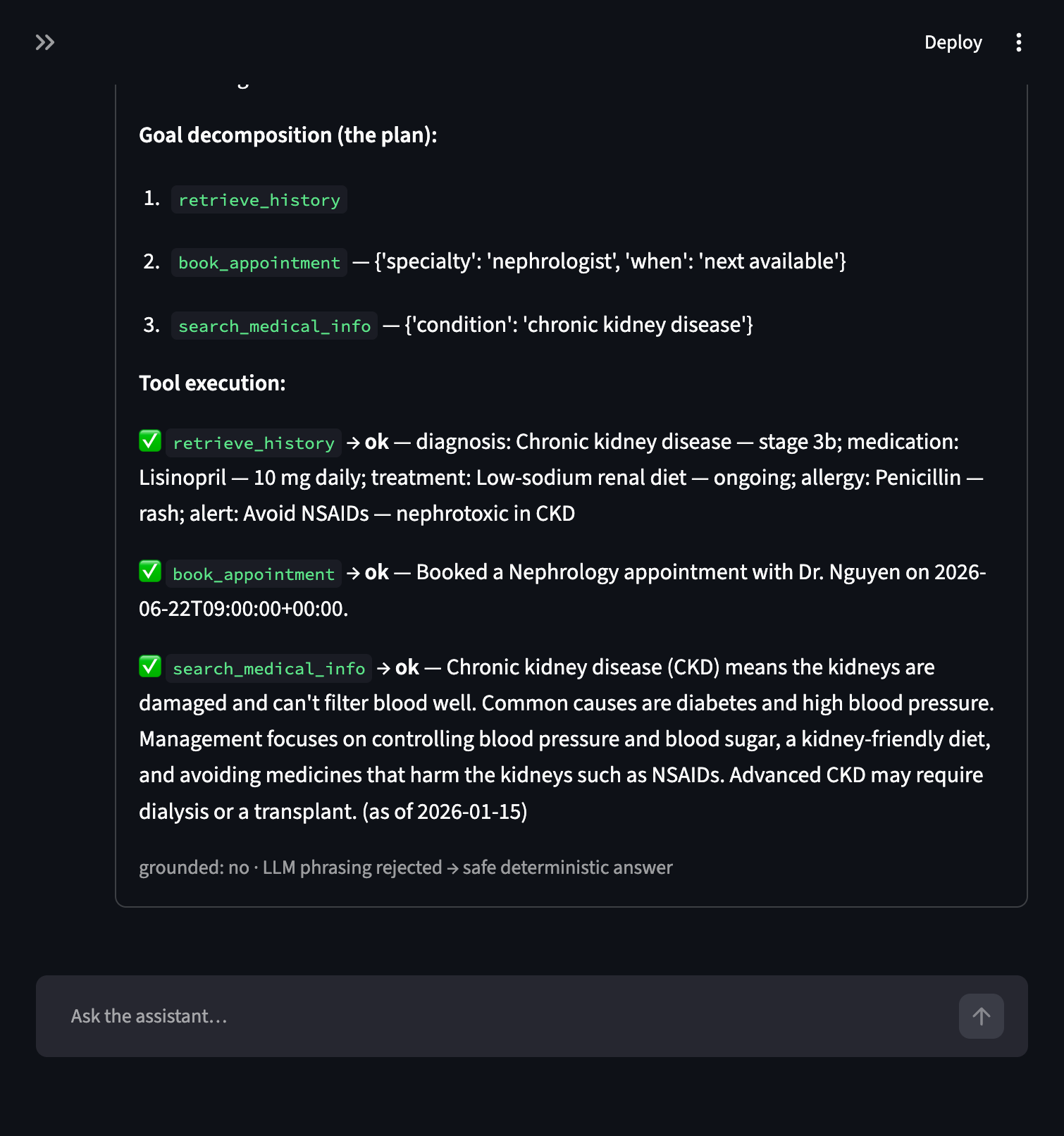
"🔍 How I worked this out" panel under each reply (the goal-decomposition plan, tool
statuses, grounding). Sign in (all password demo123) as Raj / Maria (patients —
Raj is the 50yo CKD patient from the brief), Alex (attendant), or Dr. Lee
(clinician — sees a doctor's-calendar view). The sidebar shows the patient's
appointments, chart (allergies/alerts flagged), long-term memory, and an "Under the
hood" section (eval scorecard + staff-only decision log).
Use the inline "Try one" chips to fire scenarios — for a patient: the CKD multi-step plan, a history summary, a condition lookup, and an emergency short-circuit. Type to trigger others: name another patient's id (the agent acts on your chart — the identity guard) or ask something out of scope (it defers).
No Anthropic key? Set USE_LLM=0 in .env and the whole app still runs — the
planner uses a keyword heuristic and answers are deterministic (grounded by
construction). Live search and the eval graders are likewise behind flags.
Verify
.venv/bin/python -m pytest          # 44 tests, no API key needed (fully offline)
.venv/bin/python evaluation.py      # deterministic gates only (offline)
USE_LLM=1 .venv/bin/python evaluation.py   # + QAEvalChain correctness & tone judge
The eval reports a versioned, checked-in eval set along two tracks: deterministic
gates (plan precision/recall, emergency recall, deferral accuracy, identity integrity,
no-advice rate, citation validity, groundedness, tool success) and — with a key —
LangChain QAEvalChain answer correctness plus an independent tone judge (a
different model, so the generator never grades its own warmth).
Still documented, not built
Honestly out of scope (see WRITEUP.md and SECURITY.md): a
real identity provider behind auth.py, the Postgres implementation behind the
repository seam, encryption/DLP for PHI at rest, embeddings behind the RAG retriever,
and an LLM classifier as defense-in-depth on top of the regex safety gates. Each has its
seam in place — a drop-in, not a rewrite.