
MCP Data Warehouse Server
Shimiyahya/mcp-data-warehouse-server
Query warehouse financeiro sintético em linguagem natural via MCP com segurança read-only
Ver no GitHubUm servidor MCP que expõe um data warehouse financeiro sintético (DuckDB) para LLMs consultarem via SQL natural, com camada de segurança read-only, validação AST e auditoria completa. Permite que modelos como Claude descubram o schema e executem análises multi-tabela complexas de forma segura.
Instalação
npx convez-ai Shimiyahya/mcp-data-warehouse-server1 comando no terminal: detecta o formato do repositório (marketplace ou plugin avulso) e instala via Claude Code. Requer Node 18+ e o Claude Code instalado.
Métricas
Casos de uso
- Análise de dados financeiros e de tesouraria com LLM
- Prototipagem de agentes que consultam bancos de dados
- Demonstração segura de consultas SQL complexas e multi-joins
- Auditoria e rastreamento de queries em ambiente sandbox
Veredito

Implementação sólida de um MCP server com foco em segurança e auditoria para consultas de dados. Ideal para quem quer integrar análise financeira segura com LLMs, mas exige familiaridade com DuckDB, AST parsing e arquitetura MCP.
README
A tradução para o português deste README ainda está na fila.
MCP Data Warehouse Server
Query a synthetic financial data warehouse in natural language — safely — over the Model Context Protocol.



An MCP server that exposes a small treasury & payments warehouse (DuckDB) to an LLM as MCP resources, tools, and a prompt — so a model like Claude can plan multi-step analytical SQL and reason over the results, while every query is forced through a read-only safety layer.
- What it is — a read-only MCP server over DuckDB: schema/data-dictionary as resources, plus
list_tables/describe_table/querytools. - Why it's safe — fully synthetic data, a physically read-only connection, SELECT/WITH-only validation via an AST parser, a per-table allow-list, forced row/byte caps, query timeouts, and a JSONL audit log of every call.
- What's interesting — the questions require the model to discover the schema and plan 3–4-way joins (invoices ↔ payments ↔ FX ↔ counterparties) entirely on its own.
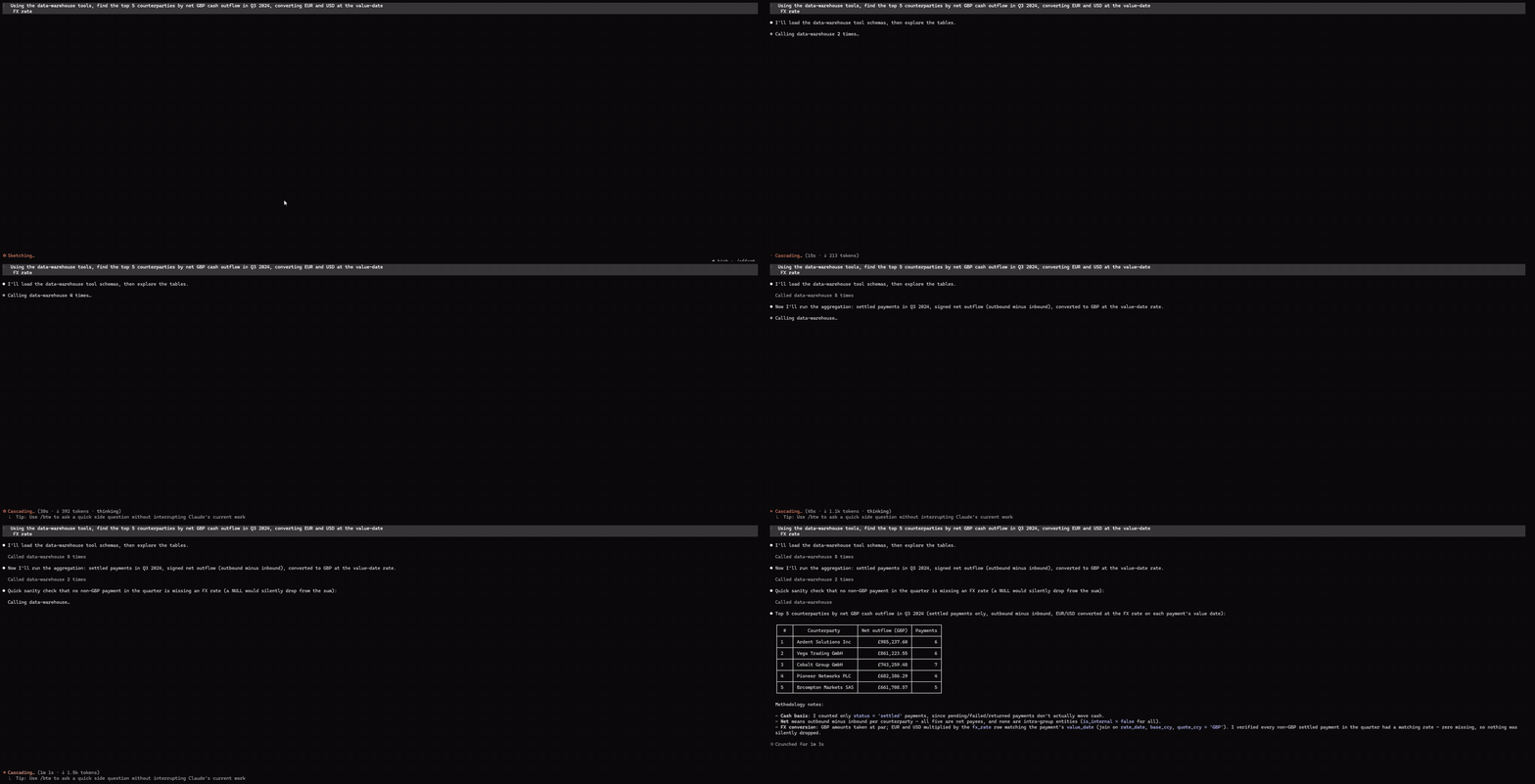
Claude answering a multi-join treasury question end-to-end via this server (record with
vhs/asciinema→docs/demo.gif).
Architecture
flowchart LR
    A["Claude<br/>(Anthropic SDK)"] -- "stdio JSON-RPC" --> B["MCP Server<br/>(FastMCP)"]
    B -- "tools: list_tables · describe_table · query" --> C
    B -- "resources: schema://catalog · table://{name}" --> C
    B -- "prompt: analyze_cashflow" --> A
    C["SQL guard<br/>(sqlglot AST)"] --> D[("DuckDB<br/>READ_ONLY")]
    E["scripts/seed.py<br/>(seed=42)"] -. "regenerates" .-> D
    B -. "every call" .-> F["audit.jsonl<br/>(stderr + file)"]
Quickstart
uv sync                              # create the venv + install deps
uv run python scripts/seed.py        # build warehouse.duckdb deterministically (seed=42)
uv run pytest -q                     # green tests — no API key needed
uv run python demo.py                # the LLM answers a multi-step question (needs ANTHROPIC_API_KEY)
demo.py reads ANTHROPIC_API_KEY from your environment or a local .env (copy .env.example).
Use it as a real MCP server
Claude Desktop — add to claude_desktop_config.json (Windows: %AppData%\Claude\…, macOS: ~/Library/Application Support/Claude/…), then restart:
{
  "mcpServers": {
    "data-warehouse": {
      "command": "uv",
      "args": ["--directory", "/ABSOLUTE/PATH/TO/mcp-data-warehouse-server", "run", "mcp-warehouse"]
    }
  }
}
Claude Code —
claude mcp add data-warehouse -- uv --directory /ABSOLUTE/PATH/TO/mcp-data-warehouse-server run mcp-warehouse
(If uv isn't on PATH for the GUI app, use its absolute path from which uv / where uv.)
The data
A fully synthetic, deterministic warehouse for a fictional company, Northwind Pay Ltd. No real entities, no PII — regenerated byte-identically from scripts/seed.py (random.seed(42)). Money is stored as integer minor units (pennies/cents) to avoid float drift; currencies are ISO-4217; FX is keyed by date so "in GBP" questions are genuinely multi-step.
erDiagram
    counterparty ||--o{ invoice : "bills / billed by"
    counterparty ||--o{ payment : "pays / paid"
    bank_account ||--o{ payment : "via"
    bank_account ||--o{ cash_balance_daily : "daily close"
    invoice ||--o{ payment_allocation : "cleared by"
    payment  ||--o{ payment_allocation : "applies to"
    fx_rate {
        date rate_date
        string base_ccy
        string quote_ccy
        decimal rate
    }
    counterparty {
        int counterparty_id PK
        string legal_name
        string country_code
        string sector
        bool is_internal
    }
    invoice {
        int invoice_id PK
        int counterparty_id FK
        string direction
        date issue_date
        date due_date
        string currency
        bigint amount_minor
        string status
    }
    payment {
        int payment_id PK
        int account_id FK
        int counterparty_id FK
        date value_date
        string currency
        bigint amount_minor
        string direction
        string method
        string status
    }
    payment_allocation {
        int payment_id FK
        int invoice_id FK
        bigint allocated_minor
    }
Eight tables in total: counterparty, bank_account, gl_account, fx_rate, invoice, payment, payment_allocation, cash_balance_daily. Run describe_table (or read the table://{name} resource) for the full column-level data dictionary.
Example questions it can answer
- "Top 5 counterparties by net GBP cash outflow in Q3 2024 (convert EUR/USD at the value-date FX rate), and what % of each one's payable invoices are still open past their due date?"
- "What was our 7-day rolling minimum cash position across all GBP accounts last quarter, and which day was tightest?"
- "SEPA vs SWIFT settlement success rate by month, weighted by EUR-converted value."
- "Days-sales-outstanding trend by counterparty sector over the last 6 months."
MCP surface
Tools
| Tool | Args | Behaviour |
|---|---|---|
list_tables | — | Lists the allow-listed tables with row-count estimates. |
describe_table | name | Columns + types + a small sample + the human data-dictionary for one allow-listed table. |
query | sql, limit? | Runs a read-only SELECT/WITH query through the safety guard; returns structured rows + a markdown preview, with explicit truncation metadata. |
Resources
| URI | Returns |
|---|---|
schema://catalog | The full table catalog + data dictionary as JSON. |
table://{name} | Columns, types, dictionary and a sample for one table. |
Prompts
| Name | Purpose |
|---|---|
analyze_cashflow | A starter prompt that primes the model to explore the schema and answer a cash-flow question. |
Security model
Fintech reviewers read this section first — so here is exactly what protects the database:
- Synthetic data only. No real PII; the warehouse is generated from a fixed seed.
- Physically read-only. DuckDB is opened with
read_only=True; external access is disabled (enable_external_access=false), extension auto-load is off, and the configuration is locked (lock_configuration=true) so injectedSETstatements can't re-enable anything. - SELECT/WITH only, single statement. Every query is parsed to an AST with
sqlglot; anything that isn't a single top-levelSELECT/WITH/set-op is rejected — this blocks the stacked-statement class of attack (e.g.… ; DROP …) that has bitten real database MCP servers. - Per-table allow-list. Only the eight documented tables are referenceable;
information_schema, catalog functions, and any file/network table functions (read_csv,read_parquet, …) are denied. - Bounded output. A
LIMITis injected/clamped, results are capped by row and serialized-byte count, and a wall-clock timeout guards runaway queries. - Audit trail. Every tool call — allowed or denied — is logged as JSON (to stderr and
logs/audit.jsonl) with the submitted SQL, the effective SQL, the decision/reason, row count and latency. Logging goes to stderr, never stdout (stdout is the MCP JSON-RPC channel).
What this does not claim: it is a portfolio demonstration, not a hardened multi-tenant product. The defenses are layered and real, but you should still run any LLM-facing database with least-privilege OS/DB credentials and in a sandbox.
Design decisions
- DuckDB — an embedded analytical (columnar/OLAP) engine: zero infra, fast aggregations, and a genuine "warehouse" feel for financial analytics.
- Official
mcpSDK +FastMCP+ stdio — the canonical, dependency-light way to build an MCP server; drops straight into Claude Desktop / Claude Code. - Integer minor units for money — avoids floating-point drift in sums.
- Deterministic seed — makes the data auditable, the demo repeatable, and the tests reliable; the
.duckdbbinary is regenerated rather than committed.
Roadmap / limitations
- DuckDB has no native statement timeout; the wall-clock guard runs the query on a worker thread and interrupts it (best-effort).
- Cursor/keyset pagination is sketched for large result sets; current default is forced
LIMIT+ explicit truncation. - Not production-hardened (see security note above).
Development
make setup   # uv sync
make data    # regenerate warehouse.duckdb
make test    # pytest
make lint    # ruff check + format --check
make demo    # run the live LLM demo
License
MIT — see LICENSE. Data is synthetic and free to use.