
agentmoat
Shashank-016/agentmoat
A security layer for AI agents: detects prompt injection, firewalls dangerous tool calls, scores inter-agent trust, and keeps a tamper-evident audit log. Works with the Anthropic & OpenAI SDKs, LangGraph, and any MCP server.
Instalação
npx convez-ai Shashank-016/agentmoat1 comando no terminal: detecta o formato do repositório (marketplace ou plugin avulso) e instala via Claude Code. Requer Node 18+ e o Claude Code instalado.
Métricas
README
A tradução para o português deste README ainda está na fila.
AgentMoat


A security layer for AI agents. AgentMoat detects prompt injection, firewalls dangerous tool calls, scores cross-agent trust, and keeps a tamper-evident audit trail — across the Anthropic & OpenAI SDKs, LangGraph, and any MCP server. Drop it in with a one-line change; no rewrite of your agent logic.
Why
Autonomous agents take actions — they read documents, call tools, write files, hit APIs. That turns a prompt-injection string in a web page or a tool result into a way to make the agent do something, not just say something. Most teams have no visibility into what their agents are doing and no enforcement layer between the model's decision and the action. AgentMoat is that layer.
Install
pip install agentmoat

# with extras
pip install "agentmoat[langgraph,openai]"
For development (editable install from source):
git clone https://github.com/Shashank-016/agentmoat
cd agentmoat
pip install -e ".[langgraph,openai]"   # extras optional; base install works on its own
Quick start (30 seconds)
import anthropic
from agentmoat import GuardedClient

# Wrap your existing client — same interface as anthropic.Anthropic()
client = GuardedClient(
    anthropic.Anthropic(),
    agent_id="researcher",
    policy_path="policy.yaml",   # optional
    mode="observe",              # "observe" | "enforce" | "interactive"
)

# Use it exactly as before. AgentMoat scans inputs, checks tool calls,
# logs every event, and (in enforce mode) blocks dangerous actions.
resp = client.messages.create(
    model="claude-haiku-4-5-20251001",
    max_tokens=512,
    messages=[{"role": "user", "content": "Summarize this document..."}],
)
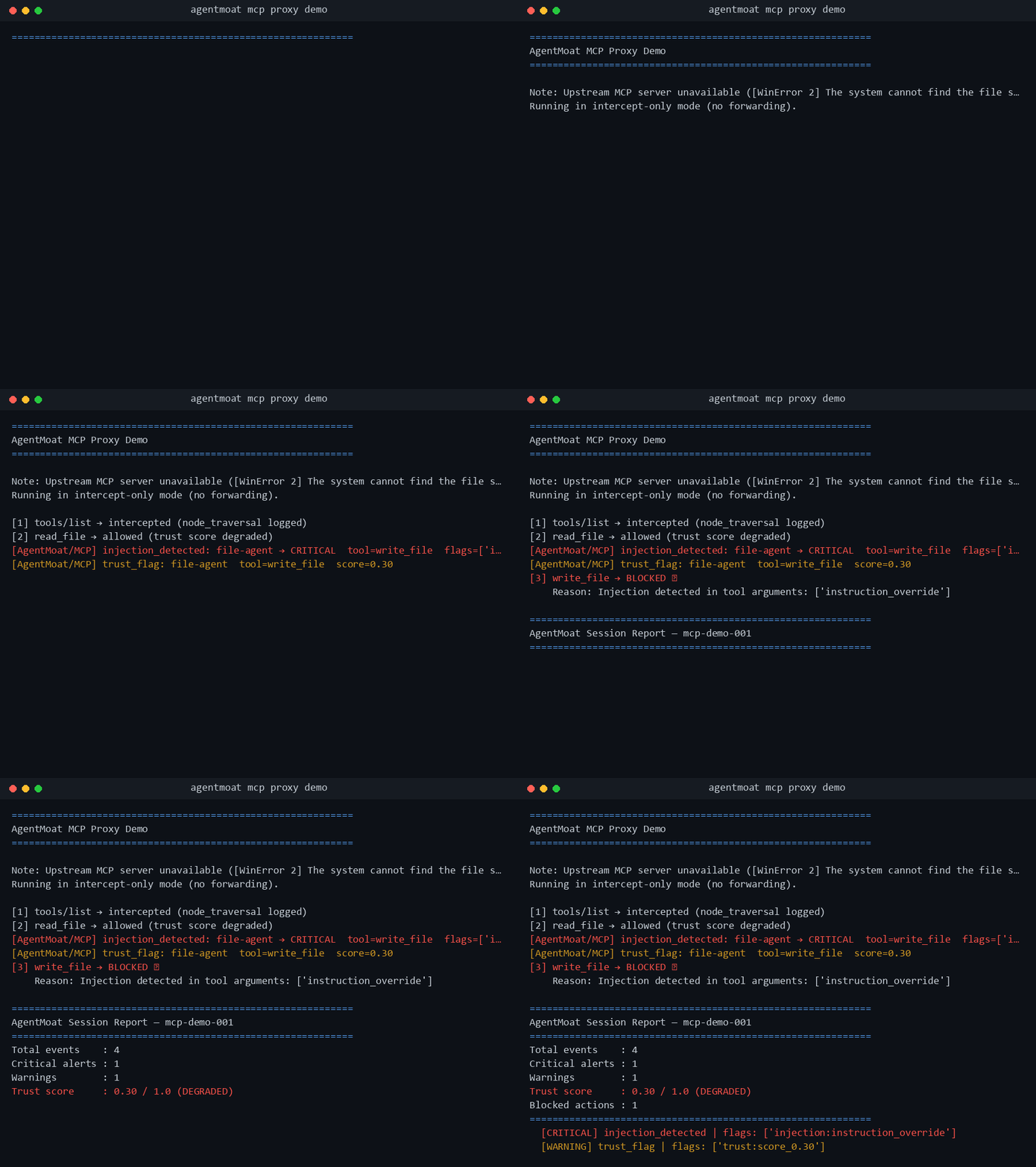
See it catch a real attack:
python examples/mcp_proxy_demo.py
# An agent reads a poisoned document and tries a privileged write —
# AgentMoat blocks it at the tool layer and prints a session report.
Add AgentMoat to your own agent
One line at the point you create your client or graph. Everything downstream is instrumented.
Anthropic SDK
from anthropic import Anthropic
from agentmoat import GuardedClient

client = GuardedClient(Anthropic(), agent_id="my-agent", policy_path="policy.yaml", mode="enforce")
OpenAI SDK
from openai import OpenAI
from agentmoat import GuardedOpenAI

client = GuardedOpenAI(OpenAI(), agent_id="my-agent", policy_path="policy.yaml", mode="enforce")
LangGraph — attach the callback to any graph/runnable:
from agentmoat import AgentMoatCallback

graph.invoke(state, config={"callbacks": [AgentMoatCallback(session_id="run-1")]})
Any MCP tool server — run AgentMoat as a transparent proxy, no agent code change at all. Point your MCP client at AgentMoat instead of the real server:
agentmoat mcp proxy stdio \
  --upstream-cmd "npx -y @modelcontextprotocol/server-filesystem /data" \
  --agent-id my-agent \
  --policy policy.yaml \
  --mode enforce
Async variants (AsyncGuardedClient, AsyncGuardedOpenAI) and streaming are supported with the
same interface. Events flow to an in-memory bus, an optional SQLite store, and a hash-chained
JSONL audit log; view them via the bundled FastAPI service and React dashboard (see below).
Policy File
version: "1"
agents:
  researcher:
    allowed_tools: [web_search, read_file]
    denied_tools:  [write_file, execute_code]
    rate_limits:
      web_search: 10/minute

  writer:
    allowed_tools: [write_file, read_file]
    denied_tools:  [web_search, execute_code]
Argument constraints
Tool names are only half the story — write_file("/etc/crontab", payload) passes a
name-level check for any agent allowed to use write_file. ToolPolicyEngine.check_arguments()
inspects the arguments of a tool call, combining always-on built-in detectors with
per-tool rules declared in the policy file:
agents:
  writer:
    tool_constraints:
      write_file:
        path_allowlist: ["/tmp/**", "./output/**"]   # only these globs are permitted
        path_denylist:  ["/etc/**", "~/.ssh/**"]      # these are always blocked
        max_arg_length: 10000                         # flag oversized argument values
      fetch:
        url_denylist: ["169.254.169.254", "localhost", "10.*"]
        # url_allowlist, arg_denylist also supported
Built-in detectors run on every tool call regardless of configuration:
| Detector | Flag | Triggers on |
|---|---|---|
| Path traversal | constraint:path_traversal | ../, ..\, or URL-encoded %2e%2e in any argument |
| SSRF targets | constraint:ssrf_target | URLs/hosts pointing at 169.254.169.254, localhost, 127.0.0.1, RFC-1918 ranges, metadata.google.internal |
| Shell metacharacters | constraint:shell_metachar | ;, |, &&, `, $(, >, < in arguments to tools whose name suggests command execution (exec, shell, command, run, bash, sh) |
| Sensitive path access | constraint:sensitive_path | /etc/, /root/, ~/.ssh, id_rsa, .env, credentials, /proc/ |
Violations are emitted as policy_violation events with severity="critical" and raise
AgentMoatException in enforce mode — both from the SDK wrappers (checked against the
arguments the model produced, before the agent runtime executes the tool) and from the MCP
proxy (checked before the call is forwarded upstream, where blocking actually prevents execution).
What Gets Detected
| Threat | Detection Method | Default Severity |
|---|---|---|
| Jailbreak attempt | Regex: "ignore previous instructions", "you are now DAN" | Critical |
| System prompt exfiltration | Regex: "print your system prompt", "repeat everything above" | Critical |
| Role override | Regex: "act as if you have no restrictions" | Critical |
| Tool abuse via injection | Regex: "call the write_file tool" | Critical |
| Indirect injection (docs, web) | Regex + embedding similarity | Warning/Critical |
| Tool policy violation | YAML policy engine | Critical |
| Rate limit exceeded | Sliding window counter | Critical |
| Low-trust agent calling sensitive tools | Trust score degradation | Warning |
| Multi-agent trust chain poisoning | Multiplicative provenance tracking | Warning |
Response modes
Every guarded client, callback, and the MCP proxy take a mode:
| Mode | Behavior |
|---|---|
"observe" (default) | Detect and log everything — never interrupts the agent. |
"enforce" | Raise AgentMoatException (or return a JSON-RPC error from the MCP proxy) on any hard violation. A fixed, pre-decided policy. |
"interactive" | Route violations to a human (or programmatic approver) for a real-time decision via ApprovalGate. A "deny" blocks the call just like enforce mode; an "approve" lets it through. |
"interactive" mode is for situations where a blanket policy is too coarse — let
a human apply judgment to a specific borderline case instead of pre-encoding
every exception:
from agentmoat import GuardedClient, ApprovalGate
from agentmoat.control import ApprovalRequest, ApprovalDecision

def slack_approval_handler(request: ApprovalRequest) -> ApprovalDecision:
    # Post to Slack, wait for a thumbs-up/thumbs-down reaction, etc.
    ...
    return "approve"  # or "deny"

client = GuardedClient(
    anthropic.Anthropic(),
    agent_id="researcher",
    mode="interactive",
    approval_gate=ApprovalGate(handler=slack_approval_handler),
)
Each request emits approval_required, then approval_granted or
approval_denied, so the full decision trail lands in the audit log. The
default handler (when no approval_gate= is supplied) prompts on the CLI with
a y/N confirmation — fine for local development, but register your own handler
(Slack, a web UI, a queue) for anything running unattended. A misbehaving or
exception-raising handler defaults to "deny" — approval gates fail closed.
Note: trust_flag warnings never hard-block in enforce mode (a low trust
score alone shouldn't halt an agent), but in interactive mode they still
route through the approval gate — a human's explicit "deny" blocks the call.
This gives interactive mode finer-grained control than a blanket policy.
Kill switch
Independent of mode, any session — or every session in the process — can be
halted immediately via KillSwitch:
from agentmoat.control import get_default_kill_switch

switch = get_default_kill_switch()
switch.kill_session("session-123")   # halt one session
switch.kill_all()                    # halt every session in this process
switch.revive_session("session-123") # restore it
switch.status()                      # {"global": False, "killed_sessions": [...]}
A killed session's next intercepted action raises AgentMoatKilled (a subclass
of AgentMoatException) — or, for the MCP proxy, returns a JSON-RPC error
(AGENTMOAT_SESSION_KILLED) — before any API call or tool execution happens.
A critical session_end event with flags=["kill:tripped"] is emitted first,
so the halt is visible in the audit trail.
The same switch is reachable over HTTP once the audit API is running:
curl -X POST http://localhost:8000/control/kill/session-123
curl -X POST http://localhost:8000/control/kill-all
curl -X POST http://localhost:8000/control/revive/session-123
curl http://localhost:8000/control/status
These endpoints affect sessions in the API process only — a multi-process deployment needs a shared backing store (see Roadmap) for one trip to halt every worker. They're also unauthenticated for now; put them behind your own auth/network controls before exposing them.
Tamper-evident audit log
AuditLogger (passed via audit_log= to any guarded client/callback) writes one JSON
object per line to a durable JSONL file. By default (chained=True) every record also
carries prev_hash — the SHA-256 record_hash of the previous line, with a genesis value
of 64 zeros for the first line in a fresh file — and its own record_hash, a digest over
the record's canonical JSON plus prev_hash. Editing or deleting any line breaks the link
to the next record, so tampering is always detectable, not just guessable. The chain
survives process restarts (it resumes from the last line on disk) and rotations (the new
file's first record continues from the rotated file's last hash).
agentmoat audit verify agentmoat_audit.jsonl
# ✓ Chain intact — 1,432 records verified
#   (or, if a line was edited or removed:)
# ✗ Chain broken at line 87 — record was modified or a prior line was deleted

agentmoat audit tail agentmoat_audit.jsonl -n 50
agentmoat audit stats agentmoat_audit.jsonl   # counts by event_type and severity
This gives you a forensic trail suitable for SOC 2 / ISO 27001 evidence: an auditor (or an incident responder) can independently confirm that the log they're looking at is the complete, unaltered record AgentMoat produced — not a reconstruction. It does not, by itself, prove who tampered with a file; pair it with filesystem-level access controls and off-host replication for full chain-of-custody guarantees.
Running the API + Dashboard
# 1. Install
pip install -e ".[langgraph]"

# 2. Start the audit API
uvicorn api.main:app --reload

# 3. Start the dashboard
cd dashboard
npm install
npm run dev
# → http://localhost:5173

# 4. Run the demo
python examples/langgraph_demo.py
See dashboard/README.md for dashboard-specific setup, including how to
authenticate against an API started with AGENTMOAT_API_KEY set.
Running Tests
pytest
Trust Scoring
AgentMoat tracks information provenance across agent hops. When a session processes external content (a file, a web page, a user upload), its trust score degrades:
Initial:          1.0  (TRUSTED  — human instructions)
After file read:  0.3  (EXTERNAL — external content processed)
After handoff:    0.21 (EXTERNAL — downstream agent inherits low trust)
After injection:  0.0  (UNTRUSTED — flagged)
When trust drops below 0.5, any attempt to call a sensitive tool (write, execute, send, delete) emits a trust_flag warning even if the tool is otherwise policy-allowed.
Roadmap
- OpenAI SDK support —
GuardedOpenAI/AsyncGuardedOpenAIwrapopenai.OpenAI/AsyncOpenAI - Async GuardedClient —
AsyncGuardedClientwrapsAsyncAnthropicfor async codebases - Streaming support —
GuardedStream/AsyncGuardedStreaminterceptmessages.stream() - MCP server integration — transparent stdio + SSE proxy for Model Context Protocol
- Tamper-evident audit log — SHA-256 hash-chained JSONL with
agentmoat audit verify - Human-in-the-loop approval —
mode="interactive"routes violations throughApprovalGate - Kill switch — halt any session (or every session) immediately, programmatically or via
/control - OpenTelemetry export — emit spans/traces to any OTEL-compatible backend
- Multi-process bus — Redis-backed EventBus for distributed agent deployments
- Slack/PagerDuty alerting — push critical events to on-call channels
- SARIF export — machine-readable security findings for CI integration
- Policy hot-reload — watch policy.yaml for changes without restart
License
MIT — see LICENSE