
AgentBridge — Meta-Bridge para Multi-Agentes
shadowhunter-92/agentbridge
Mesh protocol-agnóstico com governança incorporada no caminho da chamada
Ver no GitHubCamada de interoperabilidade neutra para sistemas multi-agentes que traduz entre N protocolos diferentes (MCP, A2A, ACP, OpenAI, Gemini) sem mapeamentos quadráticos. Inclui governança obrigatória: identidades Ed25519, orçamentos por agente, aprovações humanas e auditoria tamper-evident em hash-chain.
Instalação
npx convez-ai shadowhunter-92/agentbridge1 comando no terminal: detecta o formato do repositório (marketplace ou plugin avulso) e instala via Claude Code. Requer Node 18+ e o Claude Code instalado.
Métricas
Casos de uso
- Integrar agentes de diferentes fornecedores (Anthropic, Google, OpenAI, IBM) em um único fluxo
- Enforçar limites de orçamento e taxa por agente com auditoria criptográfica
- Implementar aprovações humanas para operações sensíveis em pipelines de agentes
Veredito

Projeto sólido e honesto em estágio de protótipo funcional com 6 protocolos testados e governança enterprise. Endereça um problema real em orquestração multi-agente, mas carece de validação de demanda comercial — apropriado para arquitetos que trabalham com multi-vendor agent ecosystems.
README
A tradução para o português deste README ainda está na fila.
AgentBridge — the Meta-Bridge
One neutral mesh every agent speaks through: translate, route, verify, govern. Any protocol in, any protocol out — with identity, budgets, and a tamper-evident audit trail built into the call path.
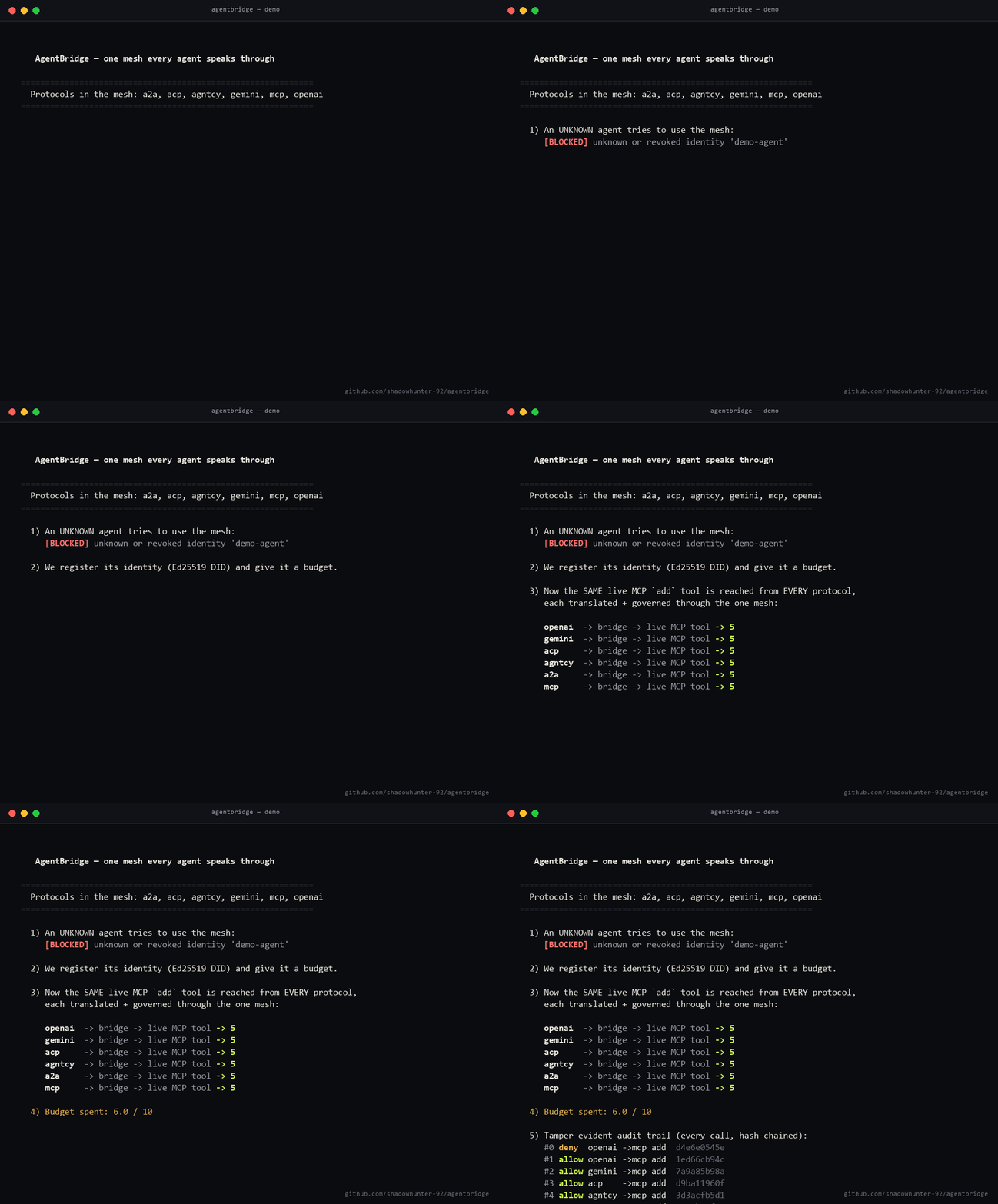
The whole product in 12 seconds: an unknown agent blocked, six protocols reaching one live MCP tool through the mesh, budget tracked, tamper-evident audit chain verified. Reproduce with python examples/demo_story.py.
Status: working prototype. 6 protocols live + conformance-tested against real SDKs, a governance plane, and an HTTP control plane. Business demand still being validated — this is an early, honest work-in-progress, not a finished product.
What it does
- N-protocol mesh (any-to-any): MCP (Anthropic), A2A (Google/LF), ACP (IBM/LF), OpenAI function-calling, Gemini function-calling, AGNTCY ACP. One canonical model → adding a protocol is one adapter, not N² mappings. Every adapter is validated against the protocol's real official SDK.
- In-line proxy: the bridge actually sits between live agents on different protocols, not
just translating (see
examples/). - Governance plane (the moat): Ed25519 agent identities (DIDs), per-agent spend/rate budgets, human-in-the-loop approvals for sensitive capabilities, and a hash-chained tamper-evident audit trail — all enforced in the call path and durable (SQLite; Postgres-swappable).
- Enterprise governance: a declarative policy engine (cost caps, business-hours, route/
capability rules), RBAC for operators, OIDC/JWT operator SSO, and signed audit checkpoints
(see
docs/ENTERPRISE.md). - Drop-in MCP server: point Claude Desktop / an IDE / a gateway at it to reach other protocols.
- Framework integrations: one helper lets LangChain / CrewAI / AutoGen / LlamaIndex agents
reach a tool/agent on any protocol — they all emit OpenAI-shaped tool calls (see
docs/INTEGRATIONS.md).
Quick start
python -m venv .venv && .venv/Scripts/pip install -r requirements.txt # (Windows; use bin/ on *nix)
Governance is optional. If you just want one agent/protocol to talk to another, use the mesh directly — no keys, no budgets, no setup:
from src.protocols import default_registry as reg
from src.protocols.canonical import CanonicalCall

call = reg.get("openai").from_canonical_call(CanonicalCall("add", {"a": 2, "b": 3}))
reg.translate_call(call, "openai", "mcp")     # -> a real MCP tools/call. That's it.
.venv/Scripts/python examples/quickstart.py # translate + bridge to a LIVE tool, zero governance
Add identity, budgets, and a tamper-evident audit trail only when you want them:
# Run the meta-bridge control plane (mesh + governance)
uvicorn src.api.control_plane:app          # docs at http://localhost:8000/docs
#   set AGENTBRIDGE_ADMIN_KEY for operator endpoints; AGENTBRIDGE_DB=/path.db (or a postgres:// URL)

# Or run it as a drop-in MCP server (stdio)
python -m src.serve.mcp_gateway

# Live demos (real agents on both ends)
.venv/Scripts/python examples/live_nprotocol_proxy.py   # OpenAI/ACP -> live MCP, MCP -> live ACP
.venv/Scripts/python examples/live_governed_proxy.py    # identity + budget + audit in action

# Tests
.venv/Scripts/python -m pytest tests/ -q                # 138 passing (+4 Postgres tests skip w/o a DB)
Architecture
flowchart LR
    subgraph clients [Agents / clients - any protocol]
        C1[MCP client]
        C2[A2A / ACP agent]
        C3[OpenAI / Gemini / AGNTCY]
    end
    subgraph bridge [AgentBridge]
        direction TB
        G[Governance gateway<br/>identity · budget · approval · audit]
        M[Canonical mesh<br/>any-to-any translation]
        G --> M
    end
    subgraph targets [Target agents / tools - any protocol]
        T1[live MCP tool]
        T2[live A2A / ACP agent]
    end
    C1 & C2 & C3 -->|signed call| G
    M -->|translated + governed| T1 & T2
    OP[Operator] -->|admin API| G
Every call enters the governance gateway (verify identity → reserve budget → check approval), is translated through the canonical mesh (any protocol → any protocol), is delivered to the target agent, then committed and written to a tamper-evident audit log.
src/protocols/— canonical hub + per-protocol adapters (the mesh)src/governance/— identity, audit, budgets, approvals, policy, gateway, persistence (the moat)src/proxy/— real transport clients + in-line proxysrc/api/control_plane.py— the shipped HTTP API (mesh + governed routing, authenticated)src/serve/mcp_gateway.py— drop-in MCP server packaging
Deployment topology: run it as a drop-in MCP server (per-developer), as a central
control-plane API (team), or inline as a proxy between agents. See docs/DEPLOYMENT.md.
Performance overhead is measured in docs/BENCHMARKS.md.
Security model
- Operator endpoints require an admin key (
X-Admin-Key). - Agent endpoints require Ed25519 signed requests (
X-Agent-Id/X-Nonce/X-Signature) with nonce replay protection. Identities can be revoked. - Per-IP rate limiting on
/control/*(blunts admin-key brute force;AGENTBRIDGE_RATE_LIMIT). - Audit is hash-chained and tamper-evident; export via
/control/audit/export.
Persistence
Chosen from AGENTBRIDGE_DB: unset → in-memory; a file path → SQLite (single node);
a postgres:// URL → Postgres (multi-instance; pip install "psycopg[binary]").
Docs
docs/DEPLOYMENT.md— how to run it, configure it, and the honest production checklistdocs/API_REFERENCE.md— the control-plane HTTP endpointsdocs/INTEGRATIONS.md— wire LangChain / CrewAI / AutoGen / LlamaIndex to any protocoldocs/ENTERPRISE.md— policy engine v2, RBAC, OIDC SSO, signed audit checkpointsdocs/ROADMAP.md— what's done, known limitations, and what's deferred (honest)docs/PROTOCOL_SUPPORT.md— the protocol support matrix + conformance approachdocs/LIVE_AGENT_TESTING.md— how the bridge is tested against real, running agentsdocs/PROTOBUF_A2A.md— notes on A2A's JSON-RPC vs protobuf wire formatsdocs/BENCHMARKS.md— measured in-process overhead (reproduce withtools/benchmark.py)CONTRIBUTING.md— setup, ground rules, and the add-a-protocol recipeAI_DISCLOSURE.md— transparency on AI-assisted development
License
Apache 2.0