
UX Workflow Check
sergiobuilds/ux-workflow-check
Detecta UX gaps vivendo o fluxo do usuário, não revisando o sistema.
Ver no GitHubSkill de agente que descobre lacunas de UX vivendo o produto como usuário em primeira pessoa, não revisando-o como builder. Usa intenção (Jobs-to-be-Done) e caminhada cognitiva para identificar gaps tacitos e features faltantes, com gates de saída que forçam convergência rigorosa entre personas.
Instalação
npx convez-ai sergiobuilds/ux-workflow-check1 comando no terminal: detecta o formato do repositório (marketplace ou plugin avulso) e instala via Claude Code. Requer Node 18+ e o Claude Code instalado.
Métricas
Casos de uso
- Descoberta de features faltantes em produtos digitais
- Análise de lacunas entre intenção do usuário e implementação
- Validação de fluxos de trabalho em aplicações web e mobile
- Pesquisa UX automatizada com múltiplas personas
Veredito

Ferramenta rigorosa e bem-construída que força descoberta genuína de UX gaps em vez de checklists genéricos, com gates que impedem convergência prematura. Portável entre agentes e validada empiricamente; ideal para quem quer feedback estruturado e não superficial em design.
README
A tradução para o português deste README ainda está na fila.
ux-workflow-check
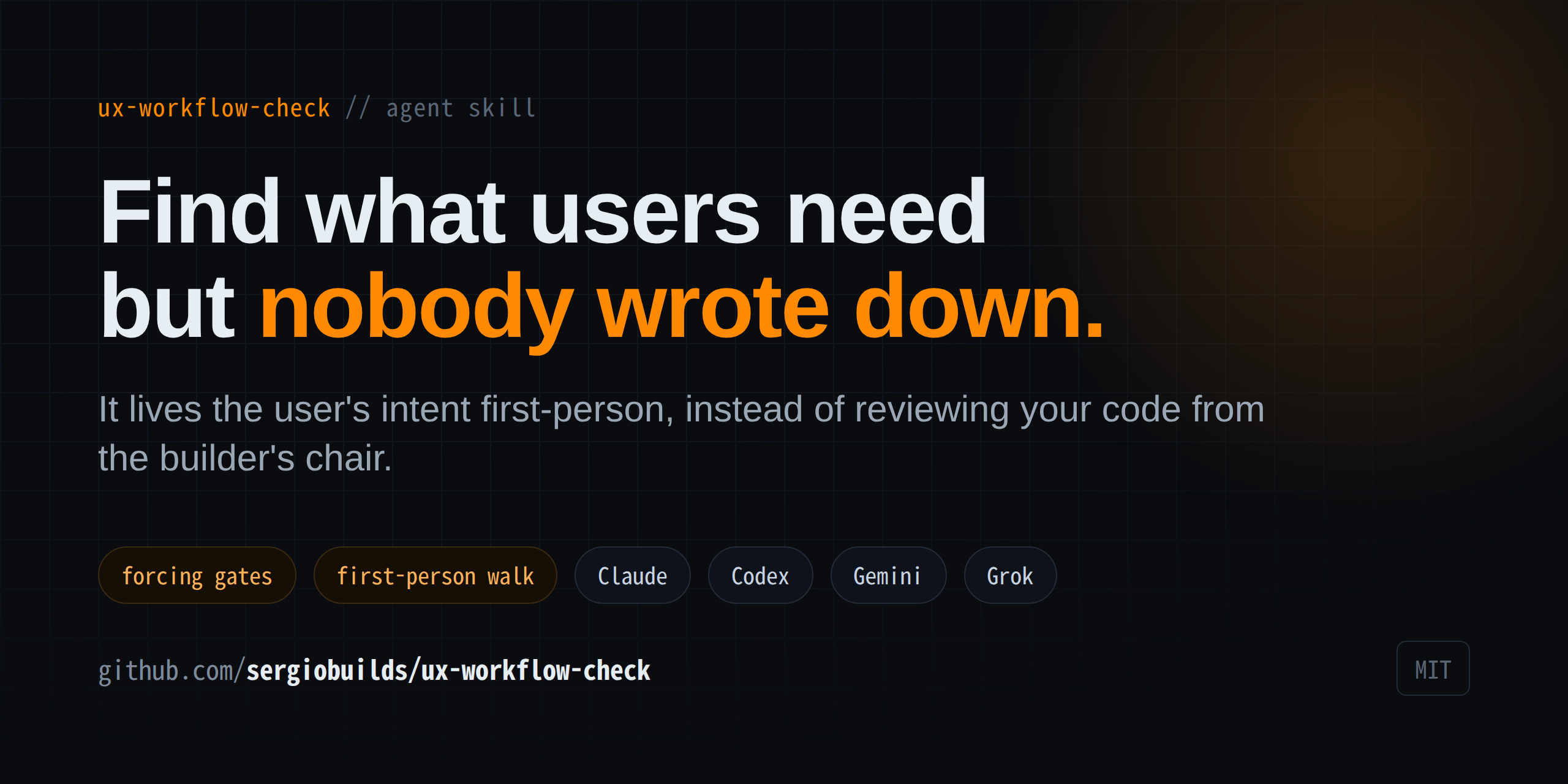
An agent skill that finds what users need but nobody wrote down — by forcing the agent to live through the product as the user, not review it as the builder.
Works as a portable skill for Claude Code, Codex, Gemini CLI, Grok, and any agent you can hand a prompt to.
The problem
Ask an AI agent to "review this product for what's missing" and you reliably get:
- findings organized by the system's components, or by Critical/Nice buckets
- generic UX best-practices (add onboarding, add tooltips, add notifications) that fit any product
- one pass, then "here are the top 3 fixes" — done
- a single implied user, happy-path only
- guesses presented as facts
It looks competent and misses the things that actually hurt — because it reviewed the artifact from the builder's chair instead of living the user's intent.
What this does differently
It starts from the user's SEED intent (Jobs-to-be-Done) and walks it first-person (Cognitive Walkthrough): what does this person actually try to do, step by step, and where do they reach for something that isn't there. Then it forces three things out of every walk:
- The intent gap — "the builder sees it shaped like X; the user lives it shaped like Y."
- Tacit assumptions — what the builder took for granted, and what breaks when each is violated.
- Missing screens/features — pinned to specific steps in the walk, not floating wishes.
Gaps are decomposed by layer — data / backend / wiring / frontend — so "the fix" isn't assumed to be a frontend tweak. A missing "notify me before the deadline" can pull work from data collection up through the UI.
Why it's a forcing skill
A guide you can skim is a guide you'll skip. This one has gates:
- Output gate — every round must produce the SEED spec, the first-person walk, the three findings, and a layered gap table. Blanks aren't allowed.
- Lens gate — four self-checks void a round if you slipped into system vocabulary, emitted a generic checklist item, skipped empty/failure/return states, or tried to quit on a "good enough" feeling.
- Convergence gate — it loops across different personas until two consecutive new-lens rounds find nothing new (or a user-named count is exhausted). Declaring "done" early, without the evidence block, is a violation. No lazy convergence.
The net effect: the agent can't wrap up with "the top 3," can't review one persona and feel finished, and can't pass guesses off as observations.
Cross-agent verified
The skill is plain text with no platform-specific tooling, so it ports across agents. It was validated by running the same product under "be quick" time pressure on four different agents:
| Agent | Rounds | Converged | Gate-compliant |
|---|---|---|---|
| Claude | ✅ | ✅ | ✅ |
| Codex | 6 | yes (dry) | ✅ |
| Gemini | 6 | yes (dry) | ✅ |
| Grok | 12 | yes (dry) | ✅ |
All four resisted the pressure to stop after one pass, rotated personas, and printed convergence evidence. A "lazy" agent submitting to the gates is the whole point.
Install
This is an Agent Skill. Drop the folder into your agent's skills directory:
# Claude Code
git clone https://github.com/sergiobuilds/ux-workflow-check ~/.claude/skills/ux-workflow-check

# Codex / Gemini CLI / others: place it in that agent's skills directory,
# or just paste SKILL.md into your prompt — it's self-contained.
Then trigger it: "UX check this", "find what's missing for users", "workflow gaps", or name a count: "run it 10 times."
Use it at either stage
- Plan stage — point it at a spec/plan to catch missing steps and assumptions before building.
- Audit stage — point it at a built product (or live URL/CLI) and have it actually drive the flow to fill in observed (vs inferred) gaps.
It applies to anything a user consumes: web UI, CLIs, reports, docs.
Example
See reference/example-dealradar.md for a full worked walkthrough on a fictional product.
How it was built
Test-driven, the way skills should be: baseline runs without the skill were observed failing in five specific ways; the gates were written to block exactly those, then re-verified across the four agents above. Roots: Jobs-to-be-Done (start from intent) + Cognitive Walkthrough (walk it first-person), extended with full-stack layer decomposition and a forcing convergence loop.
License
MIT — see LICENSE.