
WISP Orchestrator
Samuel0101010/wisp-orchestrator
Orquestrador de equipes Claude com DAG visual e preview ao vivo
Ver no GitHubAgente visual que orquestra equipes de Claude para construir aplicações web autonomamente. Oferece painel de controle em tempo real, planejamento como DAG editável, execução ao vivo no navegador e visualização de preview da aplicação sendo desenvolvida. Executa localmente, sobrevive a rate limits e falhas, e permite iteração contínua sobre o resultado.
Instalação
npx convez-ai Samuel0101010/wisp-orchestrator1 comando no terminal: detecta o formato do repositório (marketplace ou plugin avulso) e instala via Claude Code. Requer Node 18+ e o Claude Code instalado.
Métricas
Casos de uso
- Construção autônoma de aplicações web com múltiplos agentes
- Monitoramento e iteração em tempo real de projetos de desenvolvimento
- Automação de longas execuções de tarefas sem intervenção manual
- Visualização e edição de planos de execução antes da entrega
Veredito

Ferramenta madura e bem-estruturada para orquestração de agentes em escala. Diferencia-se por transparência (DAG visual) e resiliência (execução local com retry automático), atendendo casos de uso reais de desenvolvimento prolongado sem supervisão. Requer conhecimento técnico sólido e infraestrutura local.
README
A tradução para o português deste README ainda está na fila.
Why?
Most agent UIs run a single agent in a chat box. Orchestrators hide the plan behind opaque internal state, and they stop existing the moment something fails. WISP is built for the case nobody else covers — drive a team of Claude agents for hours, watch the plan as a DAG you can edit before it runs, see the live preview of the app they're building, and write change-requests against the running result.
- No babysitting. Runs survive rate-limit windows, server restarts, and Claude 5xx with transient retries + inactivity watchdog + auto-resume.
- No black box. Every plan is a DAG you can inspect, edit, and replan. Every task runs in its own git worktree. The walker streams every event into SQLite.
- No cloud dependency. Everything runs locally on your machine. Subscription auth via your
claudeCLI; flip toWISP_AUTH_MODE=apifor headless commercial use.
Quickstart (60 seconds)
Prerequisites:
git, Node 22/24 LTS, and theclaudeCLI onPATH. No GitHub account or SSH key needed — everything clones over plain HTTPS.
claude plugin marketplace add https://github.com/Samuel0101010/wisp-orchestrator.git
claude plugin install wisp@wisp-local
claude /wisp-dashboard          # opens http://127.0.0.1:4400 in your browser
Then click New project, type a goal ("Build a Kanban board in React + Vite + Tailwind"), point it at an empty git repo, and hit Run. The dashboard streams the agent team building the app, the Preview tab shows it running live, and the iteration loop is one click away.
Dashboard tour
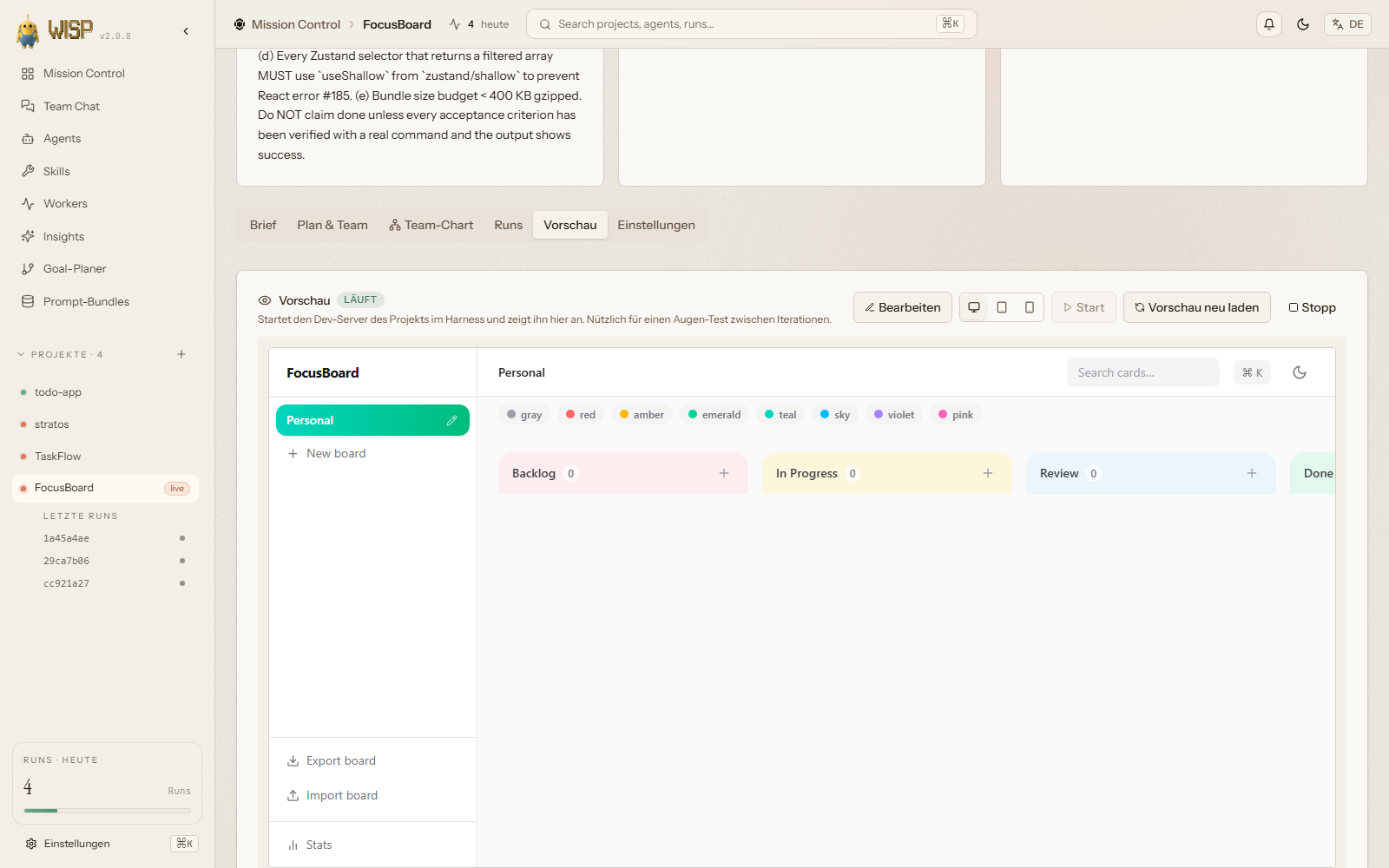 | 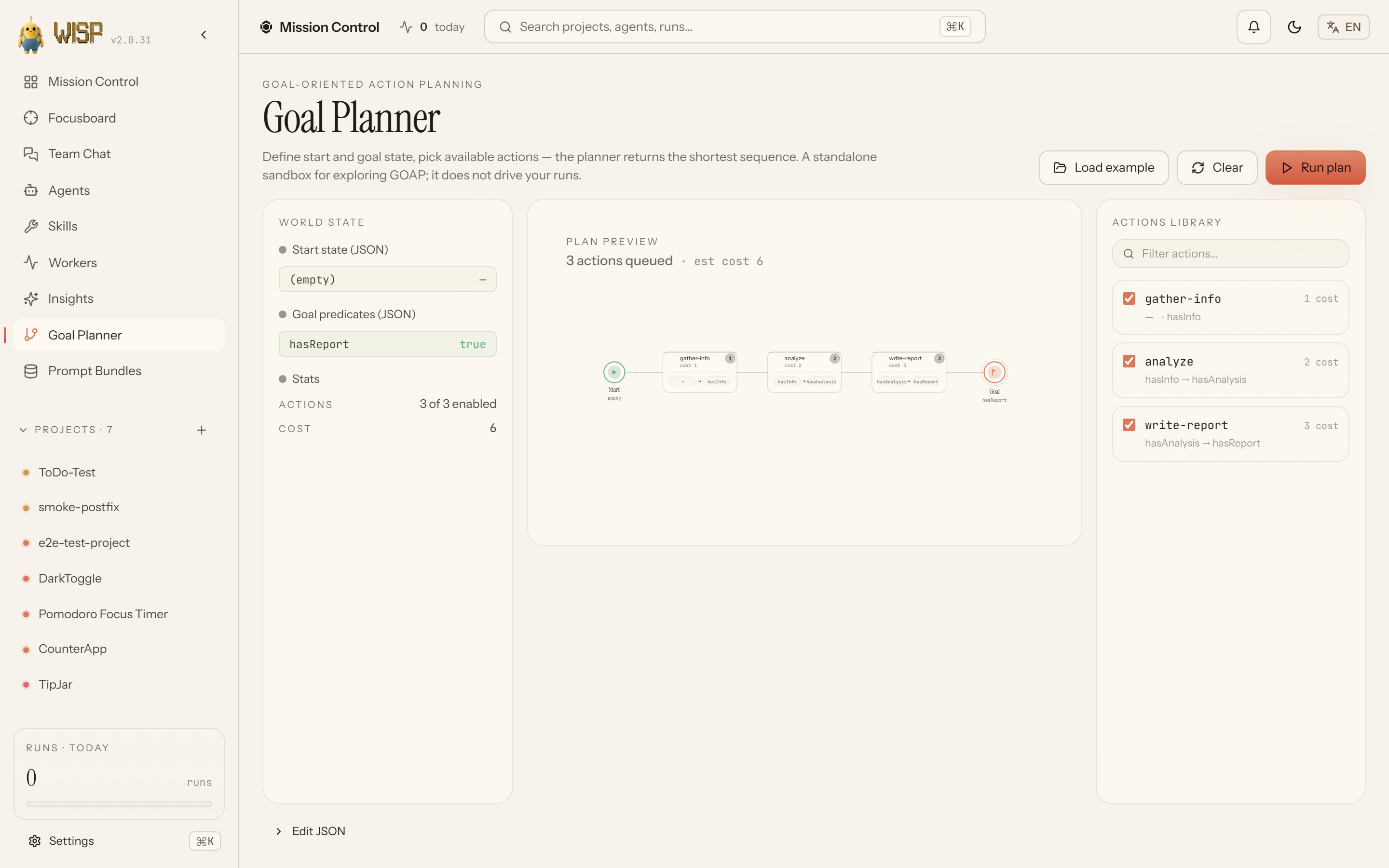 |
|---|---|
| Preview — proxied iframe of the running app, with click-to-pick visual edits. | Goal Planner — a standalone Goal-Oriented Action Planning sandbox (least-cost search). |
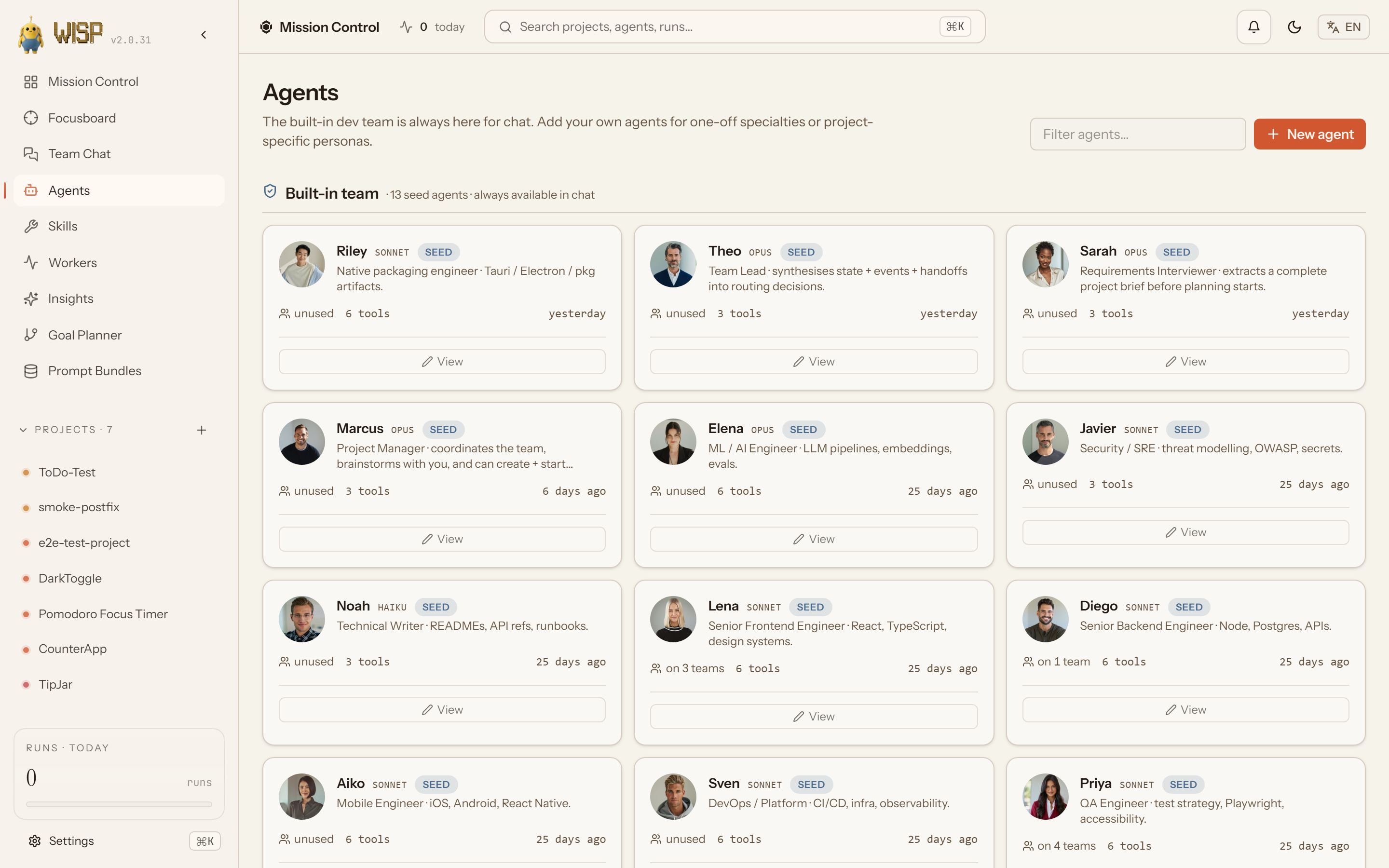 | 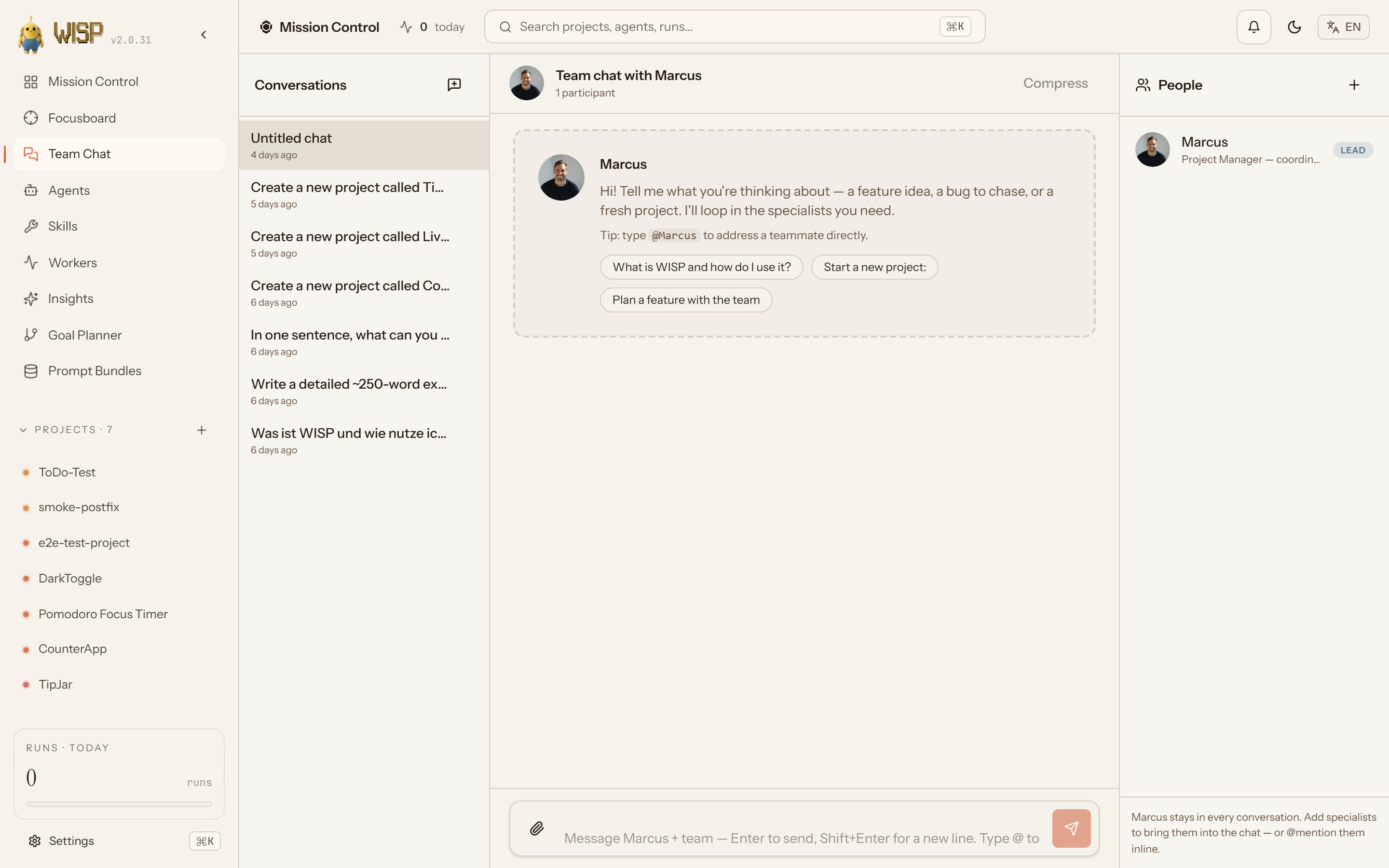 |
| Agents — registry of roles available to teams. | Chat — team conversation surface. |
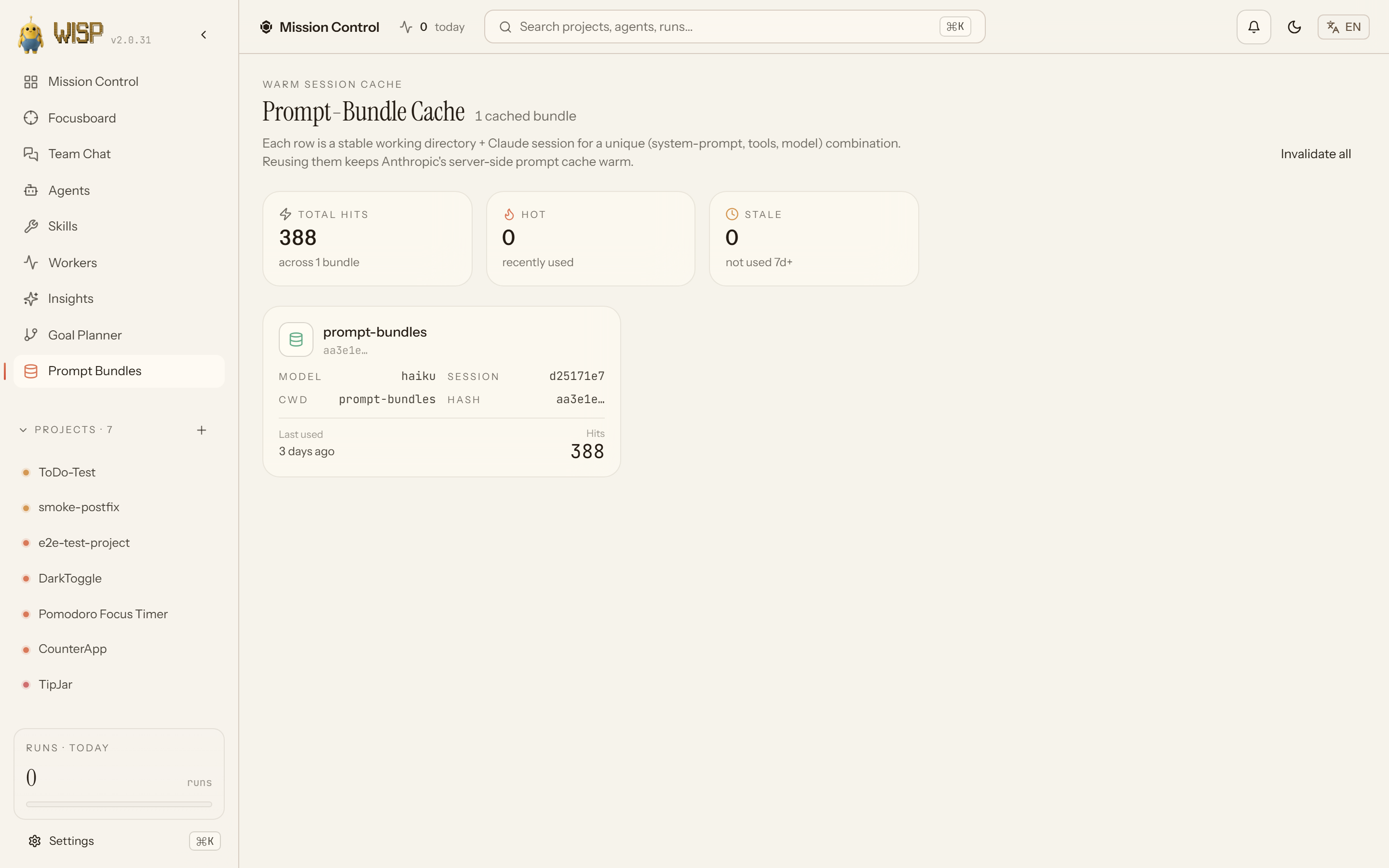 | 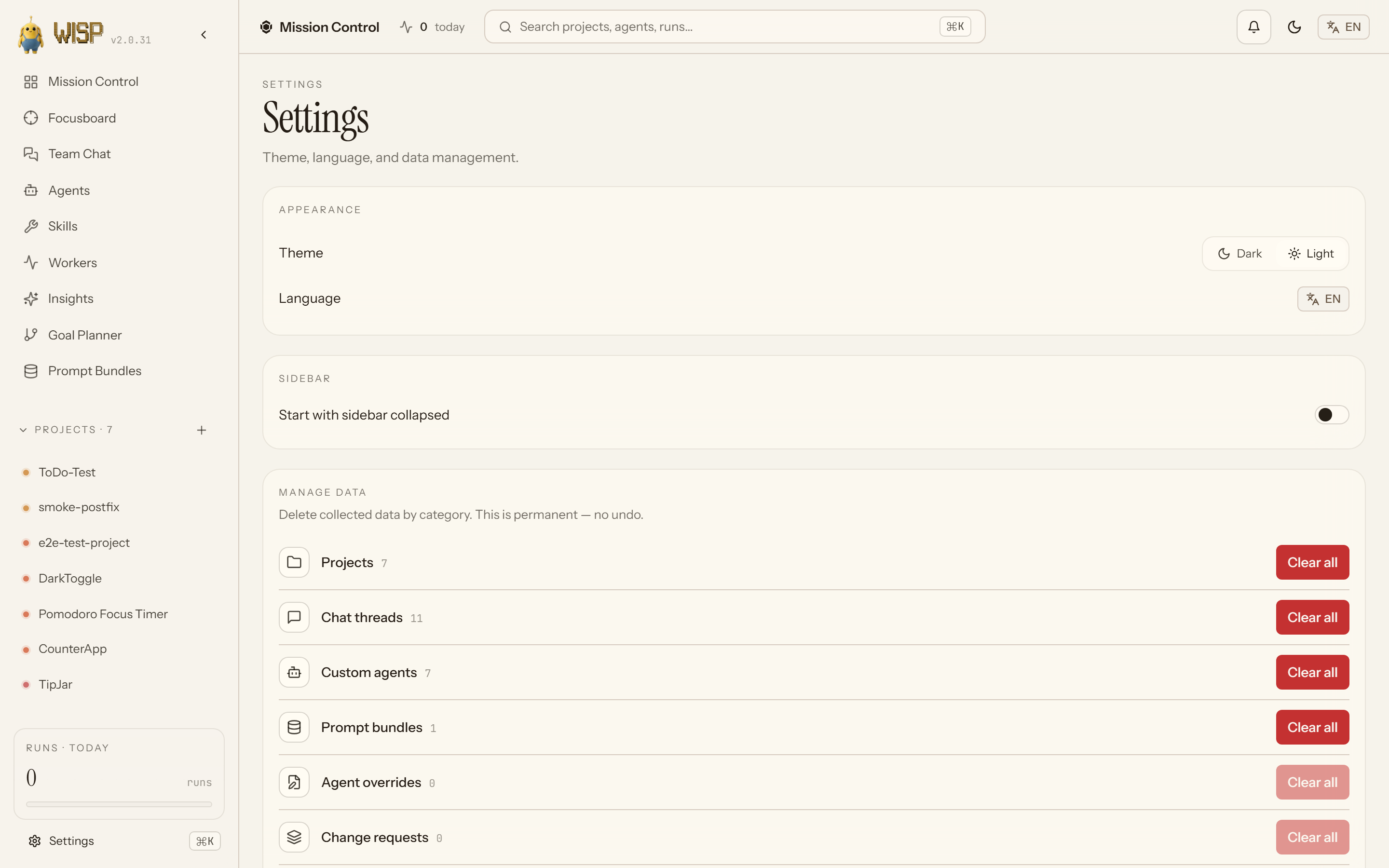 |
| Prompt Bundles — cached bundles for re-use. | Settings — theme, language, selective data clearing. |
Status
v2.0 — production-ready. The orchestrator drives full architect → dev → QA → review cycles against real Claude Max with variable team sizes, shared-memory MCP, built-in + user templates, automatic QA-replan, and a live dashboard with iteration loops, visual edit-mode, and proxied previews. See CHANGELOG.md for the full release history.
Highlights in v2.0
- Iteration loop. Once an initial run completes, the user can request changes against the previewed app (click-to-pick element + change-request, or freeform prompt). The orchestrator generates an iteration plan that builds on prior runs and reuses the existing worktree, surfacing the diff back into the live preview without a manual rebuild step.
- Reverse-proxy preview. Vite/SvelteKit dev servers spawn under
/preview/<projectId>/so the iframe sees the running app via the same origin as the dashboard. Auto-reload when an iteration run completes; manual refresh button in the preview header. - Goal Planner. A standalone Goal-Oriented Action Planning sandbox: interactive plan visualization, JSON editor, filterable action library, and a least-cost search returning the cheapest action sequence to your goal predicates. A self-contained tool for exploring how a goal decomposes into steps — it does not create teams, edit plans, or drive runs (the LLM planner agent and Plan Editor do that).
- Auto-resolver agent. When a dependency-merge run hits conflicts in
pnpm-lock.yamlorpackage.json, the orchestrator spawns a dedicated resolver agent to land a clean merge before continuing the parent run. - Hardened subprocess control. Transient retries on Anthropic 5xx + Overloaded, worktree-race retries, inactivity watchdog that cancels stuck tasks with a structured event so the planner can re-route.
- Notifications popover. Top-bar bell lists the last 8 global runs across projects with status pills, relative-time labels anchored on
endedAt ?? startedAt, and links into each run. - Plugin Skills. Four
/wisp-*slash commands so the dashboard is optional:/wisp-new-run(goal → running execution),/wisp-resume(paused runs),/wisp-inspect(result branch + git log),/wisp-diagnose(event timeline).
Requirements
- Node.js >= 20.10 (Node 22 LTS or 24 LTS recommended — they ship a prebuilt
better-sqlite3, so the first-launch build needs no C++ toolchain) - pnpm >= 9 (bootstrapped for you on first launch via corepack/npm — no manual install needed)
- Claude Code CLI (the
claudebinary) onPATH - Claude Max subscription (the orchestrator inherits
~/.claude/credentials and unsetsANTHROPIC_API_KEYso subprocesses never silently fall back to API billing) - Windows, macOS, or Linux
Anthropic Terms of Service
WISP invokes only the official claude binary as a subprocess. It
never reads ~/.claude/credentials, never extracts subscription OAuth tokens,
never calls api.anthropic.com endpoints directly, and actively unsets
ANTHROPIC_API_KEY before each spawn so subscription auth is the only path.
Subscriptions (Claude Pro / Max) are designed for personal use of the official
Claude products including Claude Code and its plugin/subagent system. Using
this plugin to run intensive headless workflows on a subscription account is
your responsibility under Anthropic's ToS. Balanced defaults
(maxParallel=2, budgetMinutes=120, interTaskPacingMs=5000,
autoResumeRateLimit=false) keep the traffic profile in line with intensive
human use rather than automated bulk usage. For commercial automation, set
WISP_AUTH_MODE=api and provide your own ANTHROPIC_API_KEY (paid per
token).
Two compliance test files (tests/compliance/) statically verify these
architectural commitments on every CI run. See
docs/anthropic-compliance.md for the full
architectural rationale.
Install
There are two supported paths.
As a Claude Code plugin (preferred)
Prerequisites on a fresh machine: git, Node 22 LTS or 24 LTS (>= 20.10 works, but an LTS ships a prebuilt better-sqlite3 so the first build needs no compiler), and the standalone claude CLI on PATH. pnpm is bootstrapped for you on first launch.
claude plugin marketplace add https://github.com/Samuel0101010/wisp-orchestrator.git
claude plugin install wisp@wisp-local
claude /wisp-dashboard
Both the marketplace and the plugin source are fetched over plain HTTPS — no GitHub account, SSH key, or known_hosts entry required.
If you added the marketplace with the owner/repo shorthand on an older Claude Code version, or your git config rewrites GitHub URLs to SSH, the clone can go over SSH and fail without an SSH key or known_hosts entry. Fix: refresh the marketplace (claude plugin marketplace remove wisp-local, then re-add with the HTTPS URL above), or tell git to use HTTPS for GitHub once:
git config --global "url.https://github.com/.insteadOf" "git@github.com:"
(In PowerShell keep the space between the two quoted arguments.)
(For local development, replace the first line with claude plugin marketplace add /absolute/path/to/agent-harness.)
The /wisp-dashboard command runs the launcher script for your platform (scripts/launch-dashboard.ps1 on Windows, scripts/launch-dashboard.sh on POSIX). On the first invocation after a fresh install, the launcher auto-runs pnpm install && pnpm build (~1-2 minutes; pnpm is bootstrapped via corepack/npm if absent). On subsequent invocations it boots straight to the server. Either way it picks a free port in 4400-4500, writes connection state to ${CLAUDE_PLUGIN_DATA}/state.json, and opens the dashboard in your default browser.
After the dashboard opens: spawning agent runs needs the claude CLI authenticated (subscription, or WISP_AUTH_MODE=api with an ANTHROPIC_API_KEY). The dashboard boots and is browsable either way — but if auth is missing it shows a banner and /api/health carries the hint. Run claude login and restart /wisp-dashboard if you see it.
From source (developer mode)
pnpm install
pnpm build
WISP_SERVE_WEB=1 node apps/dashboard-server/dist/server.js
# then open http://127.0.0.1:4400
With WISP_SERVE_WEB=1 the dashboard server static-serves the built apps/dashboard-web/dist/ from /, so a single port hosts UI + API + WS. To develop against a hot-reloading frontend instead, leave WISP_SERVE_WEB unset and run the Vite dev server in a second terminal:
pnpm --filter @wisp/dashboard-web dev
The Vite dev server runs at http://localhost:5173 and proxies API/WS calls to the backend on 127.0.0.1:4400.
First run walkthrough
- Create a project. Open the dashboard, click "New project" in the sidebar, and fill in name, goal, and
repoPath. The repo path must point at an existing git-initialized directory; the orchestrator creates per-task worktrees inside it. - Configure the team. The TeamBuilder shows role cards (architect, developer, QA, …). Defaults are sensible: opus for architect + planner, sonnet for developer + QA. Edit
model,allowedTools, orsystemPromptper role. - Generate, review, run. Hit "Generate plan" — the planner emits a DAG which renders in the PlanEditor (React Flow + dagre). Click any node to edit its prompt, dependencies, success criteria, or
maxTurns. When the plan looks right, click "Lock & Run". - Watch + iterate. RunView opens with the kanban + streaming tail. When tasks land, switch to Preview to see the app running live. Click any element in the iframe to write a change-request; hit Start iteration when you want the team to apply them.
Runtime verification (v1.8)
The harness now insists on proving an app runs before declaring it done, instead of trusting build + test green as a finish line.
- Definition-of-Done card on the project detail page lets you declare per-project acceptance criteria. Three kinds:
smoke(HTTP probe of a URL),e2e(a Playwright-driven user action — the verifier writes the actual test from your one-line description),manual(human sign-off — never auto-passes; blocks auto-release until the approver clears it). - runtime-verifier agent is auto-injected behind every terminal node of every new plan. It starts your dev server, drives Chromium against your DoD, writes
docs/runtime-report.{md,json}, and stores screenshots / traces underdocs/runtime-evidence/. - Release-gate turns the verifier's verdict into one of READY / BLOCKED / MANUAL-REVIEW. BLOCKED runs are held back from auto-merge and feed their failing gates into the next self-healing iteration. Visible on the RunView as a verdict pill + Boot / E2E / DoD count badges.
- Playwright auto-install. First runtime-verify in a fresh install downloads Chromium once into
~/.cache/wisp/playwright-browsers. Subsequent runs are instant — every worktree shares the cache viaPLAYWRIGHT_BROWSERS_PATH. pnpm doctor— runs a quick check that Node, pnpm,claude, git, and the Playwright cache are all reachable. Diagnostic only; exits 0. Prints the exact one-liner to populate anything missing.
The whole layer is opt-in per project (runtimeVerifyEnabled defaults to ON; flip it off on the Production-Modus card to fall back to v1.7 behaviour). Plans created before v1.8 keep running with their old shape — the verifier only gets injected into newly-generated plans.
Architecture
A single Fastify + WebSocket process owns SQLite, dispatches claude -p subprocesses through a SubprocessPool, and fans events out to a React dashboard. See docs/architecture.md for the full breakdown.
+--------------------+        HTTP + WS         +-------------------+
|   dashboard-web    | <----------------------> |  dashboard-server |
|  (React + Vite)    |                          |     (Fastify)     |
+--------------------+                          +---------+---------+
                                                          |
                                          +---------------+---------------+
                                          |                               |
                                  +-------v-------+              +--------v-------+
                                  |   Drizzle +   |              |   RunRuntime   |
                                  |   SQLite      |              |   + Walker     |
                                  +---------------+              +--------+-------+
                                                                          |
                                                            +-------------+-------------+
                                                            | SubprocessPool            |
                                                            | (claude -p in worktrees)  |
                                                            +---------------------------+
Configuration
The dashboard server reads its configuration from environment variables (parsed in apps/dashboard-server/src/env.ts):
| Var | Default | Purpose |
|---|---|---|
WISP_PORT | 4400 | TCP port for HTTP + WS server |
WISP_HOST | 127.0.0.1 | Bind address |
WISP_DATA_DIR | ~/.local/share/agent-harness (Win: %LOCALAPPDATA%\agent-harness); required in production | Holds SQLite DB, snapshots, worktrees |
WISP_LOG_LEVEL | info | pino log level (trace, debug, info, warn, error, fatal, silent) |
WISP_CORS_ORIGIN | http://localhost:5173 | Vite dev origin allowed by @fastify/cors |
WISP_MOCK_CLI | false | Use mock fixtures instead of real claude (for tests) |
WISP_SERVE_WEB | false | Static-serve apps/dashboard-web/dist/ from / (single-port UI + API + WS) |
WISP_INTER_TASK_PACING_MS | 5000 | Wallclock pause between consecutive task dispatches (subscription-friendly) |
WISP_AUTO_RESUME_RATE_LIMIT | false | When true, the walker auto-resumes a rate-limit pause at resumeAt. Off keeps the run paused for the user to inspect. |
WISP_AUTH_MODE | subscription | subscription (default) or api. Toggles the auth-probe path; subprocesses always inherit ~/.claude/ credentials. |
Notes:
- Setting
NODE_ENV=productionmakesWISP_DATA_DIRmandatory and disables the pretty pino transport. WISP_SERVE_WEBrequires thatapps/dashboard-web/dist/exists. Runpnpm buildfirst (or omit the flag and use the Vite dev server during development).
Claude Code Hooks (optional)
The harness can capture telemetry from Claude Code sessions running inside this
repo via the bundled .claude/settings.json. To enable:
- Pick a random shared secret and set it in
.env.local:echo "WISP_HOOK_TOKEN=$(openssl rand -hex 16)" >> .env.local - Make sure the dashboard-server is running (
pnpm --filter dashboard-server dev). - Open Claude Code in this repo. The hooks at
.claude/hooks/handler.cjswill POST events tohttp://127.0.0.1:4400/api/hooks/eventand you'll see them atGET /api/hooks/events.
Without WISP_HOOK_TOKEN, the handler exits silently and the server returns
503 — hooks are off by default and never block Claude Code.
Development
Common scripts (run from the repo root):
pnpm dev             # all packages, parallel watch
pnpm build           # tsc -b across all packages
pnpm test            # unit tests only (e2e excluded — use test:e2e for those)
pnpm test:e2e        # Playwright smoke + a11y + i18n + tooltips + wave3
pnpm typecheck       # tsc -b --pretty
pnpm lint            # eslint .
pnpm format          # prettier --write
pnpm format:check    # prettier --check
pnpm encoding:check  # mojibake guardrail (UTF-8 double-encoding)
Running the dashboard locally (Windows note)
The pnpm dev parallel wrapper does not stream backend logs cleanly on Windows
(tsx watch swallows stdout in some shell configurations). For interactive
work prefer the two-terminal split, and detach the backend process from the
parent shell when running long sessions so it survives a parent reap:
# Terminal A — backend (detached so it survives the parent PowerShell session)
Start-Process -NoNewWindow pnpm -ArgumentList 'exec','tsx','apps/dashboard-server/src/server.ts'

# Terminal B — frontend (HMR)
pnpm --filter dashboard-web exec vite
# POSIX equivalent
nohup pnpm exec tsx apps/dashboard-server/src/server.ts > harness.log 2>&1 &
pnpm --filter dashboard-web exec vite
The backend prints server ready on stdout (or in harness.log) when it's
listening on :4400; wait for that before opening http://localhost:5173. If
a long verification pass kills both processes with exit 127, it's almost
always the parent shell being reaped — re-run with Start-Process/nohup as
above rather than diagnosing further.
Drizzle migrations
The dashboard-server owns the SQLite schema. To add a migration:
pnpm --filter @wisp/dashboard-server db:generate
pnpm --filter @wisp/dashboard-server db:migrate
Migrations run automatically on server boot via apps/dashboard-server/src/db/migrate.ts.
Mock CLI mode
Setting WISP_MOCK_CLI=1 swaps the real claude binary for a deterministic fixture, used by integration tests in packages/orchestrator/src/__tests__ and apps/dashboard-server/src/__tests__. See docs/development.md for how to write a new mock mode.
End-to-end smoke test
A Playwright harness lives in tests/e2e/. One-time browser bundle download, then build + run:
pnpm exec playwright install chromium
pnpm build
pnpm test:e2e
The harness boots the dashboard with WISP_SERVE_WEB=1 + WISP_MOCK_CLI=1 on port 4499, drives the UI through the create-project → save-team → generate-plan → lock-and-run path, and asserts the run completes. See tests/e2e/README.md for full details.
Roadmap
v1.0 is personal-use complete. Open work past v1.0 is out of scope for this repo (the plan was always to ship the personal-use slice and stop).
Possible future directions, deliberately not pursued in v1.0:
- Anthropic-marketplace publication (kept private).
- Multi-tenant deployment (SQLite + per-machine paths assume one user).
- Direct-API mode beyond the existing
WISP_AUTH_MODE=apistub. (plan_id, task_id)composite key in thetaskstable so each replan version's per-task token totals are recorded independently. Today the events table is the audit source for replanned runs.
License
Apache-2.0 — see LICENSE.
Repo layout
.
├── .claude-plugin/        # plugin.json + marketplace.json
├── agents/                # architect, developer, qa, planner agent specs
├── apps/
│   ├── dashboard-server/  # Fastify + Drizzle + WS, owns SQLite + Walker runtime
│   └── dashboard-web/     # Vite + React + Tailwind + shadcn dashboard
├── commands/              # /wisp-dashboard slash-command
├── docs/                  # architecture, agents, development reference
├── hooks/                 # PreCompact + SessionStart hook config
├── packages/
│   ├── orchestrator/      # subprocess + pool + walker + worktree + verification
│   ├── memory-mcp/        # M3 — stdio MCP server for shared per-run kv store
│   └── schemas/           # Drizzle DB schema + Zod plan/event/team schemas
├── skills/                # M6 — /wisp-new-run, -resume, -inspect, -diagnose
├── scripts/               # dashboard launcher (PowerShell + bash)
├── tests/
│   └── e2e/               # Playwright end-to-end harness
├── CHANGELOG.md
├── README.md
├── package.json
├── pnpm-workspace.yaml
└── tsconfig.base.json
Further reading
- docs/architecture.md — components, data flow, state machines, resilience matrix.
- docs/agents.md — role/model/tool contract for each agent.
- docs/development.md — onboarding, gotchas, mock CLI, WS debugging.
- CHANGELOG.md — what shipped in M1.