
Adversarial Reviewer Lite
razaumair2203-ux/adversarial-reviewer-lite
Revisão adversarial independente para código AI-gerado com sign-off antes de mudanças
Ver no GitHubSkill para Claude Code que adiciona revisão adversarial independente ao fluxo de codificação com IA. Usa Codex CLI como agente revisor separado para validar código, detectar alucinações, APIs inventadas e casos extremos antes de qualquer alteração ser aplicada. Gera relatório HTML auditável com achados, impacto e próximos passos.
Instalação
npx convez-ai razaumair2203-ux/adversarial-reviewer-lite1 comando no terminal: detecta o formato do repositório (marketplace ou plugin avulso) e instala via Claude Code. Requer Node 18+ e o Claude Code instalado.
Métricas
Casos de uso
- Auditar código gerado por Claude Code antes de deploy em produção
- Validar mudanças críticas em autenticação, dados, billing ou migrações
- Reduzir risco de alucinações em APIs e lógica de negócio
- Detectar casos extremos e edge cases perdidos por revisão automática
Veredito

Ferramenta madura e bem fundamentada em pesquisa sobre limitações de auto-correção em LLMs. Resolve problema real para builders em produção — usar agente revisor independente reduz cegos que self-review não consegue corrigir. Workflow explícito (sem toques de arquivo até aprovação) é modelo defensivo apropriado.
README
A tradução para o português deste README ainda está na fila.
Adversarial Reviewer Lite
AI hallucinates. There is no denying it. You might not notice during daily usage, but when you try to build deploy-worthy products with AI coding agents — you start to see where it falters. Invented APIs, expanded scope you never asked for, shallow verification, missed edge cases.
Adversarial Reviewer Lite is a Claude Code skill that adds an independent adversarial review to your AI coding workflow. Claude Code builds. Codex CLI reviews as a separate, independent agent. The skill passes focused code context and test expectations to Codex, validates each finding with domain knowledge, and presents a readable audit report before any code is touched.
This is for product builders — people using AI to build apps, APIs, and products that matter. If you are changing auth, data writes, billing, migrations, or multi-file refactors, and a hallucinated API or missing edge case would cost real time, this workflow is for you.
Why a separate agent instead of self-review? Research shows that LLMs can struggle to self-correct without external feedback and can even degrade correct answers (Huang et al., 2023). Prompted self-correction is unreliable without external signals (TACL, 2024). Independent model perspectives can measurably reduce hallucinations (Du et al., 2023). Same-agent review often preserves the same blind spots. A different agent brings different priors and a different failure surface.
This is not circular. The builder builds and helps you define test specifications. You invoke the audit. The builder passes the code and specification contract to the reviewer. The reviewer reviews adversarially — it does not touch any files. Findings go back to the builder. The builder assesses and validates each issue — still does not touch any artifact — and presents an easy-to-read HTML report: what the issues are, their impact, and recommended next steps. Nothing changes until you sign off.
The first release is intentionally narrow: Claude Code builder, Codex reviewer, one-pass audit, Windows-aware defaults, and user sign-off before code changes. Many developers building with AI coding tools are on Windows, where Linux-style sandboxing quietly fails. This skill detects your platform, handles sandbox limitations explicitly, and works out of the box.
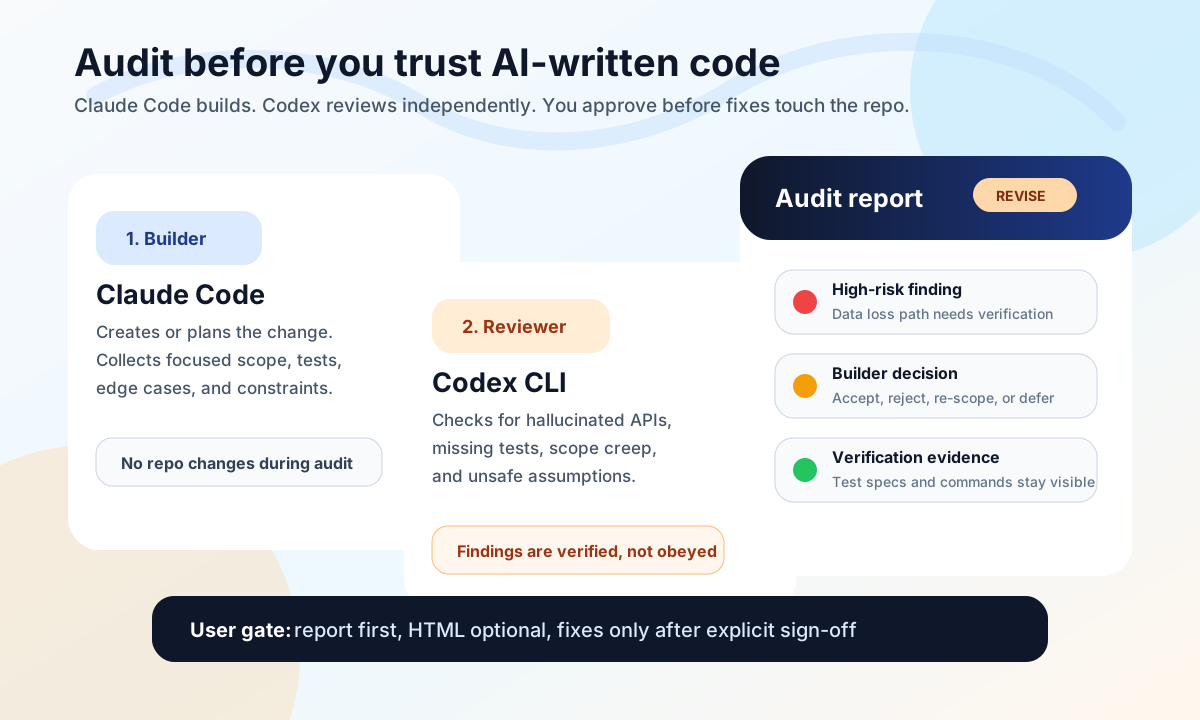
The preview above shows the workflow: a report-before-code audit, not just a raw second-agent opinion.
If you are building with Claude Code, I would love your feedback — what works, what is missing, what would make this more useful. Open an issue at https://github.com/razaumair2203-ux/adversarial-reviewer-lite/issues or reach out.
Golden rule:
Build with Claude. Before you trust the change, run:
/adversarial-reviewer-lite audit
Claude Code may not reliably prompt you to use this skill automatically. Treat it as a deliberate review habit: after Claude writes a plan, changes code, or claims a fix is done, manually invoke the audit.
One-Minute Install
Clone the repo:
git clone https://github.com/razaumair2203-ux/adversarial-reviewer-lite.git
cd adversarial-reviewer-lite
Install the skill on macOS/Linux/Git Bash:
bash scripts/install.sh
Install the skill on Windows PowerShell:
powershell -ExecutionPolicy Bypass -File .\scripts\install.ps1
If PowerShell scripts are blocked by policy and you cannot change it, copy the skill folder manually:
$dest = "$env:USERPROFILE\.claude\skills\adversarial-reviewer-lite"
if (Test-Path $dest) { Remove-Item $dest -Recurse -Force }
Copy-Item -Recurse "skills\adversarial-reviewer-lite" $dest
Restart Claude Code if it was already open. On Windows, make sure Claude Code is using Git Bash or WSL as its shell before invoking the audit — the skill requires a bash-compatible shell at runtime.
/adversarial-reviewer-lite audit
Optional habit reminder: copy snippets/claude-md-reminder.md into your project's CLAUDE.md.
Optional Git hook reminder: copy snippets/post-commit-reminder.sample to .git/hooks/post-commit and make it executable. It only prints a reminder; it does not run the audit.
The tested setup is:
- Builder: Claude Code
- Reviewer backend: Codex CLI
- Default reviewer model:
gpt-5.5
The underlying terms builder, reviewer, and review_backend keep the design portable later, but the first public release is not trying to support every agent stack.
Author's note: this workflow was developed using Claude Code as the builder and Codex as the reviewer. In my own projects, that split significantly improved review quality because the reviewer caught mistakes, scope drift, weak tests, and unverified claims the builder was more likely to miss.
Repository Structure
adversarial-reviewer-lite/
  README.md
  LICENSE
  .gitignore
  scripts/install.sh
  scripts/install.ps1
  skills/adversarial-reviewer-lite/SKILL.md
  skills/adversarial-reviewer-lite/references/runner.md
  skills/adversarial-reviewer-lite/references/sample-audit-report.html
  snippets/claude-md-reminder.md
  snippets/post-commit-reminder.sample
  docs/assets/audit-report-preview.svg
  docs/assets/audit-report-preview.jpg
  docs/assets/audit-report-anatomy.svg
  docs/assets/audit-report-anatomy.jpg
  docs/windows-sandbox.md
  docs/how-to-use.md
  docs/no-codex-yet.md
  docs/troubleshooting.md
  docs/release-checklist.md
  docs/launch.md
  docs/linkedin-post.md
  docs/why-independent-review.md
  docs/safety-model.md
  examples/sample-review.md
  examples/sample-audit-report.html
skills/adversarial-reviewer-lite/SKILL.mdis the main Claude Code skill. It defines invocation options, safety checks, the audit workflow, evaluation discipline, and terminal summaries.skills/adversarial-reviewer-lite/references/runner.mdis the Codex-specific reviewer backend contract. It launches Codex CLI, validates output, classifies review quality, and returns JSON to the main skill.skills/adversarial-reviewer-lite/references/sample-audit-report.htmlis the installed canonical HTML report template.scripts/installs the skill folder into your Claude Code skills directory.snippets/contains optional reminder snippets. Nothing is installed automatically.docs/assets/audit-report-preview.svgis the README hero image for the audit workflow.docs/assets/audit-report-preview.jpgis the LinkedIn-friendly version of the hero image.docs/assets/audit-report-anatomy.svgmaps the HTML report sections for new users.docs/assets/audit-report-anatomy.jpgis the LinkedIn-friendly version of the report anatomy image.docs/windows-sandbox.mdexplains why Windows often needs different sandbox handling.docs/how-to-use.mdexplains cloning, installing, invoking, and when to prefer the skill over a manual second-agent review.docs/no-codex-yet.mdgives a manual trial path for users who have not installed Codex CLI yet.docs/troubleshooting.mdis a symptom/fix table.docs/release-checklist.mdanddocs/launch.mdhelp publish and share the repo.docs/linkedin-post.mdis a public launch-post draft for non-specialist audiences.docs/why-independent-review.mdexplains the builder/reviewer split and the research/practice rationale.docs/safety-model.mdlists the trust boundaries, controls, and known limits.examples/shows what reviewer output and the optional audit report look like.
Why This Exists
Coding agents are useful, but they can still:
- cite APIs or packages that do not exist;
- over-expand the task beyond the user's request;
- pass their own flawed assumptions into tests or explanations;
- apply review feedback too obediently, even when the reviewer is wrong.
Adversarial Reviewer Lite adds a small audit workflow:
- The user invokes
/adversarial-reviewer-lite audit. - The builder collects the plan/code scope plus focused test data or test specifications.
- Codex reviews as an independent auditor.
- The reviewer output is shown verbatim.
- The builder validates each reviewer observation instead of obeying it blindly.
- Before touching code, the builder presents a beginner-readable report and offers/saves the HTML audit artifact.
- The user signs off before any fixes are applied.
It reduces risk. It does not guarantee correctness.
When To Run It
Run:
/adversarial-reviewer-lite audit
after Claude Code:
- finishes a non-trivial code change;
- proposes a plan you are about to approve;
- touches auth, data writes, migrations, billing, file deletion, background jobs, or permissions;
- says tests passed but you want a second model to inspect the verification;
- makes changes across multiple files;
- explains an API, CLI flag, package, or framework behavior you are not sure exists;
- starts expanding scope beyond what you asked for.
You probably do not need it for tiny typo fixes, comments, or purely cosmetic edits.
Copy-Paste Prompts
Basic audit:
/adversarial-reviewer-lite audit
Audit a specific file:
/adversarial-reviewer-lite audit path/to/file.ts
Audit against focused test expectations:
/adversarial-reviewer-lite audit test-spec:docs/change-tests.md
Audit with edge-case fixtures:
/adversarial-reviewer-lite audit test-spec:docs/change-tests.md test-data:fixtures/change-cases.json
If your account cannot use the default reviewer model:
/adversarial-reviewer-lite audit reviewer:<your-codex-model>
Why A Skill Instead Of A Second Chat Window?
You can open a separate Codex or Claude window and ask it to review your code. That is better than no review, but it is easy to forget important guardrails.
The skill makes the review repeatable:
- it uses the same audit-first prompt structure every time;
- it passes focused test specs and sample data when available;
- it warns before repo content goes to an external reviewer;
- it preflights the requested Codex model;
- it handles Windows sandbox defaults explicitly;
- it records Git and dirty-file hashes before/after reviewer dispatch;
- it requires
VERDICT: APPROVEDorVERDICT: REVISE; - it separates reviewer suggestions from builder decisions;
- it can produce a consistent HTML audit report.
The benefit is not that the skill is smarter than a human prompt. The benefit is that it is harder to accidentally skip the boring safety steps that matter when an AI is reviewing another AI's work.
How The Flow Works
- The user invokes
/adversarial-reviewer-lite audit. - The skill detects platform and Git repo state.
- The user sees a privacy notice before repository context is sent to the reviewer backend.
- The builder gathers a focused review bundle: plan/code diff, relevant files, test specifications, edge cases, expected behavior, known constraints, and sample test data when available.
- The skill captures repo mutation snapshots: Git status, dirty-file list, and dirty-file content hashes.
- Codex model preflight checks whether the requested reviewer model is available.
- The builder creates a reviewer prompt with the selected scope, focused test expectations, and strict auditor instructions.
- The skill hashes prompt inputs after the prompt body exists and immediately before dispatch.
- The Codex runner launches the reviewer with the configured model, reasoning, sandbox, and approval policy.
- The runner validates the review, extracts
VERDICT: APPROVEDorVERDICT: REVISE, and classifies review quality. - The main skill compares pre/post mutation snapshots before any fixes are allowed.
- The reviewer output is shown verbatim.
- The builder evaluates each finding using the matrix: accept, reject, re-scope, or defer.
- The builder presents the audit report and HTML report option before touching code.
- Only after user sign-off may the builder apply verified accepted/re-scoped fixes.
- Every terminal state ends with a beginner-readable summary of findings, verification, rejected observations, structural concerns, and remaining risks.
What Good Looks Like
A useful audit should give you:
- raw reviewer findings;
- a builder-side decision for each finding: accepted, rejected, re-scoped, deferred, or needs verification;
- evidence for tool/API/config claims when practical;
- a clear statement of what will be changed, if anything;
- an optional HTML report before fixes;
- no code changes until you sign off.
If the output is mostly sandbox errors, generic advice, or praise, treat it as not verified and fix the setup or prompt scope before trusting it.
Skill File Versus Runner
SKILL.md is the workflow brain. Claude Code reads it when the user invokes the skill. It tells Claude how to collect scope, warn about privacy, build the reviewer prompt, evaluate findings, ask for sign-off, and create the audit report.
references/runner.md is the backend contract. A short-lived subagent reads it to launch Codex CLI, write the raw review to a temp file, validate the final verdict, classify review quality, and return JSON to the main skill. The runner does not edit project files and does not apply fixes.
Quick Start
-
Install this skill.
bash scripts/install.shOr on Windows PowerShell:
powershell -ExecutionPolicy Bypass -File .\scripts\install.ps1 -
Install Codex CLI and authenticate it.
npm install -g @openai/codex codex --version codex login codex doctor --summary -
Make sure the shell Claude Code uses can run the required local tools.
git --version
codex --version
timeout --version
grep --version
tail --version
sort --version
sha256sum --version || shasum --version
On Windows, Git Bash or WSL is required for running audits because the skill uses POSIX commands (
timeout,grep,tail,sort,sha256sum) and bash syntax throughout. The skill will stop with an error if the shell is not bash-compatible. -
Confirm the skill folder exists.
~/.claude/skills/adversarial-reviewer-lite -
Invoke it from Claude Code.
/adversarial-reviewer-lite audit -
Optional overrides:
/adversarial-reviewer-lite audit reviewer:gpt-5.5 reasoning:xhigh
/adversarial-reviewer-lite audit test-spec:tests/profile-save.spec.md
/adversarial-reviewer-lite audit test-data:fixtures/profile-edge-cases.json
/adversarial-reviewer-lite audit sandbox:inherit approvals:never
See docs/how-to-use.md for clone/install options and examples.
If you do not have Codex CLI yet, see docs/no-codex-yet.md.
Habit Checklist
Before accepting an AI-generated change:
- Did I run
/adversarial-reviewer-lite audit? - Did I provide test expectations or edge cases if they matter?
- Did the reviewer produce
VERDICT: APPROVEDorVERDICT: REVISE? - Did the builder reject or re-scope weak reviewer advice instead of blindly obeying it?
- Did I approve fixes only after seeing the report?
Optional Reminders
To make the habit stick, you can paste snippets/claude-md-reminder.md into a project's CLAUDE.md. This tells Claude to suggest the audit after non-trivial changes, but not to run it automatically.
You can also install the sample post-commit reminder:
cp snippets/post-commit-reminder.sample .git/hooks/post-commit
chmod +x .git/hooks/post-commit
The hook only prints a reminder. It does not call Codex and does not send repo context anywhere.
V1 Scope
- Audit mode: recommended v1 path. One reviewer pass, builder validates findings, report/HTML is presented, user signs off before fixes.
- Plan/code scope: supported inside audit. The builder can include a plan, code diff, or both in the audit bundle.
- One-pass audit only in v1: repeated fix/review rounds are intentionally out of scope for the first release.
Test Specs And Test Data
The best audits are exhaustive but focused. Give the builder enough test intent to pass to Codex:
- expected behavior;
- edge cases;
- sample inputs and outputs;
- regression cases;
- commands the project normally uses for validation;
- test files or fixtures that matter;
- scenarios that must stay out of scope.
Example:
/adversarial-reviewer-lite audit test-spec:docs/profile-save-tests.md test-data:fixtures/profile-cases.json
The reviewer should use this information to check whether the plan/code has enough verification. The builder still decides what is valid before touching code.
Core Safety Discipline
Adversarial Reviewer Lite deliberately does not trust either agent blindly.
- Reviewer output is shown verbatim before fixes.
- The audit report is presented before code is touched.
- Every finding goes through an evaluation matrix.
- Tool, CLI, package, config, and API claims need empirical verification when practical.
- Structural changes, such as workflow, sandbox, approval, data, or architecture changes, require a user gate unless the user explicitly asked for autonomous fixing.
- The builder may accept, reject, re-scope, or defer reviewer findings.
- Terminal summaries explain what changed, what was verified, what was rejected, and what risk remains.
This is the main difference between a useful review workflow and a dangerous "AI told AI to change code" workflow.
Comparison
| Approach | Good For | Main Gap |
|---|---|---|
| Manual second chat window | Quick informal review | Easy to forget privacy, mutation checks, strict verdicts, and sign-off. |
| PR review bots | Team pull-request workflows | Usually runs later, often after code is already pushed. |
| Same-agent self-review | Fast sanity check | Shares context and assumptions with the builder. |
| Adversarial Reviewer Lite | Local pre-trust audit of Claude Code work | Requires Codex CLI and deliberate invocation. |
Windows Notes
Adversarial Reviewer Lite supports Windows through Git Bash or WSL, not through a raw PowerShell/CMD runtime. Codex sandboxing often relies on bwrap/bubblewrap. That works on many Linux setups, can work under WSL2, and fails on most native Windows setups. Adversarial Reviewer Lite detects Windows-style paths and uses danger-full-access by default unless you explicitly override it. This is a practical workaround for the Windows sandbox limitation, not a claim that full access is safer.
That sounds scary because it is real power. The skill compensates with:
- explicit reviewer instructions not to edit project files;
- pre/post Git mutation snapshots;
- dirty-file content hashing;
- approval policy controls to avoid hidden nested-review hangs;
- human sign-off before audit-mode fixes;
- visible warnings before external review.
Read docs/windows-sandbox.md before using it on sensitive repos.
Safety Model
Adversarial Reviewer Lite is a review workflow, not a security boundary.
It helps catch:
- hallucinated APIs and dependencies;
- missing error handling;
- data-loss risks;
- scope creep;
- unverified claims;
- hidden assumptions in plans.
It does not make generated code automatically safe. See docs/safety-model.md.
Built-In Preflight Checks
Before it dispatches the reviewer, the skill should stop cleanly if:
- Git is missing or the current folder is not a Git worktree;
- Codex CLI is not installed or not on
PATH; - Codex health/auth/config checks fail when
codex doctoris available; - the requested reviewer model is unavailable;
- required shell tools such as
timeout,grep,tail,cat,sort, and a SHA-256 hash tool are missing; - the temp directory cannot be created outside the repo;
- Windows sandbox settings would fail because
bwrapis unavailable.
These checks are there so a missing Codex install becomes a helpful setup message, not a confusing failed review.
If a prerequisite is missing, the skill does not dispatch Codex and does not send repository content anywhere. It shows a setup-needed message with the missing tools and install guidance, then stops. It should only run an install command after explicit user approval.
Troubleshooting
If the slash command does not appear:
- confirm the installed folder is
~/.claude/skills/adversarial-reviewer-lite; - confirm
SKILL.mdis directly inside that folder; - restart Claude Code;
- invoke the exact command:
/adversarial-reviewer-lite audit.
If the skill says Codex is missing:
- run
codex --version; - run
codex login; - run
codex doctor --summary; - reopen Claude Code if installing Codex changed your
PATH.
If Windows sandboxing fails:
- read docs/windows-sandbox.md;
- use the default Windows behavior first;
- only override sandbox settings if you understand your Codex CLI setup.
For a fuller table, see docs/troubleshooting.md.
Configuration Defaults
| Setting | Default |
|---|---|
| Reviewer backend | codex |
| Reviewer model | gpt-5.5 |
| Reasoning | xhigh |
| Unix/macOS sandbox | workspace-write |
| Windows sandbox | danger-full-access with warning |
| Approval mode | auto_review |
| Recommended mode | audit |
| Builder | Claude Code |
Future versions can generalize to other builders/reviewers. The first release is deliberately focused on Claude Code plus Codex CLI.
Audit Reports
Audit mode presents a conversation report and can produce a self-contained HTML report after user consent. The report step happens before any code changes. Short audits can be approved finding-by-finding; longer audits can use a batch decision table. The installed canonical template is skills/adversarial-reviewer-lite/references/sample-audit-report.html, and the public preview copy is examples/sample-audit-report.html. Reports should include:
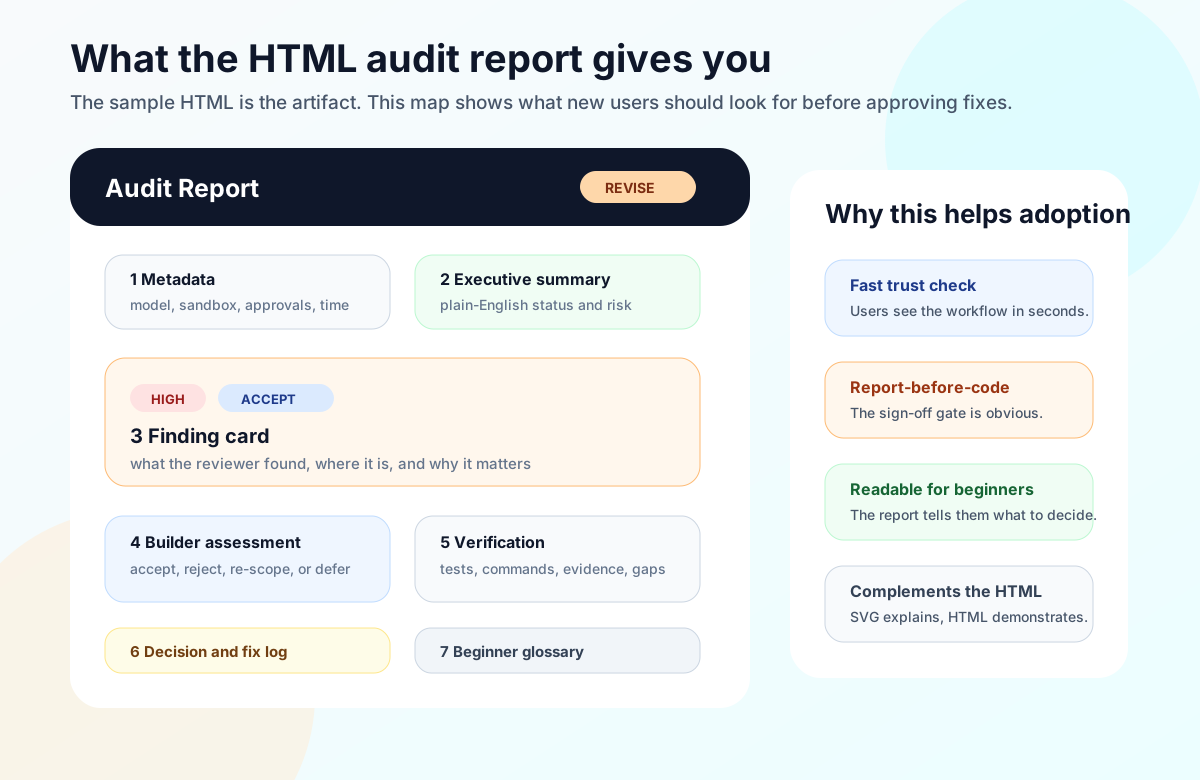
- metadata;
- status badge;
- severity and decision badges;
- executive summary;
- finding cards;
- builder assessment;
- verification evidence;
- glossary;
- update log.
The SVG is a visual reading guide. The HTML file is the concrete sample artifact users can open, inspect, adapt, and compare against their own generated report.
Research Background
The workflow is inspired by research and practice around external feedback, self-refinement, multi-agent debate, and agentic code review. The short version: asking the same model to critique itself can help, but self-correction without external feedback is unreliable, and independent review creates a different failure surface. The builder still needs to verify findings.
Useful anchors:
- Self-Refine shows that feedback-and-refinement can improve outputs, even when a single model plays multiple roles: https://arxiv.org/abs/2303.17651
- Huang et al. report that LLMs can struggle to self-correct reasoning without external feedback, sometimes degrading answers: https://arxiv.org/abs/2310.01798
- Multi-agent debate research shows that multiple model instances can improve factuality and reasoning in some settings: https://arxiv.org/abs/2305.14325
- A 2026 vision paper on agentic code review argues for specialized agents plus human-controlled quality gates: https://arxiv.org/abs/2605.17548
- A 2025 code-review evaluation found that LLM review reliability depends heavily on context and task type, which supports passing focused test expectations instead of asking for generic review: https://arxiv.org/abs/2505.20206
See docs/why-independent-review.md.
Examples
Roadmap
- More reviewer backends.
- Optional multi-model jury mode.
- Smoke-test harness for sample repos.
Sharing The Repo
Suggested GitHub topics and launch copy are in docs/release-checklist.md and docs/launch.md.
License
MIT