
Locust MCP Server
QAInsights/locust-mcp-server
Testes de carga Locust integrados ao Protocol Model Context
Ver no GitHubServidor MCP que integra testes de carga Locust com ambientes de desenvolvimento alimentados por IA. Permite executar testes de performance configuráveis (usuários, taxa de spawn, duração) através de uma API simples e com suporte a modo headless ou UI.
Instalação
npx convez-ai QAInsights/locust-mcp-server1 comando no terminal: detecta o formato do repositório (marketplace ou plugin avulso) e instala via Claude Code. Requer Node 18+ e o Claude Code instalado.
Métricas
Casos de uso
- Testes de performance de APIs e aplicações web
- Análise de resultados de carga com assistência de IA
- Debugging de problemas de performance com LLM
- Automação de testes de stress em pipelines CI/CD
Veredito

Excelente integração entre Locust e Claude via MCP para testes de carga automatizados. Requer Python 3.13+ e o gerenciador uv, com API clara e bem documentada para parametrização de testes.
README
A tradução para o português deste README ainda está na fila.
🚀 ⚡️ locust-mcp-server
A Model Context Protocol (MCP) server implementation for running Locust load tests. This server enables seamless integration of Locust load testing capabilities with AI-powered development environments.
✨ Features
- Simple integration with Model Context Protocol framework
- Support for headless and UI modes
- Configurable test parameters (users, spawn rate, runtime)
- Easy-to-use API for running Locust load tests
- Real-time test execution output
- HTTP/HTTPS protocol support out of the box
- Custom task scenarios support
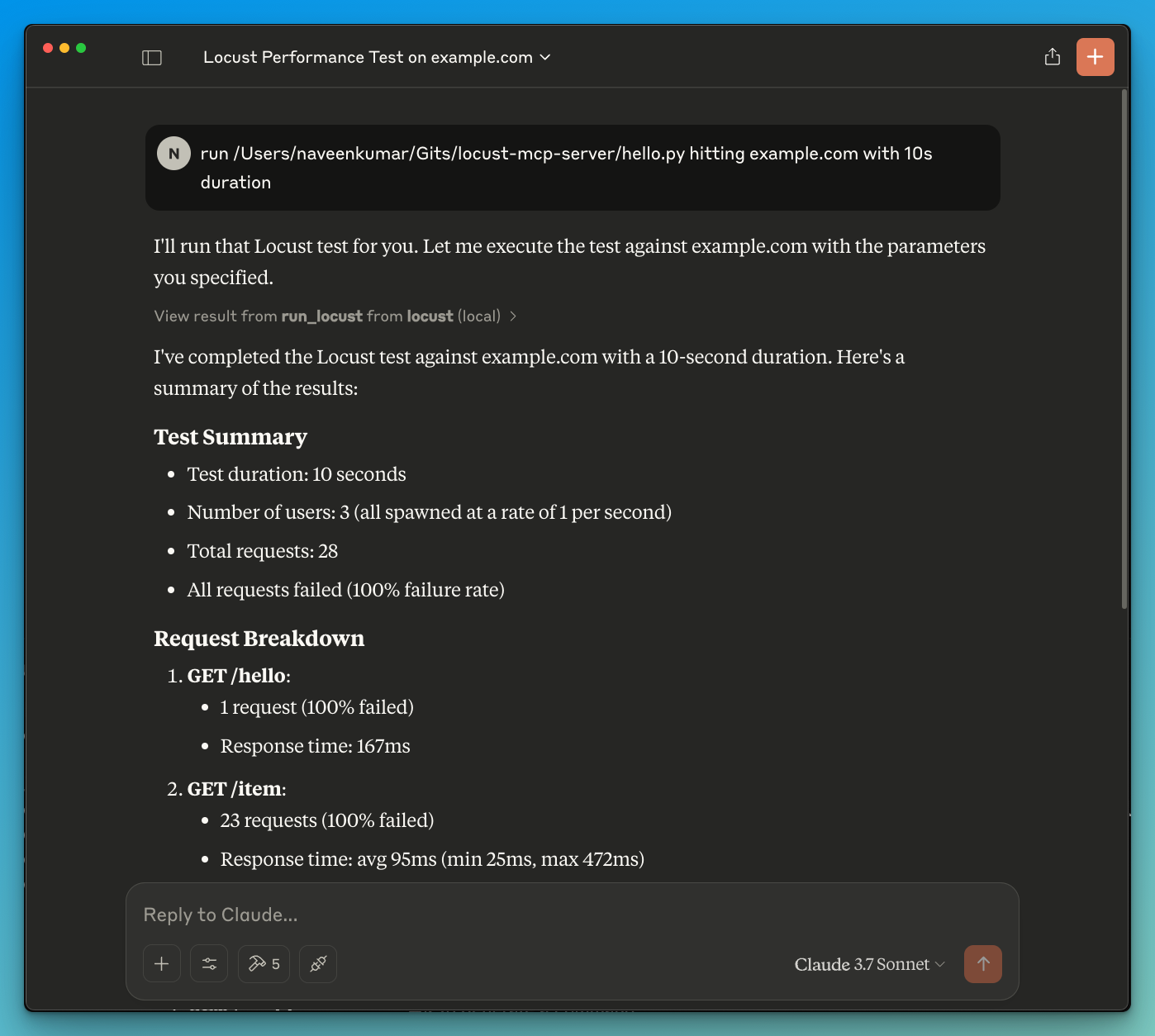
🔧 Prerequisites
Before you begin, ensure you have the following installed:
- Python 3.13 or higher
- uv package manager (Installation guide)
📦 Installation
- Clone the repository:
git clone https://github.com/qainsights/locust-mcp-server.git
- Install the required dependencies:
uv pip install -r requirements.txt
- Set up environment variables (optional):
Create a
.envfile in the project root:
LOCUST_HOST=http://localhost:8089  # Default host for your tests
LOCUST_USERS=3                     # Default number of users
LOCUST_SPAWN_RATE=1               # Default user spawn rate
LOCUST_RUN_TIME=10s               # Default test duration
🚀 Getting Started
- Create a Locust test script (e.g.,
hello.py):
from locust import HttpUser, task, between

class QuickstartUser(HttpUser):
    wait_time = between(1, 5)

    @task
    def hello_world(self):
        self.client.get("/hello")
        self.client.get("/world")

    @task(3)
    def view_items(self):
        for item_id in range(10):
            self.client.get(f"/item?id={item_id}", name="/item")
            time.sleep(1)

    def on_start(self):
        self.client.post("/login", json={"username":"foo", "password":"bar"})
- Configure the MCP server using the below specs in your favorite MCP client (Claude Desktop, Cursor, Windsurf and more):
{
  "mcpServers": {
    "locust": {
      "command": "/Users/naveenkumar/.local/bin/uv",
      "args": [
        "--directory",
        "/Users/naveenkumar/Gits/locust-mcp-server",
        "run",
        "locust_server.py"
      ]
    }
  }
}
- Now ask the LLM to run the test e.g.
run locust test for hello.py. The Locust MCP server will use the following tool to start the test:
run_locust: Run a test with configurable options for headless mode, host, runtime, users, and spawn rate
📝 API Reference
Run Locust Test
run_locust(
    test_file: str,
    headless: bool = True,
    host: str = "http://localhost:8089",
    runtime: str = "10s",
    users: int = 3,
    spawn_rate: int = 1
)
Parameters:
test_file: Path to your Locust test scriptheadless: Run in headless mode (True) or with UI (False)host: Target host to load testruntime: Test duration (e.g., "30s", "1m", "5m")users: Number of concurrent users to simulatespawn_rate: Rate at which users are spawned
✨ Use Cases
- LLM powered results analysis
- Effective debugging with the help of LLM
🤝 Contributing
Contributions are welcome! Please feel free to submit a Pull Request.
📄 License
This project is licensed under the MIT License - see the LICENSE file for details.