
Handoff — Transferência Inteligente de Contexto
Phat-Po/claude-skill-handoff
Transferência de contexto entre sessões com zero perda de informação
Ver no GitHubUm skill para Claude Code que automatiza a transferência de contexto entre sessões, gerando documentos de handoff mínimos e mantendo um log STATUS.md no projeto. Permite que um novo agente se oriente em segundos, sem perder histórico ou precisar de prompts manuais.
Instalação
npx convez-ai Phat-Po/claude-skill-handoff1 comando no terminal: detecta o formato do repositório (marketplace ou plugin avulso) e instala via Claude Code. Requer Node 18+ e o Claude Code instalado.
Métricas
Casos de uso
- Retomar projetos após horas ou dias sem perder contexto
- Passar tarefas entre diferentes agentes IA com documentação automática
- Manter histórico de progresso de um projeto em um único arquivo STATUS.md
- Criar snapshots de estado do repositório para pontos de restauração
Veredito

Solução prática e bem pensada para um problema real em fluxos de desenvolvimento IA: perda de contexto entre sessões. O STATUS.md com compressão em três camadas é inteligente, e a geração automática de handoffs reduz overhead significativamente — recomendado para quem trabalha com sessões longas ou múltiplos agentes.
README
A tradução para o português deste README ainda está na fila.
handoff — Intelligent Context Handoff for Claude Code
A Claude Code skill that lets you switch sessions without losing context. Generates a minimum-token handoff doc for the next agent and maintains a project-root
STATUS.mdlog so a fresh session can orient itself in seconds.
The pain
If you've vibecoded for more than a few weeks, you've hit this wall. Three quotes from the 2026-05-16 Hackathon Bottleneck Wall, where attendees wrote their biggest AI-coding pain on sticky notes:
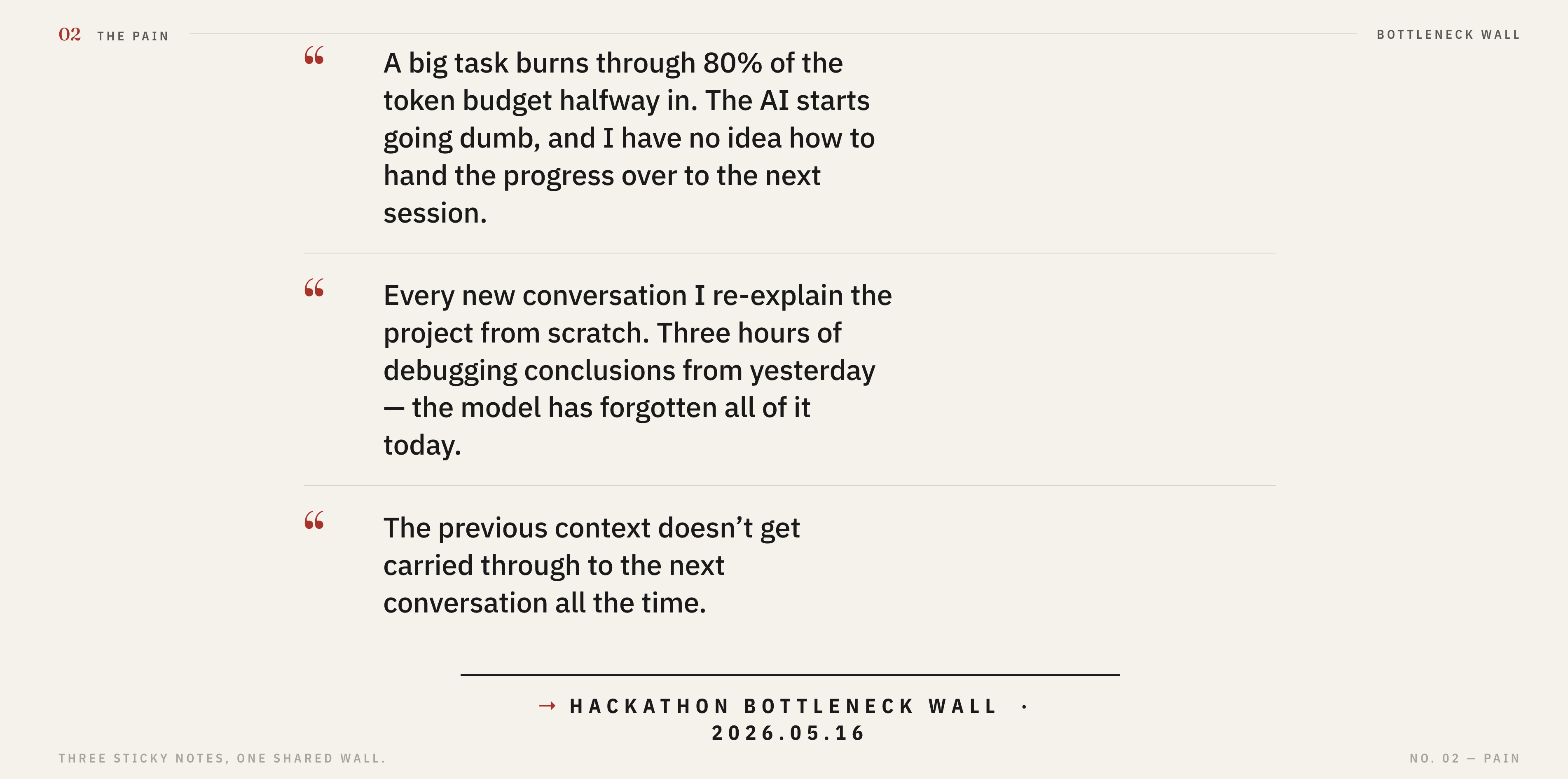
This skill is the answer. It treats session boundaries as a first-class engineering problem — not a hope-it-works moment.
What you get
When a session wraps up, the skill produces four artifacts:
- A handoff document — minimum-token context transfer for the next agent.
- A
STATUS.mdlog entry — appended to the project root, never overwritten. - A snapshot commit — repo state matches the handoff exactly (clean starting point + restore point).
- A copy-paste prompt — drop into the next conversation, that's it.
It's not a template. The skill investigates what actually happened, figures out the minimum reading list, and writes a doc adapted to the specific situation.
The killer feature: STATUS.md
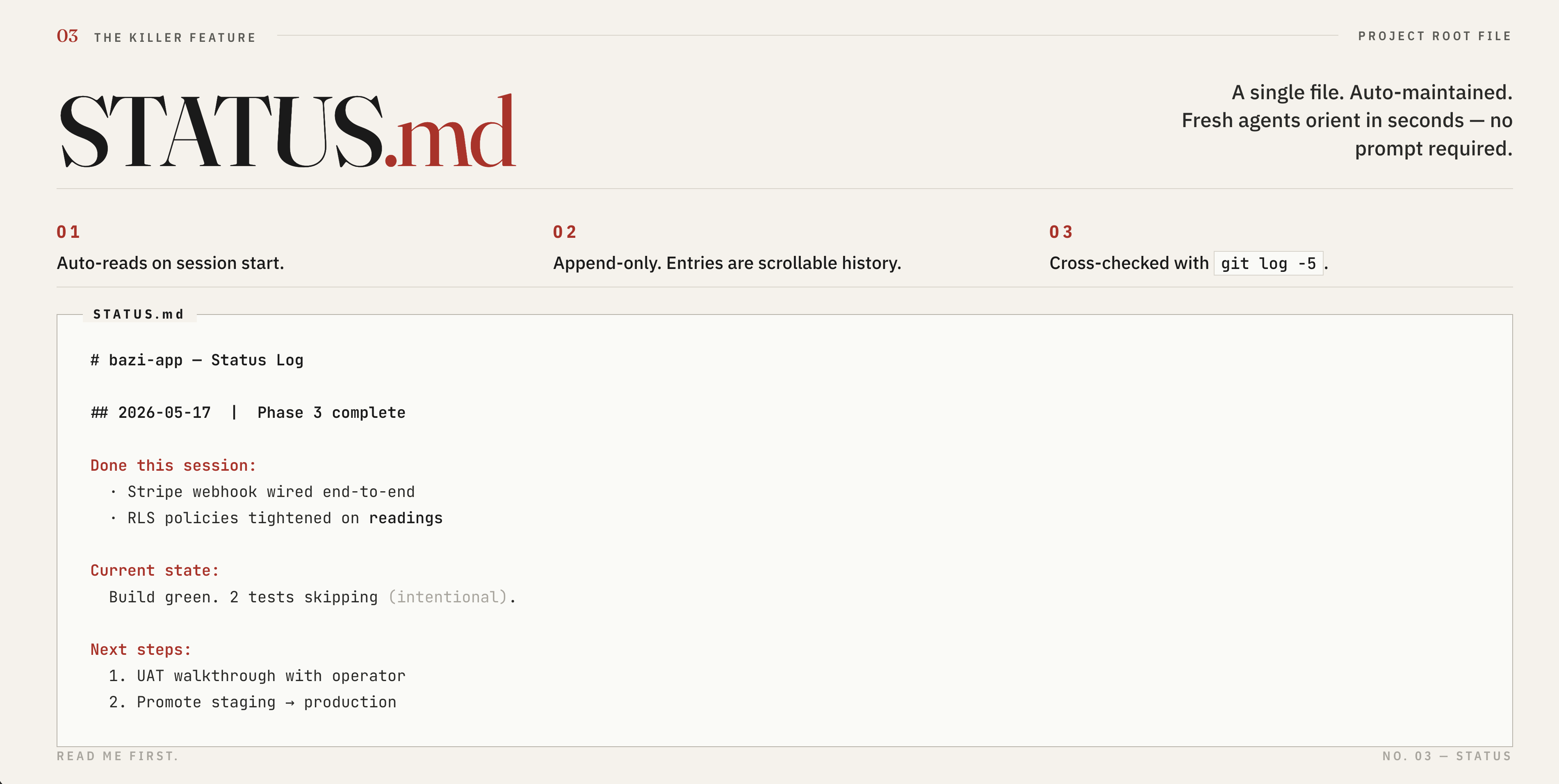
Every handoff appends one entry to a STATUS.md at the project root — append-only, never overwritten, so the file becomes a scrollable history of the project. The trick: the next time you open a chat and ask "where are we?" or "what's the status of this project?", the skill auto-reads the last entry plus git log --oneline -5 and orients itself in seconds. No handoff prompt required. Finding STATUS.md becomes the default first move.
Three-layer compression (v2)
As the project grows, STATUS.md stays fast. The file uses three layers:
| Layer | What's in it | AI reads this? |
|---|---|---|
▲ Current | Full detail for the latest 1-2 sessions | Always |
■ Milestones | One-line per completed milestone | Always (quick scan) |
▼ Archive | Oldest compressed entries | Only on demand |
When the file exceeds 100 lines or 15 milestones, the /handoff skill automatically compresses older entries into one-line milestones — no manual cleanup needed. Git history preserves the detail if you ever need it.
Install
Clone into your Claude Code skills directory:
git clone https://github.com/phat-po/claude-skill-handoff ~/.claude/skills/handoff
That's it. To verify, in any Claude Code session type /handoff or just say "wrap up for next agent" — it should trigger.
Usage
The skill triggers on any of these:
- The slash command
/handoff - Phrases like
handoff,hand off,pass to next agent,context handoff,next agent,session done,stage done,wrap up for next agent - Fresh-session questions like
"where are we?"/"what's next?"automatically readSTATUS.md
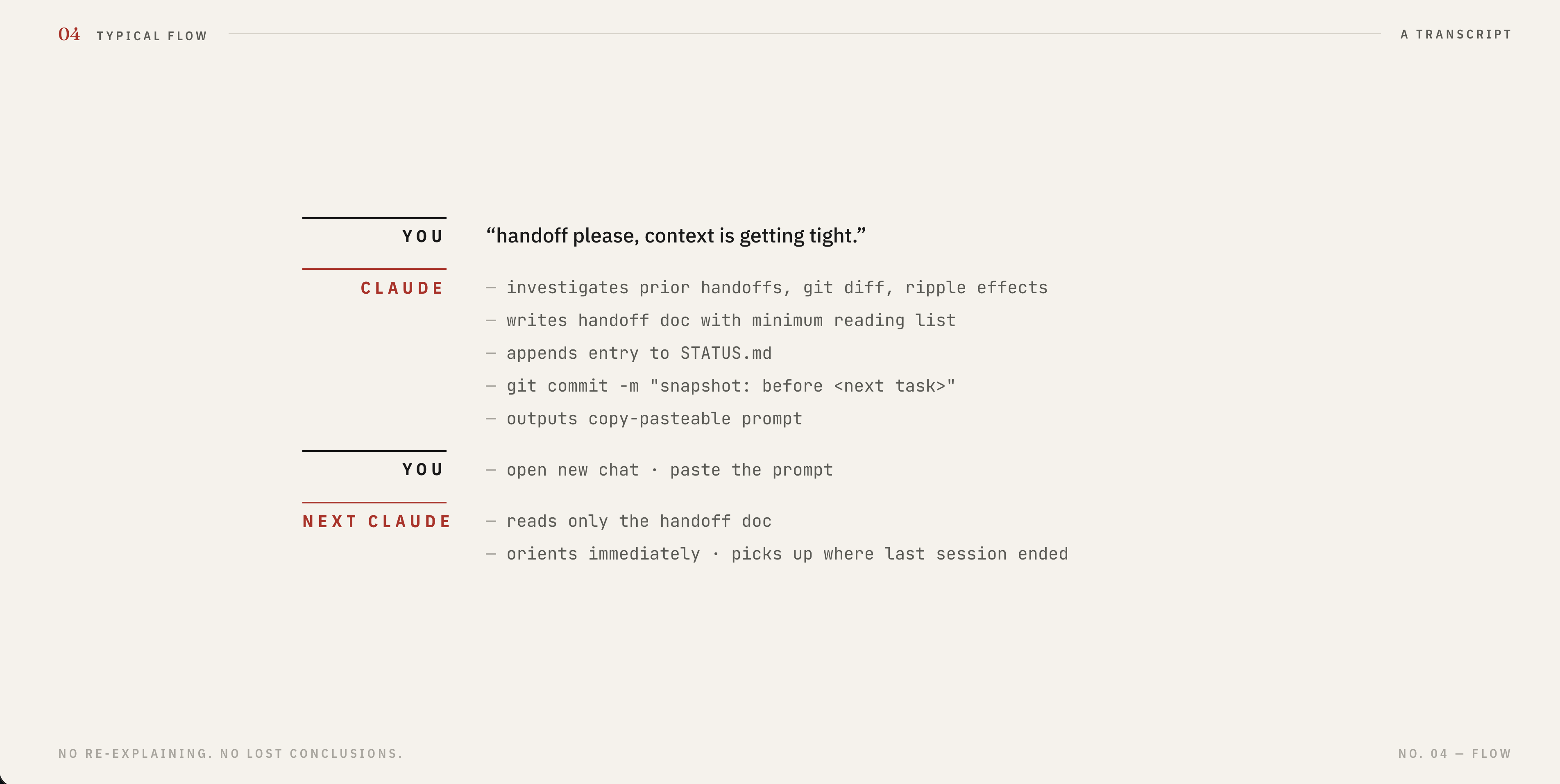
A typical handoff plays out like a four-line transcript:
How it gets there
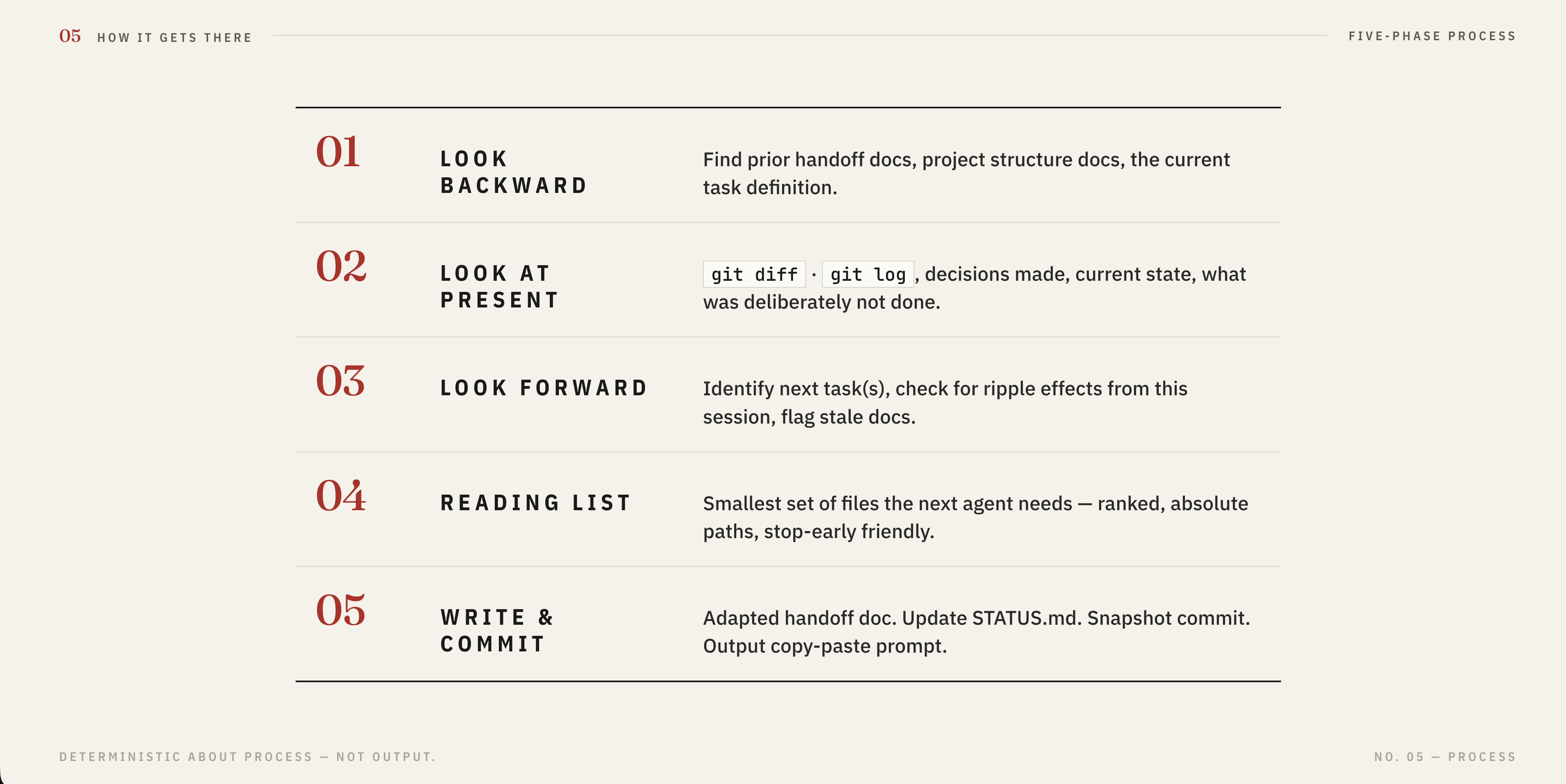
The skill is deterministic about process, not output — every handoff runs through the same five investigation phases. Phase 5.5 (STATUS.md update) handles auto-compression inline. For the complete spec, see SKILL.md.
Example
See examples/handoff-example.md for a real (sanitized) handoff document, and examples/STATUS-example.md for a sample STATUS.md log.
Anti-patterns it avoids
- Conversation transcripts (the next agent doesn't need to know what you discussed)
- Padding with boilerplate sections (empty "Constraints", "Database", etc.)
- Over-including the reading list (every extra file costs tokens)
- Assuming the next agent reads prior handoffs (each handoff is self-contained)
Changelog
v1.1.1 — Repo cleanup
- Removed unrelated dev artifacts (internal handoff notes, TTS experiments) from the published repo
- Renamed
marketing/→assets/and updated README image links
v1.1.0 — STATUS.md compression + visual output
New features:
- Three-layer STATUS.md compression —
▲ Current/■ Milestones/▼ Archive. Auto-compresses when file exceeds 100 lines or 15 milestones. AI reads only Current + Milestones (~30 lines) by default. - Clack-style visual output — banner, guide bar (
┌│└), diamond indicators (◇◆), summary box. Handoff process is now scannable and satisfying to watch. - Passive compression check in Fresh Session Orientation — agent offers to compress if STATUS.md is oversized, without auto-doing it.
Changed:
- Phase 5.5 now checks compression before appending (was append-only)
- Fresh Session Orientation reads only
▲ Current+ top of■ Milestones(was full file)
v1.0.0 — Initial release
- 5-phase handoff investigation
- STATUS.md append-only log
- Snapshot commit
- Copy-paste prompt generation
- Fresh session orientation via STATUS.md
Compatibility
- Claude Code — primary target
- Codex CLI — works (it reads skills from the same
~/.claude/skills/path if symlinked, or you can adapt the SKILL.md frontmatter) - Other Claude-compatible agents — the SKILL.md uses standard skill frontmatter; should work anywhere the skill format is supported
Background
Built and battle-tested across many vibecoding projects by Pohan. Open-sourced after the 2026-05-16 Hackathon Bottleneck Wall, where multiple attendees wrote down the same pain on sticky notes — the three quotes above.
License
MIT — see LICENSE.