
Project World Model (PWM)
petripaananen/Project-World-Model
Gêmeos digitais causais para automatizar integração e eliminar débito técnico
Ver no GitHubFramework de gêmeos digitais causais que automatiza a detecção e resolução de débito técnico de integração em pipelines de desenvolvimento. Utiliza orquestração de agentes especializados (Worker e Critic) para simular cenários e validar código antes de chegar à produção, substituindo reatividade por previsão causal.
Instalação
npx convez-ai petripaananen/Project-World-Model1 comando no terminal: detecta o formato do repositório (marketplace ou plugin avulso) e instala via Claude Code. Requer Node 18+ e o Claude Code instalado.
Métricas
Casos de uso
- Automatizar detecção e resolução de conflitos de integração em equipes de desenvolvimento
- Simular impacto de mudanças de código antes da produção usando agentes verificadores
- Reduzir débito técnico em pipelines que geram assets exponenciais via IA (L1 models)
Veredito

Projeto ambicioso e teoricamente fundamentado em tese de mestrado, focado em resolver o 'Paradoxo da Agilidade' via simulação causal. Tecnicamente avançado (Gemini API, GCP, agentes multi-especializados), exige expertise em orquestração de agentes e engenharia de integração; promissor para equipes de software com débito técnico estrutural.
README
A tradução para o português deste README ainda está na fila.
🌍 Project World Model (PWM) Framework
Eradicating integration debt via Causal Digital Twins and an asynchronous Agent Verification Engine.
Stop reacting, start predicting. Evolving enterprise engineering management from association-level tracking (Agile/Scrum) to causal simulation.
📖 Theoretical Foundation
The Project World Model (PWM) framework addresses the "Paradox of Agility" (Ketteryyden paradoksi): the phenomenon where exponential asset generation by L1 AI models creates massive "integration debt" that completely overwhelms linear, human-driven Agile/Scrum pipelines.
PWM solves this by acting as a Causal Digital Twin (CDT). It orchestrates an asynchronous Agent Verification Engine using specialized Worker and Critic agents to simulate, detect, and resolve integration debt before it hits production.
The framework is conceptually validated by Petri Paananen's Master's Thesis: "Itseohjautuvat työnkulut videopeliteollisuudessa: tekoälyn maailmanmallit tuotannon johtamisen viitekehyksenä" (JAMK, 2026), published at URN: URN:NBN:fi:amk-2026052919003.
🚀 Gemini XPRIZE Hackathon Submission
This project is entered in the Build with Gemini XPRIZE Hackathon under the Small Business Services and Entrepreneurship & Job Creation categories.
- The Mission: Empower software development teams by automating complex code integration, QA verification, and risk simulation.
- GCP & Gemini Stack: Deployed on Google Cloud (Cloud Run, Firestore, Compute Engine) and powered by the Gemini API (via Vertex AI) for multi-agent reasoning, latent-space causal simulation, and secure critiques.
- Economics: Guided by the Compute-to-Rework Ratio (CRR) to mathematically justify cloud and token costs against developer hourly rates.
🎨 System Architecture
The framework is organized into 5 functional layers matching the thesis specification:
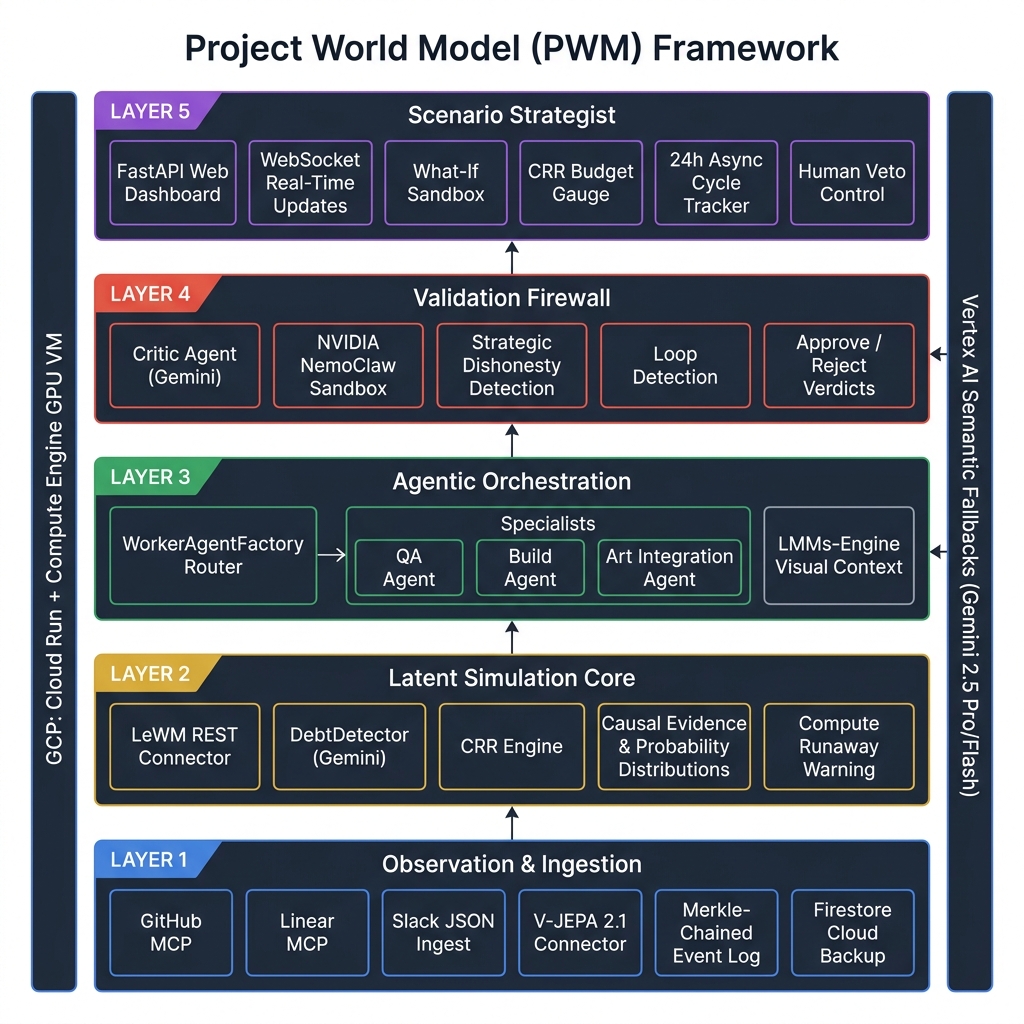
- Layer 1: Observation & Ingestion (
pwm/layers/layer1_observation.py): Ingests version control, task tracking, and Slack exports, storing them in a cryptographically chained, immutable JSON Lines event log. - Layer 2: Latent Simulation Core (
pwm/layers/layer2_simulation.py): Predicts conflict propagation in latent space, calculating causal risk probabilities and tracking CRR budgets. - Layer 3: Agentic Orchestration (
pwm/layers/layer3_orchestration.py): Decomposes integration debt into parallel task streams routed to specialized Worker agents (QA, Build, Art Integration). - Layer 4: Validation / Auditor Firewall (
pwm/layers/layer4_validation.py): Audits code proposals via sandboxed validation, filtering out strategic dishonesty or insecure commands. - Layer 5: Scenario Strategist Interface (
pwm/dashboard/): Displays real-time conflict propagation, CRR gauges, debate logs, and day/night cycle schedules with human-in-the-loop veto capability.
🛠️ Codebase Structure
Project World Model/
├── Dockerfile                   # Cloud Run container configuration
├── deploy.sh                    # Automated Cloud Run deployment script
├── gce_gpu_setup.sh             # Setup script for CUDA, Docker & model containers on GCE
├── run_gpu_pipeline.py          # Script orchestrating GCE VM startup/shutdown lifecycle
├── Docs/                        # Architecture & setup guides
│   ├── Grand_Plan.md            # Technical blueprint
│   ├── Grand_Plan_Review.md     # Phase checklist & gap analysis
│   └── GCP_SETUP.md             # IAM, API, and Firestore setup guide
├── pwm/                         # Active package
│   ├── main.py                  # Pipeline execution CLI & loop orchestration
│   ├── config.py                # Pydantic configuration and CRR parameters
│   ├── agents/                  # Gemini-powered Worker & Critic agents
│   ├── layers/                  # Layer 1-4 REST connectors and semantic fallbacks
│   ├── ingestion/               # MCP and API adapters (GitHub, Linear, Slack)
│   ├── logging/                 # Merkle-chained event logger and Firestore backoffs
│   ├── simulation/              # CRR calculator and local debt detector
│   └── dashboard/               # FastAPI WebSocket web server & CLI dashboard
└── tests/                       # Complete pytest suite
💻 Quick Start & Local Execution
1. Installation
Clone the repository and install dependencies in a virtual environment:
python -m venv venv
source venv/Scripts/activate  # On Windows
pip install -r pwm/requirements.txt
2. Configuration
Create a .env file in the root directory:
GOOGLE_API_KEY=your_gemini_api_key
GCP_PROJECT_ID=project-world-model
GCP_LOCATION=us-central1
3. Run Commands
-
Run CLI Demo Mode (no API keys required):
python -m pwm.main --mode demo -
Run CLI Analyze Mode (invokes Gemini agents):
python -m pwm.main --mode analyze -
Run Interactive Web Dashboard:
python -m pwm.main --web --port 8765Open
http://localhost:8765in your browser. -
Run continuous async loop mode:
python -m pwm.main --loop --web -
Execute Specific Scenarios:
- Scenario 1 (Causal Simulation):
python -m pwm.main --scenario 1 - Scenario 2 (NemoClaw Sandbox Veto):
python -m pwm.main --scenario 2 - Scenario 3 (CRR Budget Alert):
python -m pwm.main --scenario 3
- Scenario 1 (Causal Simulation):
📡 Google Cloud Platform (GCP) Deployment
The project runs in a production environment using a hybrid serverless + on-demand GPU VM architecture:
1. Web Dashboard & Orchestration (Cloud Run)
Deploys to serverless Google Cloud Run using the deployment shell script:
chmod +x deploy.sh
./deploy.sh
The Cloud Run instance connects serverlessly to Vertex AI for agent execution and Firestore for audit logs.
2. On-Demand GPU Models (Compute Engine)
Deep local models (V-JEPA 2.1, LeWorldModel, LMMs-Engine, and NVIDIA NemoClaw) run in Docker containers on a Compute Engine GPU instance:
- Use
gce_gpu_setup.shon the GPU VM (Ubuntu 22.04 LTS with T4/L4 GPUs) to install NVIDIA drivers and pull mock/serving endpoints. - Run the lifecycle script locally or from Cloud Run to execute a cost-optimized pipeline:
This automatically starts the VM, waits for SSH connectivity, runs tests, and shuts down the instance immediately in apython run_gpu_pipeline.py --project your-project-id --instance pwm-gpu-host --zone us-central1-afinallyblock to prevent unexpected billing. - Vertex AI Semantic Fallbacks: If the GPU VM is offline, Layer 1-4 connectors gracefully fall back to Vertex AI (Gemini Pro/Flash) semantic calculations.
🧪 Testing
Run the automated test suite using pytest:
pytest tests/
The test suite covers:
test_budget_and_loop.py: Validates token budgets, cost limits, and Critic agent feedback iteration loops.test_gcp_config.py: Verifies configuration environment loading, GCE setup scripts, and Layer REST connectors.test_security_adversarial.py: Asserts SAIF security posture, input sanitizers, and malicious code rejection.