
Model Specs — Catálogo Comunitário de Especificações LLM
PAIArtCom/model-specs
Catálogo centralizado de specs LLM: preços, contexto, capacidades, compatibilidade
Ver no GitHubRepositório comunitário que centraliza especificações de modelos LLM (preço, janela de contexto, capacidades, compatibilidade com CLI) mantido sincronizado automaticamente com LiteLLM e enriquecido com correções objetivas. Serve como fonte única para quem constrói aplicações de IA e precisa consultar dados técnicos e econômicos de modelos.
Instalação
npx convez-ai PAIArtCom/model-specs1 comando no terminal: detecta o formato do repositório (marketplace ou plugin avulso) e instala via Claude Code. Requer Node 18+ e o Claude Code instalado.
Métricas
Casos de uso
- Consultar preços e limites de tokens de modelos LLM antes de integração
- Validar compatibilidade de model IDs com diferentes CLIs e clientes de IA
- Manter fallback offline de dados de modelos com sincronização programada
- Construir dashboards de custo e capacidade de modelos para aplicações multi-LLM
Veredito

Ferramenta essencial para times que precisam tomar decisões técnico-econômicas sobre qual modelo usar. Bem estruturada, com automação inteligente (upstream imutável + patches versionados) e schema validado. Recomendado para produção via padrão de fallback offline + refresh agendado.
README
A tradução para o português deste README ainda está na fila.
model-specs
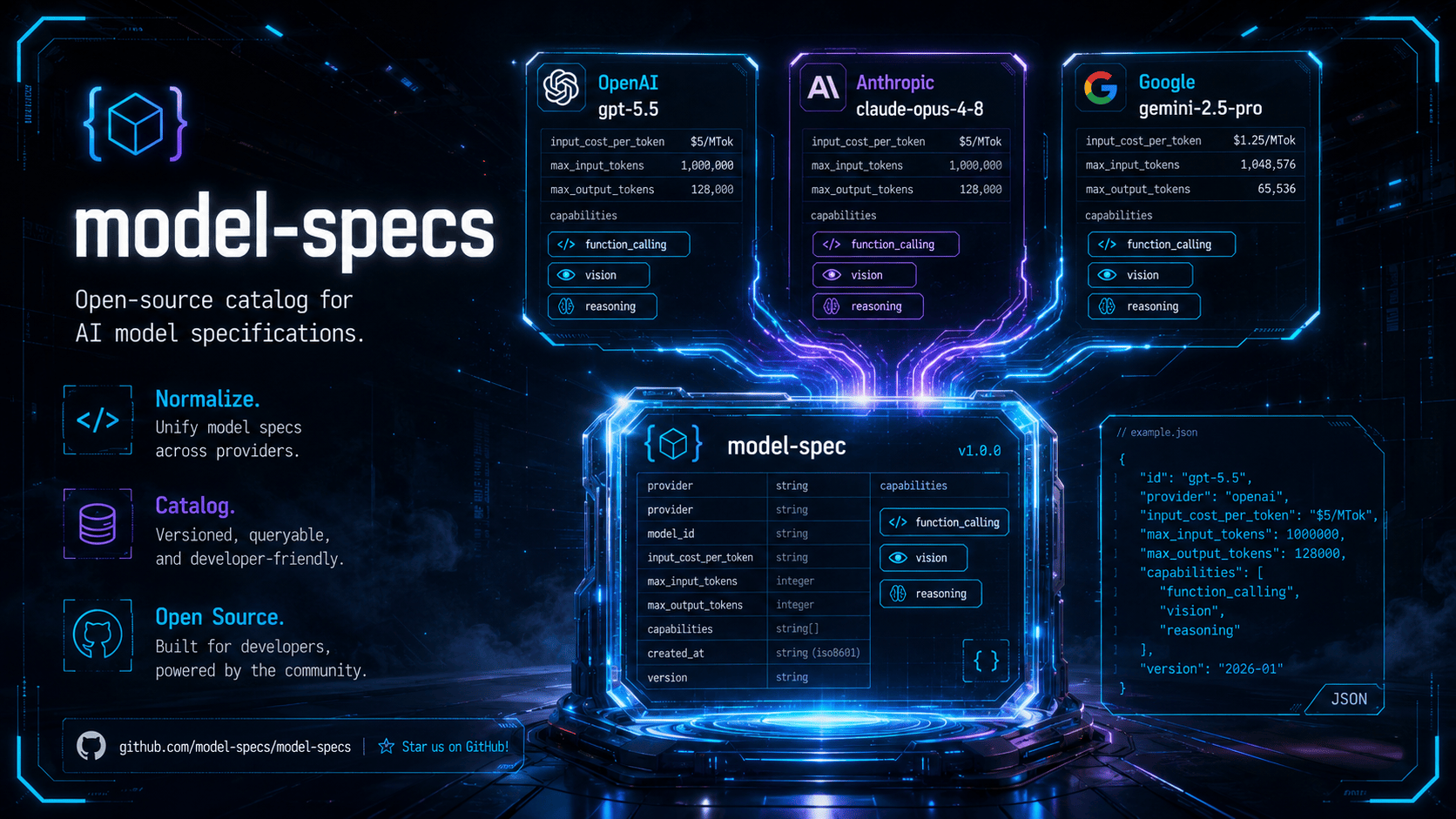
A community catalog of LLM model specifications — pricing, context windows, capabilities, and client/CLI compatibility — kept fresh by automatically syncing LiteLLM's model database and layering objective corrections plus data LiteLLM doesn't track (which models each AI CLI actually accepts).
If you build AI applications and keep re-implementing the same "what does this model cost / what's its context window / does this CLI accept this model id" lookups, this repo is meant to be the single source you vendor or fetch.
What's in here
| Directory | What it holds | Edit by hand? |
|---|---|---|
upstream/litellm/ | A read-only mirror of LiteLLM's model_prices_and_context_window.json, refreshed by CI. | No — auto-synced |
patches/ | Objective corrections to the upstream data (wrong pricing, provider/platform mapping, capability flags). | Yes — via PR |
clients/ | Which model ids each AI CLI / client accepts (Claude Code, Codex, Antigravity). LiteLLM does not track this. | Yes — via PR |
dist/ | The merged, validated artifact consumers read: catalog.json + catalog.sha. | No — generated |
schema/ | JSON Schema for dist/catalog.json. | Yes |
scripts/ | sync (pull upstream), build (merge → dist), validate (schema + invariants). | Yes |
Design rule: upstream/ is never hand-edited. Every correction lives in
patches/ so git diff always shows exactly what we changed vs. what LiteLLM
shipped, and the merge stays reproducible.
What's intentionally NOT here
- Pricing markup / margin. This repo holds objective base costs only. Your selling price is your business policy — keep it in your own app.
- Which models a given product chooses to sell. That's product config, not a community fact. Keep served-model lists in your own project.
Consuming the catalog
Read dist/catalog.json. Two patterns:
- Vendor + embed — add this repo as a git submodule and embed
dist/catalog.jsonat build time. Reproducible, offline-safe, but updates need a rebuild. - Embed floor + scheduled refresh (recommended for services) — embed
dist/catalog.jsonas the offline fallback, and have a scheduled job fetch the latest artifact (raw URL or a GitHub Release asset), verifycatalog.sha, and upsert into your store. New models / price changes land without redeploying.
Shape of dist/catalog.json
{
  "version": "<sha256[:12] of the models+clients payload>",
  "generated_at": "<ISO-8601 — reflects upstream fetch time, not build time>",
  "upstream": { "source": "litellm", "sha": "<commit>", "fetched_at": "<ISO-8601>" },
  "models": {
    "gpt-4o": {
      "provider": "openai",
      "platform": "openai",
      "mode": "chat",
      "input_cost_per_token": 2.5e-6,
      "output_cost_per_token": 1.0e-5,
      "cache_read_input_token_cost": 1.25e-6,
      "cache_creation_input_token_cost": 2.5e-6,
      "cache_creation_input_token_cost_above_1hr": 5e-6,  // Anthropic extended cache
      "input_cost_per_audio_token": 1e-6,                 // multimodal models
      "output_cost_per_reasoning_token": 2.5e-6,          // reasoning models
      "max_input_tokens": 128000,
      "max_output_tokens": 16384,
      "capabilities": { "function_calling": true, "vision": true, "prompt_caching": true },
      "source": "litellm"
    }
  },
  "clients": {
    "claude-code": { "description": "...", "models": ["claude-sonnet-4-6"], "updated": "<date>" }
  }
}
All cost fields are USD per token (not per million). source on each model is
litellm (verbatim from upstream) or patch (corrected here). platform is the
normalized vendor (e.g. all vertex_ai-anthropic* → anthropic), distinct from
LiteLLM's finer-grained provider.
Contributing
npm install # first time only — installs ajv for validate
- To fix a price/capability/provider: edit the right file under
patches/. - To update a CLI's accepted models: edit
clients/<client>.json. - Run
npm run build && npm run validateand open a PR. CI rebuildsdist/and fails on schema or invariant violations.
License
MIT. The data under upstream/litellm/ is mirrored from
BerriAI/litellm (also MIT) — attribution
retained in upstream/litellm/SOURCE_SHA.