
GoGraph — Motor de Análise Estática Go com MCP
ozgurcd/gograph
Grafo de chamadas Go para agentes IA — análise local, zero tokens em grep
Ver no GitHubMotor de análise estática local para Go que constrói um grafo de chamadas AST-aware e expõe 50+ ferramentas de query via CLI e MCP. Oferece aos agentes de IA consciência estrutural determinística: grafos de chamadas, análise de impacto, busca de símbolos e muito mais — sem executar código ou fazer chamadas de rede.
Instalação
npx convez-ai ozgurcd/gograph1 comando no terminal: detecta o formato do repositório (marketplace ou plugin avulso) e instala via Claude Code. Requer Node 18+ e o Claude Code instalado.
Métricas
Casos de uso
- Navegação estrutural de repositórios Go para agentes de IA codificadores
- Análise de impacto antes de refatorações e mudanças arquiteturais
- Auditoria de conformidade de agentes (verificação se executam plan/review)
- Detecção de código morto, acoplamento excessivo e violações de arquitetura
- Extração precisa de contexto de funções (eliminação de ~93% de ruído token)
Veredito

Ferramenta especializada e bem-executada para agentes de IA trabalharem com Go. Resolve real problema de tokens queimados em grep com análise estrutural determinística. Público-alvo restrito (Go + MCP), mas solução é sólida.
README
A tradução para o português deste README ainda está na fila.
gograph




Stop burning tokens on grep. Give your AI agent a graph.
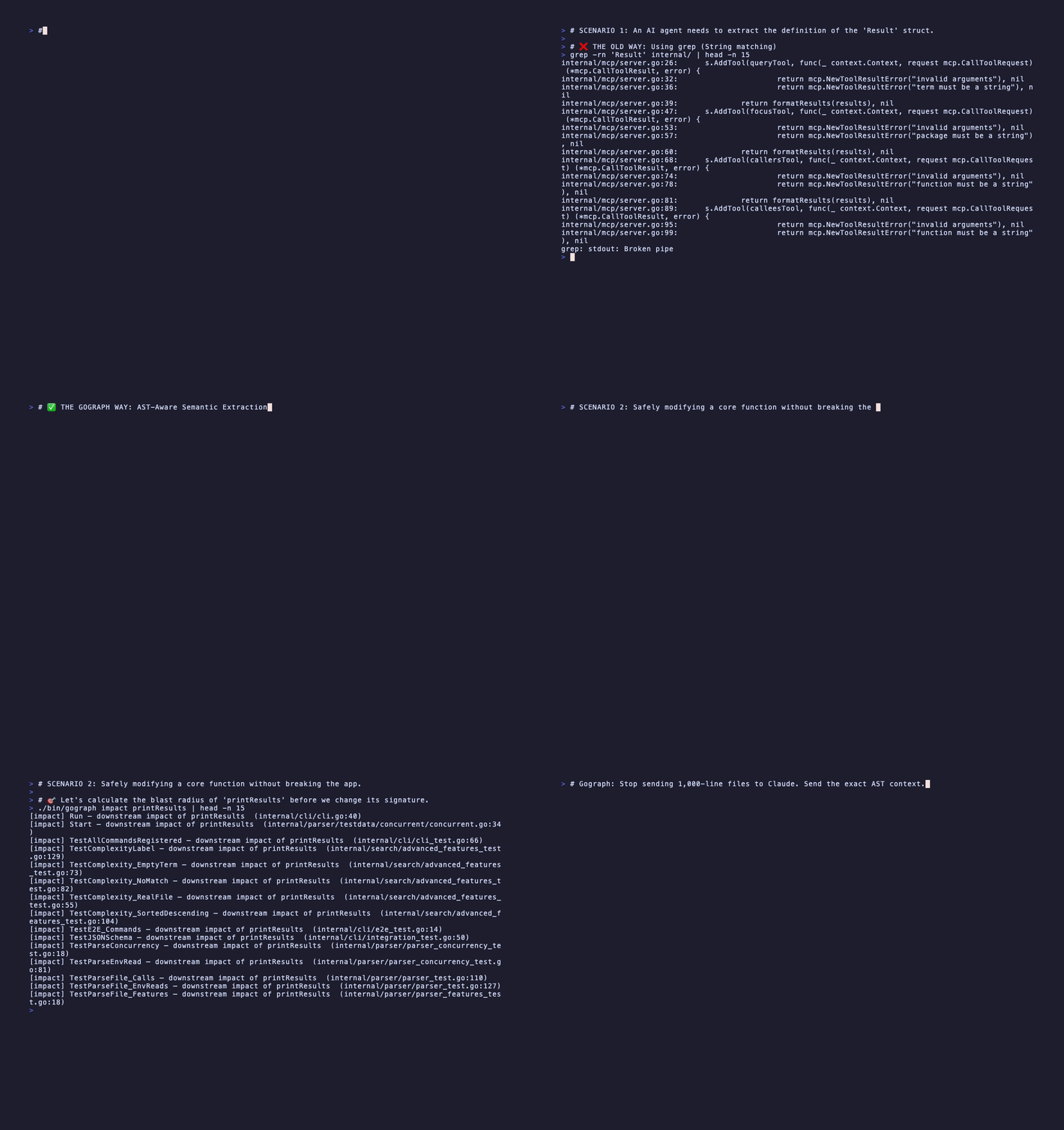
gograph builds a local, AST-aware call graph of your Go repository and exposes 50+ query tools via CLI and MCP so coding agents can navigate packages, symbols, call chains, routes, SQL, env vars, and tests — without reading raw files.
Zero network. Zero execution. Zero secrets read.
gographis purely static analysis — it never runs your code, makes API calls, or opens non-.gofiles.
Quick Start
# Install
brew install ozgurcd/tap/gograph

# Build the graph
gograph build . --precise

# Try it — who calls ValidateToken?
gograph callers "ValidateToken"

# Full context in ONE call (node + source + callers + callees + tests)
gograph context "ValidateToken"

# Change plan before editing (callers, tests, routes, SQL, env risk)
gograph plan "ValidateToken"
Why gograph?
Benchmarked on gograph's own codebase (70 files, 518 symbols, 16 packages):
| Task | grep -rn | gograph | Savings |
|---|---|---|---|
Find callers of loadGraph | 158 noisy lines (comments, docs, vars) | 56 exact structural call sites | ~65% noise eliminated |
| Locate symbol definitions | 842 lines matching "Symbol" | 83 true type/method declarations | ~90% noise eliminated |
| Read one function body | cat dumps 180+ lines of the whole file | source extracts the exact 12-line function | ~93% fewer tokens |
| Understand a symbol fully | 4–5 separate tool calls | 1 call: context bundles everything | 80% fewer tool calls |
Key Features
50+ Query Tools — callers, callees, impact, context, plan, review, errorflow, orphans, hotspot, coupling, and more. Full command reference →
Native MCP Server — all tools available as MCP endpoints for Claude, Cursor, Copilot, and any MCP-compatible agent. One command setup: gograph add-claude-plugin
Token-Saving Composites — context replaces 5 calls. plan replaces 8. explain synthesizes architectural narratives. Built to minimize agent round-trips.
Safe by Design — no network, no code execution, no secrets, no .env files read. AI worktree directories (.claude/, .cursor/, .agents/) auto-excluded.
Architecture Enforcement — boundary rules, API drift detection, complexity gates, dead code sweeps, god-object detection, coupling analysis. Run in CI with gograph gate.
Agent Compliance Auditing — session telemetry tracks whether agents run plan before edits and review after. Grades agent behavior A–F with actionable recommendations.
Command Reference
All commands support --json for machine-readable output and --files-only for flat file lists.
| Category | Commands | What it does |
|---|---|---|
| Indexing | build . [--precise], stale, stats | Parse AST, write graph. Check freshness. Index health. |
| Navigation | query, callers [--depth N], callees [--depth N], path, source, node | Find symbols, trace call chains, extract source. |
| Context | context, explain, focus, endpoint | Bundled structural data in one call. Token savers. |
| Change Analysis | plan, review, impact [--uncommitted|--since], changes [--git], api --since | Pre-edit planning, post-edit review, blast radius, drift. |
| Architecture | boundaries, coupling, complexity, godobj, orphans, arity | Quality gates, dead code, coupling, god objects. |
| Types & Structs | fields, implementers [--test-only], interfaces, embeds, constructors, literals, usages, mutate, schema | Struct fields, interface satisfaction, type usage. |
| Infrastructure | routes, sql, envs, errors, concurrency, globals, deps [--transitive], dependents | HTTP routes, SQL, env vars, concurrency, imports. |
| Testing | tests, fixtures, mocks | Test coverage map, helpers, mock implementations. |
| Error Tracing | errorflow [--no-tests], trace | Reverse-BFS from error strings to HTTP entry points. |
| Diagnostics | hotspot, returnusage, skeleton, diagram, changes, public | Hotspots, return usage, API signatures, Mermaid diagrams. |
| CI/CD | check [--since|--uncommitted], gate, snapshot save|diff|list|drop | Policy checks, threshold enforcement, metric snapshots. |
| Telemetry | session create|end|audit|cleanup | Agent compliance tracking and grading (A–F). |
| LLM-Wiki | wiki [--output dir] | Generate llm-wiki/ — machine-first markdown pages for zero-cost agent orientation (overview, architecture, hotspots, routes, env, errors, concurrency, per-package, API surface). |
| Summary | summary [--json] | Single-call codebase briefing: top 3 hotspots, worst instability package, highest complexity function, orphan count, god-object count. Replaces 5 separate calls. |
| Untested | untested [--pkg name] [--top N] [--json] | Functions with callers but zero test edges — coverage gaps invisible to orphans or per-symbol test queries. One sweep replaces N tests <sym> calls. |
| Doc | doc <pkg[.Symbol]> [--json] | go doc wrapper — signature + doc comment for any stdlib or third-party symbol. No graph required. Closes the gap when call chains leave the project. |
Full command reference with examples: gograph.identuum.ai/docs/command-reference
Define boundaries in .gograph/boundaries.json:
{
  "layers": [
    { "name": "domain", "packages": ["internal/domain/**"], "may_import": [] },
    { "name": "handler", "packages": ["internal/handler/**"], "may_import": ["internal/service/**", "internal/domain/**"] }
  ]
}
Run gograph boundaries — exits with code 1 on violation. Works in CI/CD.
AI Agent Integration
One-command setup (Claude Desktop + Claude Code):
gograph add-claude-plugin
This registers the MCP server, injects CLAUDE.md steering rules, and installs a PreToolUse hook that redirects grep on Go symbols to gograph tools.
Other agents (Cursor, Copilot, Antigravity, etc.):
gograph mcp . # Run as MCP server over stdio
Add to your .cursorrules or AI system prompt:
Before answering architecture or repository questions, inspect the available
gograph_*MCP tools and use them instead of grep/find. Rungograph capabilitiesfirst.
All commands support --json for machine-readable output:
gograph callers "ValidateToken" --json
# → {"schema_version": "1", "command": "callers", "status": "ok", "count": 2, "results": [...]}
For full integration guides, see docs/coding-agent-usage.md.
Zero-cost orientation with llm-wiki/: Run gograph wiki once per session to generate a directory of machine-first markdown pages — overview, architecture diagram, hotspots, routes, env vars, error sites, concurrency, per-package docs, and the full API surface. Agents read these pages instead of issuing dozens of individual tool calls:
gograph build . --precise
gograph wiki                 # writes to ./llm-wiki/
# then read: llm-wiki/README.md → project.md → rules.md → agent-contract.md → overview.md
Add llm-wiki/ to .gitignore — these files are regenerated each session.
Example Output
When you run gograph build ., the generated GRAPH_REPORT.md gives your AI a condensed context map:
External Dependencies (Tech Stack)
| Module | Version |
|---|---|
github.com/gin-gonic/gin | v1.9.1 |
github.com/jackc/pgx/v5 | v5.5.5 |
Important Symbols (Top by outgoing calls)
| Symbol | Kind | File | Line | Calls out |
|---|---|---|---|---|
(Server).Start | method | server.go | 42 | 18 |
ValidateAuth | function | auth.go | 12 | 14 |
Why not use a Language Server (gopls)?
gopls is optimized for human IDEs. gograph is optimized for terminal-based LLMs:
- Protocol Mismatch —
goplsreturnsfile:line:colcoordinates. Agents must then burn tokens runningcat/sedto read the actual code.gographextracts the exact structural slice and formats it as Markdown. - Graph-Level Diagnostics —
goplsdoes hover and go-to-definition.gographdoes reverse-BFS error tracing, full blast radius analysis, and PR-level change plans across the entire call graph. - Composable Intelligence —
goplsanswers one question at a time.gograph contextbundles node + source + callers + callees + tests in a single call.gograph planaggregates impact, routes, SQL, env, and test risk into one checklist.
- Default mode uses Go AST parsing and best-effort heuristics. Tolerates incomplete or non-compiling repositories.
- Precise mode uses type-checked enrichment and requires compilable packages.
- Heuristic extractors (routes, SQL, tests, error mapping) are navigation aids, not authoritative program analysis.
- No multi-language parsing
- No AI/model API calls
- No embeddings or SaaS backend
- No telemetry
- No replacement for compiler/type-checker correctness
Contributing
Pull requests welcome! See CONTRIBUTING.md for build, test, and contribution guidelines.
Language Support:
gographcurrently parses Go only. The architecture is extensible — if you want to add Python, TypeScript, Rust, etc., please open an issue first.
License
MIT — see LICENSE.
