
orkia
orkiaHQ/orkia
An agentic shell that runs AI coding agents (Claude Code, Codex, Gemini) as governed, audited Unix jobs.
Instalação
npx convez-ai orkiaHQ/orkia1 comando no terminal: detecta o formato do repositório (marketplace ou plugin avulso) e instala via Claude Code. Requer Node 18+ e o Claude Code instalado.
Métricas
README
A tradução para o português deste README ainda está na fila.
orkia
Your shell runs commands. orkia runs agents.
bash launches a process and forgets it. orkia owns it. Every Claude Code, Codex, or Gemini session runs as a governed job inside an isolated PTY — tracked like a Unix process, policed like one, and recorded in a signed, tamper-evident audit chain you can replay later.
A command can fire an agent. Only a shell can own its life.
orkia is not a wrapper around claude. It's the shell underneath it. Built on
the brush POSIX engine — everything bash
does still works.
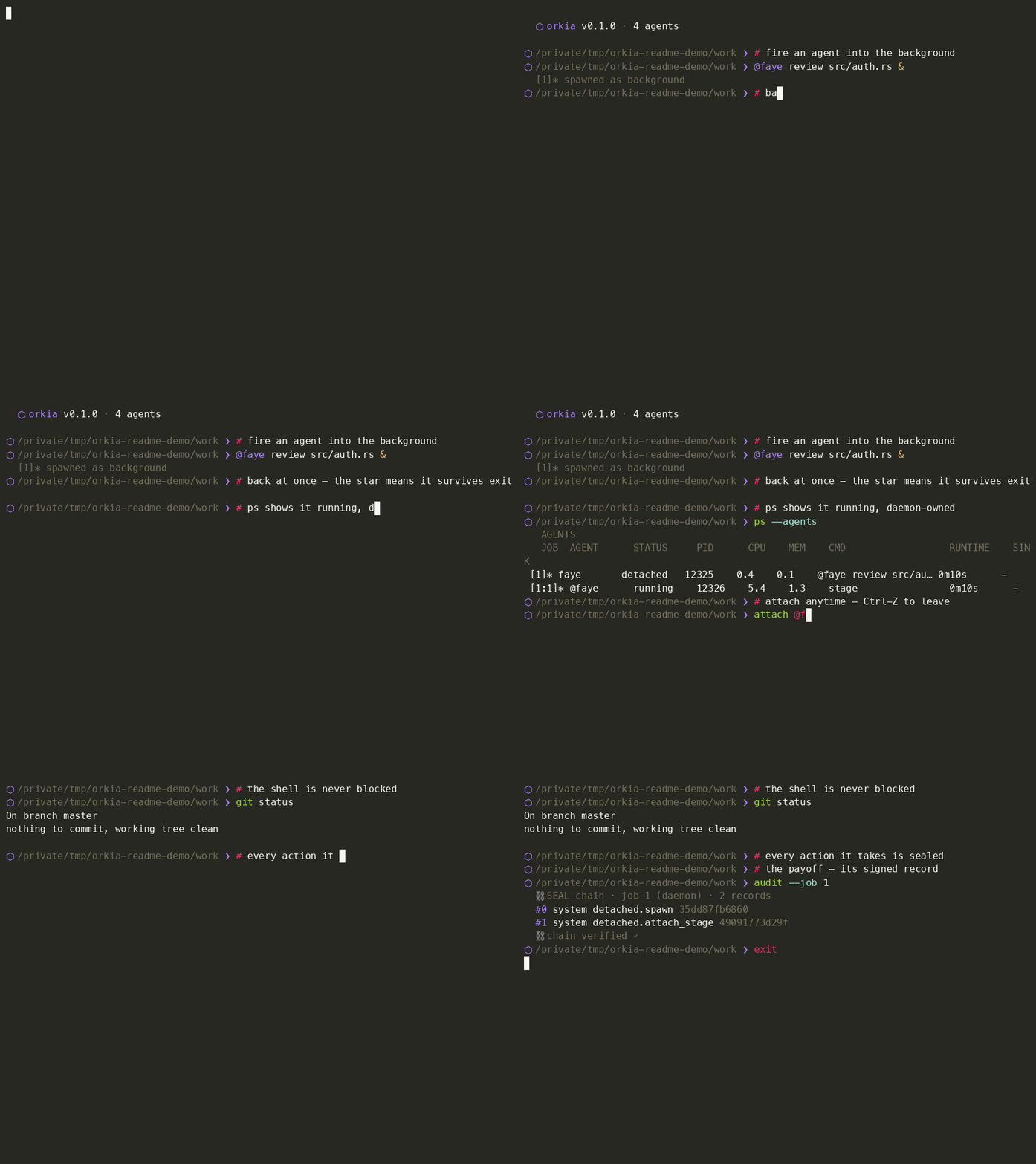
# Fire a coding agent into the shell as a real job. @faye is the
# engineering agent (backed by Claude Code; Codex- and Gemini-backed agents
# work the same way).
$ @faye refactor the auth module to use the new token type
[job 1] faye · running · pty/3

# It's a job. The REPL isn't blocked — list jobs while it works.
$ ps
 AGENTS
 JOB  AGENT   STATUS   CMD                                             RUNTIME
 1    faye    running  refactor the auth module to use the new token…  0m12s

# Do normal shell things in the meantime.
$ git status
On branch main
Changes not staged for commit:
  modified:   crates/orkia-auth/src/lib.rs

# When it's done, replay everything it did — on a signed, tamper-evident chain.
$ audit --job 1
⛓ SEAL chain · job 1 (faye) · 14 records · closed
  ...
⛓ chain verified ✓

# Or just verify the chain is intact, end to end.
$ audit verify --job 1
⛓ audit verify · job 1 (faye)
  ✓ 14 records · SHA-256 chain intact · verify ok
A representative session. Agent dispatch (
@faye …),ps, andauditare real commands; record counts and timings will differ from your run.
Nothing here phones home. Local-first, BYO key, runs offline.
Quickstart
Install the release binary with one command:
curl -fsSL https://orkia.dev/install | sh
orkia
The installer fetches a release binary, verifies its Ed25519 signature against
the published release key, and puts orkia on your PATH. Prefer to inspect
first? Pipe the script to a file and read it before running.
Once you're in: it's still your shell. ls, cd, pipes, and jobs all work —
orkia is built on the brush POSIX engine.
Prerequisites
The shell runs standalone, but firing an agent (@faye …) requires at least
one agent CLI installed and authenticated — Claude
Code, Codex, or Gemini. orkia
is bring-your-own-key: it never proxies your prompts or holds your
credentials.
Dispatching an agent
Every @agent you fire from the prompt is daemon-owned: it runs in the
orkia daemon, not the REPL, so it survives exit — relaunch the shell and
ps still lists it. Two independent choices shape a dispatch:
- Attachment — does your terminal splice onto the live agent TUI?
- Lifecycle — does the session stay alive after its turn, or run once and go?
These are orthogonal, so there are four foreground forms:
persistent (default) — idles after its turn, tell/attach-able until kill | one-shot (--once) — runs one turn, prints its final response, exits, is reaped | |
|---|---|---|
attached (default) — splices onto the live TUI (Ctrl-Z detaches) | @faye review src/auth.rs | @faye --once review src/auth.rs |
background (&) — returns to the prompt at once, no TUI | @faye review src/auth.rs & | @faye --once review src/auth.rs & |
All four are daemon-owned and survive shell exit; the only differences are
whether you land inside the session and whether it outlives its first turn.
& controls attachment only — a backgrounded agent is just as durable as an
attached one (it is not an in-process shell job that dies with the REPL).
For non-interactive launches (scripts, cron, cat file | orkia …), the same
daemon dispatch is reachable with the --detach flag:
orkia --detach -c '@faye --once review src/auth.rs' # fire and return; the job runs in the daemon
This is the same ownership as a prompt @faye — a different entry point, not a
stronger survival guarantee.
Build from source
# The shell has no system deps beyond a working libc. A debug build needs no
# extra configuration:
cargo build --bin orkia
./target/debug/orkia --version

# A --release build is locked to a production kernel key (SEC-003): it will not
# compile without ORKIA_KERNEL_PUBKEY_HEX set. For local release builds, export
# any 64-hex-char Ed25519 public key (SEAL chains just won't verify against the
# real kernel). See CONTRIBUTING.md for details.
export ORKIA_KERNEL_PUBKEY_HEX=<64-hex-char ed25519 public key>
cargo build --release --bin orkia
Source-available under Elastic License 2.0; plugin SDK and build tooling
under Apache License 2.0. Full per-crate breakdown in LICENSE.
What orkia is
orkia is an agentic shell that replaces bash/zsh and hosts AI agents (Claude Code, Codex, Gemini, and others) inside isolated PTYs. It is not an application — it is infrastructure. It runs 24/7, owns every agent process, every command, every workflow.
This workspace holds the shell core (REPL, classifier, router, SEAL), the
PTY/terminal engine, the TUI renderer, and the shared data types used across
the project. The CLI binary lives in bins/orkia.
Subsystems
Five subsystems carry the weight. Each maps to a directory so you know where code lives:
- RFC (
crates/orkia-rfc-*,bins/orkiarfcbuiltin) — the primary primitive. A short markdown+TOML contract describing what changes and why, used both to contribute to this repo and to drive work at runtime. Seedocs/rfc-primitive.md. - SEAL (
crates/orkia-shell/src/seal) — the signed, tamper-evident audit chain. Every agent job and project gets a hash-linked JSONL chain; replay and verify with theauditbuiltin. - Cage (
bins/orkia-cage,bins/orkia-sh) — the execution boundary that mediates what a running agent is allowed to do, command by command. cap(crates/orkia-capabilities,capbuiltin) — plan-to-capability resolution: which capabilities a given plan grants an agent.- Kernel client (
crates/orkia-kernel-*) — the local IPC client and trust anchor. The kernel daemon and its learned services are part of Orkia OS; this repo ships the client and a dev trust key.
The ATLAS coordinator and
oos-syslearned services referenced in design docs live in the commercial Orkia OS, not this repo (see the table below).
Architectural principles
The design follows a small number of non-negotiable rules (see CLAUDE.md for
the full text):
- Durability over speed of implementation. Channels and dedicated threads
beat
Arc<Mutex<T>>on shared state; pick the structurally sound option even when it costs more plumbing. - No band-aids on structural problems. If a component keeps growing workarounds, rewrite it.
- The REPL main loop is sacred. It never blocks on I/O other than user input; side effects happen on dedicated threads, and event draining runs every iteration.
- One owner per resource. PTY master fds, the alacritty
Termgrid, the journal store, agent job state — each lives behind exactly one thread/struct. Other code communicates by message-passing. - Treat every byte as untrusted. Bytes from a PTY, the journal socket, or user stdin are parsed defensively; malformed escape sequences must not crash the shell.
Crates
Shell core
crates/orkia-shell-types— shared types and trait definitions (Decision,Mode,ShellRenderer,AgentRouter,IntentClassifier,JobInfo,SealRecord,Workspace, …). No I/O, no business logic.crates/orkia-shell— the REPL, decision engine, brush-backed shell engine, classifier and router implementations, SEAL emitter, job controller, journal store, approval watcher, and agent context plumbing.crates/orkia-builtin— builtin commands (ps,aroute,approve,agent,briefing,rfc,issue,project,config,history,kill,migrate-rc, …).
Shared libraries
crates/orkia-entities-core— canonical entity types shared across the Orkia ecosystem (AgentCore,WorkspaceCore,IssueCore,RfcCore,SealRecordCore, …) and the wire-format envelopes for bootstrap/delta sync.crates/orkia-difficulty-scorer— prompt complexity scoring (structural + English-language signals) with no external dependencies, used for routing and tier selection.crates/orkia-model-catalog— canonical model capability catalog (ModelProfile,IntentQuality) with a seed function returning the built-in reference set.
PTY / terminal engine
crates/orkia-pty— generic PTY abstraction overportable-pty+alacritty_terminal. No engine logic.crates/orkia-terminal-core— the three-thread lock-free terminal engine (Reader / Extractor / Render) packaged behindTerminalEngine.crates/orkia-shell-tui—ratatui-basedShellRendererimplementation with sidebar, scrollable block log, input bar, and attached-PTY widget.
Binaries
bins/orkia— theorkiaCLI binary. Routes between shell mode (default), TUI mode (--tui), stdout mode (--no-tui, pipes, CI),-c <command>single-shot mode, and CLI subcommands (setup,migrate-rc,bridge,journal).
Build
The workspace uses Rust edition 2024 with MSRV 1.92, pinned in
rust-toolchain.toml. Install the toolchain via rustup —
the pinned channel is honoured automatically.
Building the shell
The orkia binary has no system dependencies beyond a working libc. Debug
builds need no extra configuration:
# Debug build — compiles with a dev kernel key, no env vars needed
cargo build --bin orkia
./target/debug/orkia --version

# Release build — requires the production kernel key (SEC-003). Export any
# 64-hex-char Ed25519 key for local builds; the official release sets the real
# one. See CONTRIBUTING.md ("Release builds need ORKIA_KERNEL_PUBKEY_HEX").
export ORKIA_KERNEL_PUBKEY_HEX=<64-hex-char ed25519 public key>
cargo build --release --bin orkia
./target/release/orkia --version
Building the full workspace (contributors)
Building --workspace additionally compiles orkia-forge-viewer-bin, a
Tauri-based desktop preview that pulls GTK/WebKit2 system libraries on Linux.
The shell itself does not need any of this — only run the workspace-wide
commands if you are working on orkia-forge-viewer*.
# Linux only — system deps for the forge-viewer Tauri build
sudo apt-get install -y \
  libgtk-3-dev libwebkit2gtk-4.1-dev libsoup-3.0-dev \
  libayatana-appindicator3-dev librsvg2-dev pkg-config

# Workspace build, tests, and lint (zero-warnings policy)
cargo build
cargo test --workspace
cargo clippy --workspace --all-targets -- -D warnings
cargo fmt --all --check
macOS contributors do not need the GTK packages — the Tauri build links against system frameworks already present.
Local brush development
The brush-core / brush-parser / brush-builtins dependencies are pinned to
a fork of the brush shell engine at a specific revision (5a50c12e at the
time of writing). For local development on brush itself, copy
.cargo/config.toml.example to .cargo/config.toml (gitignored) and ensure a
sibling ../brush/ checkout exists.
What's in this repo vs. Orkia OS
orkia is built as a shell core plus pluggable strategy traits. The shell defines the contracts; specific strategies (routing, classification, rendering, multi-agent coordination) are implementations. This repo ships the default, fully-functional implementations. The commercial Orkia OS package replaces them with learned, networked alternatives.
| Capability | This repo (source-available) | Orkia OS (commercial) |
|---|---|---|
| Shell core (REPL, jobs) | Full | (same — uses this crate) |
| PTY engine + terminal core | Full | (same — uses this crate) |
| Built-in commands | Full (ps, seal, aroute, rfc, …) | Adds kernel-daemon integration, contribute |
| Intent classifier | Heuristic (rules + regex) | Learned classifier (server-assisted) |
| Agent router | Heuristic (round-robin + trust hints) | Learned router (trust-weighted, per-tenant) |
| Shell renderer | ratatui TUI + stdout | GPU-rendered desktop app, web dashboard |
| SEAL audit chain | Local JSONL, signed | + cloud sync, multi-host verification |
| LLM provider integration | Anthropic, OpenAI, Gemini (BYO key) | + multi-vendor routing, cost optimization |
| Approval policy | Interactive approve / deny | + policy engine, RBAC |
| RFC workflow | Local + MCP | + multi-agent pipeline coordinator |
Everything in the left column works standalone with no dependency on proprietary code. You can run, install, and self-host the source-available shell indefinitely, subject to the per-crate licenses.
Status
orkia is 0.1.0 — pre-1.0, under active development. The core loop (shell,
agent jobs, ps/attach/tell, SEAL audit, RFC workflow, Cage) is the
load-bearing surface and is exercised by the acceptance suite. Some crates are
earlier-stage and scoped accordingly: the reasoning graph
(crates/orkia-reasoning-*) ships local-first but is QA-scoped, and the
Forge app builder (crates/orkia-forge-*) is a preview. Pre-1.0,
backwards-incompatible changes may land in minor bumps; see
CHANGELOG.md.
Upgrade path: Orkia OS plugs in by implementing the same traits this repo
defines (IntentClassifier, AgentRouter, ShellRenderer,
AgentPipelineCoordinator). The boundary is enforced by the type system — no
proprietary code touches this workspace's compilation graph. Verifiable with
cargo tree --workspace.
License
The orkia workspace is source-available under mixed licensing. Unless a crate
declares a more specific license, workspace crates are licensed under the
Elastic License 2.0 (Elastic-2.0); see LICENSE.
The plugin SDK and build tooling crates are licensed under the Apache License
2.0 (Apache-2.0):
crates/orkia-plugin-sdk— Rust plugin SDK.crates/orkia-plugin-sdk-macros— SDK proc macros.crates/orkia-plugin-build— plugin compiler/build artifact.
The primary shell product and core contract crates are licensed under the
Elastic License 2.0 (Elastic-2.0); see
LICENSE:
bins/orkia(orkia-cli) — theorkiashell binary.crates/orkia-shell— REPL, jobs, shell engine integration, classifier, router, journal, approval watcher, and local SEAL plumbing.crates/orkia-builtin— built-in commands for the orkia shell.crates/orkia-pty— PTY abstraction.crates/orkia-terminal-core— terminal rendering engine.crates/orkia-shell-types— shared shell contracts and trait types.crates/orkia-entities-core— shared ecosystem entity types.crates/orkia-value— shared value/type bridge.crates/orkia-rfc-core— RFC primitive, state machine, and persistence.crates/orkia-plugin— sandboxed plugin runtime host.bins/orkia-cage— execution-boundary launcher.bins/orkia-sh— command-mediation shell shim.crates/orkia-forge-build— local Forge build mechanics.crates/orkia-forge-permissions— Forge permission model.crates/orkia-forge-seal— Forge app SEAL chain.crates/orkia-forge-viewerandbins/orkia-forge-viewer— Forge viewer.crates/orkia-auth— auth primitives and provider boundary.crates/orkia-kernel-client— local kernel IPC client.crates/orkia-kernel-installer— kernel installer.crates/orkia-capabilities— plan-to-capability resolution.
Third-party / vendored components (brush, alacritty_terminal) are attributed in
THIRD_PARTY_LICENSES.md and NOTICE.
Transitive dependency licenses are enforced at build time by cargo deny check
against the allow list in deny.toml.
The code licenses grant you rights in the code; they do not grant rights in
the name or branding. Use of the "Orkia" name, logos, and product marks is
governed by TRADEMARK.md.