
Orkas — Desktop Multi-Agent AI Commander
Orkas-AI/Orkas
Orquestre equipes de agentes IA local-first, sem código, com seus próprios LLMs
Ver no GitHubAplicativo desktop open-source para construir e orquestrar equipes de agentes IA especializados através de uma única conversa. Funciona local-first (seus dados, chaves de API e conversas nunca saem da sua máquina), suporta múltiplos provedores de LLM (Claude, OpenAI, Gemini, DeepSeek, etc.) e permite que agentes evoluam autonomamente. Disponível para macOS, Windows e Linux.
Instalação
npx convez-ai Orkas-AI/Orkas1 comando no terminal: detecta o formato do repositório (marketplace ou plugin avulso) e instala via Claude Code. Requer Node 18+ e o Claude Code instalado.
Métricas
Casos de uso
- Automatizar relatórios e pesquisas de mercado com sub-agentes especializados
- Quebrar especificações de produto em tarefas distribuídas entre agentes
- Analisar documentos locais mantendo dados privados na máquina
- Orquestrar agents CLI existentes (OpenClaw, Claude Code, etc.) em workflows
Veredito

Orkas preenche um espaço único entre frameworks de código (CrewAI, LangChain) e plataformas SaaS: oferece orquestração multi-agente sem código, mantendo total soberania de dados. Ideal para profissionais que querem automação complexa com privacidade e flexibilidade de provedores de LLM.
README
A tradução para o português deste README ainda está na fila.
Orkas
Open-source, local-first desktop app to build and command a team of AI agents — in one chat, with your own LLM keys. Fully offline-capable. macOS · Windows · Linux.





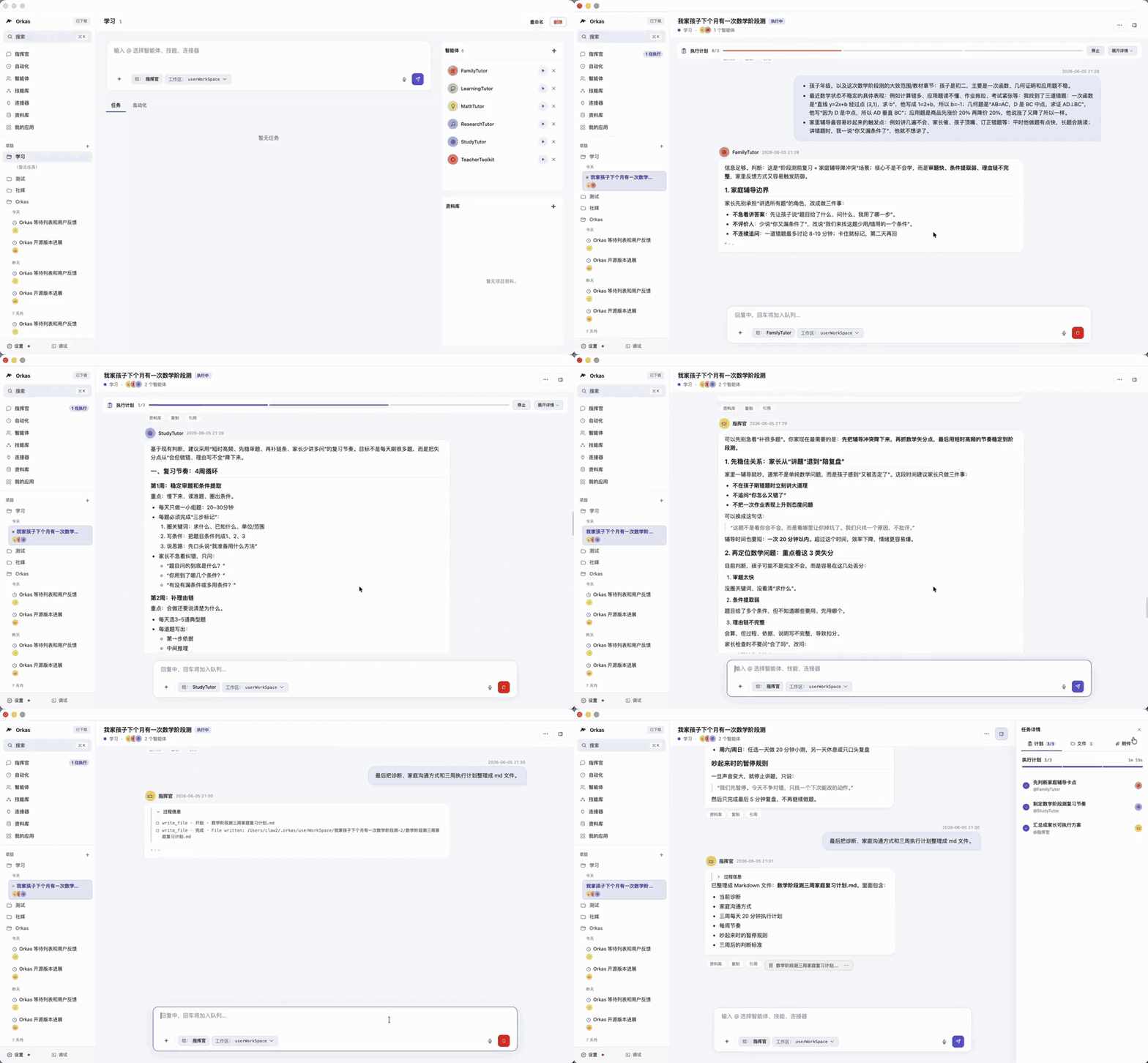
A commander LLM assembles a team of sub-agents and dispatches them in parallel or in series. Agents self-evolve through reflection. Your conversations, files, and API keys never leave your machine.
What is Orkas?
- What it is — a desktop GUI app where you build a team of specialized AI agents and command them through a single chat. Not a code framework, not a hosted SaaS.
- Local-first — conversations, files, API keys, knowledge bases, and custom agents all stay on your disk. Model calls go straight from your machine to the provider — never through Orkas servers.
- Multi-agent (lead + sub-agents) — one commander LLM dispatches sub-agents in parallel or in series; each agent has its own private skills and memory, and self-evolves after each task.
- Bring your own LLM keys — plug in Claude, OpenAI, Gemini, DeepSeek, Kimi, GLM, Qwen, MiniMax, or Doubao. Mix providers across agents. No vendor lock-in.
⭐ If Orkas is useful to you, a star helps more people find the project.
What can you build with it?
- Automate recurring reports & market research — a sub-agent that gathers, summarizes, and ships a weekly report.
- Turn a product spec into dev tasks — the commander breaks a PRD into tasks and dispatches them across agents.
- Chat with your documents & run local data analysis — drop files in, keep the data on your machine.
- Orchestrate existing CLI agents — OpenClaw, Hermes-Agent, Claude Code, Codex and other local CLI agents plug in as backends and take handoffs.
Download
- Get the app → orkas.ai (macOS · Windows installers)
- Run from source → see Quick start below
How Orkas compares
| Tool | What it is | How Orkas differs |
|---|---|---|
| LangChain | A developer framework/library for building LLM apps and agents — code-first, embedded in your own Python/JS app. | Orkas is a no-code desktop GUI: you assemble and command a team of agents through chat, not by writing orchestration code. Data and keys stay local by default. |
| CrewAI | A Python framework for orchestrating role-playing autonomous agents — you define crews and agents in code. | Orkas gives you the same multi-agent orchestration without code, in a desktop app, with local-first storage and per-agent self-evolution built in. |
| Cloud agent platforms (SaaS orchestrators) | Server-hosted; conversations, files, and API keys live on the vendor's infrastructure. | Orkas is local-first: everything stays on your machine, and model API calls go straight to the provider — never archived by Orkas. |
| OpenClaw | A single always-on personal assistant reaching you across messaging channels. | Orkas builds a team of specialized agents directed from one desktop chat — and OpenClaw plugs in as an Orkas CLI backend. |
| Hermes-Agent | Nous Research's self-improving personal agent (TUI + multi-channel gateway). | Orkas is desktop-GUI and team-shaped, with per-agent private skills and meta-cognition — and Hermes-Agent plugs in as an Orkas CLI backend. |
Orkas is for you if you want a team of agents (not one assistant), a desktop GUI with file drop-in and visual agent management, and your data, keys, and agents on your own disk rather than a vendor cloud.
Quick start
Prefer the packaged app? Use the production installer links:
- macOS Apple Silicon -> Orkas-mac-arm64.dmg
- macOS Intel -> Orkas-mac-x64.dmg
- Windows x64 -> Orkas-Setup.exe
To run from source:
Requirements: Node 20+ · Python 3 · macOS / Windows 10+ / recent Linux
git clone https://github.com/Orkas-AI/Orkas.git
cd Orkas
./run.sh           # macOS / Linux
run.cmd            # Windows
run.sh / run.cmd auto-installs dependencies and downloads the embedding model (~95 MB). First launch creates a workspace under ~/.orkas/ (macOS / Linux) or <smallest non-system drive>:\.orkas\ (Windows). Then open Settings → AI Providers to add an API key or OAuth.
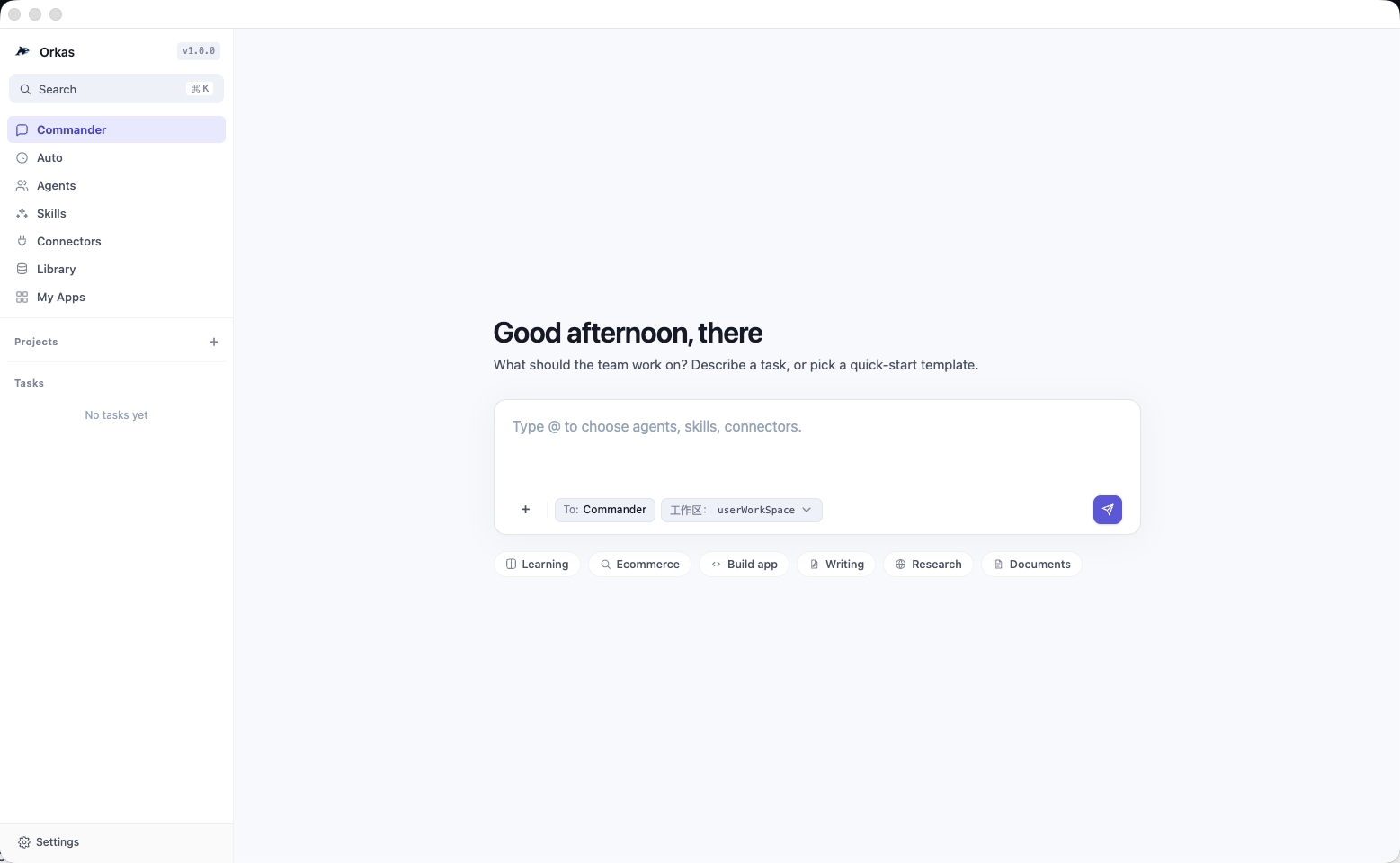
Screenshots
How it works (core design)
Full design and hard constraints →
CLAUDE.md
Group chat: visibility slicing + a single scheduling primitive
In one chat there's a commander, N agents, and you — but each agent does not see the same conversation.
- Visibility slicing — the main conversation is one full jsonl; each agent only gets a slice (
from==me ∨ to∋me ∨ mentions∋me). A worker never reads the full main conversation — saves tokens and prevents private context from leaking across agents. - One scheduling primitive — every dispatch (the commander's
dispatch_to, the user's@, plan steps) funnels into the sameenqueueprimitive. No parallel routing paths. - Shared plan — when agents collaborate, the commander writes progress into one
plan.md, visible to every member.
Agent dispatch: structured channels, not @ in prose
- Structured dispatch — commander↔agent dispatches go through the
dispatch_to({to, message})tool call;@in prose is not treated as a dispatch signal (the user's@is still recognized — UX unchanged). - Deferred wake-up — a
dispatch_toonly stages; the recipient wakes only after the commander's turn finishes, preventing premature execution. - Turn-based safety stop — the runaway guard counts turns (
MAX_WORKER_TURNS=100), not wall-clock time, so a slow-but-progressing LLM isn't killed.
Self-evolution: meta/ + self-managed skills
Each agent maintains, in its own directory:
meta/COMPETENCE.md— what it's good / not good at.meta/LEARNING_STRATEGIES.md— methods that have worked for it.
After each task the agent reflects and updates these; on the next task meta/ is fed back into the system prompt, so experience shapes the next run. Via the skill_manage tool an agent can also crystallize "how I solved X" into a private skill, reused directly next time.
Acknowledgments
Some core modules draw on these open-source projects — special thanks to: