
claude-agent-team
origen-ae/claude-agent-team
A ready-to-run agent team for Claude Code: 7 agents, an 8-stage serial workflow with human approval gates, a PRD/SPEC/TEST-PLAN/ADR/RUNBOOK document system, and an auto-generated status dashboard.
Instalação
npx convez-ai origen-ae/claude-agent-team1 comando no terminal: detecta o formato do repositório (marketplace ou plugin avulso) e instala via Claude Code. Requer Node 18+ e o Claude Code instalado.
Métricas
README
A tradução para o português deste README ainda está na fila.
🤖 Claude Agent Team
English · 简体中文
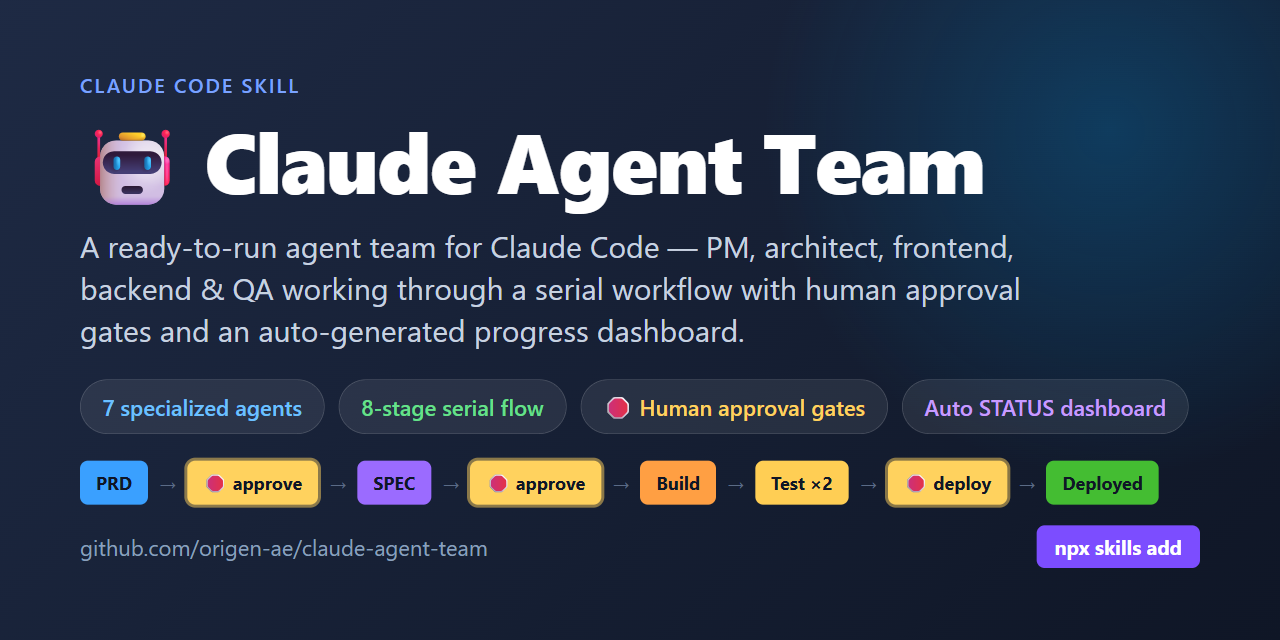
A ready-to-run agent team for Claude Code — PM, architect, frontend, backend & QA working through an 8-stage serial workflow with human approval gates, a shared document system (PRD/SPEC/TEST-PLAN/ADR/RUNBOOK/BACKLOG), and an auto-generated progress dashboard.




One assistant can write code. A team can ship it — with design, review, tests, and your sign-off at every gate. ⭐ Star this if it's useful.
7 agents · 8 stages · 3 human approval gates · 7 doc types · 0 external dependencies
Who it's for: solo developers orchestrating AI coding, small teams that want a repeatable AI dev process, and anyone who needs an auditable trail from requirement to design to tests to ship.
Contents: Why · Quick start · What you get · Dashboard · Worked example · How it's different · Contributing
What it is
Claude Agent Team scaffolds a complete, opinionated multi-agent development team into your project in one step. Instead of one assistant doing everything, you get seven focused agents that hand work off in a strict, reviewable order — and a dashboard that shows you exactly where every requirement stands.
Why
Multi-agent coding usually breaks down in predictable ways:
- Progress is a black box — you can't tell what's done, in progress, or stuck.
- Agents freelance — they skip design, invent APIs, and step on each other.
- No human checkpoints — work barrels past the points where you'd want to approve.
- Docs scatter — requirements, design, and tests drift apart.
This skill fixes all four: a serial flow, mandatory approval gates, a centralized auto-generated dashboard, and an ID-paired document system.
Quick start
Via plugin marketplace:
- Add the marketplace:
/plugin marketplace add origen-ae/claude-plugins - Install:
/plugin install claude-agent-team - In your project, tell Claude Code: "set up an agent team in this project."
Via git clone:
- Clone the skill into your skills directory:
# Global — available in all projects: git clone https://github.com/origen-ae/claude-agent-team.git ~/.claude/skills/claude-agent-team # Or project-local: git clone https://github.com/origen-ae/claude-agent-team.git .claude/skills/claude-agent-team - In your project, tell Claude Code: "set up an agent team in this project."
Then: approve the scaffold, install dependencies, and run your first requirement through the 8 stages.
Installing into a project that already has
.claude/settings.json? The scaffold is merged key-by-key, not overwritten: setenv.CLAUDE_CODE_EXPERIMENTAL_AGENT_TEAMS=1, union the existingpermissions.denylist, and append the PostToolUse hook. A.bakbackup of yoursettings.json(andCLAUDE.md) is taken first.
What you get
| Agent | Responsibility | Key output |
|---|---|---|
| pm | Requirements + progress roll-up | PRD + STATUS |
| architect | Tech design, decisions | SPEC, ADR |
| frontend | UI implementation | code + component tests |
| backend | API/business logic | code + unit tests |
| qa | Test design & execution (2 rounds) | TEST-PLAN, E2E |
| reviewer | Code review (subagent) | review report |
| librarian | Doc retrieval (subagent) | search results |
flowchart TD
    A[User request] --> B[PM writes PRD]
    B -->|🛑 approve| C[Architect writes SPEC]
    C -->|🛑 approve| D[Frontend // Backend build + self-test]
    D --> E[QA round 1 + Playwright E2E]
    E --> F[QA round 2: regression + fix verification]
    F -->|🛑 approve| G[Done: merge-ready]
    G --> H[PM rolls up → STATUS.md / status.html]
The dashboard
Every agent only updates a stage field in each doc's frontmatter; scripts/build_status.py aggregates them by requirement ID and regenerates STATUS.md and status.html. A PostToolUse hook runs a cross-platform Python entry (scripts/refresh_status.py) on every docs/*.md edit — working identically on Windows, macOS, and Linux — so the board is never stale.
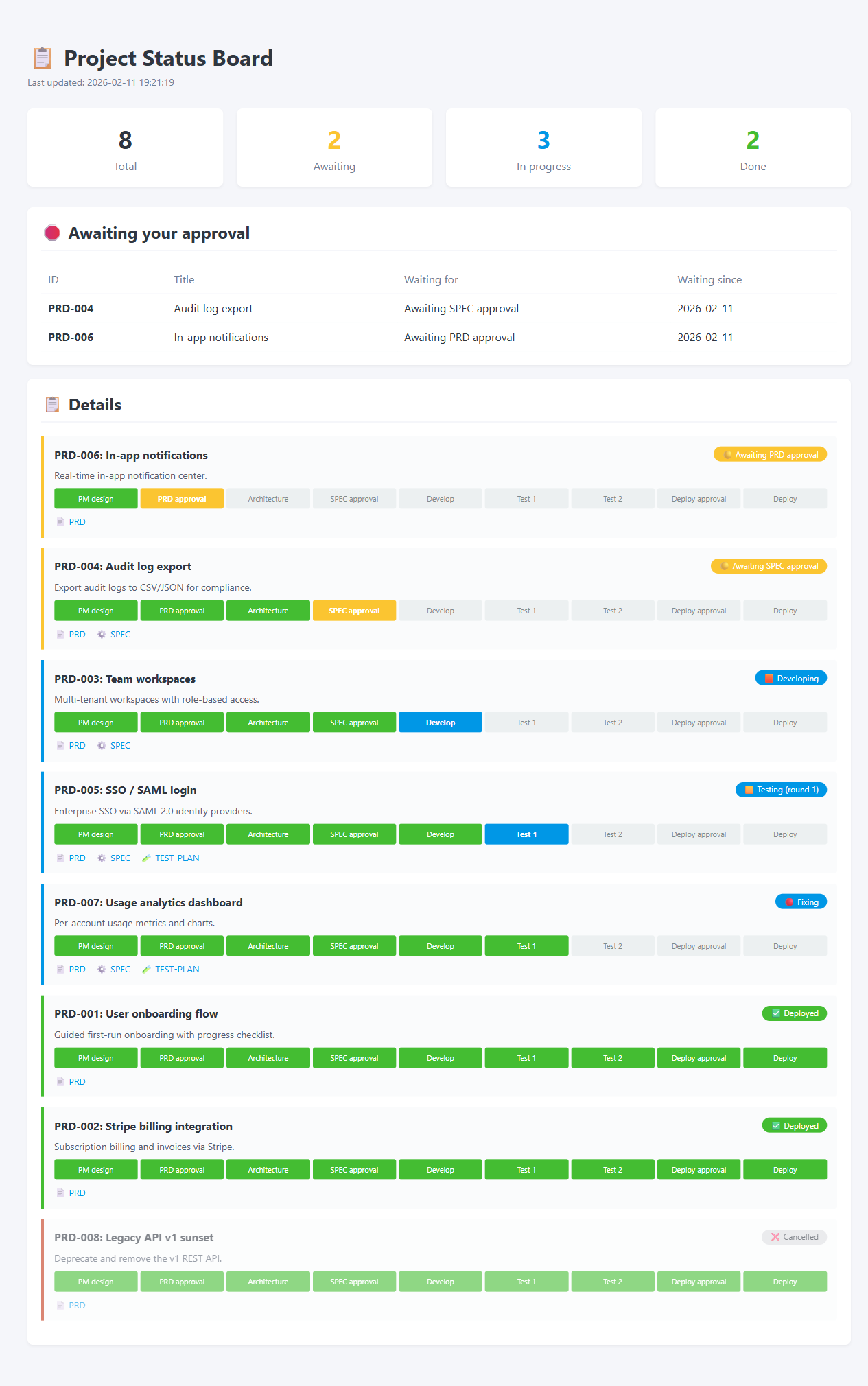
Each requirement shows a live progress bar across all milestones — done, current, and pending:

What a session looks like
You: "Add points-based checkout discounts."
- PM drafts
PRD-008— features, prototype, business flow, data flow → 🛑 waits for your approval. - You approve. Architect writes
SPEC-008— API, data model, task breakdown → 🛑 waits for your approval. - You approve. Frontend and Backend build in parallel, each spawning reviewer when done.
- QA writes
TEST-PLAN-008+ Playwright E2E and runs round 1; failures bounce back to dev asfixing. - QA reruns regression (round 2) → 🛑 waits for your ship approval.
- You approve → Done (approved & merge-ready). Every stage change refreshes the dashboard automatically.
At each 🛑 the team stops and waits — you stay in control, and the board always shows who's doing what.
Worked example
Want to see the actual output? examples/loyalty-points-checkout/ holds the real, filled-in documents the team produced for one shipped feature — not templates:
PRD-001 → SPEC-001 → TEST-PLAN-001
The same ID threads through all three, and the test plan even records a real round-1 failure (a cents-rounding bug) and its verified round-2 fix.
How it's different
| Single Claude | Ad-hoc subagents | Claude Agent Team | |
|---|---|---|---|
| Specialized roles | ❌ | ⚠️ improvised | ✅ 7 defined agents |
| Serial orchestration & handoffs | ❌ | ❌ | ✅ 8-stage flow |
| Human approval gates | ❌ | ❌ | ✅ PRD · SPEC · ship |
| Centralized progress board | ❌ | ❌ | ✅ auto-generated |
| ID-paired docs (PRD→SPEC→tests) | ❌ | ❌ | ✅ |
| Right-sized flow (S/M/L tiers) | ❌ | ❌ | ✅ small changes skip the ceremony |
| Built-in E2E test layer | ❌ | ⚠️ | ✅ Playwright |
Bundled skills
After scaffolding, two additional skills land in your project's .claude/skills/ and are immediately usable:
| Skill | Trigger | Purpose |
|---|---|---|
/doc-conventions | any agent creating or editing a doc | Frontmatter format, ID pairing rules, stage enum, modification rules |
/playwright-testing | QA writing or running E2E tests | File layout, JSDoc header, locator priority, run commands |
These are project-local — they don't require a separate install and are automatically picked up by Claude Code.
Browse the agents
You don't have to install anything to read the design:
- Agents · Bundled skills · Doc templates
- Full design: workflow · roles · document system · scenarios · FAQ
Requirements
Claude Code (agent teams) and Python 3 (for the dashboard scripts and the PostToolUse hook — the hook is pure Python and runs on Windows, macOS, and Linux alike, with no POSIX shell, Git Bash, or WSL needed). Optionally Node + Playwright for the E2E layer.
The team delivers approved, tested, merge-ready code. Running CI/CD and the actual production deploy stay your responsibility — migration/rollback scripts and the RUNBOOK are produced for you, but no stage executes them.
Upgrading
Via plugin marketplace: /plugin update claude-agent-team
Via git clone:
cd ~/.claude/skills/claude-agent-team && git pull # adjust path if project-local
The skill trigger and scaffolding logic update immediately. Already-scaffolded projects won't auto-update — agent definitions and templates were copied into your project at install time. The installed version is stamped into your project as an HTML comment marker (<!-- claude-agent-team: vX.Y.Z -->) at the top of the project's CLAUDE.md, so you can always tell what you're running. To pick up changes from a new version, do a selective diff/merge of assets/ against your .claude/ directory — your own docs/ are never touched. See CHANGELOG for what changed between versions.
Uninstall
The scaffold owns a known set of paths: .claude/agents/*, .claude/skills/doc-conventions, .claude/skills/playwright-testing, scripts/*.py, docs/_templates/, playwright.config.ts, plus the agent-team block it appends to .claude/settings.json and CLAUDE.md. To remove it cleanly: restore .claude/settings.json and CLAUDE.md from the .bak backups taken at install, then delete the skill-owned paths above. Your own docs/ requirements are yours to keep. Tip: install on a clean git tree or a dedicated branch so a git checkout is a reliable one-command rollback.
Working as a team
Sharing the scaffold across a team has its own protocol — commit .claude/ as shared truth (don't have everyone install separately), claim doc IDs with scripts/next_id.py on the integration branch before branching, and so on. See the "Multi-Developer Mode" section in your project's CLAUDE.md for the full workflow.
Add this to the target project's .gitignore:
# claude-agent-team generated artifacts
status.html
docs/index.yaml
playwright-report.json
__pycache__/
Only the integration branch commits STATUS.md.
Security
Security is handled at the layers the team actually controls:
- Design time — for any feature touching auth, money/balances, PII, file uploads, or untrusted input, the architect's SPEC includes a "Security & abuse cases" section (a lightweight STRIDE pass: each threat → mitigation → the test that verifies it). That drives qa's negative tests and the reviewer's scrutiny.
- Review time — the reviewer runs a security deep-dive on sensitive diffs (authorization on every mutation / no IDOR, injection, secrets & PII, money/state integrity, new dependencies).
What stays yours (CI): consistent with the delivery boundary, dependency/supply-chain scanning and SAST run in your CI, not the agent team. Recommended:
# in your own CI, on PRs
- run: npm audit --audit-level=high      # or: pip-audit
# optional static analysis:
# - uses: github/codeql-action/analyze   # or semgrep
Also enable Dependabot or Renovate so new/transitive dependencies get CVE alerts. A dedicated security agent is intentionally not included — it's heavy for a small team; the design-time + review-time coverage above is the high-value, in-scope part.
Contributing
Issues and PRs welcome — see CONTRIBUTING.md. If this saves you time, please ⭐ star the repo — it genuinely helps others find it.
Topics:
claude-codeclaudeai-agentsmulti-agentagentic-workflowclaude-code-skill
Star history
License
MIT — see LICENSE.