
workways
noahjohnson0/workways
Workways: agentic workflows, skills, and methods for AI coding agents. Battle-tested Claude Code patterns you scaffold into your own repo with npx.
Instalação
npx convez-ai noahjohnson0/workways1 comando no terminal: detecta o formato do repositório (marketplace ou plugin avulso) e instala via Claude Code. Requer Node 18+ e o Claude Code instalado.
Métricas
README
A tradução para o português deste README ainda está na fila.
Agentic workflows, skills, and methods for AI coding agents. Battle-tested patterns pulled out of real Claude Code projects and packaged so you can drop them into your own. Most clusters ship a ready-to-use .claude/ skill or a CLAUDE.md-linkable method, so your agent picks up the capability the moment it lands: drive a real logged-in browser, run parallel e2e suites, attach screenshots to PRs, see UI options side by side.
Distributed as a scaffolder, not a runtime dependency: npx workways add <cluster> copies the files into your repo so you own and edit them, instead of depending on workways at runtime.
Demo
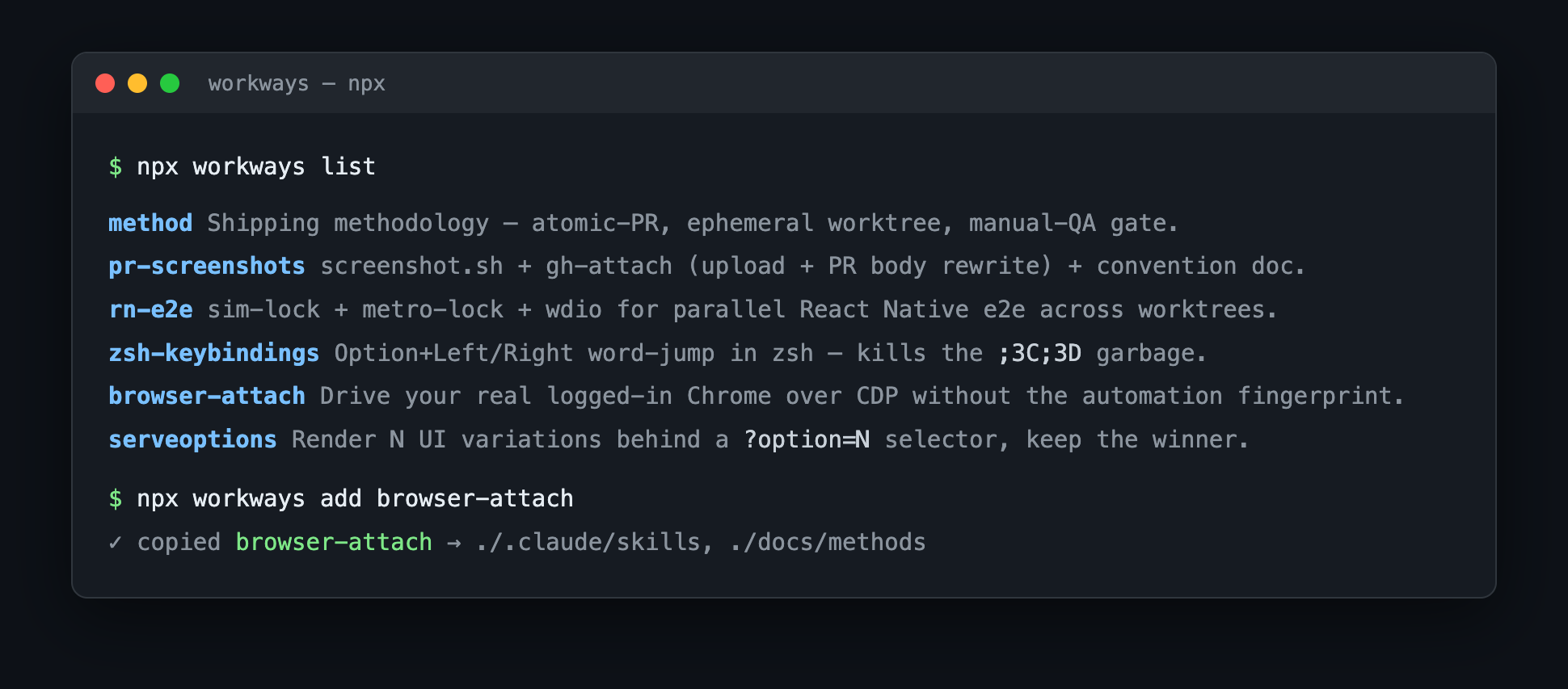
Quickstart
npx workways list                  # see available clusters
npx workways add pr-screenshots    # copy one cluster into cwd
npx workways add --all             # copy everything
Flags: --dest <dir>, --force, --dry-run.
Clusters
method
Shipping methodology: atomic-PR, ephemeral worktree, manual-QA gate, PR-screenshot rule. Drops a docs/methods/ Markdown bundle you can adapt and link from your CLAUDE.md / CONTRIBUTING.md.
pr-screenshots
End-to-end pipeline for embedding screenshots/videos in private-repo PR descriptions:
scripts/screenshot.sh— iOS-sim screenshot helper, names by branch + routescripts/record-webm.mjs— record a headless webm of a local page with Playwright, optionally driving a control on a timer (cycling aserveoptionspicker, demoing a flow); yields stills from the same runscripts/gh-attach/— Playwright wrapper that borrows your Chrome session, uploads togithub.com/user-attachments, and rewrites the PR body in placedocs/methods/pr-screenshots.md— the conventiondocs/methods/headless-webm.md— the headless-recording gotchas (recordVideo on the context, close-to-flush, VP8→VP9 re-encode, size vs deviceScaleFactor)
rn-e2e
Full parallel-Appium-on-iOS toolkit for React Native / Expo apps — run multiple e2e suites concurrently from separate worktrees without sim, Metro, or DerivedData collisions:
scripts/sim-lock/— auto-discovers a free iOS sim from a candidate list, boots it, holds a UDID-keyed lock; exportsIOS_UDID/IOS_DEVICE_NAMEscripts/metro-lock/— allocates a free Metro port from a range, holds a port-keyed lock;with-derived-data.shredirects XcodeDerivedDatainto a per-worktree dir so parallelexpo run:iosbuilds don't corrupt each otherscripts/e2e/run-with-metro.sh— spawnsexpo starton the locked port, waits for/status, runs wdio, tears Metro down on exit (E2E_METRO_EXTERNAL=1to skip)e2e/— wdio + Mocha harness with per-spec webm recording (startRecordingScreen→ ffmpeg →e2e/recordings/), native-build and Expo-Go wdio configs, accessibility-id selector helpers, and aversion-footerspec that asserts build-mode-aware version stringsdocs/methods/parallel-appium.md— composition diagram, the Metro-port-baked-into-.appgotcha (and thebuildReactNativeFromSource: trueworkaround), and conventions for reserving a sim for manual QAdocs/proof/PARALLEL-VALIDATION.md— captured evidence from cumbreTrial #82/#87: two worktrees, two sims, two Metros,login-invalidgreen on both concurrently withlsofshowing each app on its own bundler port
browser-attach
Drive the user's real, logged-in Chrome over CDP instead of letting an
automation MCP spawn its own flagged browser. The automation fingerprint
(navigator.webdriver + the "controlled by automated test software" banner)
comes from the --enable-automation launch switch, not the CDP connection — so
attaching to a human-launched Chrome looks like an ordinary browser. Ships a
Claude skill with lazy-loaded per-site subskills:
.claude/skills/browser-attach/SKILL.md— the attach setup (debug port + non-default profile for Chrome 136+,--browserUrlMCP arg, restart) and the scrape-with-evaluate_scriptworking pattern.claude/skills/browser-attach/sites/ebay.md— Akamai/sch"Access Denied" and the search-from-homepage workaround; result selectors; query params.claude/skills/browser-attach/sites/facebook.md— Marketplace login, location-scoped URLs, "Partner listing" ≠ local, scroll-to-load, obfuscated- class scraping.claude/skills/browser-attach/sites/_new-site.md— stub for the next sitedocs/methods/browser-attach.md— the method, including what it does/doesn't defeat (beats the flag; not Akamai/Cloudflare/Turnstile or Google sign-in)
zsh-keybindings
Fix Option+Left / Option+Right in zsh so they jump word-by-word (matching Claude Code, browsers, and every native macOS text field). Without this you get garbage like ;3C;3D in your prompt.
shell/option-arrow.zsh— drop-inbindkeyrules;sourcefrom~/.zshrcdocs/methods/zsh-keybindings.md— explainer with debugging tips for non-standard terminals
serveoptions
Make a visual/UX decision by seeing it. Generates N meaningfully-distinct variations of a UI feature, drops a floating dev-only selector pill that cycles them via a ?option=N URL param, and serves locally so you pick the winner in the browser. After you choose, the selector and losing options are stripped, leaving only the chosen implementation.
.claude/skills/serveoptions/SKILL.md— the workflow (build options → wire selector → serve → keep the winner)
godot
Verify a Godot 4.x change by seeing it, plus the co-op + dedicated-server lessons that cost real debugging time. Godot's --headless mode runs a dummy DisplayServer (no window) but still renders internally, so you can capture the viewport to a PNG from a headless boot, on CI, a VM, or a remote shell where an OS screen-grab is blocked.
.claude/skills/godot-shots/SKILL.md— the agent workflow and the capture pattern that actually produces a clean frame (settle N process frames so GI/fog/shadows finish,await RenderingServer.frame_post_draw, thenget_viewport().get_texture().get_image().save_png())scripts/godot-shot/dev_shots.gd— drop-in autoload: parses--shot <name>, runs your registered scene setup, captures, quitsscripts/godot-shot/godot-shot.sh/.ps1— wrapper that finds the Godot binary, rebuilds the class-name cache (--import, else a fresh checkout dies with "Identifier not declared"), runs the shot, and copies PNGs to./shots/docs/methods/godot-coop.md— the gotchas: bumpPROTOCOL_VERSIONwhen the@rpcsurface on an always-present node changes (the checksum-mismatch trap),set_multiplayer_authorityafteradd_child,call_localreliable RPCs for shared state, headless still needslibX11/libGLlinked, mount a volume foruser://,HeightMapShape3DoverConcavePolygonShape3Dfor terrain, MultiMesh-batch repeated props
prose-voice
Kill the tells that make writing read as AI-generated. The giveaway is sentence shapes (antithesis, aphorisms, rhetorical-question reveals, em-dash asides), not vocabulary, so banning hype words alone never fixes it. Drops a banned-constructions checklist plus a scanner that flags the mechanical tells and fails non-zero, so it slots into pre-commit or CI.
docs/methods/writing-voice.md— the checklist, with before/after rewrites, and the flat-technical default registerscripts/prose-scan.mjs— dependency-free Node scanner:node scripts/prose-scan.mjs content/**/*.md
Philosophy
Scaffold, don't depend. Half of this is bash + Markdown — that has to live in your repo anyway. The Node/Playwright pieces you'll want to customize. Owning the files makes both natural.
License
MIT