
Heed
nibbletech-labs/heed
Monitor de estado para agentes IA locais via arquivo JSON atualizado
Ver no GitHubDaemon que monitora sessões de agentes IA (Claude Code, Codex) em execução local e expõe seu estado via arquivo JSON. Permite que orquestradores, agentes irmãos e ferramentas consultem status, transcrições e eventos de sessões de forma estruturada e em tempo real.
Instalação
npx convez-ai nibbletech-labs/heed1 comando no terminal: detecta o formato do repositório (marketplace ou plugin avulso) e instala via Claude Code. Requer Node 18+ e o Claude Code instalado.
Métricas
Casos de uso
- Orquestrador coordenando múltiplos agentes filhos
- Agente lendo transcrição de sessão irmã para sumarização
- Barra de status/tmux mostrando carga de sessões ativas
- Notificador alertando quando sessão aguarda entrada do usuário
Veredito

Ferramenta sólida em Rust para integração e observabilidade de agentes IA locais. Contrato bem definido via arquivo JSON torna fácil construir orquestradores e ferramentas que dependem dele; demanda instalação manual e conhecimento técnico.
README
A tradução para o português deste README ainda está na fila.
Heed
A daemon that watches the AI agent sessions running on your machine — Claude Code, Codex, others — and exposes their state as a file that other programs can read.
heed install once, and from then on ~/.heed/state.json contains, for every active session, what it's currently doing (working, awaiting input, idle), what tool it just ran, where its transcript lives, and a few other useful fields. Tools (or other agents) consume that file. Humans get a CLI on top — heed status, heed watch, heed tui — but those are debug surfaces; the file is the contract.
A few things this is useful for:
- An orchestrator wanting to know which of its child agents needs input before routing the user
- An agent that wants to read a sibling agent's transcript path so it can summarise or coordinate
- A status line or tmux bar showing how many sessions are busy
- A notifier that pings you when any session goes to
awaiting input
Install
You need Rust (rustup).
cargo install --git https://github.com/nibbletech-labs/heed
heed install
Prebuilt binaries appear on GitHub Releases once a tag is pushed. A Homebrew tap is planned.
heed install writes hook entries into ~/.claude/settings.json and ~/.codex/config.toml, drops some shell scripts under ~/.heed/, and starts a small daemon in the background. Re-running it is safe. To remove everything, heed install --uninstall.
On macOS, heed install --service-install writes a launchd plist so the daemon comes back at login.
The state file
~/.heed/state.json is the consumption surface. Schema is versioned. Updated within ~100ms of any event. Writes are atomic, so readers never see partial data.
{
  "schema_version": 1,
  "updated_at": 1778605400.5,
  "threads": {
    "claude:ce4f-...": {
      "cli": "claude",
      "activity": "awaiting_input",
      "liveness": "live",
      "subtitle": "Picking 3 options",
      "transcript_path": "/Users/.../<uuid>.jsonl",
      "cwd": "/Users/.../some-project",
      "pid": 67891,
      "last_event": 1778605400.0
    }
  }
}
Consume it however suits you: poll it, watch the parent directory with notify / fswatch, or shell out to heed status --json if you want a CLI wrapper with a stable interface.
Human CLI
For when you want to glance at it yourself:
heed status              # coloured snapshot
heed watch               # refreshing
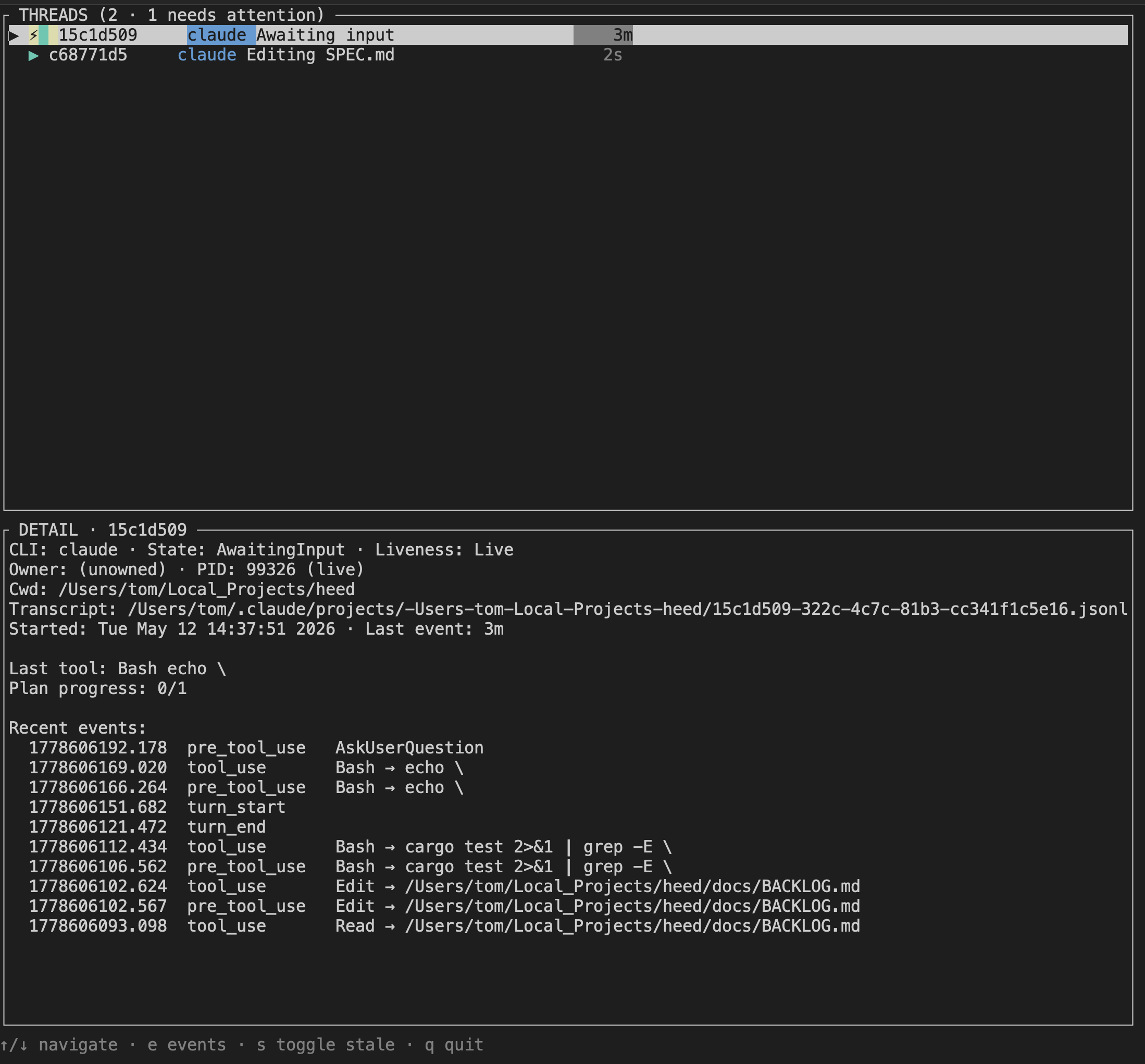
heed tui                 # interactive split-pane (below)
heed events --follow     # raw event tail
How it works
Claude and Codex fire shell hooks at known session lifecycle points. Heed installs scripts at those hooks; each one appends a JSON line to ~/.heed/events.jsonl. A small daemon tails that file, runs the events through a state machine, polls process liveness, and writes the result.
hooks/*.sh  →  ~/.heed/events.jsonl  →  heedd (daemon)  →  ~/.heed/state.json  →  consumers
                                            ↑
                                  ~/.heed/owners.json (overlay)
owners.json is an optional metadata file consumers can write to tag threads with their own product/session ids (so an orchestrator can filter state.json down to its own children). The heed owner register CLI (or writing owners.json directly) sets it.
Limits
Heed watches activity, not output. It doesn't capture or surface assistant text (beyond a one-line check on the last reply to decide whether the assistant ended its turn with a question), doesn't track tokens or cost, and doesn't orchestrate anything. If a consumer wants the actual transcript, the path is in state.json and it can read the JSONL directly.
License
MIT — see LICENSE.