
Ella — Agente IA Autônomo Chief-of-Staff
newmindsgroup/ella-claude-code-ai-agent
Chief-of-staff IA autônomo, multi-tenant, pronto para produção em VPS barato
Ver no GitHubMCP server que implementa um agente autônomo baseado em Claude Code para funcionar como assistente executivo de negócios. Inclui integração Telegram, orquestração de 21 sub-agentes especializados, memória persistente, dashboard em tempo real e automação de tarefas operacionais. Pronto para deploy em VPS com Ubuntu em menos de uma hora.
Instalação
npx convez-ai newmindsgroup/ella-claude-code-ai-agent1 comando no terminal: detecta o formato do repositório (marketplace ou plugin avulso) e instala via Claude Code. Requer Node 18+ e o Claude Code instalado.
Métricas
Casos de uso
- Assistente executivo para founders e consultores
- Triagem inteligente e delegação de tarefas via Telegram
- Automação de pipelines operacionais e propostas estratégicas diárias
Veredito

Solução robusta e production-ready para automação empresarial com Claude Code. Excelente para operações solo ou pequenas equipes que buscam escalar via IA; requer familiaridade com deploy em VPS e config YAML, mas documentação é clara.
README
A tradução para o português deste README ainda está na fila.
Ella — Claude Code AI Agent for Any Business
An autonomous, single-tenant AI chief-of-staff agent built on Claude Code. Talks via Telegram. Runs on a $20/mo VPS. Replicable for any business in under one hour.



Designed and built by Daniel Gonell — brand, UX & AI systems consultant.
📐 This is a template repository — the canonical source of truth. Click Use this template (or clone it) to start a deployment. Deployed agents are consumers: they pull updates into their own deployment and never push back here. See
AGENTS.mdfor the rules agents follow.
What this is
This repo is a production-grade, idempotent installer + multi-tenant template for standing up an autonomous Claude Code AI agent for any business. The reference implementation runs a personal-brand consulting agent on Telegram. The same stack works for a fractional CMO, an agency owner, a SaaS founder, or a solo law firm by changing one config file.
What you get when you deploy this:
- An always-on chief-of-staff agent that triages every message you send via Telegram, delegates specialist work to 21 sub-agents (5 hand-built patterns + 16 cherry-picked from the agency-agents MIT collection), and never forgets a commitment via a persistent task ledger.
- A brand-voice + brand-visual single source of truth (voice playbook + DESIGN.md) that voice-aware sub-agents read before drafting any human-facing copy or visual artifact. Banned phrases never ship.
- A knowledge graph (Graphify) the agent queries instead of grepping, plus Firecrawl MCP for web scraping, search, and structured extraction. Weekly auto-rebuild keeps the graph current with zero LLM cost.
- A morning-brief / proposed-moves system: every morning the agent posts 2–3 strategic proposals to Telegram with Run/Skip buttons. You tap. It executes via the right sub-agent.
- A proactive notification pipeline — 7 watchers that ping you when something needs attention without you having to ask. Task deadlines, goal pace, stalled deals, disk space, hot leads in inbox, calendar conflicts, brand drift. All event-driven, all dedup-logged, all dirt cheap (no LLM-per-check on 4 of them).
- Agent self-service ops — 5 sudoers-gated wrapper scripts let the agent update its own Claude Code binary, deploy the website, restart services, reload nginx, install systemd units WITHOUT your password. The wrappers are the audit boundary — raw sudo is still locked down.
- An autonomous deploy command: edit a YAML spec, send
/deploy v1.2.3from your phone, get one approval prompt after smoke tests pass, tap Ship. Code commits, pushes, and rolls out. - A public-facing dashboard behind basic-auth (Mission Control) showing real-time agent activity, task ledger, telemetry, goals, and per-task cost. Opens inline as a Telegram Mini App via
/dashboard— no browser switch. - Voice round-trip — Telegram voice notes get transcribed by local Whisper (auto-detects English vs Spanish), processed, and replied to via edge-tts audio. Three modes (
off/reply/always) persisted via/voice. - Channels-plugin patches (5 passes) — local TS patches to the upstream Telegram bot plugin add Ship/Hold/Revise on drafts, Run/Skip on proposals, Reply/Archive/Snooze on emails, forward-detection metadata, and the deploy callback flow. All idempotent + sentinel-checked.
- End-to-end smoke test —
bash {agent_home}/scripts/smoke-test.shruns 60+ checks across 12 sections (services, timers, scripts, plugin patches, bot identity, watchdog state, voice stack, knowledge graph). Re-runnable any time. Useful as a cron health check or after any system change.
What this is NOT:
- ❌ A wrapper around the Claude API. This runs on Claude Code with an Anthropic Max/Pro/Team subscription. ToS-clean. No API keys.
- ❌ A prompt-engineering project. Claude Code is the brain — this is infrastructure + governance + business-tier integrations around it.
- ❌ A SaaS. There's no hosted version. You deploy on your own VPS. You own everything.
Quick links
| If you want to... | Read |
|---|---|
| See the architecture end-to-end | docs/architecture.md |
| Install the agent on your laptop (local dev) | docs/install-local.md |
| Install the agent on a VPS (production) | docs/install-vps.md |
| Customize for a new business / client / tenant | docs/tenant-customization.md — also vps-setup/PORTING.md |
| Understand how the agent decides which tool to use | docs/tool-leverage-heuristics.md |
| Lock down brand voice + visual identity | docs/voice-and-visual-ssot.md |
| See every external dependency and why | docs/upstream-dependencies.md |
| Add the agent stack to an existing project (just the rituals layer) | agent-stack/README.md |
Architecture in one diagram
                 Phone (Telegram)
                        │
                        ▼
            ┌─────────────────────────┐
            │  Telegram Bot Channel   │   ← claude-code-plugins official + local patches
            │  (your @YourAgentBot)   │       (callback_data, voice notes, mini-apps)
            └────────────┬────────────┘
                         │
                         ▼
        ┌────────────────────────────────────┐
        │  Chief-of-Staff Agent              │   ← Claude Code in tmux, systemd-managed
        │  /opt/{tenant}/agents/             │      (CLAUDE.md = behavioral spec,
        │                                    │       rendered from agent-template)
        │  ┌──────────────────────────────┐  │
        │  │ Triage rules                 │  │   ← trivial / specialized / conversational / ambiguous
        │  │ Tool-leverage heuristics     │  │   ← when to fire firecrawl, graphify, sub-agents
        │  │ Task ledger                  │  │   ← state machine: proposed→committed→done
        │  │ Memory recall                │  │   ← knowledge-graph MCP across sessions
        │  └──────────────────────────────┘  │
        └────────────┬───────────────────────┘
                     │
       ┌─────────────┼─────────────────────────────────────────┐
       ▼             ▼                  ▼                      ▼
   Sub-agents   MCP tools         Brand canon            Public dashboard
   ─────────    ─────────         ───────────            ────────────────
   • 16 from    • GHL/HubSpot     • Voice playbook       • blueprint.{your-tld}
     agency-      (your CRM)      • DESIGN.md              (Cloudflare + nginx +
     agents     • Firecrawl       • Messaging              basic-auth + 60s pull)
   • Hand-      • Graphify          framework            • {your-tld}/dashboard
     built      • Memory MCP                                (Mission Control,
     domain     • Filesystem                                 telemetry, tasks,
     experts    • Playwright                                 goals, proposals)
                • Chroma RAG
The agent reads its behavioral spec (CLAUDE.md), looks at incoming messages, decides which tools and sub-agents to fire, executes work, narrates progress to the task ledger (which pings the user via Telegram), and emits proposals to act on tomorrow's moves.
What's in this repo
ella-claude-code-ai-agent/
├── README.md                          ← you are here
├── LICENSE                            ← MIT
├── agent-stack/                       ← Portable installer (works for any project, not just VPS)
│   ├── scripts/                         00-prereqs → 09-install-graphify, install-all, verify-all
│   ├── config/                          client.example.env, CLAUDE.md.template (engineering rituals)
│   ├── agency-agents-installer/         install.py + manifest + voice-paths.example.json
│   └── docs/per-server/                 chroma, fetch, filesystem, memory, playwright, superpowers
├── vps-setup/                         ← Multi-tenant agent template (production)
│   ├── PORTING.md                       end-to-end "spin up this stack for a new business"
│   ├── agent-template/                  CLAUDE.md.tmpl + scripts + dashboard + nginx + systemd + tasks
│   ├── tenants/EXAMPLE_TENANT.yml       comprehensive example tenant config (~150 lines, fully documented)
│   ├── scripts/                         render-tenant.sh, bootstrap-tenant.sh, health.sh, smoke.sh, preflight.sh
│   ├── runbooks/                        operating-principles.md (the 7 commitments)
│   └── mcp-patches/                     idempotent patch-applier for vendored MCP servers
├── docs/                              ← Deep-dive documentation
│   ├── architecture.md                  system architecture, file flow, service health
│   ├── install-local.md                 laptop install (Mac/Linux dev) — 15 min
│   ├── install-vps.md                   VPS install (production) — 60 min from blank Ubuntu
│   ├── tenant-customization.md          per-business customization
│   ├── tool-leverage-heuristics.md      when to fire which tool (the autonomy playbook)
│   ├── voice-and-visual-ssot.md         brand voice + DESIGN.md pattern
│   └── upstream-dependencies.md         every git repo / npm package / pypi package this depends on, with why
├── examples/                          ← Drop-in templates for any new tenant
│   ├── DESIGN.md                        blank Stitch 9-section visual SSOT template
│   ├── AGENTS.md                        blank brand-context template
│   └── voice-playbook.example.md        blank voice-DNA + banned-phrases template
└── CONTRIBUTING.md
Quick start (60-second TL;DR)
Local install (laptop)
# 1. Make sure Claude Code is installed and authenticated
claude --version
claude auth status

# 2. Clone this repo
git clone https://github.com/newmindsgroup/ella-claude-code-ai-agent.git ~/ella
cd ~/ella

# 3. Configure
cp agent-stack/config/client.example.env agent-stack/config/client.env
$EDITOR agent-stack/config/client.env

# 4. Install
bash agent-stack/scripts/install-all.sh

# 5. Drop the brand-voice + visual templates into your project repo
cp examples/AGENTS.md examples/DESIGN.md examples/voice-playbook.example.md /path/to/your/project/
That gives you the rituals + sub-agents + MCPs + brand-voice infrastructure in any Claude Code session.
VPS install (production always-on agent)
See docs/install-vps.md — the short version is:
# On a clean Ubuntu 22.04+ VPS, as root (from the cloned repo):
git clone https://github.com/newmindsgroup/ella-claude-code-ai-agent.git /tmp/ella
cd /tmp/ella

cp vps-setup/tenants/EXAMPLE_TENANT.yml vps-setup/tenants/<your-tenant-id>.yml
$EDITOR vps-setup/tenants/<your-tenant-id>.yml

# ONE command: render, create user, install Node/Claude, copy files, activate
# ops, install systemd units, AND (step 7d) install every capability —
# Graphify, MCP servers, agency-agents, Firecrawl, the memory-v2 embedding
# daemon, the Obsidian crontab, Mission Control, and all 31 timers.
sudo bash vps-setup/scripts/bootstrap-tenant.sh vps-setup/tenants/<your-tenant-id>.yml

# Authenticate the subscription, then re-run the capability installer ONCE so the
# auth-dependent pieces (Superpowers, MCP servers, Graphify skill) finish:
sudo -u <linux_user> -H claude login
sudo bash vps-setup/scripts/install-capabilities.sh vps-setup/tenants/<your-tenant-id>.yml
install-capabilities.sh is idempotent and re-runnable — it's the one to run if a deploy ever looks incomplete (no Graphify, no Obsidian, missing timers). Verify with vps-setup/scripts/post-deploy-verify.sh (now includes a capability-coverage section).
Then point your domain's DNS at the VPS and you have a fully autonomous always-on agent reachable via your Telegram bot in ~60 minutes from blank Ubuntu.
Fresh-client deploy (v0.4+) — local Claude orchestrates the whole thing
For deploying a new client agent on a fresh VPS, the recommended flow is local-Claude orchestrated. You open Claude Code in a workspace folder, give it the client's credentials + brand context, and Claude SSH's to the VPS and walks through every step (DNS, TLS, Telegram, systemd, smoke test). About 30 minutes from "I have credentials" to "first morning brief fires."
mkdir -p ~/code/<client>-workspace && cd ~/code/<client>-workspace

# Get the latest templates
git clone --depth=1 https://github.com/newmindsgroup/ella-claude-code-ai-agent /tmp/ella-tmp
cp /tmp/ella-tmp/examples/client-credentials.template.md client-credentials.md
cp /tmp/ella-tmp/NEW-CLIENT-CLAUDE.md NEW-CLIENT-CLAUDE.md

# Fill in credentials + write a client-context.md
$EDITOR client-credentials.md     # tick every checkbox at the bottom
$EDITOR client-context.md         # paragraphs about the brand, voice, business

# Open Claude Code in the workspace and say:
#  "Deploy a fresh agent for this client following NEW-CLIENT-CLAUDE.md"
claude
Full runbook (12 phases, dependency-ordered): vps-setup/DEPLOY-NEW-CLIENT.md. Pre-flight check that validates every credential before mutating state: vps-setup/scripts/preflight-new-client.sh.
What makes this different
| Feature | Why it matters |
|---|---|
| Single-tenant, owned by you | Your VPS, your data, your Anthropic subscription. No SaaS vendor between you and your agent. |
| ToS-clean | Built on Claude Code with a normal Anthropic Max/Pro/Team subscription. No API keys. No third-party brain wrappers. No grey-zone token reselling. |
| Multi-tenant template | One config file (tenant.yml) drives every business-specific value. The engine is identical across tenants. Stand up a new client in under an hour. |
| Brand voice as code | The voice playbook is a markdown file the agent reads before every draft. Banned phrases are absolute. No more catching "thrilled to" in copy review. |
| Visual SSOT (DESIGN.md) | Companion to AGENTS.md. AI tools (Cursor, v0, Lovable, Claude Code) read it before generating UI. Same aesthetic across every project. Reusable as a client deliverable. |
| Strategic tool autonomy | The chief-of-staff has explicit Tool-Leverage Heuristics in its CLAUDE.md mapping common situations to tool combos. It reaches for incident-response-commander when production breaks. It runs /graphify proactively before answering big-picture codebase questions. You don't memorize tool names. |
| Real engineering discipline | operating-principles.md is non-negotiable: idempotent installs, dry-runs before production changes, append-only audit logs, no force-push to main. The kind of discipline a real ops shop runs on. |
| Mobile-first UX | Designed to be operated entirely from your phone via Telegram. Voice notes work. Inline approval buttons. Mini-apps for the dashboard. Voice round-trip in English/Spanish (extensible). |
The 21-strong sub-agent roster
The agent has a curated set of specialists it auto-routes to via "Use PROACTIVELY when..." description triggers — you don't memorize names, you describe what's needed.
Hand-built patterns (project-scoped — the examples live in vps-setup/agent-template/CLAUDE.md.tmpl; replace with your own):
comms-agent— client-facing emails, Telegram replies, short social postspipeline-agent— read-only CRM analysis, deal status, stalled-deal flaggingcontent-agent— long-form drafting (newsletter, blog posts, scripts)research-agent— prospect lookup, competitive intel, public web researchdrift-scanner— audits recently published content for banned phrases / brand drift
Cherry-picked from msitarzewski/agency-agents (MIT) — installed by scripts/07-install-agency-agents.sh:
- Engineering:
ai-engineer,autonomous-optimization-architect,incident-response-commander,sre,code-reviewer,database-optimizer - Multi-agent / orchestration:
agents-orchestrator,workflow-architect,agentic-identity-trust,identity-graph-operator - Content production (voice-aware — defer to brand voice playbook):
linkedin-content-creator,carousel-growth-engine,ai-citation-strategist,document-generator - Visual / production gate:
image-prompt-engineer,reality-checker
The cherry-pick list is in agent-stack/agency-agents-installer/manifest.json — edit and re-run to add/remove.
Three-tier sub-agent delegation (v0.6+)
The 21-agent roster above is Tier 1. v0.6 adds two more tiers for genuinely multi-step work.
| Tier | What | When to use | Cost |
|---|---|---|---|
| Tier 1 | Agent tool sub-agents (21 specialists) | Multi-context investigation, parallelizable work, anything where 2-4 agents can fan out in their own context windows | Within Anthropic subscription |
| Tier 2 | Domain swarms via swarm-router.sh | Task matches a known shape: bizdev (prospect → research + outreach + proposal), content (idea → drafts), delivery (client deliverables), onboarding (kickoff + intake) | claude --print per step (~$0.01-0.05) |
| Tier 3 | VRSEN/OpenSwarm (optional) | Heavy-lift media generation: slides, video, image-gen, data analysis, 10K+ integrations via Composio | Variable, can be expensive |
Tier 3 is opt-in. Enable with features.multi_agent_swarms: true in tenant.yml + run installers/openswarm/install-openswarm.sh during deploy.
The agent's CLAUDE.md.tmpl includes a Tier decision matrix that the LLM consults before delegating — so it picks the cheapest tier that can do the job.
For long-running independent work (10+ min audits, deep research), the agent uses the v2026+ claude agents background flags (--add-dir, --settings, --mcp-config, --effort high, --permission-mode bypassPermissions) so the parent session stays responsive.
Mission Control — the observability dashboard (v0.7+)
Mission Control is the agent's single-pane-of-glass: a self-hosted dashboard at https://<your-subdomain>/, behind nginx HTTP basic-auth, that shows everything the agent is doing, how long it's taking, what it's costing, and what it would have cost a human. It also opens inline as a Telegram Mini App via /dashboard — no browser switch on mobile.
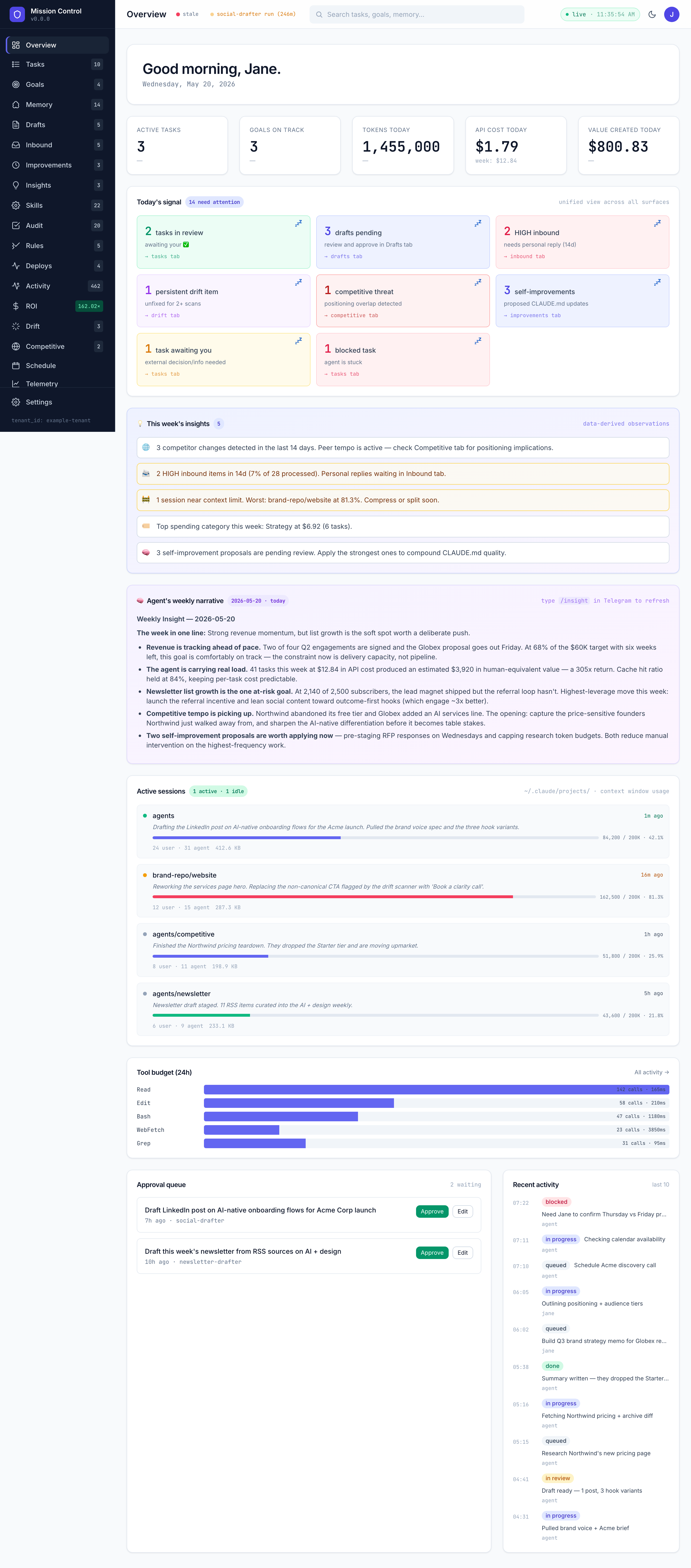
📸 Full visual tour of all 20 views:
docs/mission-control.md. (All screenshots are from a demo tenant with synthetic data — no real client information.)
Architecture: a single-file SPA (dashboard/index.html, Tailwind, no build step) reads ~15 /api/*.json snapshots regenerated by dashboard-sync.sh, plus a FastAPI write-action backend (dashboard-chat/server.py, bound to 127.0.0.1:8001) for the interactive bits. A Server-Sent-Events channel (/api/chat/events) pushes live updates so the page reacts in real time.
The 20 views
| View | What it shows |
|---|---|
| Overview | Greeting + date, live-agent indicator, KPI strip (open tasks, drafts, goals, today's spend), Tool Budget widget, cache-attribution KPI, latency widget, circuit-breaker banner |
| Tasks | The task ledger — every task with state, deadline, and per-task cost |
| Goals | Outcome goals with target dates, progress bars, behind-pace flags |
| Memory | The SQLite memory vault — facts, decisions, relationships, preferences, patterns, commitments, goals, context |
| Drafts | Pending drafts awaiting review (LinkedIn, email, newsletter, etc.) |
| Inbound | High-priority inbound email/messages, triaged |
| Improvements | Self-improvement review output — what the agent proposes to do better |
| Insights | Strategic insights + saved recommendations |
| Skills | The skill registry with one-click Run buttons |
| Audit | Append-only audit log of every write action the agent took |
| Rules | The behavioral rules engine — active YAML rules, last-fired times, Run-now |
| Deploys | The /deploy lifecycle state machine (started → preflight → smoke → ready → shipped) |
| Activity | Live agent-action feed (SSE-driven) |
| ROI | Per-task-type return-on-investment — agent cost vs. human-equivalent cost, with realization-rate adjustment |
| Drift | Brand-drift scan results (banned phrases, off-brand language, entity leaks) |
| Competitive | Competitive-monitor diffs (pricing/positioning/hiring changes on tracked sites) |
| Schedule | Calendar view — today + upcoming, conflicts surfaced |
| Telemetry | Token usage, daily spend history, model mix, anomaly markers |
| Chat | Full chat with the agent — streaming, voice, attachments (see below) |
| Settings | Per-tenant configuration surfaced read-only |
The observability stack under the hood
This is the part most agent frameworks don't have — full, OpenTelemetry-conformant accounting of every action:
- Spans (
_spans.py) — an OTel GenAI-conformant SQLite span store.session-parser.pyingests~/.claude/projects/*.jsonlevery 2 minutes (idempotent viatool_use_idprimary keys, 30-day hot window with auto-prune). Every tool call, sub-agent, and skill run becomes a span with input/output/cache token counts. - ROI (
_roi.py) — per-task-type ROI math with arealization_rate(Superkind/METR methodology): agent cost vs. what the same work would cost at a human hourly rate. None of the OSS observability projects surveyed ship per-skill ROI — this is industry-first. - Rules engine (
rules-engine.py) — a YAML-DSL evaluated every 5 minutes. Operators (>=, >, ==, in, contains, …) and actions (telegram,audit,log,circuit_breaker). Ships with 5 starter rules (drift-persistent-escalate, inbound-high-pileup, cost-spike-escalate, anomaly-cost-z-spike, budget-ceilings). - Anomaly detection (
anomaly-detect.py) — rolling z-score + EWMA over token history every 30 minutes. 2σ = noteworthy, 3σ = extreme. - Cost circuit breakers (
_budget.py) — hard daily cost ceilings. When breached, watchers enter "frugal mode" and skip LLM calls until reset. Extend-only, fail-open on corrupt state. - Deploy state machine (
_deploy_states.py) — validates every/deployphase transition against a frozen graph, so a half-finished deploy can't silently sit forever.
The ROI view turns all of this into one number — agent cost vs. human-equivalent cost, per task type:
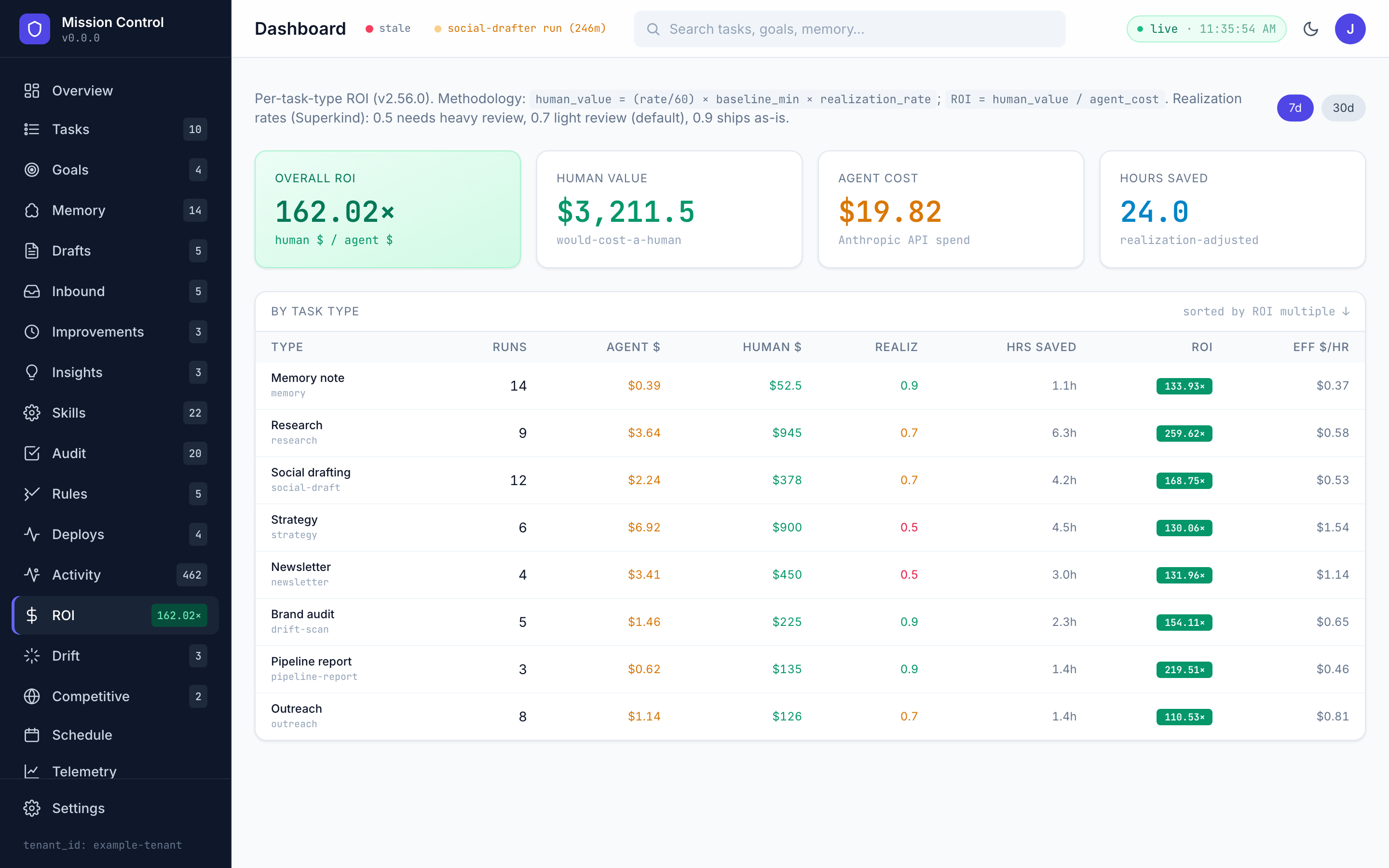
All of it is opt-in via tenant.yml flags (mission_control_v0_7, enable_rules_engine, enable_anomaly_detection, enable_session_parser, enable_circuit_breakers, enable_observability_dashboard) and validated by a 62-test pytest suite that runs with no VPS dependencies (CI-safe).
Methodology draws on OpenTelemetry GenAI Semantic Conventions, the agent-telemetry-spec taxonomy, and ROI realization-rate research (Superkind, METR HCAST).
Telegram ↔ dashboard chat parity (v0.8+)
The dashboard Chat view and Telegram are now two windows onto the same conversation — use whichever is in front of you and they stay in sync.
- Unified store (
dashboard-chat/_conversation.py) — one SQLite conversation thread is the single source of truth, with each message tagged by source (dashboard / telegram / voice), role, tokens, and cost. Both surfaces read and write it. - Streaming rich text —
POST /api/chat/streamdoes SSE token-delta streaming with a blinking caret + Stop button, markdown + fenced-code rendering, and per-message copy/regenerate. - Bidirectional mirror — outbound Telegram messages (briefs, watcher nudges, replies) appear in the dashboard via a
tg-send.shtee; dashboard chat exchanges mirror to Telegram (loop-safe). A new channels-plugin PASS 6 captures inbound Telegram messages into the unified store. - Voice — browser mic → whisper.cpp transcription → text; agent reply → edge-tts → audio, with a per-message 🔊 speak button and an auto-voice toggle.
- Files + images — paperclip attach + paste-image, 30 MB cap with an allowlist, path-traversal-safe serving. Files land under the agent's home so it can read them; images render inline.
Net effect: a tenant can run their entire relationship with the agent from a phone (Telegram) or a desktop (Mission Control chat) interchangeably, with full history either way.
Proactive notification pipeline (v0.3+)
The agent doesn't just respond — it pings you when something needs attention. Seven watchers run on systemd timers, each with its own cadence and dedup strategy:
| Watcher | Schedule (tenant TZ) | What it watches | Cost-per-run |
|---|---|---|---|
task-deadline-watcher | hourly 08–22 | tasks/active.json deadlines crossing 24h / 4h / due / overdue | local file (free) |
goal-deadline-watcher | daily 09:30 | goals/active.json — 7d / 1d / overdue windows + behind-pace check (>25% gap between time-elapsed and progress) | local file (free) |
stalled-deal-watcher | daily 10:00 | GHL opportunities ≥$2K (default) idle ≥7d (default) | 1 GHL REST call (free) |
disk-space-watcher | every 4h, around the clock | All filesystems — 75% yellow / 85% orange / 95% red, escalating dedup windows | local df (free) |
hot-lead-inbox-watcher | 4×/day (12/16/20/00) | Gmail threads in lookback window, cross-referenced against GHL contacts | claude --print + GHL REST (~$0.01) |
calendar-conflict-watcher | 3×/day (07/12/17) | Overlapping events on primary calendar, today + lookahead | claude --print (~$0.01) |
graphify-rebuild | weekly Sunday 03:00 | AST-only refresh of the project-repo knowledge graph | local (free) |
Each watcher logs to notifications/<name>-nudges.jsonl for dedup + audit. Disable any of them via features.<watcher_name>: false in tenant.yml.
The architectural lesson — when an LLM is required (Gmail, Calendar), do the split LLM/bash design: LLM does ONE tool call → returns JSON, bash does all downstream filtering / cross-referencing / formatting / sending. Single-purpose prompts succeed reliably; multi-step prompts under sparse data sometimes short-circuit.
Agent self-service ops (v0.3+)
The agent on the VPS can update itself, deploy the website, restart services, and install systemd units without your password. Capabilities are gated through 5 auditable wrapper scripts in {{TENANT_AGENT_HOME}}/scripts/ops/, not raw sudo to arbitrary commands. Every wrapper validates inputs, logs to /var/log/{{TENANT_LINUX_USER}}-agent-ops.log, and pings Telegram on completion.
| Wrapper | What it does |
|---|---|
ops-claude-update.sh | Updates @anthropic-ai/claude-code global npm package, verifies 5 channels-plugin patches survive, pre-prunes watchdog history, restarts agent, runs smoke test, pings Telegram |
ops-website-deploy.sh [--no-build] [--skip-deps] | pnpm install (optional) + pnpm build (optional) + restart website systemd service + HTTP probe + Telegram confirm |
ops-service-restart.sh <name> | Restarts any allowlisted systemd service (strict allowlist: agent + watchers + nginx + dashboard-chat + agent-skill@*). Refuses sshd, cron, anything outside the agent stack |
ops-nginx-reload.sh | nginx -t first (refuses reload on bad config), then zero-downtime systemctl reload nginx |
ops-systemd-install-unit.sh <src> <name> | Copies a unit from {{TENANT_AGENT_HOME}}/... to /etc/systemd/system/, daemon-reload, auto-enable timers |
The sudoers entry (/etc/sudoers.d/{{TENANT_LINUX_USER}}-agent-ops) is a single line: {{TENANT_LINUX_USER}} ALL=(root) NOPASSWD: {{TENANT_AGENT_HOME}}/scripts/ops/. Adding a capability = adding a wrapper (auditable). Emergency lockdown = rm /etc/sudoers.d/{{TENANT_LINUX_USER}}-agent-ops.
Still locked down (deny list in settings.json): /etc/**, /var/www/**, ~/.ssh/**, ~/.claude.json writes; reboot, shutdown, passwd, useradd, chown, chmod 777; all rm -rf / flavors.
Telegram polish — the 5 channels-plugin patches
The upstream Telegram bot plugin's callback handler only recognizes perm: patterns. Five idempotent local patches add additional callback routing for every approval flow in the stack:
| Pass | Pattern | What taps do |
|---|---|---|
| v2.22.2 | deploy:(ship|cancel):v<MAJ>.<MIN>.<PATCH> | Ship/Cancel buttons on /deploy approval messages |
| v2.24.0 | draft:(ship|hold|revise):t-YYYYMMDD-xxxx | Ship/Hold/Revise on every draft surfaced to Telegram |
| v2.27.2 | prop:(run|skip):p-YYYYMMDD-aaaa | Run/Skip on morning-brief Proposed Moves cards |
| v2.27.3 | forward_origin metadata | Surfaces forwarded-message provenance so agent auto-offers to save to memory |
| v2.27.4 | email:(reply|archive|snooze):<gmail-thread-id> | Reply/Archive/Snooze action buttons on /inbox triage cards |
All 5 patches re-apply on every claude-agent.service start via ExecStartPre={{TENANT_AGENT_HOME}}/scripts/patch-channels-plugin.sh. Sentinel-checked; multi-pass-aware; verified TS-compiles after each pass. Adding a sixth callback flow = adding a sixth pass following the documented pattern.
Upstream dependencies (what makes this work)
This repo is architecture + governance + glue — not original code for the most part. Full inventory in docs/upstream-dependencies.md. The non-negotiable ones:
| Dependency | What | Why |
|---|---|---|
| Claude Code (Anthropic) | The brain | The whole stack runs on it. Max/Pro/Team subscription. |
| Superpowers | Engineering rituals plugin | Planning, TDD, systematic debugging, verification, code review |
| agency-agents (MIT) | 16 cherry-picked sub-agents | Specialist coverage across engineering, marketing, design, testing |
| Graphify | Code/doc → knowledge graph | Agent navigates by graph instead of grepping |
| Firecrawl MCP | Web scraping + structured extract | JS-rendered scrapes, bulk crawls, AI-search visibility audits |
| VoltAgent/awesome-design-md | DESIGN.md format | Visual SSOT format AI tools read most reliably |
@modelcontextprotocol/server-memory | Persistent knowledge graph MCP | Cross-session memory |
@modelcontextprotocol/server-fetch | Single-URL HTML→markdown reads | Light web reads (Firecrawl handles the heavy lifting) |
@modelcontextprotocol/server-filesystem | Scoped filesystem operations | Bounded file access |
@playwright/mcp | Headless browser automation | Smoke tests + complex scrapes |
| Chroma | Local vector RAG | Embeddings over project knowledge library |
| whisper.cpp | Local transcription | Telegram voice notes → text |
| edge-tts | Text-to-speech | Voice replies via Telegram |
| GoHighLevel-MCP (or your CRM's MCP) | CRM integration | Email templates, social posts, contacts, calendar — example uses GHL; swap for HubSpot / Salesforce / Pipedrive MCPs as needed |
License
MIT — see LICENSE. Use it for your business, your clients' businesses, anywhere.
The cherry-picked sub-agents from msitarzewski/agency-agents are also MIT. Each MCP server has its own license — check the upstream repos.
Author
Ella is designed and built by Daniel Gonell — a brand, UX, and AI-systems consultant who builds autonomous tools that let small teams operate like large ones.
The architecture, install scripts, and agent-stack baseline were distilled from a production single-tenant agent Daniel runs for his own consulting practice. The chief-of-staff template, task ledger, proposed-moves system, voice round-trip, memory layer, and Mission Control dashboard were battle-tested across a long live release cycle before being generalized into this multi-tenant template.
- Website / portfolio: danielgonell.com
- Questions, ideas, or "I deployed this and here's what happened" → open a GitHub issue
Acknowledgements
Built on top of work by:
- Anthropic (Claude Code, MCP spec, official MCP servers)
- Jesse Vincent (Superpowers plugin, agentic skills patterns)
- Safi Shamsi (Graphify)
- Maciej Sitarzewski (agency-agents)
- VRSEN (OpenSwarm — 8-specialist multi-agent framework)
- VoltAgent (awesome-design-md / DESIGN.md format)
- Mendable (Firecrawl)
- Upstash (Context7 — live library docs MCP)
- Microsoft (Playwright MCP)
If your work is in here and you'd like better attribution or want it removed, open an issue.
Status
v0.8.0 — feature-complete for autonomous multi-tier delegation + full observability. Memory layer v2, Discord command center, Obsidian mirror, 3-tier sub-agent system, OpenSwarm integration, Mission Control observability stack (rules engine + anomaly detection + ROI/cost tracking), and Telegram ↔ dashboard chat parity (streaming, voice, attachments) — all available, all opt-in via tenant.yml feature flags. Battle-tested in a production single-tenant deployment; the multi-tenant orchestrator (NEW-CLIENT-CLAUDE.md + INTERVIEW.md + DEPLOY-NEW-CLIENT.md) takes a fresh client from blank VPS to a verified green deploy.
See CHANGELOG.md for the full release history.
Issues, PRs, and "I deployed this for company X and here's what broke" reports are all welcome.