
Atlas Tasker
myrrazor/atlas-tasker
Jira no terminal para agentes de IA e versionamento git
Ver no GitHubSistema de rastreamento de tarefas baseado em terminal, otimizado para agentes de IA (Claude Code, etc). Oferece funcionalidades de Jira — quadros kanban, dependências, gates de revisão, histórico de auditoria — como arquivos markdown locais + índice SQLite, sem servidor ou conta. Integra-se nativamente com agentes via MCP para reivindicar tickets, desbloquear dependências e orquestrar fluxos de trabalho.
Instalação
npx convez-ai myrrazor/atlas-tasker1 comando no terminal: detecta o formato do repositório (marketplace ou plugin avulso) e instala via Claude Code. Requer Node 18+ e o Claude Code instalado.
Métricas
Casos de uso
- Orquestração de fluxos de trabalho para agentes de código (Claude, etc)
- Rastreamento de tickets e dependências sem servidor externo
- Auditoria e versionamento de histórico de tarefas via git
- Gerenciamento de filas de trabalho para múltiplos agentes simultâneos
Veredito

Ferramenta bem arquitetada e pronta para produção, preenchendo um vazio real na orquestração de agentes de IA. A abordagem local-first com markdown + SQLite é robusta e alinha-se bem com fluxos de desenvolvimento versionados em git. Ideal para equipes que precisam coordenar múltiplos agentes sem infra adicional.
README
A tradução para o português deste README ainda está na fila.
Atlas Tasker
Jira for your terminal, built for AI coding agents.


Atlas Tasker is a local-first issue tracker and orchestration layer that lives in your repo. You get Jira-grade tickets — boards, dependencies, review gates, audit history — as plain markdown files plus a fast SQLite index, with no server, no account, and no browser tab. Then it goes where Jira can't: your coding agents (Claude Code, Codex, anything that speaks MCP) claim tickets, get blocked on each other, wake up when their dependencies land, attach evidence, and hand work off for review.

Install
curl -fsSL https://raw.githubusercontent.com/myrrazor/atlas-tasker/main/scripts/install.sh | sh
That's it. The installer downloads the latest release for your platform, verifies the checksum and the GitHub build attestation, and drops a single tracker binary into /usr/local/bin (set BIN_DIR to install somewhere else, VERSION to pin a specific release).
Building from source works too:
git clone https://github.com/myrrazor/atlas-tasker && cd atlas-tasker
go build -o tracker ./cmd/tracker
Five minutes to a working board
tracker init
tracker project create APP "My App"
tracker ticket create --project APP --title "Ship first feature" --type task --actor human:owner --reason "first ticket"
tracker ticket move APP-1 ready --actor human:owner --reason "groomed"
tracker board
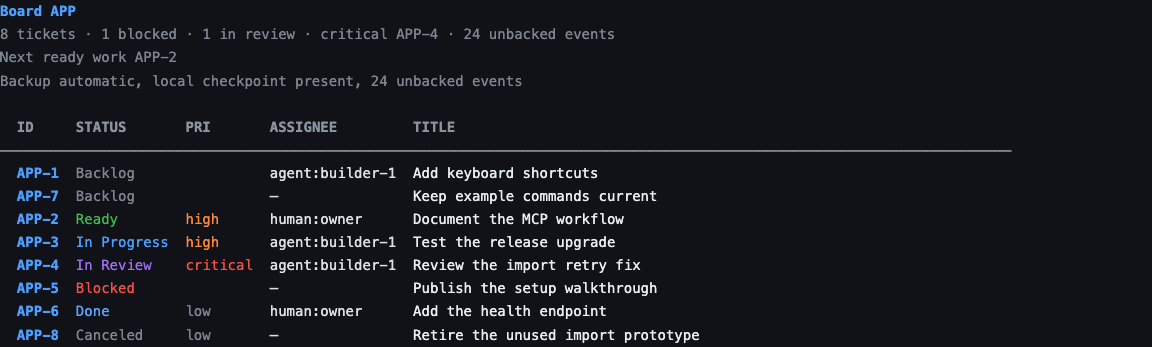
Every ticket is a markdown file under projects/, every change is an append-only event in .tracker/, and a SQLite projection keeps queries instant. Your tracker ships with your repo: branch it, diff it, git blame a status change. If the index ever gets corrupted, tracker doctor --repair rebuilds it from the event log.
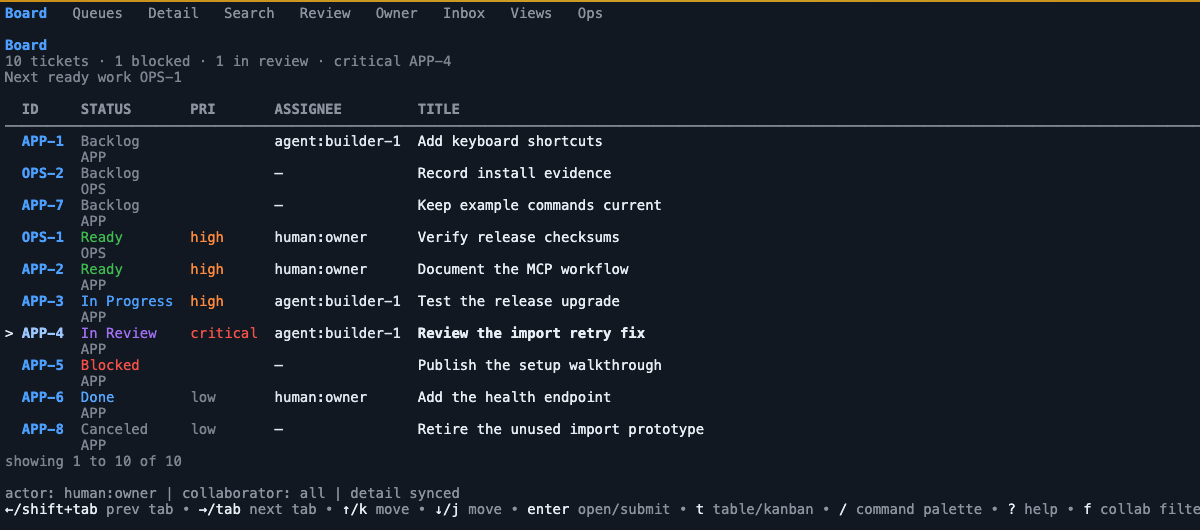
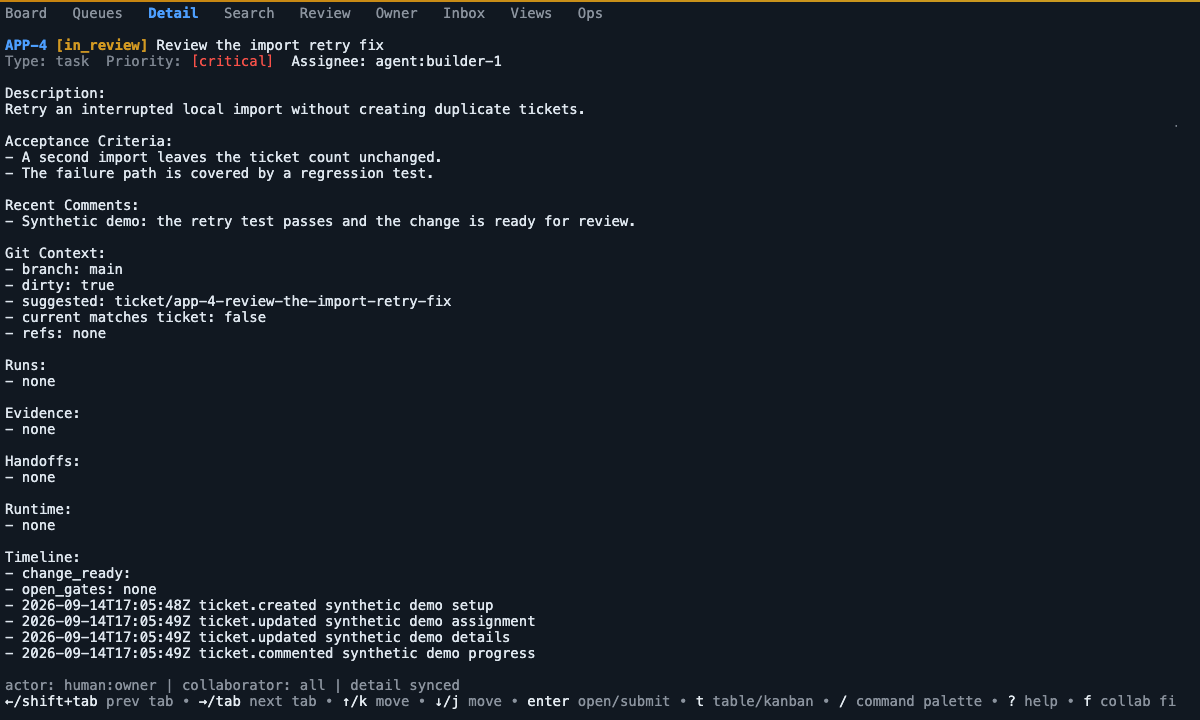
Prefer a full-screen view? tracker tui opens the interactive console — board, work queues, ticket detail with timeline, search, review and owner queues, inbox, and an ops dashboard, all keyboard-driven.
Built for agents, not just humans
This is the part Jira doesn't do. Register your agents, assign them tickets, wire up the dependency graph, and let the workflow drive itself:
tracker agent create builder-1 --name "Builder" --provider claude --capability go \
  --actor human:owner --reason "register"
tracker ticket assign APP-2 agent:builder-1 --actor human:owner --reason "agent work"
tracker ticket link APP-2 --blocked-by APP-1 --actor human:owner --reason "needs the API first"
Each agent has its own work queue — what's ready for it, what it has claimed, what's still blocked and why:
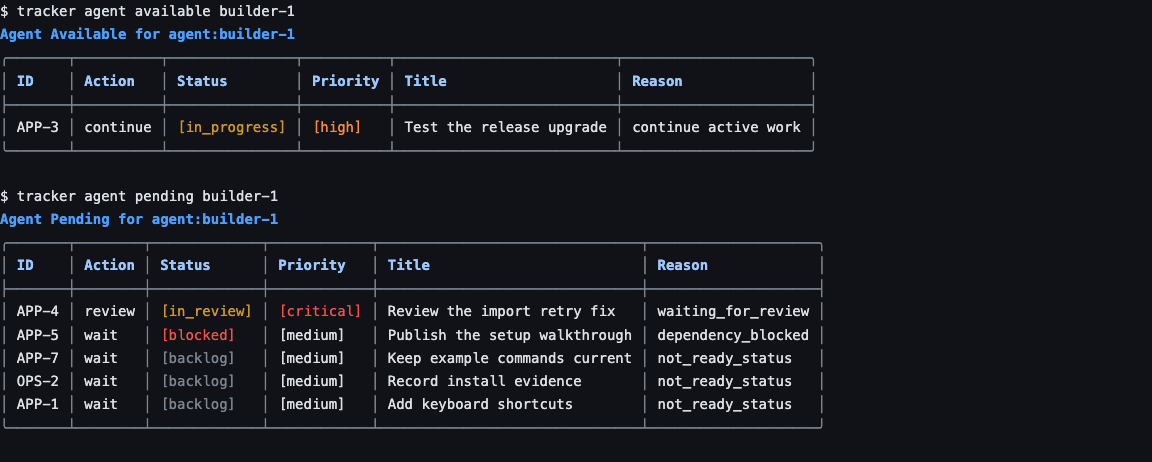
When APP-1 lands, Atlas notices that APP-2 just became unblocked and wakes the assigned agent: it emits an agent.work_available event, records a wakeup you can inspect with tracker agent wakeups list, and — if you've opted in — launches a command of your choosing, no shell involved:
tracker agent auto set builder-1 --mode command \
  --argv claude --argv "work the tracker ticket {ticket_id}" \
  --actor human:owner --reason "auto pickup"
Around that core, agents get the full delivery loop:
- Leases stop two agents from grabbing the same ticket; stale claims expire on their own.
- Runs track each work session, with checkpoints and per-run git worktrees.
- Evidence attaches proof to runs — test output, diffs, logs, screenshots — so review isn't vibes.
- Gates block completion until a reviewer, owner, QA, or release check signs off.
- Handoffs package up changed files, open questions, and risks for the next agent.
- MCP exposes all of it as tools (
tracker mcp serve), with tiered profiles from read-only to admin and typed approvals for high-impact operations. - Goal manifests (
tracker goal brief APP-1 --md) give an agent the full context of a ticket in one shot.
The Claude Code guide, Codex guide, and generic agent guide walk through real setups.
Pick your team
You don't have to design the org chart yourself. One command turns a fresh workspace into a working agent team — profiles, runbook, separation-of-duties permissions, and the right completion gate included:
tracker team apply crossfire --actor human:owner --reason "team setup"
| Preset | What you get |
|---|---|
solo | One builder working the whole board, completions stay open |
pair | Builder + reviewer with an enforced review gate — builders can't approve their own work |
swarm | Three builders pulling by routing weight, QA gate, owner delegate |
crossfire | Codex builds, Claude reviews (flip it with --provider claude) — two different models keeping each other honest |
tracker team show <preset> previews the roster, --dry-run applies nothing, and re-running is always safe — existing agents are never overwritten. Then install the matching skill (tracker integrations install claude or codex), file your tickets, and the agents handle claiming, building, review handoffs, and wake-ups on their own. The team presets guide has the full walkthrough.
Everything else you'd expect from a real tracker
Epics with progress rollups, subtasks, labels, priorities, comments, saved views, full-text search (tracker search 'text~payment status=ready'), bulk operations with dry-run previews, watch subscriptions, automations, a REPL shell, JSON output and stable exit codes on every command for scripting, import/export, archives, and a doctor that can actually fix things.
For the paranoid (complimentary): signed artifacts and trust keys, governance policies, structured redaction, signed audit packets, and side-effect-free restore planning. Read what Atlas deliberately does not claim in security limitations — local-first means your filesystem is the trust boundary.
Docs
Start at the docs landing page, or jump to installation, getting started, your first agent workflow, MCP for agents, the command reference, or troubleshooting.
Status
v1.9.0 is the first stable release, shipped with full release gates: verified hosted assets, signed build attestations, an SBOM, and recorded release evidence. Found something broken? Open an issue — and please don't paste private keys, tokens, or full .tracker archives into it. Security reports go through private vulnerability reporting.
Contributing
PRs welcome — read CONTRIBUTING.md for the local gates (tests, vet, no secrets in examples). The project is MIT licensed.