
prism
mcoder33/prism
🔷 Recursive decomposition workflow for AI coding agents — small confirmable design steps instead of mega-diffs. Installs /prism slash commands for Claude Code, Cursor, Codex, Gemini & more
Instalação
npx convez-ai mcoder33/prism1 comando no terminal: detecta o formato do repositório (marketplace ou plugin avulso) e instala via Claude Code. Requer Node 18+ e o Claude Code instalado.
Métricas
README
A tradução para o português deste README ainda está na fila.
🔷 PRISM
Stop letting your AI agent one-shot 2000-line changes it doesn't understand.
Recursive decomposition workflow for AI coding agents — turn a vague idea into an implemented, verified change through small, confirmable steps.



The problem
You ask an AI agent for a non-trivial feature. It either:
- dives straight into code and you discover its (wrong) design decisions in a 1500-line diff, or
- writes a 10-page design doc that you skim, approve without really reading, and that drifts from reality by step three.
Both fail the same way: the unit of review is too big. Humans are great at judging one small, concrete decision — and terrible at auditing a wall of text or a mega-diff.
The PRISM way
PRISM splits design into small recursive nodes — one digestible node.md at a time, each with
an explicit decision gate. The agent proposes, you react, it drills deeper. Nothing gets implemented
until every node is atomic — small enough to be obviously right.
flowchart LR
    P[propose] --> D[decompose]
    D --> R[drill]
    R -->|until atomic| R
    R --> I[integrate]
    I --> A[apply]
    A --> V[verify]
    V --> X[archive]
The core principles, baked into every command:
- Decision-first, not analysis-first. Not "here are 3 options, you weigh them" — but "I propose X because Y; rejected B/C in one line." One thing to react to.
- One small node at a time. You never face the whole analysis at once.
- Recursive decomposition until a node becomes obvious.
- Grounded in real code — the agent reads your codebase before designing, never in a vacuum.
- No big upfront docs. They overwhelm and get skimmed. Forbidden by convention.
- Sized to the change. A
small-tier change is one atomic node: two gates total, no decomposition theater,integrateskipped entirely. The full flow is for changes that earn it.
Every node carries an explicit status (⚪ proposed → 🟡 in progress → 🟢 atomic → 🔵 applied →
✅ verified, plus ⏸ for user-deferred parts) with formally defined transitions — a killed
session resumes exactly where it stopped, and status offers a gated repair when the state
table and reality disagree.
Quick start
go install github.com/mcoder33/prism@latest
cd your-project
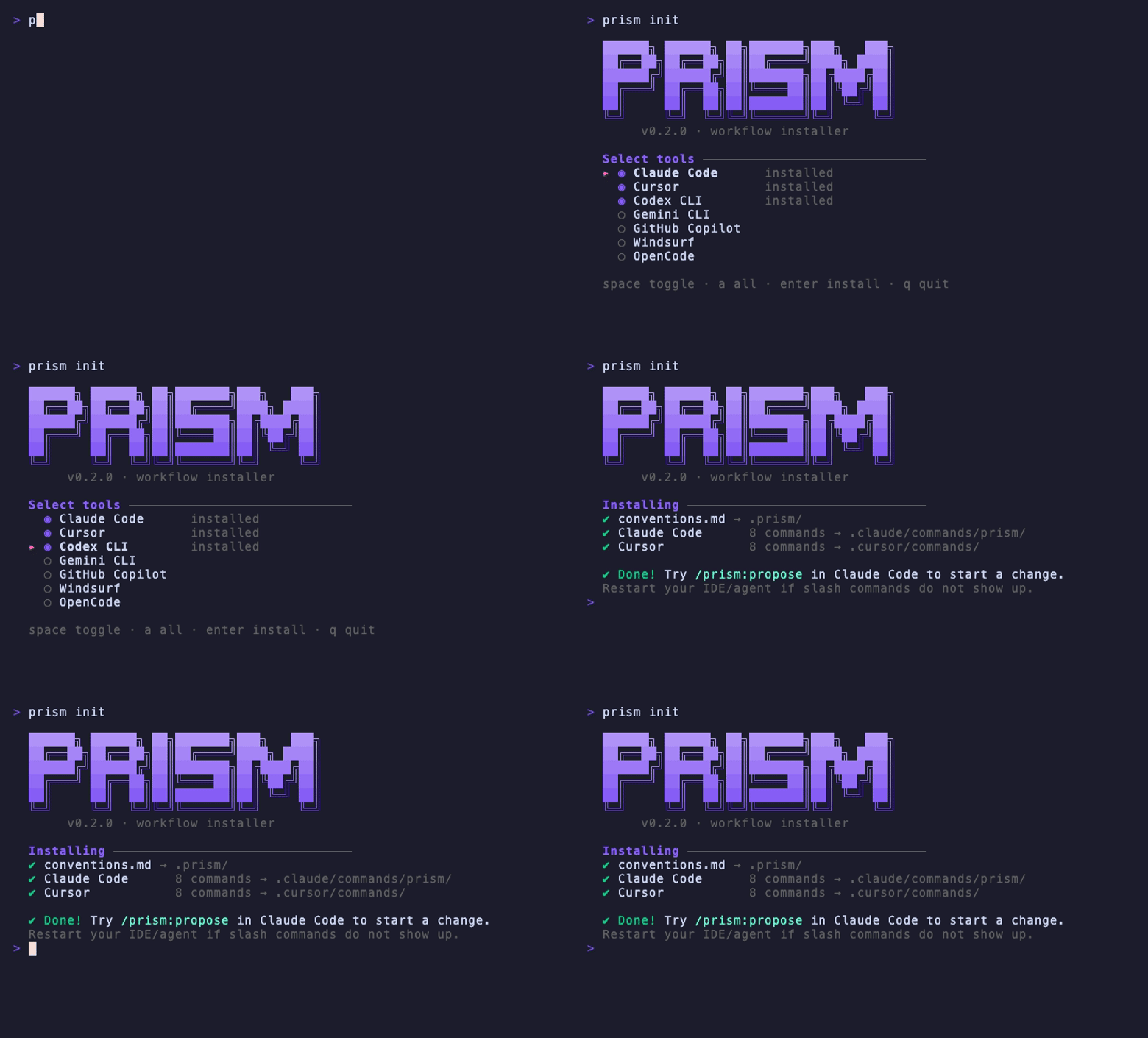
prism init          # interactive TUI — pick your agents
Then, inside your agent:
/prism:propose      # describe the problem, get a 1-screen seed proposal (+ change tier)
/prism:decompose    # split into 2-4 small parts (a single part for small-tier changes)
/prism:drill        # drill ONE part until atomic (spec, detail, diagram, tasks)
/prism:integrate    # cross-part wiring: diagram + combined signatures (skipped for small)
/prism:apply        # implement part-by-part, one commit per part, checks after each
/prism:verify       # pedantic QA on a running dev env: tests, smoke, concurrency, load
/prism:status       # where am I — phase, node table vs reality, the one next action
All design artifacts live in .prism/ at the repo root — git-excluded automatically,
it's local working state. (Optionally a project can commit .prism/archive/ as shared
reference — see the conventions installed by prism init.)
First time with PRISM?
- Skim the principles above.
- Open the worked example — a complete small-tier change, every artifact in its final state:
.prism/archive/example-json-list/. Start with itsREADME.md(the status table), thenproposal.mdand the01-json-flag/node. - Run
/prism:proposein your agent and let the gates walk you through your first change.
Inside a drilled node
/prism:drill takes one part and brings it to atomic. It writes the node.md digest first
and stops at a gate — you react to the digest and the proposed artifact set before anything
else is generated (trivial nodes skip the diagram and spec). Here's what that looks like for a
01-token-bucket node of a rate-limiter change — three artifacts carry the weight:
node.md — the unit of review. 5-7 lines. You react to this, not to a design doc:
concept.drawio — a real diagram, not ASCII art. The agent hand-crafts mxGraph XML and
validates it with xmllint. Open it in draw.io or the VS Code extension:
signatures.md — the API before any code. Signatures + what/why comments, no implementation.
Catch a bad interface here, where changing it costs nothing:
Plus spec.md (Requirement/Scenario — they drive the tests later) and tasks.md (the checklist
apply executes). If a node turns out too big — drill redirects to decompose instead of
patching on the fly.
What you get per change
.prism/<change>/
├── proposal.md          Why / What / Constraints / Decisions / Non-goals  (< 1 screen)
├── concept.md           surveyed best practices + chosen/rejected strategies
├── data-flow.drawio     conceptual data-mutation chain
├── 01-parser/           ← a node
│   ├── node.md          5-7 line digest — the unit of review
│   ├── spec.md          requirements as Requirement/Scenario
│   ├── detail.md        decision-complete implementation plan
│   ├── signatures.md    code sketch: signatures + what/why
│   └── tasks.md         checklist the agent executes
├── 02-renderer/         ← another node (drills into 02a, 02b... if needed)
├── integration.drawio   how the parts connect
└── tasks.md             root order + cross-cutting concerns only
Switch between concurrent changes like git branches: /prism:use persists the active change
in .prism/CURRENT, and every command targets it automatically.
Supported tools
One prism init installs native slash commands for every agent you use — same methodology,
shared .prism/ state, so you can propose in Claude Code and apply in Cursor.
| Tool | Commands | Invocation |
|---|---|---|
| Claude Code | .claude/commands/prism/ | /prism:propose |
| Cursor | .cursor/commands/ | /prism-propose |
| Codex CLI | .codex/prompts/ | /prism-propose |
| Gemini CLI | .gemini/commands/prism/ | /prism:propose |
| GitHub Copilot | .github/prompts/ | /prism-propose |
| Windsurf | .windsurf/workflows/ | /prism-propose |
| OpenCode | .opencode/command/ | /prism-propose |
Adding a tool is one adapters.Tool value (internal/adapters/adapters.go) —
file path + naming + frontmatter format. PRs welcome.
How is this different from OpenSpec / spec-kit?
OpenSpec and spec-kit pioneered spec-driven AI development, and PRISM borrows the installer model from them. The difference is the shape of the artifact:
| Spec-driven (OpenSpec, spec-kit) | PRISM | |
|---|---|---|
| Unit of review | a spec document | a 5-7 line node |
| Structure | flat: spec → tasks | recursive tree, drill until atomic |
| Decision style | options to evaluate | one decision to react to |
| Depth control | fixed | per-node — drill only where it's murky |
| Post-implementation | done at merge | verify: tests, smoke, concurrency, load |
If your changes are small, spec-driven is enough. PRISM earns its keep on changes where the design itself is the risk: refactors, new subsystems, concurrency, integrations.
CLI reference
prism init [path] [--tools claude,cursor|all]   # install commands (TUI without --tools)
prism update [path] [--force]                   # regenerate after a CLI upgrade
prism list [path]                               # list active changes in .prism/
Generated files are tool-owned: each carries a prism:generated v<version> stamp and is
overwritten wholesale by prism update — edit templates/, not the output.
Single static binary, zero runtime dependencies, templates embedded via go:embed.
Development
make ci          # everything CI runs: test -race, vet, lint, vuln, mod-check
make test        # just the tests
make cover       # tests + coverage summary
make install     # build + put `prism` on PATH
make help        # list all targets

prism init --tools claude /tmp/sandbox        # smoke test
CI (GitHub Actions) runs the same five checks on every push and PR; lint and vuln
auto-install their tools, so a fresh clone only needs Go.
Layout:
main.go                      entrypoint → internal/cli
templates/                   tool-neutral command bodies + shared conventions (go:embed)
internal/
  workflows/                 command registry (id, title, description) + Version
  adapters/                  per-tool: paths, slash-command naming, frontmatter
  installer/                 detection, rendering, writing, git-exclude
  cli/                       cobra commands + bubbletea TUI
Stack: Go stdlib + cobra + bubbletea/lipgloss.
License
If PRISM saves you from one bad mega-diff, consider a ⭐ — it helps others find it.