
Elpis - Orquestrador de Agentes com Controle de Contexto
MasihMoafi/A-Modular-Kingdom
Orquestração de agentes com contexto inteligente e isolamento seguro
Ver no GitHubHarness de agentes para Linux que gerencia contexto, memória persistente e equipes de agentes coordenados. Permite controlar precisamente o que cada agente vê, executar workflows complexos de múltiplos agentes e monitorar cada passo da execução. Integração nativa com Claude e OpenAI.
Instalação
npx convez-ai MasihMoafi/A-Modular-Kingdom1 comando no terminal: detecta o formato do repositório (marketplace ou plugin avulso) e instala via Claude Code. Requer Node 18+ e o Claude Code instalado.
Métricas
Casos de uso
- Coordenar equipes de agentes de código para tarefas complexas
- Executar revisão de código automática com múltiplos agentes
- Monitorar e auditar ações de agentes em tempo real
- Isolamento de contexto e gerenciamento de memória para agentes
Veredito

Solução madura e production-ready para quem trabalha com agentes de código. Preenche uma lacuna real no controle de contexto e orquestração, mas exige Linux e está em fase alpha — avaliar estabilidade antes de usar em produção crítica.
README
A tradução para o português deste README ainda está na fila.
Demo
Quick start
This command installs both apps, the desktop app and the terminal app, on Linux x86_64:
curl -fsSL https://raw.githubusercontent.com/MasihMoafi/Elpis/main/scripts/install.sh | bash
Then run elpis-app for the desktop app or elpis for the terminal app. Sign in with ChatGPT or Claude, or set up a provider. Claude models run through your own Claude Code install. Open a chat and look at its Context Ledger before you send the first message.
From the v0.5.3 release; every file has a SHA-256 checksum:
- Ubuntu, Debian:
sudo apt install ./elpis_0.5.3_amd64.deb ./elpis-desktop_0.5.3_amd64.deb - Fedora, Arch, Omarchy, any Linux:
chmod +x Elpis-0.5.3-x86_64.AppImage, then run it; addelpisto run the terminal app. - Arch, Omarchy (native package):
git clone https://github.com/MasihMoafi/Elpis && cd Elpis/packaging/aur/elpis-bin && makepkg -si - Terminal app only:
curl -fsSL https://raw.githubusercontent.com/MasihMoafi/Elpis/v0.5.3/scripts/install-elpis.sh | bash - Terminal app with npm:
npm install -g elpis-cli, thenelpis. The first run downloads the v0.5.3 release and checks its SHA-256.
Both apps share one engine and one state folder, ~/.elpis-next.
The problem
Without Elpis, a coding agent loads every instruction file it finds and keeps the whole conversation until the window fills. You cannot see what it was told, and you cannot take it back. Several agents on one task make it worse: they write over each other's files, nobody checks the work, and you merge the result by hand.
Elpis treats both as one problem: the context an agent works in. With Elpis, two rules apply:
- You choose what each agent sees. The Context Ledger lists every instruction file, chosen file and memory with its token cost, and you include or exclude each one.
- Each agent owns what it writes. In a workflow every agent has its own folder, a second agent checks its work, and the Mother agent reviews the combined result before anything reaches your project.
How it works
Elpis keeps Codex's Rust engine, its tools and its sandbox, and adds its controls around the chosen model:
-
Context Ledger. It shows every instruction file, file and memory an agent receives, with its token cost. You include or exclude each one.
-
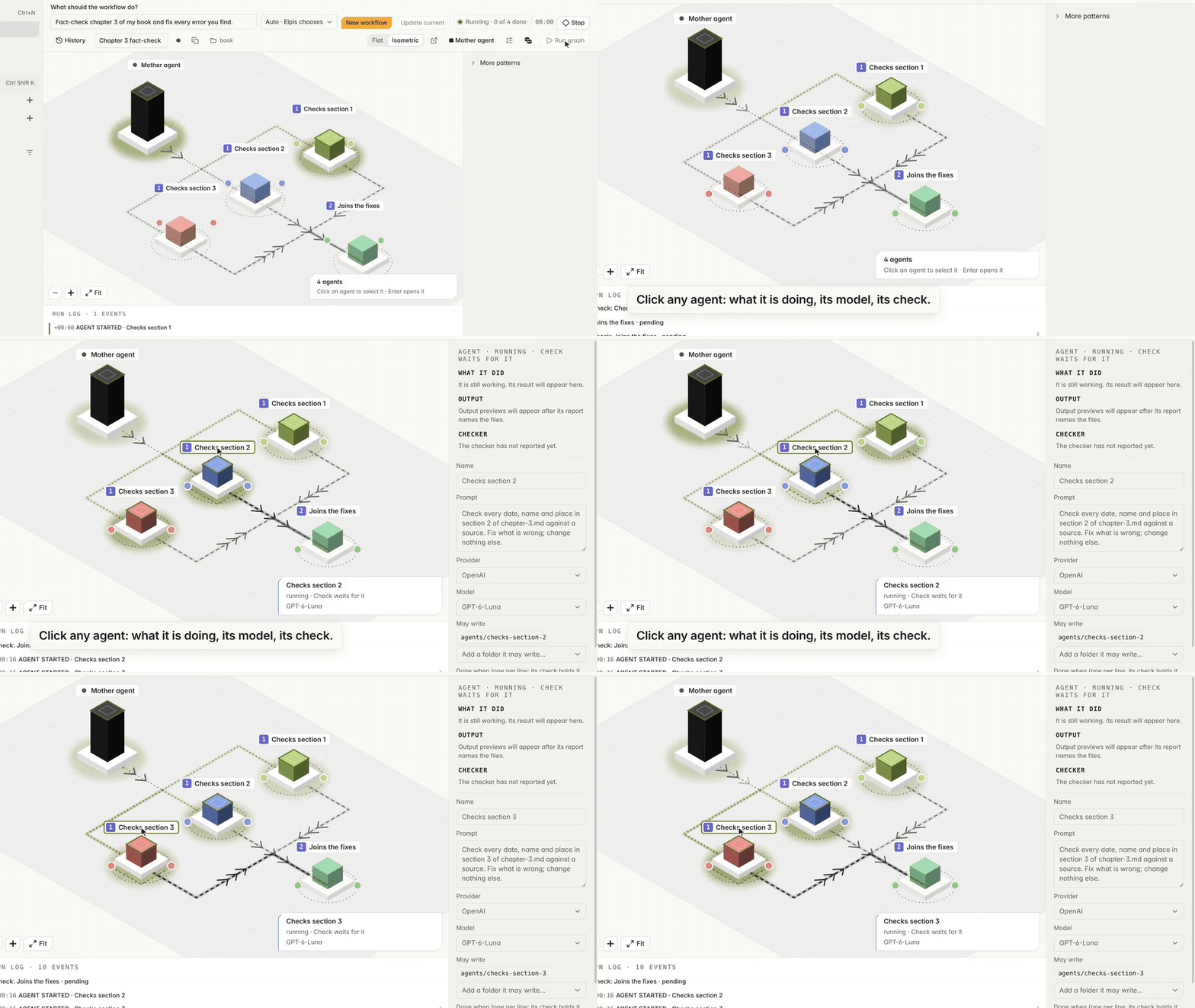
Workflows. You describe a job. The Mother agent does it herself, or designs a team on a board you can edit. Patterns: Sequential, Parallel, Kahn graph waves, Recursive and Voting.
-
Observability. Every request, tool call, token and cache hit of a chat sits on one timeline: in the desktop app's Observability page, and in the terminal's
/dashboard(next release). -
One app for every model. GPT, Claude, Gemini and OpenRouter, through your ChatGPT or Claude subscription or an API key. You can switch models without losing the thread, and import chats from Claude Code and Codex.
-
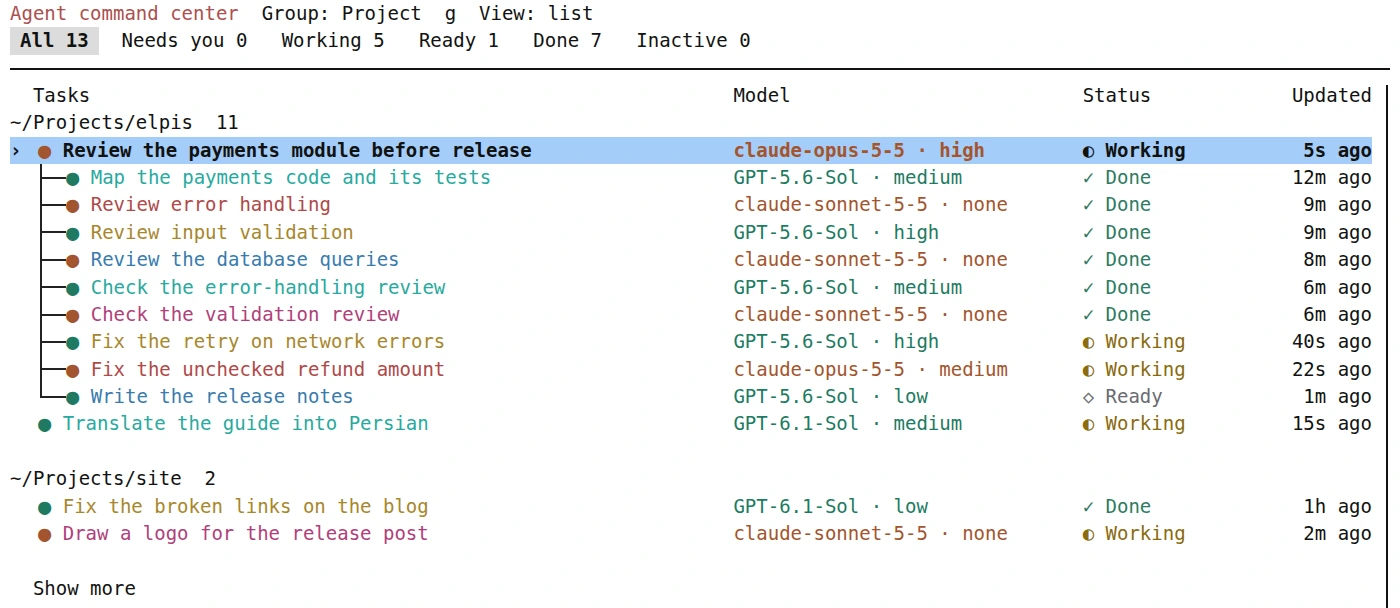
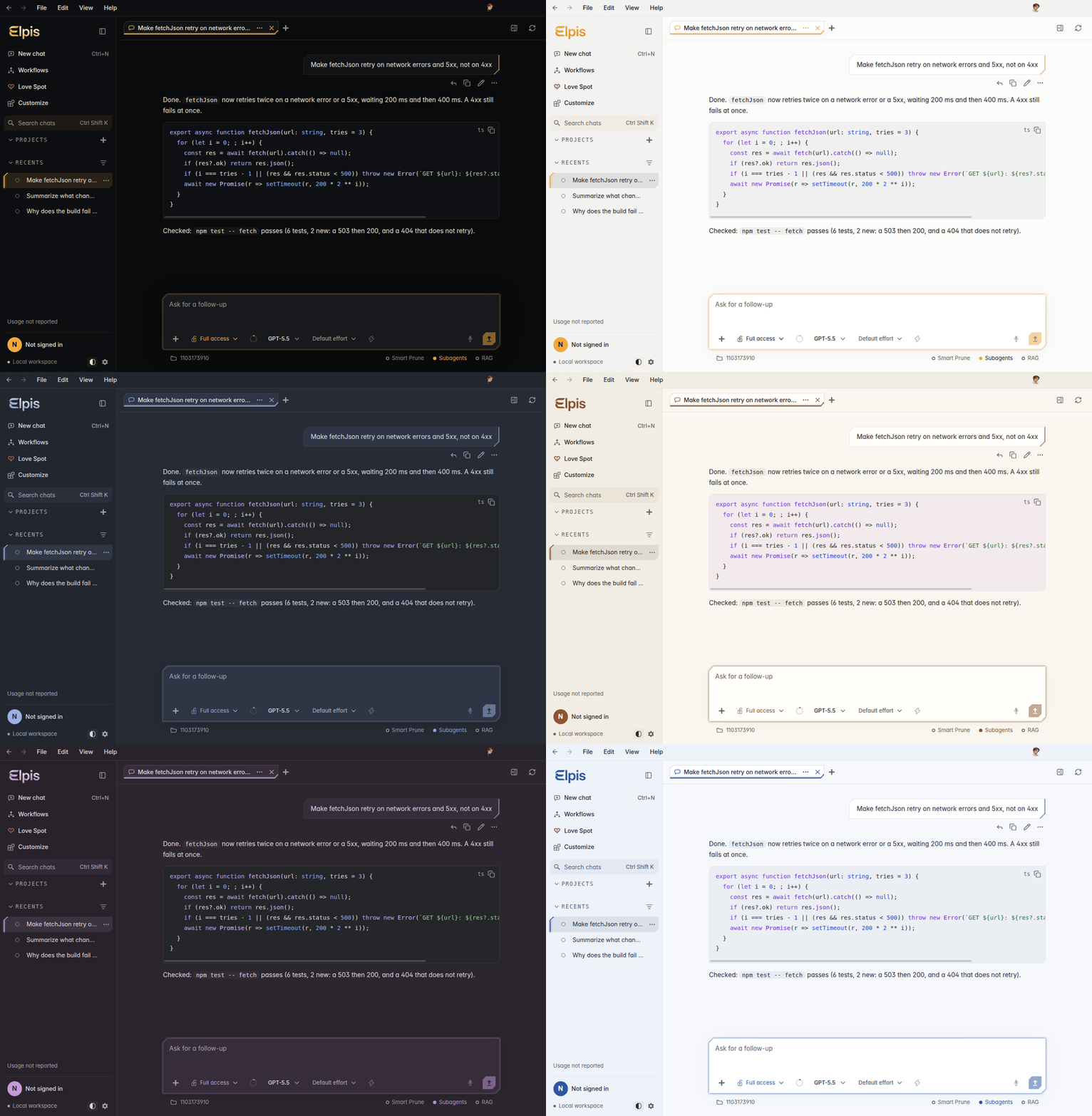
Two apps, one engine. A desktop app (four themes, light and dark) and a terminal app share sessions and state. In the terminal, the Agent command center shows each helper under its parent chat.
-
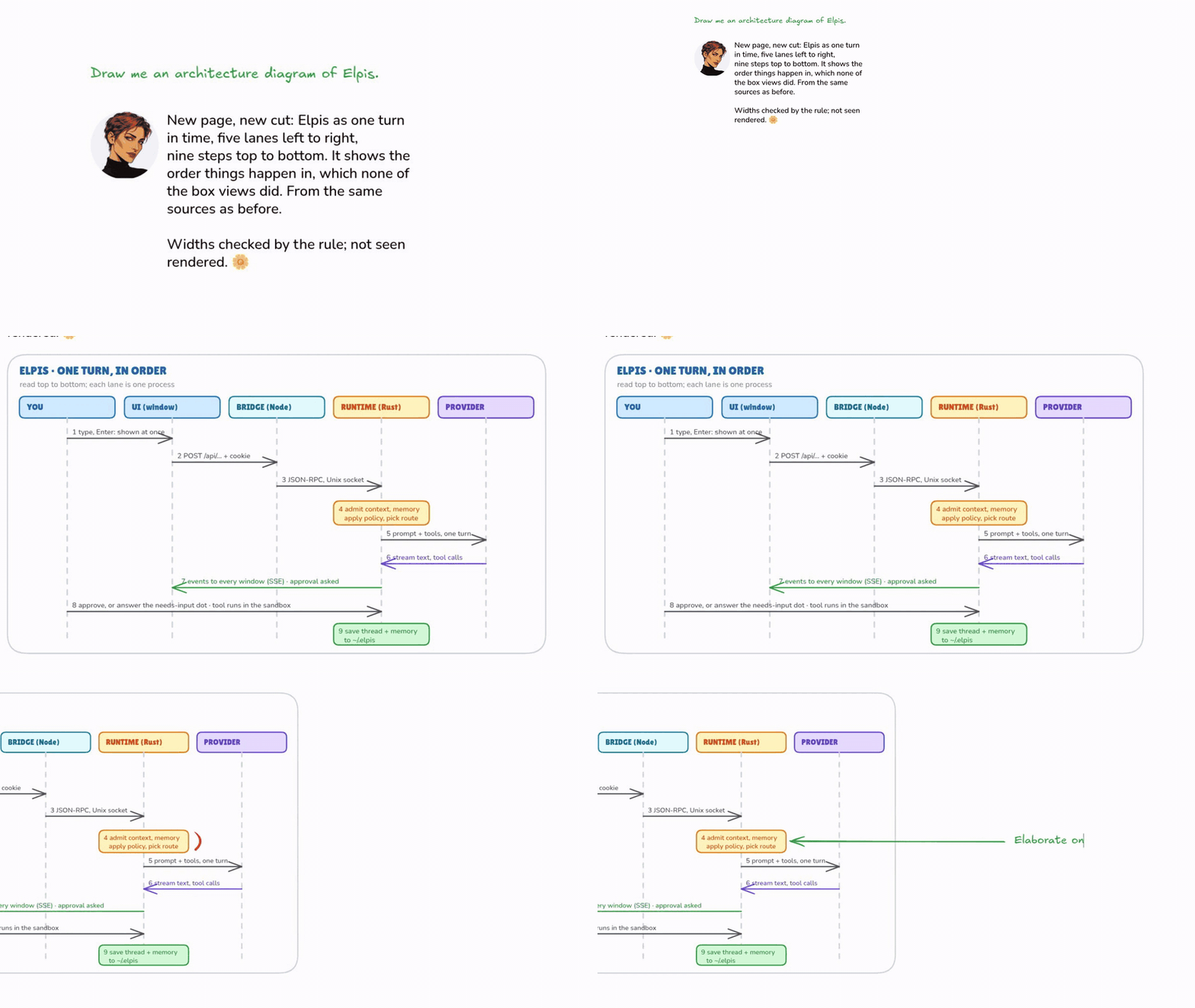
Love Spot. A drawing board where Matilda, the app's companion, answers and draws with you.
The desktop app is Electron with a Node bridge, which drives each agent over the Agent Client Protocol. No model weights are bundled. State lives in ~/.elpis-next, or in the folder that ELPIS_HOME names.
How a workflow orders its steps. Elpis sorts the board with Kahn's algorithm. An agent starts when everything it waits for has passed, and the check of that work has passed too. Agents in one wave run side by side. Elpis refuses a loop before any agent starts, unless you choose the Recursive pattern and a round limit. The Voting team runs in four waves:
%% id: voting-waves
%% alt: The Voting team in four waves: the Mother agent starts three answering agents, each answer has its own check, a tally agent joins the checked answers, a check reviews the tally, and the Mother agent reviews and merges.
flowchart LR
  M([Mother agent]) --> A1[Answer 1] & A2[Answer 2] & A3[Answer 3]
  A1 --> C1{{Check 1}}
  A2 --> C2{{Check 2}}
  A3 --> C3{{Check 3}}
  C1 & C2 & C3 --> T[Tally]
  T --> CT{{Check tally}}
  CT --> R([Mother agent reviews and merges])
Details: technical guide, context, sessions.
Current state
The state of each item, with its check and evidence: production.md.
- Verified: the Voting workflow on two models, and the release checks of each terminal release (both under Evidence).
- Under acceptance: Smart Prune and reasoning expiry are experimental. The codebase dashboard (size, churn, duplicates and agent readiness for any Git project open in Elpis) is built and installed but not yet in a release; its items are in codebase-dashboard.md.
- Planned: see Next.
- Unsupported: macOS and Windows builds. Not claimed: the whole inherited Codex test suite.
What sets it apart
Who may write what: ownership, as in Rust. Rust lets many readers or one writer hold a value, never both, and checks this before the program runs. Elpis applies the same rule to agents:
| Rust | Elpis workflow |
|---|---|
| A value has one owner | Each agent owns agents/<its name> and the folders you give it. In a Git project it works in its own worktree, and a step that changed files outside its folders fails. |
| Shared borrows read, never write | A check follows every writer. It reads the writer's work and writes only agents/<name>/check. |
| No two mutable borrows at once | Two agents linked to work alongside may not share a folder. |
| The owner decides what lives | The Mother agent reviews the combined commit. It must pass it with evidence before Elpis fast-forwards your project. |
The tradeoff: outside a Git project the folders are instructions, not enforced.
What Elpis builds on, and what it adds. Elpis is a fork of OpenAI's Codex (Apache-2.0). Its engine, about 2.3 million lines in codex-rs/, carries Elpis's changes but stays close to upstream. Outside the engine the repository holds about 360,000 lines, 13% of its code: the desktop app with its bridge, the workflows, the tools, the website and the scripts. The Context Ledger and the other terminal additions live inside codex-rs/. Elpis keeps the attribution and notices of upstream Codex (LICENSE). The Observability page is a port of the Trajectory view from DeepSeek Harness (MIT); thank you to its authors.
Evidence
- Workflows: a Voting team (three answering agents and one tally agent, each with its own check) finished on GPT-6 Luna and on Claude Haiku 5.5 in 74 to 100 seconds. The test is
tests/canvas-live.runtime.mts. - Releases: Release CI gates each terminal release on Elpis's Rust checks, runtime evals with failing controls and clean offline installs. These checks do not prove that Elpis writes better code.
Next
- Matilda as the one agent you talk to. She routes work to the right agents, sets up workflows, keeps schedules and reminds you, on the model of DeepSeek Harness's super agent.
- Automations. Prompts and workflows that run on a schedule, set with a calendar or asked for in one sentence.
CONTRIBUTING.md explains how to build, test and report a bug.
More projects
- Rustidian: a native Markdown notebook for Linux that opens Obsidian-format vaults
- rag-mcp: local hybrid search over your documents, as a CLI and MCP server
- Skills: SKILL.md workflows for coding agents
- WhisperType: local voice input for developers
- Read Aloud: select text, press Super+R, hear it in a local voice
- Love Spot: a shared drawing board where characters talk, draw and compete with you
- SVG Studio: high-quality image vectorization
- Pin: an always-on-top priority note, saved as plain Markdown
- Clocki: a floating desktop timer for tracking focus hours
All of them: masihmoafi.com