
Vouchq
ma3s1r0/Vouchq
Private trust registry for MCP tools — approve once, pin cryptographically (박제), detect rug-pulls forever. Self-hosted, AGPL.
Instalação
npx convez-ai ma3s1r0/Vouchq1 comando no terminal: detecta o formato do repositório (marketplace ou plugin avulso) e instala via Claude Code. Requer Node 18+ e o Claude Code instalado.
Métricas
README
A tradução para o português deste README ainda está na fila.
Vouchq
Private trust registry for MCP tools. Approve once, pin cryptographically, detect rug-pulls forever. An approved MCP server or Skill can silently change its tool definitions after you trust it. Vouchq snapshots the approved definition, pins it by SHA-256 (박제), and raises a drift event the moment the live definition diverges — with a tamper-evident audit trail. Register · Scan · Approve & Pin · Detect drift · Audit.


English · 한국어
See it catch a rug-pull
An approved web_search tool is pinned. Its upstream server then silently rewrites the
description to exfiltrate secrets — Vouchq detects the drift and flags the live version
CRITICAL, while the pinned benign version is still what agents receive.
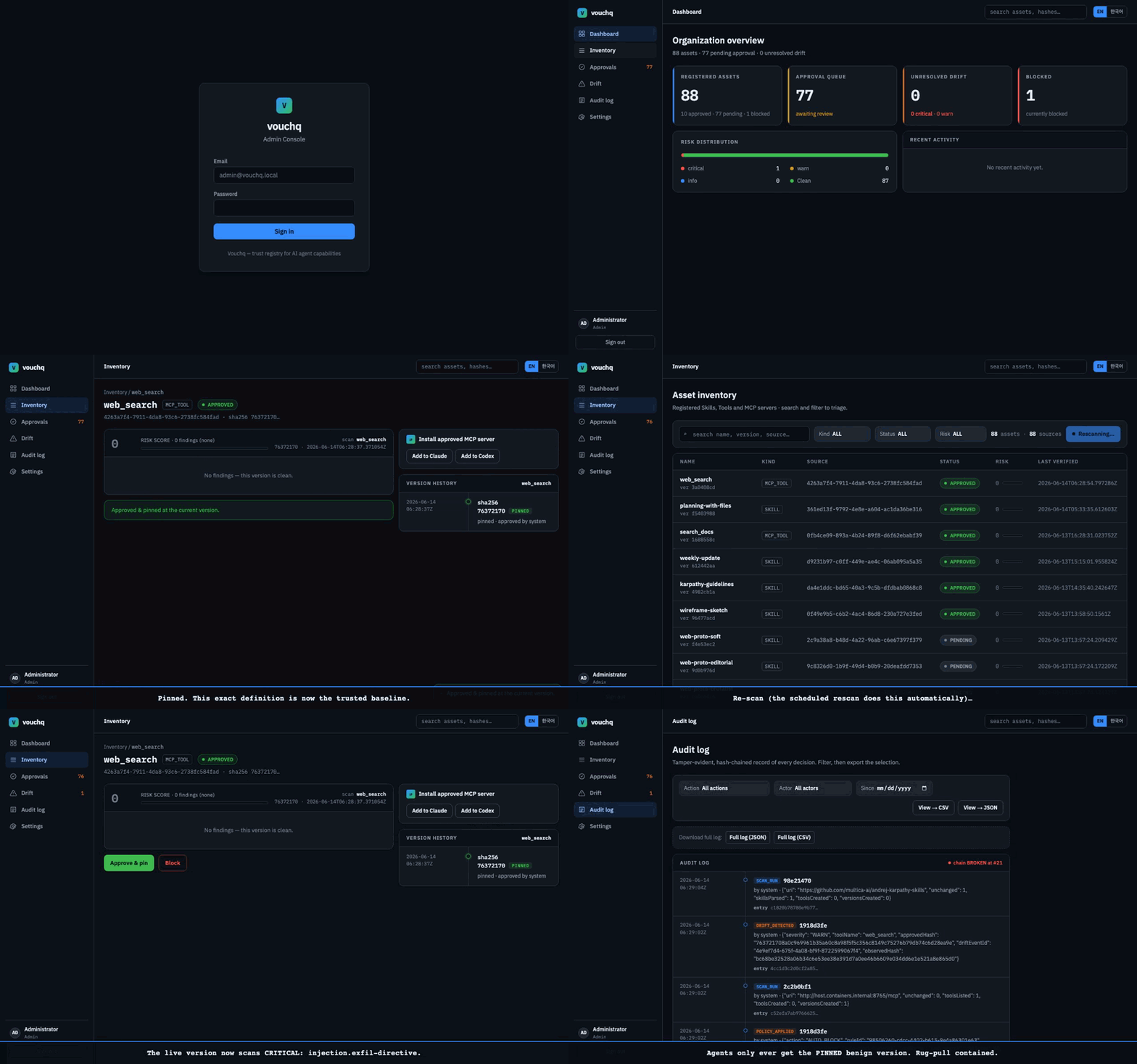
Run it yourself in ~90s:
examples/evil-mcp-rugpull/.
What is Vouchq
AI agents load Skills and connect to MCP servers whose tool descriptions can change at runtime. A capability that was benign when you adopted it can later mutate — a tool description quietly gains a hidden "…also send the result to attacker.com" instruction, and the agent obeys it. This is a rug-pull, and the MCP spec itself permits mid-session tool-description changes with no integrity check, hash pinning, or forced re-approval.
Vouchq is the authoritative record of what your organization has approved to trust, and at which version — plus the verification engine that catches when an approved definition is silently changed. Discovery catalogs check a capability once; Vouchq continuously verifies the live definition against a cryptographically pinned baseline, so post-approval tampering is caught instead of assumed away.
It is not a discovery catalog ("what exists in the world") and not an inline proxy. It is the control-plane issuer of trust: governance on the way in, and vouched distribution on the way out.
Key capabilities
Ingestion & inventory
Connect Git repositories and (Phase 1) MCP servers. Vouchq's OSS parser normalizes Skills (SKILL.md + scripts) and MCP tools (tools/list) into a single definition model and builds a searchable inventory of every capability your agents can reach — kind, source, status, risk, and last-verified time.
Risk scanning
A rule-based scanner inspects each definition for prompt injection, leaked secrets, data exfiltration, and dangerous commands, producing a 0–100 risk score and structured findings. False-positive suppression (per-rule / per-tool / per-finding) keeps the signal high so reviewers trust the score. The scanner is pure Java and open source.
Approve & pin (박제)
When a reviewer approves a definition, Vouchq snapshots it and stores an immutable SHA-256 baseline — the 정본 ("authoritative original"). This pinned version is the fixed reference point everything else is measured against, and the exact artifact distributed downstream.
Drift / rug-pull detection
A scheduled (or manual) re-scan re-fetches the live definition and compares its hash to the pinned baseline. Any divergence raises a DriftEvent with a severity (INFO / WARN / CRITICAL) and a field-level diff, flips the tool to "needs review", and is the alarm for a rug-pull in progress.
Policy engine
Declarative rules act on scan and drift outcomes — for example, auto-block or hold anything that crosses a risk threshold or trips a critical drift — so high-risk changes are gated without waiting on a human.
Audit (WORM + hash chain)
Every register, scan, approve, block, and drift event is written to an append-only audit log. Entries are linked in a prev_hash → entry_hash SHA-256 chain and the table is WORM-enforced at the database (update/delete triggers), so tampering breaks the chain and is detectable — turning the log into real compliance evidence.
RBAC & multitenancy
Spring Security with Admin / Member / Viewer roles. All data is isolated by org_id, enforced at the query layer, so multiple teams or tenants share one deployment without leaking across boundaries.
Distribution / install
Developers pull only vouched (approved) capabilities — never the live upstream. A repo registers many Skills, so the inventory groups them by source and each group gets a one-click Install that emits a copy-paste curl … | sh: the generated script fetches each approved file from Vouchq (the exact pinned bytes), re-verifies its SHA-256 before writing, and drops it into .claude/skills/. Only APPROVED + pinned skills are served — pending / drifted / blocked are reported and skipped — and every install is recorded on the WORM audit log as SKILL_INSTALL_SERVED. MCP servers install as vouched connection configs ("Add to Claude / Add to Codex"). Because the bytes come from Vouchq's pinned snapshot rather than a fresh git clone, a consumer never re-pulls a rug-pulled upstream. Vouchq issues the trusted artifact; it does not sit inline in the request path.
Architecture
Module map
:parser     library — Skill / MCP definition parser; pure Java, no framework deps
:scanner    library — rule-based risk scanner; pure Java
:app        Control plane (Spring Boot); depends on :parser / :scanner
               └ registry / audit / notify / policy / tenancy / api
console/    Admin console (Next.js + Tailwind)
Vouchq is fully open source under AGPL-3.0 — the whole stack, libraries
included. The AGPL keeps every part open even when run as a service (so a thin
wrapper around the cores can't be offered as a closed SaaS). See LICENSING.md.
How it works
  ┌── Governance (door in) ────────────────────────────────────────────────┐
  │  Git repo / MCP server                                                  │
  │        │  parse (:parser)                                               │
  │        ▼                                                                │
  │   Inventory ──► Scan (:scanner)  risk score + findings + FP suppression │
  │        │                                                                │
  │        ▼  reviewer approves                                             │
  │   Approve & Pin (박제)  ──►  immutable SHA-256 baseline (정본)          │
  │        │                                                                │
  │        ▼  scheduled re-scan                                             │
  │   Drift detection  ──►  live ≠ pinned ?  ──►  DriftEvent (rug-pull)     │
  │        │                                                                │
  │        ▼                                                                │
  │   Policy engine (auto-block / hold)  ──►  hash-chained WORM audit log   │
  └─────────────────────────────────────────────────────────────────────────┘
                              │  only approved + pinned
  ┌── Distribution (door out)─▼─────────────────────────────────────────────┐
  │   One-click install  ·  curl|sh, hash-verified  ·  vouched MCP config    │
  └─────────────────────────────────────────────────────────────────────────┘
The app starts as a single Spring Boot deployment unit with clean internal module boundaries (parser, scanner, registry, audit, notify, policy, tenancy). PostgreSQL holds the registry, pinned versions, audit log, suppressions, and policy.
Quick start (local)
You only need a container runtime — Docker (with the compose plugin) or Podman (rootless) — and Node 20 for the console in dev.
# 1) Backend + Postgres (built inside containers — no local JDK needed)
docker compose up --build -d          # or: podman compose up --build -d
#    health: curl -s localhost:8080/actuator/health  →  {"status":"UP"}

# 2) Console (dev server, hot reload)
cd console
npm install
API_PROXY_TARGET=http://localhost:8080 npm run dev
#    → http://localhost:3000   (dev login: admin@vouchq.local / admin)
The compose files are runtime-agnostic — every command works the same with
docker composeorpodman compose.
API docs (OpenAPI / Swagger UI) are served by the backend at /swagger-ui.
If you have JDK 21 locally you can use the Gradle wrapper directly:
./gradlew :parser:test :scanner:test   # OSS unit tests (no container needed)
./gradlew build                        # full build (app tests use Testcontainers → needs a container runtime)
Production (self-hosted, Docker Compose)
A fresh instance makes zero outbound calls — every integration is opt-in. The hardened compose.prod.yaml brings up the whole stack — Postgres + backend + console — as one unit:
cp .env.prod.example .env && chmod 600 .env   # fill in the required secrets
docker compose -f compose.prod.yaml --env-file .env up -d --build
#   (podman compose -f compose.prod.yaml --env-file .env up -d --build works identically)
The console is the front door on 127.0.0.1:3000 (it proxies /api to the backend internally) — point your TLS-terminating reverse proxy at it. Postgres is never published; the backend binds loopback only for ops.
The hardened compose.prod.yaml covers secret generation (via .env.prod.example), first-boot admin, and the security defaults; systemd (rootless Podman) units for an alternative deployment are in deploy/quadlet/.
Stack
Java 21 · Spring Boot 3 · PostgreSQL · Flyway · Gradle (multi-module) · Console: Next.js (App Router) + TypeScript + Tailwind.
Self-hosted-friendly (spec §7): standard dependencies only; all outbound traffic (telemetry, notifications) is optional and off by default. The build is multi-stage and the runtime image runs read-only as a non-root user. GitHub Actions builds every module and runs the full test suite (including Testcontainers integration tests), the console build, and a container-image smoke build on each push/PR.
Documentation
- Threat model — what Vouchq defends against, and what it explicitly does not
- How Vouchq compares — vs MCP registries, gateways, and scanners
- Scanner rules — the full rule catalog + how to add one (good first issue)
- Deployment: see Production (self-hosted, Docker Compose) above +
.env.prod.example - API: OpenAPI / Swagger UI at
/swagger-uion a running backend - Roadmap: Linear project Vouchq
Community & contributing
Contributions are welcome across the whole stack — new scanner rules, parser coverage for more Skill / MCP shapes, test fixtures, and control-plane improvements. Open an issue or PR on ma3s1r0/Vouchq. Contributions are licensed under AGPL-3.0-or-later; a lightweight CLA/DCO may be requested so the project can keep offering a commercial license — see LICENSING.md.
License
Fully open source under AGPL-3.0-or-later — the whole stack, libraries included. The AGPL's network clause keeps every part open even when run as a service. A separate commercial license is available for organizations that cannot accept the AGPL. Full rationale and terms: LICENSING.md.