
DPYC Community — Registro de Membros e Governança
lonniev/dpyc-community
Registro e governança descentralizada para operadores Tollbooth Lightning
Ver no GitHubMCP server para gerenciar registro de membros e governança da comunidade DPYC (Don't Pester Your Customer), um modelo de monetização de APIs via Lightning Network com saldos pré-financiados em Bitcoin. Implementa identidade baseada em Nostr e cadeia de honra descentralizada sem KYC.
Instalação
npx convez-ai lonniev/dpyc-community1 comando no terminal: detecta o formato do repositório (marketplace ou plugin avulso) e instala via Claude Code. Requer Node 18+ e o Claude Code instalado.
Métricas
Casos de uso
- Gerenciar membros e autoridades em ecossistema de APIs monetizadas
- Validar identidades Nostr (npub) sem KYC
- Organizar estrutura de taxas entre operadores Tollbooth e authorities
Veredito

MCP server especializado em governança descentralizada para monetização Lightning de APIs. Nichos bastante específico (DPYC/Tollbooth), mas bem construído para operadores que já adotam esse modelo. Requer compreensão profunda de Lightning, Nostr e arquitetura MCP.
README
A tradução para o português deste README ainda está na fila.
DPYC™ Community
This registry:
github.com/lonniev/dpyc-community
Membership registry and governance for the Don't Pester Your Customer™ Tollbooth community.
Read the DPYC Creed — our founding declaration of values.
What is DPYC?
Don't Pester Your Customer — a philosophy for API monetization using pre-funded Bitcoin Lightning balances instead of KYC, stablecoins, or per-request payment negotiation.
Customers fund their balance once with a Lightning payment, then use API services without interruption. No credit cards. No identity verification. No payment popups mid-session. Just sats in, service out.
Why Tollbooth?
Tollbooth DPYC™ monetizes complete business information — full MCP tool responses — not raw REST data fragments. A single Tollbooth-metered tool call delivers a ready-to-use answer that would otherwise require assembling dozens of individual API calls.
Fewer round-trips, no interruptions. Pre-funded Lightning balances mean each tool call is a single HTTP request. Protocols like x402 and L402 take a different approach — gating individual REST endpoints with per-request payment challenges (402 → pay invoice → retry). That pattern works well for simple resource access, but adds 6+ HTTP round-trips per request and interrupts agent workflows with payment redirects.
For AI agents: your tool chain will never be interrupted by payment ceremonies. Fund once, call tools, get answers.
| Tollbooth (MCP) | x402 / L402 (REST) | |
|---|---|---|
| What's metered | Complete tool responses (business information) | Individual REST endpoints (data fragments) |
| Round-trips per call | 1 (pre-funded balance) | 6+ (challenge → pay → retry) |
| Agent experience | Seamless — no mid-session interruptions | Payment redirects between calls |
| Identity | Nostr npub (no KYC) | Varies by implementation |
x402 and L402 are respected approaches solving real problems in HTTP-native monetization. Tollbooth operates at a different layer — the MCP tool layer — where the unit of value is a complete answer, not a data fragment.
What is the Honor Chain?
The DPYC Honor Chain is a voluntary community of Tollbooth Operators and Authorities, organized as a Network Society in the Balaji Srinivasan tradition. Members agree to:
- Use BTC and Lightning for all commerce within the ecosystem
- Avoid saving customer PII — especially financial data (the DPYC philosophy)
- Properly identify their upstream Tollbooth Authority via their Nostr npub
- Honor their Authority's fee schedule as the cost of participating in the chain
- Accept community governance including member banning for violations
How It Works
Identity is a Nostr keypair. Your npub is your member ID everywhere in the ecosystem.
The registry is stored as individual JSON files under members/, organized by role:
members/
  prime/              # Prime Authority
  authorities/        # Authorities
  operators/          # Operators
  advocates/          # Advocates (community utility services)
  citizens/           # Citizens
  persona-non-grata/  # Banned members
  read-only-lookup-cache.json  # Generated — do not edit
Each file is named {npub}.json and contains the member record. The read-only-lookup-cache.json index is a generated artifact auto-rebuilt by CI from these individual files. Downstream consumers (like the DPYC Oracle) use this cache for fast member lookup. When a Tollbooth Authority certifies a purchase, it checks this registry to verify the operator's npub is active.
Governance uses GitHub's native tools — PRs for membership changes, Issues for ban proposals, branch protection for integrity. Git's Merkle tree provides a tamper-evident audit trail.
Honor Chain Structure
Prime Authority (Lonnie VanZandt)
  npub1l94pd4qu4eszrl6ek032ftcnsu3tt9a7xvq2zp7eaxeklp6mrpzssmq8pf
  |
  +-- thebrain-mcp (Operator)
  |     npub1y20qa7d3ddmh6730hdr0u0r08zys4p7pyk30uhur9edx4d88q4zqnr3q2h
  |
  +-- excalibur-mcp (Operator)
  |     X (Twitter) posting service with Secure Courier credential delivery
  |
  +-- tollbooth-oauth2-collector (Advocate)
  |     Community OAuth2 callback mailbox
  |
  +-- Authority A (registered DPYC member)
  |     +-- Operator A1
  |     +-- Operator A2
  |     +-- Sub-Authority A-sub
  |           +-- Operator A-sub-1
  ...
Value flows from actual API consumption at the edges, not from recruitment. Each Authority charges a certification fee from its Operators, motivating them to vet onboarding, police downstream, and maintain standing. This is a franchise model, not MLM.
How to Join
-
Generate a Nostr keypair — use any Nostr client, or:
pip install nostr-sdk python -c "from nostr_sdk import Keys; k = Keys.generate(); print(f'npub: {k.public_key().to_bech32()}'); print(f'nsec: {k.secret_key().to_bech32()}')" -
Find a sponsoring Authority — an existing Authority in the Honor Chain who will vouch for you.
-
Your Authority submits a PR adding a file
members/{role}/{npub}.jsonwith your role, services, and their npub as yourupstream_authority_npub. Citizens can self-register via the DPYC Oracle using Schnorr signature verification. Advocates (community utility services) register directly via the Oracle'sregister_advocatetool. -
PR reviewed and merged — the CI workflow validates individual member files and auto-regenerates
members/read-only-lookup-cache.json.
How Banning Works
- Issue opened on this repo with evidence of the violation
- Community discussion — 72-hour period for Authorities to weigh in
- PR submitted changing the member's
statusto"banned"with aban_reasonlinking the Issue - Banned members retain their record (transparency) but can no longer transact through the Honor Chain
- Appeals via new Issue referencing the original ban — community review, restore PR if upheld
See GOVERNANCE.md for the full governance process.
Related Repositories
| Repository | Purpose |
|---|---|
| dpyc-community | This repo — Honor Chain registry and governance |
| dpyc-oracle | Free community concierge MCP — membership, governance, onboarding |
| tollbooth-dpyc | Operator-side Python library for MCP monetization |
| tollbooth-authority | Authority-side certification and fee collection |
| thebrain-mcp | First Tollbooth Operator — TheBrain MCP Server |
| excalibur-mcp | X (Twitter) posting MCP service with Secure Courier credential delivery |
| schwab-mcp | Charles Schwab brokerage data MCP with OAuth2 patron auth |
| taxsort-mcp | Tax classification MCP with Cloudflare Pages frontend |
| tollbooth-shortlinks | Community utility — ephemeral short URLs for OAuth flows |
Built On
- Nostr — decentralized identity and social protocol
- Bitcoin / Lightning Network — payments
- BTCPay Server — self-hosted payment processing
- Model Context Protocol (MCP) — AI tool interoperability
- GitHub — governance and tamper-evident registry
Further Reading
- Tollbooth Whitepaper — full technical architecture, economic model, and the DPYC Honor Chain
- Competitive Landscape — how Tollbooth compares to L402, x402, MCPize, and other approaches
- The Phantom Tollbooth on the Lightning Turnpike — the full story of how we're monetizing the monetization of AI APIs
Economic Model
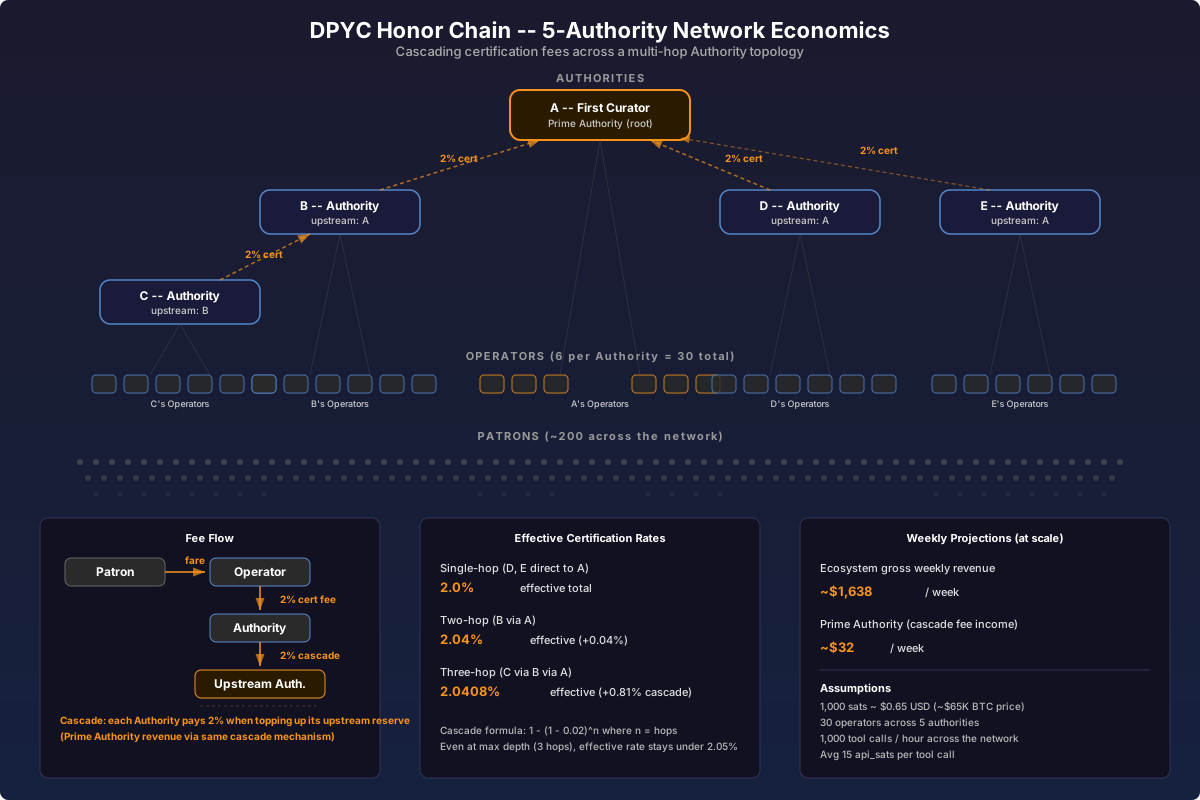
The Honor Chain uses a cascading certification fee model. Each Authority collects an ad valorem fee (configurable per Authority; default 2%) when certifying operator purchase orders. Multi-hop chains (C→B→A) create a small cascade effect, keeping the total effective rate low even at maximum depth.
Ecosystem features (v0.14.x):
- x402 upstream encapsulation — Operators transparently consume Coinbase x402-protected APIs; patrons see pre-funded sats, never USDC or 402 handshakes
- Global-state constraint persistence — SurgePricing and FiniteSupply constraints share the
tool_demandtable in Neon with hourly windowed keys and lifetime sentinel keys - FiniteSupply Neon backing — global-scope invocation caps now persist across restarts; monotonic counter with adjustable ceiling
- Volume discount pricing — SurgePricing supports multipliers < 1.0 (busier = cheaper)
- Constraint scoping — per-tool (
tool_ids) and per-patron (patron_npubs, max 10) targeting - TrancheLifetime — configurable credit expiration (replaces DemurrageConstraint)
- Per-operator schema isolation — each operator gets its own Neon schema with
encrypted_blobcolumn for credential storage - Happy Hour recurrence — user-facing constraint with
in_effect,until,repeats,apply_on,percent_off,max_discountfields
DPYP-01: Base Certificate Protocol — the canonical specification for Honor Chain credit certificates.
Patent & Trademarks
Patent Pending — US Provisional Application 64/045,999
DPYC, Tollbooth DPYC, and Don't Pester Your Customer are trademarks of Lonnie VanZandt. See TRADEMARKS.md for usage guidelines.
License
Apache License 2.0 — see LICENSE for details.