
Skillflow
lininn/skillflow
Orquestrador visual de skills multi-ferramenta com armazenamento local
Ver no GitHubConstrutor visual de workflows local-first que compõe skills de Claude, Codex e Cursor em workflows reutilizáveis. Escaneia recursos existentes, valida grafos e gera pacotes executáveis com preservação de contexto para recuperação em tempo de execução.
Instalação
npx convez-ai lininn/skillflow1 comando no terminal: detecta o formato do repositório (marketplace ou plugin avulso) e instala via Claude Code. Requer Node 18+ e o Claude Code instalado.
Métricas
Casos de uso
- Compor workflows complexos entre Claude, Codex e Cursor
- Reutilizar skills em múltiplas ferramentas de desenvolvimento
- Validar e gerar workflows com regras de handoff explícitas
- Recuperar estado de execução com contexto limitado
Veredito

Skillflow é uma solução madura e bem-arquitetada para composição de workflows multi-ferramenta. Destaca-se pela abordagem local-first, validação de grafo e geração de skills com recuperação de contexto, ideal para equipes que trabalham com múltiplos assistentes IA.
README
A tradução para o português deste README ainda está na fila.
Skillflow
Skillflow is a local-first workflow builder for composing Claude, Codex, Cursor, and manual skills into reusable workflow skills.
It scans the skills and commands that already exist on your machine, lets you arrange them in a visual workflow designer, validates the graph, and generates target-tool SKILL.md packages with a canonical workflow.json next to them.
Why Skillflow
- Local-first by default: project state lives under
.skillflow/; global state lives under~/.skillflow/. - Multi-tool skill registry: import Claude, Codex, Cursor, and manual
SKILL.mdresources from known global and project directories. - Visual workflow composition: arrange imported resources into layers, nodes, and edges in a browser-based designer.
- Workflow generation: generate runnable skills for supported target tools while preserving the workflow graph as
workflow.json. - Explicit handoff rules: same-tool edges can be automatic, confirm-before-continue, or manual; cross-tool edges are forced to manual handoff.
- Recoverable runtime contract: generated skills include bounded recovery guidance for active runs, pending tasks, handoffs, and artifact summaries.
Architecture
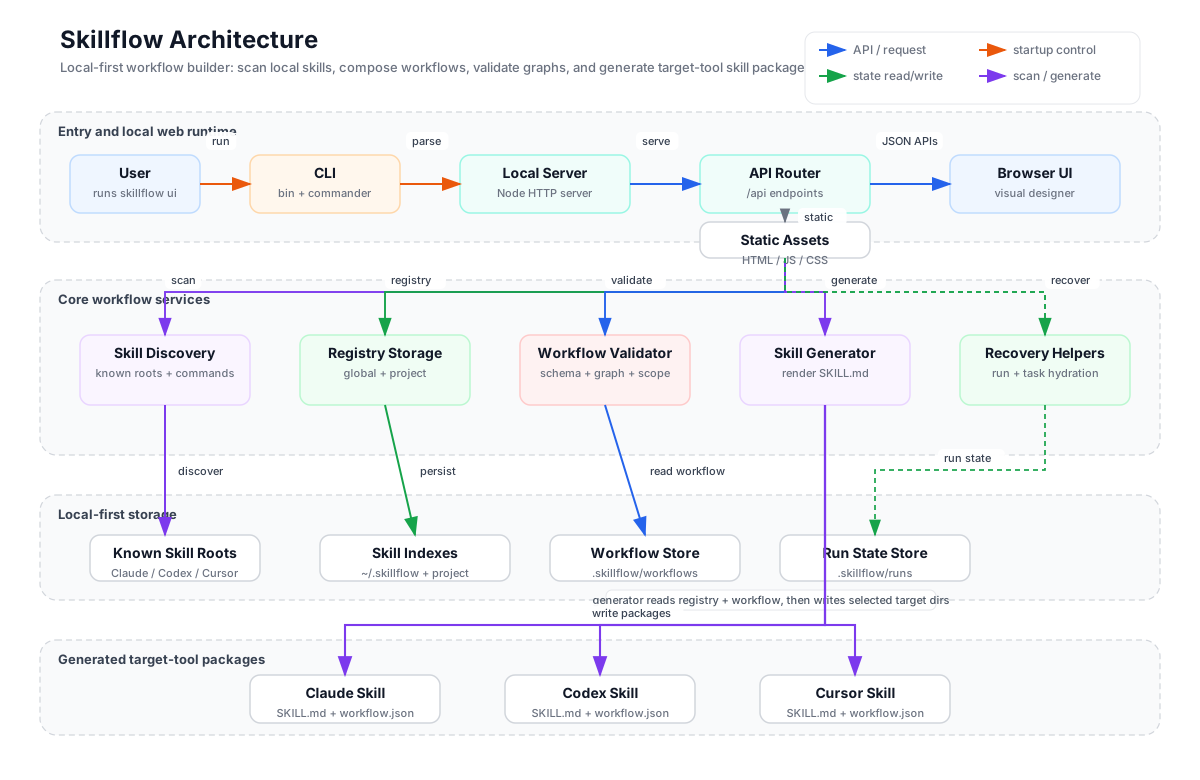
Skillflow has four main layers:
- Entry and local web runtime —
skillflow uistarts a local Node HTTP server and opens a browser-based workflow designer. - Core workflow services — API routes scan/import skills, persist registries, validate workflow graphs, generate target-tool skills, and support recovery metadata.
- Local-first storage — visible state is split between global
~/.skillflow/and project-local<project>/.skillflow/directories. - Generated target-tool packages — Skillflow writes
SKILL.mdandworkflow.jsoninto.claude/skills,.codex/skills, or.cursor/skillsdepending on the selected target.
Data Flow
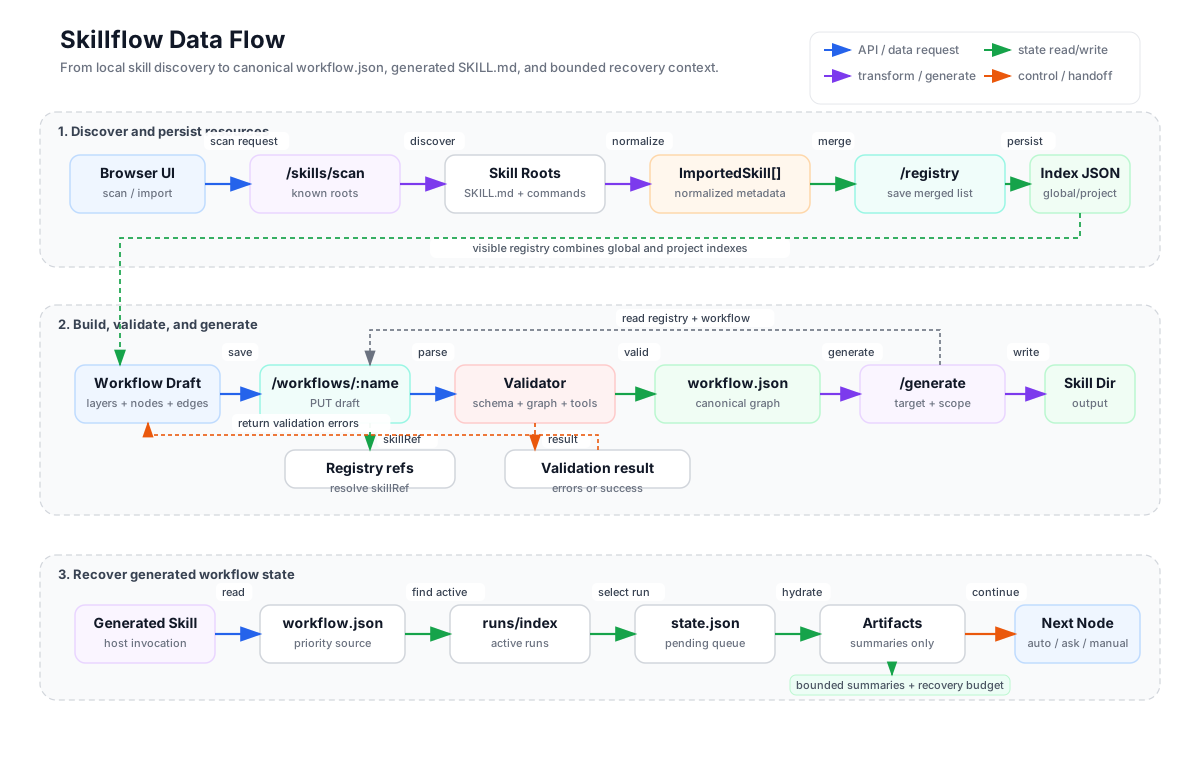
The core flow is:
- Discover resources — the UI calls
/api/skills/scanor imports a manual path; Skillflow normalizes discovered skills and commands intoImportedSkill[]metadata. - Persist the registry — the UI saves the merged registry through
/api/registry; Skillflow writes global entries to~/.skillflow/skills/index.jsonand project entries to<project>/.skillflow/skills/index.json. - Build a workflow — the designer creates a draft with layers, nodes, edges, target tools, and scope.
- Validate and save —
/api/workflows/:nameand/api/workflows/:name/validatecheck schema, graph shape, resource scope, and target-tool compatibility before persistingworkflow.json. - Generate a skill —
/api/workflows/:name/generatere-validates the stored workflow and writes the generated target package. - Recover generated workflow state — generated skills treat adjacent
workflow.jsonas the source of truth and can hydrate bounded context from.skillflow/runs/metadata.
Install
Skillflow requires Node.js 18 or newer.
npm install -g @lininn/skillflow
Verify the installation:
skillflow --version
skillflow --help
Quick Start
1. Start the local UI
Run Skillflow in the current project:
skillflow ui
Or point Skillflow at another project directory:
skillflow ui --project /absolute/path/to/project
Optional host and port flags are available when you need a stable local address:
skillflow ui --host 127.0.0.1 --port 3333 --project /absolute/path/to/project
Skillflow starts a local web server and prints a URL such as:
Skillflow UI: http://127.0.0.1:3333
Open that URL in your browser.
2. Scan or import resources
In the UI, scan known directories or import a manual path. Skillflow discovers:
~/.claude/skills/~/.codex/skills/~/.cursor/skills/~/.claude/commands/<project>/.claude/skills/<project>/.codex/skills/<project>/.cursor/skills/<project>/.claude/commands/- manual directories that contain
SKILL.md
Project-scoped imports are stored in:
<project>/.skillflow/skills/index.json
Global imports are stored in:
~/.skillflow/skills/index.json
3. Build a workflow
Create workflow nodes from imported skills, commands, or subcommands. Each workflow is stored as:
<project>/.skillflow/workflows/<workflow-name>/workflow.json
A workflow document records:
- target tools such as
claude,codex, orcursor - ordered layers
- nodes that reference imported skills or commands
- edges that describe how context moves between nodes
- scope, metadata, and runtime contract information
4. Configure handoff rules
Edges define how context moves from one node to the next:
| Mode | Behavior |
|---|---|
auto | Continue automatically when there is one unambiguous next step. |
ask | Ask the user before moving to the downstream node. |
manual | Stop and require a manual handoff before continuing. |
Cross-tool transitions are always manual because Skillflow does not programmatically invoke another host tool on your behalf.
5. Validate and generate
Validation checks:
- workflow schema
- duplicate node IDs
- unknown edge endpoints
- same-layer or backward edges
- graph cycles
- resource scope rules
- target-tool compatibility
Generation writes a target-tool skill directory, for example:
<project>/.claude/skills/<workflow-name>/SKILL.md
<project>/.claude/skills/<workflow-name>/workflow.json
The generated skill can then be invoked from the target tool's normal skill or command surface.
Runtime Contract
Generated SKILL.md files treat workflow.json as the canonical workflow source. The generated instructions enforce these boundaries:
- The workflow file has priority over prose.
- Each node executes only the referenced skill or command.
- Edge modes control whether execution continues automatically, asks first, or stops.
- Cross-tool boundaries require manual handoff.
- Recovery loads only the active run, selected pending task, direct handoff payload, and bounded artifact summaries needed for the next step.
Skillflow is a workflow builder and generator. It does not include a skillflow run engine in this version.
Local Data Layout
Project state:
<project>/.skillflow/
├── skills/
│   └── index.json
├── capabilities/
│   └── index.json
├── runs/
│   ├── index.json
│   └── <runId>/
│       ├── state.json
│       ├── events.jsonl
│       ├── handoffs/
│       ├── artifacts/
│       └── nodes/
└── workflows/
    └── <name>/
        └── workflow.json
Global state:
~/.skillflow/
├── skills/
│   └── index.json
└── capabilities/
    └── index.json
Generated target skills:
# project scope
<project>/.claude/skills/<workflow-name>/
<project>/.codex/skills/<workflow-name>/
<project>/.cursor/skills/<workflow-name>/

# global scope
~/.claude/skills/<workflow-name>/
~/.codex/skills/<workflow-name>/
~/.cursor/skills/<workflow-name>/
Each generated directory contains:
SKILL.md
workflow.json
Development
npm install
npm run build
npm test
The test suite covers CLI wiring, server routes, static assets, skill discovery, workflow validation, workflow generation, capability storage, and recovery behavior.
Project Structure
skillflow/
├── bin/skillflow.js          # npm executable entry
├── src/
│   ├── cli/                  # commander CLI and UI launcher
│   ├── core/                 # discovery, storage, validation, generation, recovery
│   ├── server/               # Node HTTP API and static asset server
│   └── web/                  # browser-based workflow designer
├── templates/                # generated skill templates
├── test/                     # node:test coverage
├── docs/                     # localized docs and diagrams
└── package.json
Publishing
The package is published as:
npm install -g @lininn/skillflow
Repository:
https://github.com/lininn/skillflow
License
MIT