
AI Orders Agent
legalrealist/ai-orders-agent
MCP server para dataset de decisões judiciais com IA — chat, REST e OpenAPI
Ver no GitHubServidor MCP que expõe um dataset de decisões judiciais envolvendo IA através de múltiplas interfaces: chat, MCP, OpenAPI e REST. Permite que agentes LLM consultem 943 decisões de tribunais americanos com filtros avançados para pesquisa jurídica e análise de jurisprudência sobre IA.
Instalação
npx convez-ai legalrealist/ai-orders-agent1 comando no terminal: detecta o formato do repositório (marketplace ou plugin avulso) e instala via Claude Code. Requer Node 18+ e o Claude Code instalado.
Métricas
Casos de uso
- Pesquisa jurídica sobre regulação e uso de IA nos tribunais
- Análise de padrões em sanções a advogados por má conduta com IA
- Integração de dados judiciais em aplicações legais com Claude
- Rastreamento de requisitos de divulgação de IA por jurisdição
Veredito

Solução bem-arquitetada para exposição de dados especializados (jurisprudência sobre IA) via múltiplas superfícies de agente. O design é limpo, read-only e stateless; útil principalmente para pesquisadores e desenvolvedores jurídicos que precisam de acesso programático a decisões judiciais americanas.
README
A tradução para o português deste README ainda está na fila.
ai-orders-agent
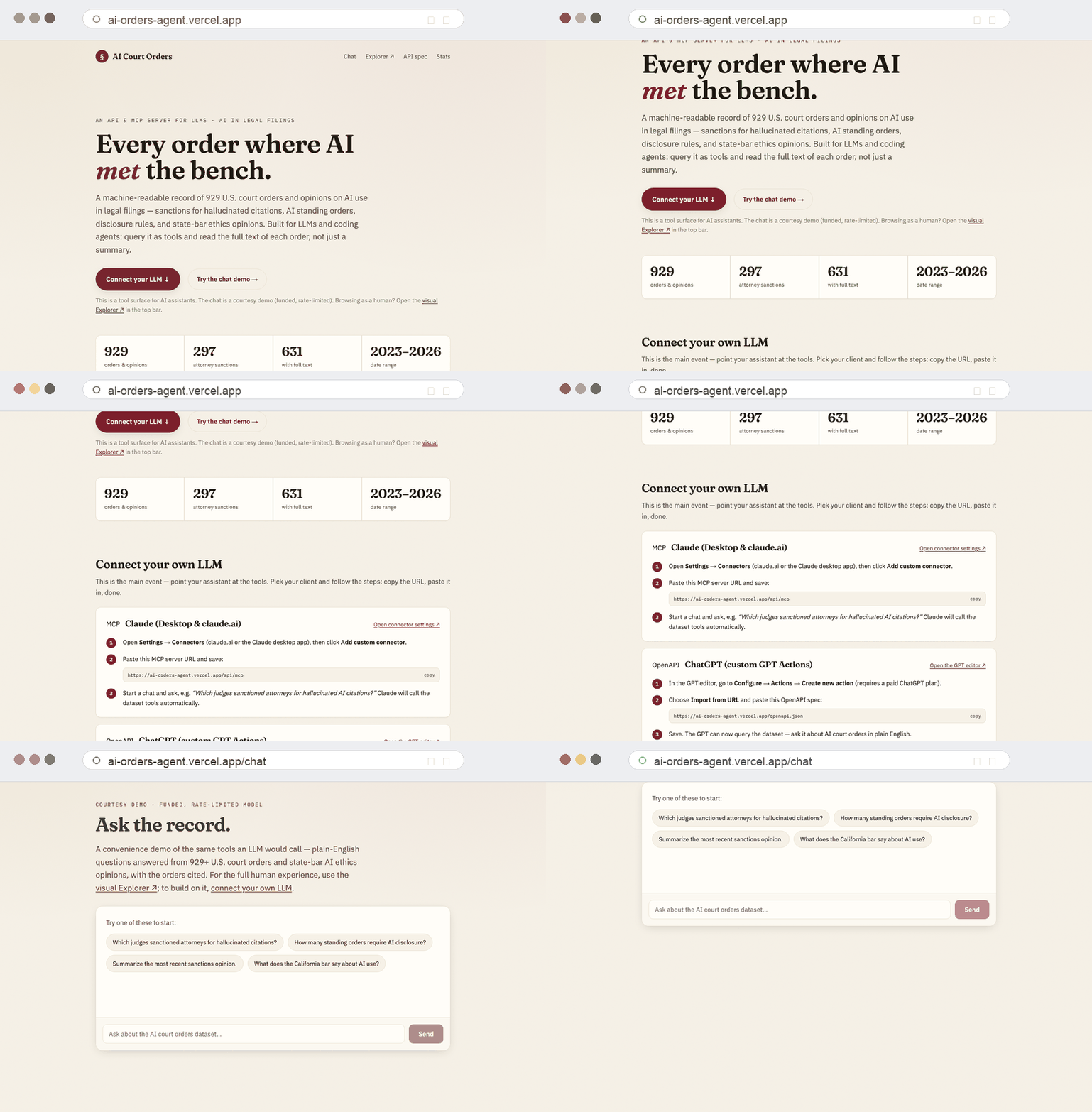
The live deployment at ai-orders-agent.vercel.app.
Agent-facing service for the AI Court Orders dataset — one Vercel project that exposes the same queries four ways:
- Chat (
/chat) — a hosted chat UI; ask in plain English, no setup. A funded, rate-limited LLM (OpenRouter DeepSeek by default) answers by calling the dataset tools (see Chat below). - MCP (
/api/mcp) — add as a custom connector in Claude Desktop / claude.ai, or any MCP client. - OpenAPI (
/openapi.json) — import into a ChatGPT GPT (Actions) or any function-calling LLM. - REST/JSON (
/api/*) — call directly from code or the browser.
It is read-only and stateless: it live-fetches the dataset the AI-orders-explorer repo publishes (that repo owns the data pipeline, the human web explorer, and the Claude-Code skill — this one is purely the agent surface) and caches it in memory.
Data source
Set ORDERS_DATA_BASE to where the dataset (explorer_data.json and
bar_opinions.json) is published. Defaults to the live published copy at
https://legalhack.io/data (943 records). See .env.example.
Endpoints
GET /api/search?q=&<filters>&limit=&full=&count= | full-text search + filters |
GET /api/list?<filters> | filter without a text query |
GET /api/record/{id} · GET /api/pdf/{id} | one record · its PDF/links |
GET /api/facets?field=&limit=&all=&<filters> | distinct values + counts (honors all search/list filters) |
GET /api/stats · GET /api/bar?state= | summary · state-bar opinions |
GET /api/mcp · GET /openapi.json | MCP endpoint · OpenAPI spec |
GET /chat · POST /api/chat | hosted chat UI · streaming chat backend |
Filters (search/list/facets): judge (title-insensitive), court (alias-aware: sdny/S.D.N.Y./full name),
state, type, consequence, ai_type, applies_to (multi-value), source, jurisdiction,
tag, requires, date_from, date_to, has_pdf, has_link.
requires=<key> matches records whose reqs[key] is set — disclose (~128), certify_if_ai (~106),
verify, prohibited, certify_all, proprietary — answering "which courts require AI disclosure / a
certification?". Because facets honors every filter, facets?field=court&consequence=sanctions_attorney
ranks courts by attorney-sanction count and facets?field=court&requires=disclose ranks them by disclosure
requirements. The compact projection includes summary.
Chat
/chat is a streaming chat UI. The backend (POST /api/chat) runs a bounded
tool-calling loop: an LLM answers questions by calling the same dataset
operations the MCP/REST surfaces use (tool definitions are shared via
lib/tools.ts, so the surfaces never drift). It is read-only — the tools only
search and read the public dataset.
Provider. Default is OpenRouter (CHAT_PROVIDER=openrouter) on a cheap
DeepSeek model. Set CHAT_PROVIDER=anthropic or openai to switch; each reads
its own server-only key. Keys never reach the browser.
Rate limiting. The funded path is protected by three independent limits —
per-IP burst, per-IP daily cap, and a global daily kill-switch — backed by
Upstash Redis. Set UPSTASH_REDIS_REST_URL and
UPSTASH_REDIS_REST_TOKEN for the public deploy. Without Upstash, limiting
falls back to a best-effort in-memory limiter that is not durable across Vercel
invocations — fine for local dev, not safe for a public funded endpoint.
See .env.example for all chat/rate-limit variables.
Run / deploy
npm install
npm run dev        # http://localhost:3000  (try /chat, /api/stats, /openapi.json, /api/mcp)
npm test           # query-logic parity tests
vercel deploy      # or push to a Vercel-connected GitHub repo
Connect it
- Claude (Desktop or claude.ai): add a custom connector pointing at
https://<your-deploy>/api/mcp. - ChatGPT: create a GPT → Actions → import
https://<your-deploy>/openapi.json. - Other LLMs / code: call the REST endpoints, or use the OpenAPI spec for function-calling.
Query behavior (court aliasing, title-insensitive judge match, multi-value
applies_to, facet placeholder handling) mirrors the explorer's orders CLI.
License
MIT — see LICENSE.