
Multi-Agent Orchestrator Skill
lazze2026/multi-agent-orchestrator-skill
Orquestra agentes lógicos em uma sessão de IA com checkpoints e verificação independente
Ver no GitHubSkill para coordenar trabalho multi-agente lógico dentro de uma única ferramenta de IA, usando Task Specs, Worker Briefs, checkpoints, verificação independente e dashboard de leitura. Implementa um modelo operacional leve com planejamento explícito, execução escópica, log de transições e Loop de workspace com guardrails para evitar derivas de estado.
Instalação
npx convez-ai lazze2026/multi-agent-orchestrator-skill1 comando no terminal: detecta o formato do repositório (marketplace ou plugin avulso) e instala via Claude Code. Requer Node 18+ e o Claude Code instalado.
Métricas
Casos de uso
- Decomposição e execução de tarefas longas em ferramentas de IA sem perder contexto
- Verificação independente de trabalho de agentes workers para evitar contaminação de julgamento
- Monitoramento e recuperação de tarefas bloqueadas com dashboard estático em tempo real
- Automação de ciclos repetidos (Loop) com dry-run, validação incremental e guardrails de segurança
Veredito

Solução robusta e praticamente orientada para orquestração de agentes dentro de uma mesma sessão de IA, com ênfase em prevenção de deriva de estado e verificação independente. Ideal para fluxos complexos e tarefas longas que precisam de checkpoint e recuperação, mas requer compreensão clara da arquitetura event-first.
README
A tradução para o português deste README ainda está na fila.
Multi-Agent Orchestrator Skill
Coordinate logical multi-agent work inside one AI coding tool with Task Specs, Worker Briefs, checkpoints, independent verification, a read-only dashboard, and now a workspace-level timed Loop.
中文简介:这是一个面向 Codex、ClaudeCode、OpenClaw 等 AI 编程工具的多 Agent 协同 Skill。它不创建真实后台服务,而是在同一个 AI 工具会话里,用 Coordinator / Worker / Verifier / Monitor / Dashboard / Loop 这些逻辑角色,把长任务拆解、执行、校验、恢复和看板展示标准化。






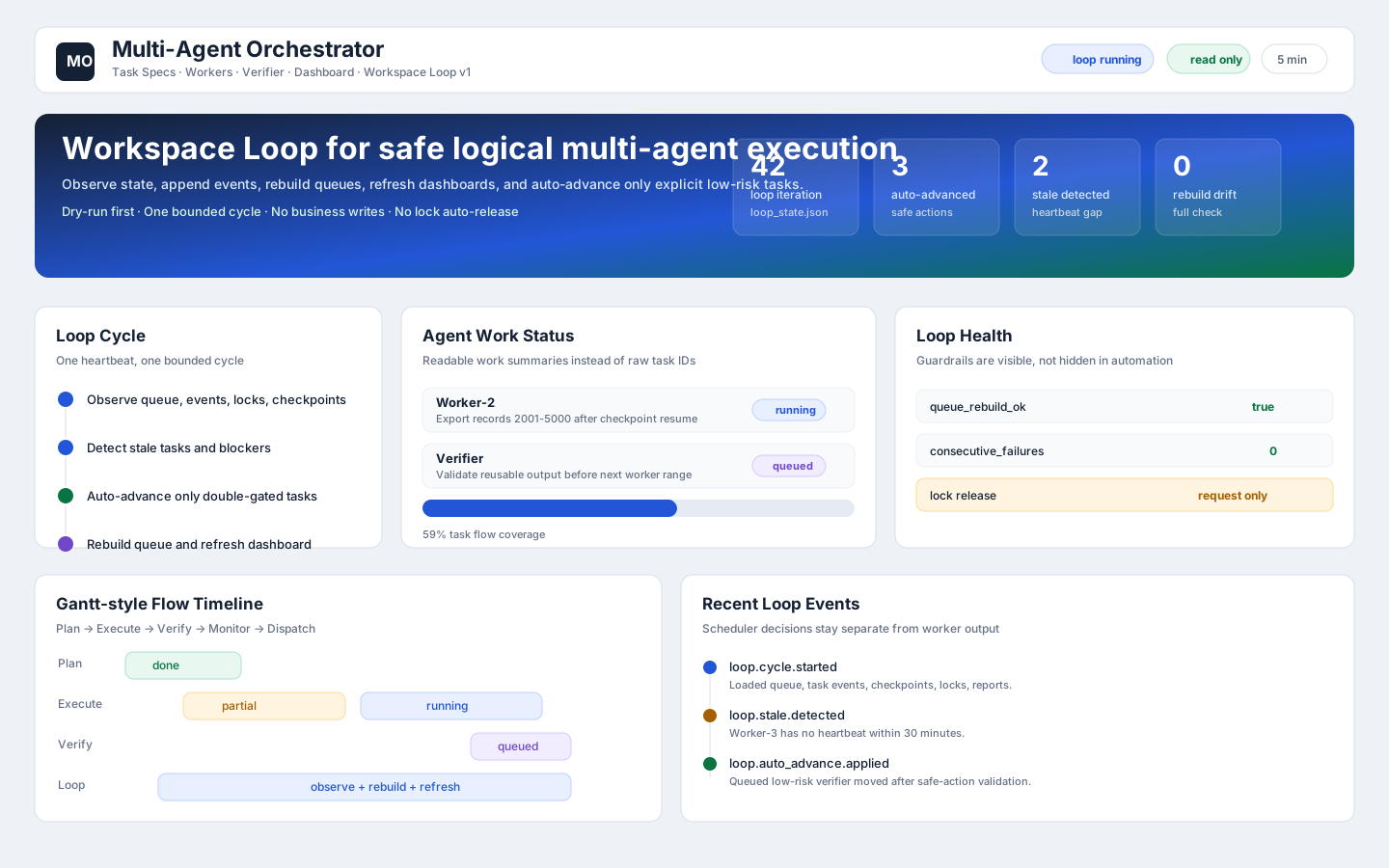
Why This Project Exists
Long AI-agent tasks usually break down in familiar ways:
- the tool loses track of what is already done
- verification gets polluted by the worker's own conclusions
- partial output is forgotten after context compaction
- a blocked worker becomes invisible until a human asks
- dashboard refresh is manual and state drift goes unnoticed
This project gives one AI tool a lightweight operating model:
- plan first
- execute inside explicit scope
- log every transition
- checkpoint partial progress
- verify independently
- surface status in a read-only board
- optionally run a timed Loop that checks the workspace every few minutes
What Makes It Different
Most "multi-agent" demos either hand-wave the protocol or jump straight to autonomous background systems. This Skill stays practical:
- single-tool only: no fake distributed architecture
- event-first: queue and dashboard are derived, not authoritative
- authorization-aware: no silent write expansion
- verifier-separated: implementation and verification do not share judgment
- Loop with guardrails: dry-run, one-cycle execution, incremental rebuild, scheduled full validation, and no automatic business writes
New in v1.4.0
Workspace Loop v1 is now implemented.
scripts/loop_runner.pyfor one bounded workspace cycle--dry-runmode for policy preview without writes--oncemode for heartbeat-friendly executionscripts/simulate_loop.pyfor future-cycle prediction- stale detection based on missing heartbeat or progress events
- explicit safe actions:
status_update_to_runningstatus_update_to_verifyingverifier_trigger
- incremental queue rebuild plus full rebuild validation every 12 cycles by default
- stale lock holder detection with
lock.release.requested, but no default auto-release
At a Glance
What you get out of the box:
- Task Spec first: scope, authorization, risk, allowed paths, forbidden actions, deliverables, acceptance criteria
- Worker Briefs: bounded work cards with dependencies and reporting format
- State machine:
queued,running,partially_completed,blocked,verifying,done,needs_human_decision - Event log: append-only events with
caused_byandtrigger_event_id - Checkpoint recovery: resumable long-running work with idempotency checks
- Independent Verifier: checks deliverables from task spec, not worker self-assessment
- Monitor warnings: lock conflicts, stale agents, queue pressure, rate limits, fallback decisions
- Read-only dashboard: tasks, agents, blockers, swimlanes, dispatch actions, checkpoints, recent events
- Workspace Loop v1: periodic observation and cautious auto-advance with audit trails
Quick Start
Clone into a shared skills directory:
git clone https://github.com/lazze2026/multi-agent-orchestrator-skill.git ~/.shared-skills/multi-agent-orchestrator
GitLab mirror:
git clone https://gitlab.com/chenkimi679-group/chenkimi679-project.git ~/.shared-skills/multi-agent-orchestrator
Link or copy it into your tool's skills folder:
~/.codex/skills/multi-agent-orchestrator
~/.claude/skills/multi-agent-orchestrator
~/.openclaw/skills/multi-agent-orchestrator
Ask your AI tool to use it:
Use multi-agent-orchestrator to split this long-running task into Task Spec, Worker Briefs, event log, checkpoint, verifier report, dashboard state, and a workspace Loop plan.
Workspace Loop v1
Loop v1 turns an orchestrator workspace into a timed, auditable cycle. It reads state, appends Loop events, rebuilds queue snapshots, refreshes the dashboard, and only auto-advances explicitly allowed low-risk tasks.
Preview the next cycle without writing files:
python scripts/loop_runner.py ./workspace --dry-run
Run one bounded cycle:
python scripts/loop_runner.py ./workspace --once
Simulate the next 10 cycles without mutating the source workspace:
python scripts/simulate_loop.py ./workspace --cycles 10 --output simulation.json
Loop guardrails:
- no business deliverable writes
- no lock auto-release by default
- no verifier trigger without plan and artifacts
- no status jump without explicit safe action
- full rebuild validation every 12 cycles by default
Dashboard Demo
A static demo is included:
python -m http.server 8765 --bind 127.0.0.1 --directory tests/simulations/dashboard-static-html
Open:
http://127.0.0.1:8765/index.html
The dashboard reads only state.json. It does not mutate queue, events, locks, reports, checkpoints, or task status.
Current dashboard capabilities:
- KPI cards through
summary.metrics - richer Agent cards with
current_work,detail, andlast_observed - horizontal gantt-like flow timeline
- generic
entity_gridfor batch/module/shard/task matrix views - localized rendering through
display_dictionary - friendlier event names through
event_display_rules - optional business-specific display additions through
domain_extensions - Loop section with cycle summary, health, and recent Loop events
Note: the bundled timeline inference currently uses real task-group status with placeholder start and span values. Event-time-based timeline inference is planned as a future enhancement.
CI
Both hosted copies run the same standard-library test suite:
python -m unittest discover -s tests -v
- GitHub Actions:
.github/workflows/tests.yml - GitLab CI:
.gitlab-ci.yml
Generate Dashboard State
Requirements:
- Python 3.9+
- standard library only
Generate state.json from an orchestrator workspace:
python scripts/generate_dashboard_state.py ./workspace
Custom output:
python scripts/generate_dashboard_state.py ./workspace --output ./workspace/dashboard/state.json --refresh-interval 180
Validate a dashboard state file:
python scripts/validate_state.py ./workspace/dashboard/state.json
Best Fit
Use this Skill for:
- long-running AI coding tasks that need checkpoints
- batch work split by date range, module, file set, or data shard
- risky changes where implementation and verification should stay separate
- workflows with dependencies, locks, partial completion, or cancellation risk
- teams who want a visible Agent/task board while one AI tool coordinates the work
- workspace-level periodic review with a cautious Loop instead of a free-running autonomous agent
Avoid it for:
- simple one-step tasks under about 10 minutes
- highly interactive work that needs constant user input
- work without clear authorization or acceptance criteria
- cross-tool orchestration
Typical Workflow
flowchart LR
  U[User Request] --> TS[Task Spec]
  TS --> Q[Queue]
  Q --> W[Worker Briefs]
  W --> E[Event Log]
  W --> C[Checkpoint]
  W --> V[Independent Verifier]
  E --> M[Monitor]
  C --> M
  V --> M
  M --> D[Read-only Dashboard]
  D --> L[Workspace Loop]
Repository Map
multi-agent-orchestrator-skill/
|-- SKILL.md
|-- agents/openai.yaml
|-- references/protocol.md
|-- references/loop-v1-design.md
|-- references/loop-v1-design.zh-CN.md
|-- references/templates/
|-- scripts/
|   |-- generate_dashboard_state.py
|   |-- validate_state.py
|   |-- loop_runner.py
|   |-- simulate_loop.py
|   `-- dashboard
|-- tests/
|   |-- test_loop_runner.py
|   |-- test_simulate_loop.py
|   `-- simulations/
`-- docs/
    |-- install-codex-claudecode-openclaw.md
    `-- images/
Core Safety Rules
auto-approveis not write authorization- worker completion is not final completion; Verifier must review it
- Verifier must not inherit Worker conclusions
- dashboard is read-only
- Loop may request lock release, but must not treat a request as approval
- priority cannot bypass authorization, locks, dependencies, or verification
- cancellation is not rollback; any deletion, overwrite, or DB rollback is a separate authorized write action
Documentation
- Skill entry point
- Full protocol
- Workspace Loop v1 design
- Workspace Loop v1 design, zh-CN
- Install for Codex, ClaudeCode, and OpenClaw
- Dashboard simulation
- API rate limit simulation
Releases
v1.0.0: initial public releasev1.3.0: dashboard schema and demo upgradev1.4.0: workspace Loop v1 runner, simulator, stale detection, queue rebuild validation, and Loop dashboard fields
Community
Issues and pull requests are welcome. Before proposing a change, please read:
License
MIT License. See LICENSE.