
seo
labirinth/seo
skill_claude
Instalação
npx convez-ai labirinth/seo1 comando no terminal: detecta o formato do repositório (marketplace ou plugin avulso) e instala via Claude Code. Requer Node 18+ e o Claude Code instalado.
Métricas
README
A tradução para o português deste README ainda está na fila.
SEO/LLM Skill Cluster
Mirror. Copied from the upstream project sergekostenchuk/seo-llm-skill-cluster by Sergey Kostenchuk, under the MIT License (see LICENSE). Kept here as a personal copy for reuse across projects. All credit to the original author.





This repository contains a staged Codex skill cluster for building, auditing, and improving websites that need to work well for people, search engines, and LLM agents.
The cluster grew out of work on mlllm.io, a personal AI news and builder-lab site by Sergey Kostenchuk. The site was created as a public profile and evidence surface while preparing an OpenAI open-source grant application, and it became a practical test case for sending AI news from lookatainews on Telegram into a public website with clean SEO, structured data, and LLM-readable discovery files.
After two intense days of iteration with several models, the useful pattern became clear: this should not be one large SEO prompt. It should be a coordinated group of skills with an orchestrator, specialists, validators, test artifacts, and a task plan that keeps the work auditable.
Quick Start
Clone the repository and run the local validation checks:
git clone https://github.com/sergekostenchuk/seo-llm-skill-cluster.git
cd seo-llm-skill-cluster

python3 plans/seo-llm-skill-cluster/scripts/lint_skill_cluster.py . \
  --report .reports/seo-llm-cluster-lint.json

python3 plans/seo-llm-skill-cluster/scripts/verify_mvp_evals.py . \
  --report .reports/seo-llm-mvp-evals.json

for f in skills/*/evals.json; do
  python3 -m json.tool "$f" >/dev/null
done
Then inspect:
- examples/mlllm-case-study for sample outputs;
- plans/seo-llm-skill-cluster/TASK-PLAN.md for the full task-plan history;
- plans/seo-llm-skill-cluster/final-validation-report.md for the validation snapshot.
What The Skills Produce
| Skill | Main output |
|---|---|
site-growth-orchestrator | Handoff packet, routing decisions, task sequencing |
semantic-core-architect | Query, intent, entity, topic, and language map |
information-architecture-seo | URL model, section map, canonical/hreflang rules |
internal-link-graph-architect | Brief-longform-topic-project link graph |
technical-seo-schema-engineer | Metadata, schema.org, sitemap, RSS, robots, llms.txt audit |
llm-friendly-site-architect | Agent-readable discovery model, source trail, answer block guidance |
seo-regression-validator | Static SEO regression reports for public pages |
editorial-quality-gate | Editorial QA checklist and content improvement report |
ux-journey-architect | Reader journeys, onboarding gaps, retention path recommendations |
server-log-crawler-analyst | Crawler access and bot behavior reports |
llm-citation-monitor | Prompt matrix and citation evidence report |
external-authority-placement-scout | Dry-run authority opportunity register |
backlink-quality-validator | White-hat backlink risk and quality report |
Example Output
The mlllm.io case study includes real example artifacts:
- goal brief
- routing and handoffs
- semantic core
- URL map
- internal link graph
- technical SEO/schema audit
- LLM-friendly audit
- improvement backlog
- JSON regression reports for homepage, news, article, and site access checks.
mlllm.io Case Study
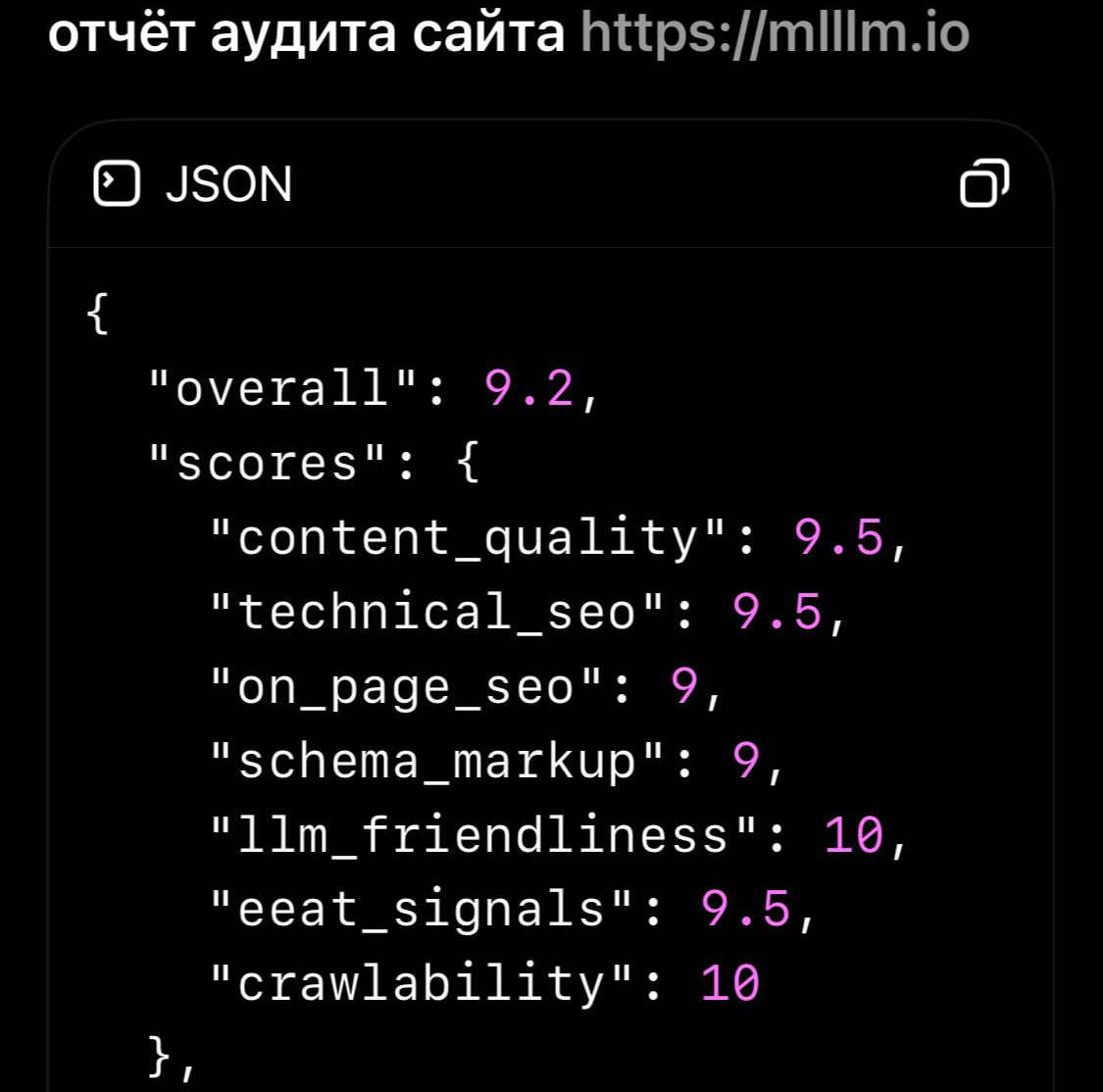
This image is an example audit snapshot from the mlllm.io case study. It is a model-assisted audit result, not a formal third-party certification. The useful part is not the number by itself, but the workflow behind it: structured metadata, schema, llms.txt, public discovery files, source trails, internal linking, and validation artifacts.
Read the case study: docs/mlllm-case-study.md.
Why This Exists
Modern public sites need more than classic SEO:
- humans need clear navigation, trust signals, and a readable content model;
- search engines need metadata, canonical URLs, hreflang, sitemap coverage, and schema;
- LLM agents need crawlable HTML,
llms.txt, source trails, entity pages, and stable linking; - operators need evidence from tests, logs, crawler behavior, and live audits instead of guesses.
The goal of this cluster is to turn that combined work into repeatable skills.
Task-Plan Driven Work
The work was managed with task-plan-v2-dashboard.
That dashboard matters because multi-step agent work quickly becomes hard to supervise from chat alone. A task plan with visible status, blockers, validation, and handoff notes gives the user room to stop watching every model turn and at least make a cup of coffee while the agent continues through a controlled checklist.
The task plan in this repository is not decoration. It is the control document for scope, sequencing, tests, safety boundaries, and publication hygiene.
Cluster Shape
The central orchestrator is:
site-growth-orchestrator
Core SEO/LLM skills:
semantic-core-architectinformation-architecture-seointernal-link-graph-architecttechnical-seo-schema-engineerllm-friendly-site-architectseo-regression-validator
Companion skills:
editorial-quality-gateux-journey-architectserver-log-crawler-analystllm-citation-monitorexternal-authority-placement-scoutbacklink-quality-validator
Safety Boundaries
This cluster is intentionally evidence-first and white-hat:
- no hidden bot-only content;
- no duplicate content factories;
- no fake rankings, citations, or crawler claims;
- no link farms, PBNs, spam comments, fake reviews, or doorway pages;
- no external posting, outreach, PRs, DMs, or submissions without explicit authorization;
- schema must match visible user-facing content;
- monitoring reports must distinguish observed facts, inferences, and open questions.
Authority placement skills are dry-run by default. They can scout and validate opportunities, but real-world posting requires approval and platform-specific rules.
Repository Layout
skills/
  site-growth-orchestrator/
  semantic-core-architect/
  information-architecture-seo/
  internal-link-graph-architect/
  technical-seo-schema-engineer/
  llm-friendly-site-architect/
  seo-regression-validator/
  editorial-quality-gate/
  ux-journey-architect/
  server-log-crawler-analyst/
  llm-citation-monitor/
  external-authority-placement-scout/
  backlink-quality-validator/

examples/
  mlllm-case-study/

docs/
  mlllm-case-study.md

plans/seo-llm-skill-cluster/
  TASK-PLAN.md
  FEATURE-PREPARATION.md
  cluster-architecture.md
  validation-matrix.md
  final-validation-report.md
  scripts/
  evals/

wiki/
  seo-llm-skill-cluster.md
Validation
The staged cluster includes JSON eval files, validation reports, a cluster linter, an MVP eval verifier, and a GitHub Actions workflow.
CI runs on push and pull request:
- JSON syntax validation;
- YAML syntax validation;
- skill-cluster linter;
- MVP eval verifier;
- public package sensitive-pattern scan.
Status
This is a staged skill workspace, not an automatic production install.
Use it as:
- a reference implementation for a skill cluster;
- a reusable SEO/LLM site architecture playbook;
- a task-plan example for multi-agent website optimization;
- a starting point for controlled local Codex skill installation.
Before installing these skills into a live Codex skills directory, review the trigger map, run validation, and keep backups of any existing skills with overlapping names.