
Data Catalog Lineage MCP Server
Keshetti-Nikhil/data-catalog-lineage-mcp-server
Análise de impacto de mudanças em colunas com linhagem de dados de alta precisão
Ver no GitHubServidor MCP em TypeScript que expõe ferramentas de linhagem sobre um grafo de dependências de 400 mil ativos, com análise de impacto em nível de coluna. Inclui benchmark comparando quatro métodos de impacto, mostrando que linhagem em nível de coluna (F1 0.79) reduz alertas falsos em 8x versus análise transitiva completa.
Instalação
npx convez-ai Keshetti-Nikhil/data-catalog-lineage-mcp-server1 comando no terminal: detecta o formato do repositório (marketplace ou plugin avulso) e instala via Claude Code. Requer Node 18+ e o Claude Code instalado.
Métricas
Casos de uso
- Avaliar impacto de mudanças em colunas antes de migrações de dados
- Comparar métodos de análise de linhagem (tabela vs coluna) em escala
- Identificar quais ativos downstream realmente quebram ao alterar uma coluna
- Reduzir alert fatigue em pipelines de dados críticos
Veredito

Ferramenta altamente técnica e especializada para equipes de engenharia de dados que precisam entender real impacto de mudanças. Benchmark sólido e código bem estruturado; não é para iniciantes, mas resolve um problema real e bem definido em linhagem de dados.
README
A tradução para o português deste README ainda está na fila.
data-catalog-lineage-mcp-server



A Model Context Protocol server, in TypeScript, that exposes data-catalog lineage tools over a 400,000-asset dependency graph, plus a benchmark that scores four impact-analysis methods on what actually breaks when a column changes. It speaks JSON-RPC over stdio and drops into Claude Desktop.
The challenge
"If I change this column, what breaks?" is the question every data engineer asks before a migration, and the usual answer, the full transitive set of downstream tables, is almost useless: it flags everything reachable, most of which never touches the changed column. That is alert fatigue. The precise answer needs column-level lineage, but column-level lineage metadata is usually incomplete, so it trades coverage for precision. This bench measures exactly that trade.
Use case
Use it to reason about lineage tooling: why table-level impact analysis over-alerts, how much precision column-level lineage buys, and how incomplete column metadata caps the recall you can achieve.
MCP tools
| Tool | Description |
|---|---|
search_assets | List assets in an id range |
get_lineage | Immediate upstream and downstream of an asset |
impact_analysis | Assets impacted by a column change, by chosen method |
column_lineage | Downstream columns derived from a given column |
find_orphans | Non-source assets with no downstream consumer |
Headline result
400,000 assets · 3 columns each · 18% sources · 22% of column edges missing metadata · 500 change scenarios.
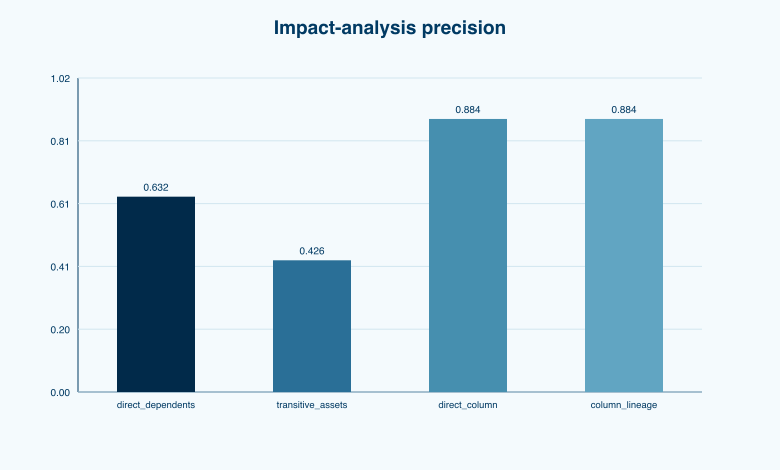
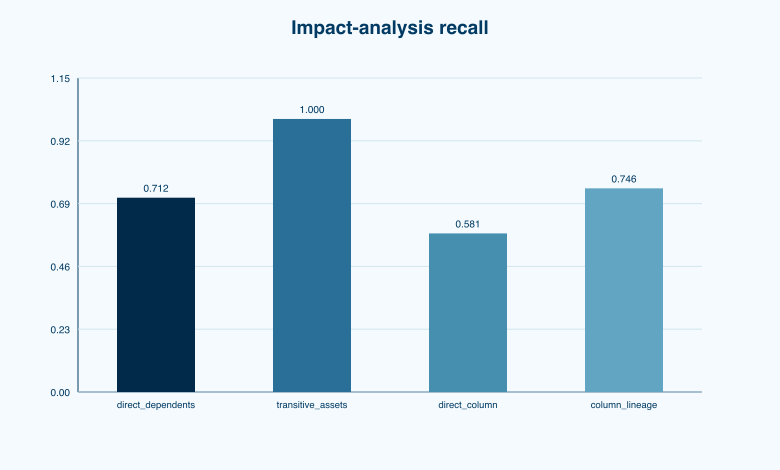
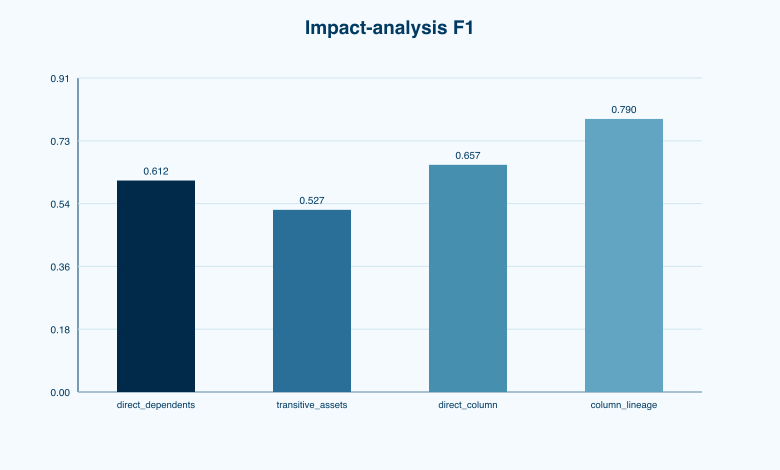
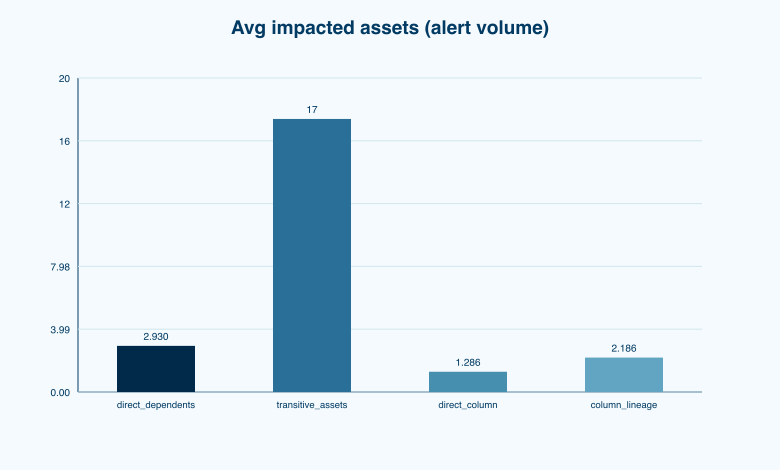
| Method | Precision | Recall | F1 | Avg impacted | Missed breakage |
|---|---|---|---|---|---|
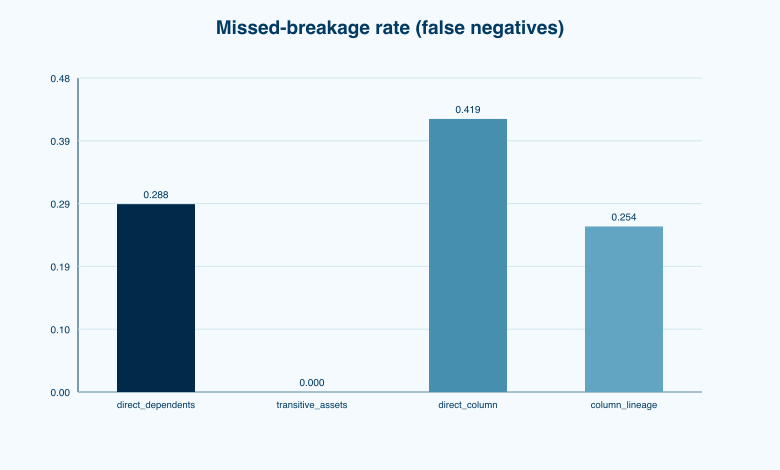
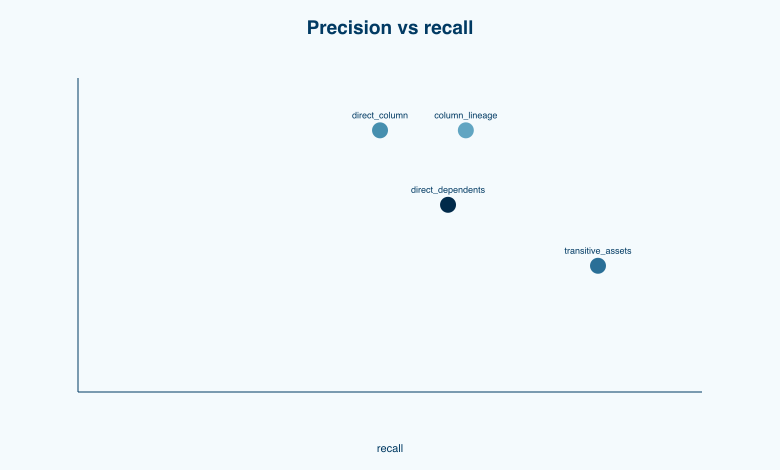
| direct_dependents | 0.632 | 0.712 | 0.612 | 2.9 | 0.288 |
| transitive_assets | 0.426 | 1.000 | 0.527 | 17.3 | 0.000 |
| direct_column | 0.884 | 0.581 | 0.657 | 1.3 | 0.419 |
| column_lineage | 0.884 | 0.746 | 0.790 | 2.2 | 0.254 |
- Full transitive impact analysis never misses (recall 1.000) but precision is 0.43, flagging 17.3 assets when 2-3 actually break, an 8x over-alert. This is the alert-fatigue failure that makes teams ignore impact warnings.
- Column-level lineage is the best method (F1 0.79) with 8x less noise than transitive, because it follows only the changed column's derivations.
- But column lineage misses 25% of real breakage, and that number is no accident: it tracks the 22% of column edges whose metadata is missing. Recall is capped by metadata completeness, the single most important lever.
- Direct (one-hop) methods are a trap: cheap, but they miss all transitive breakage (29-42% missed), which is exactly the breakage that surprises you in production.
Run it as an MCP server
npm install
npm run serve     # JSON-RPC over stdio
Claude Desktop (claude_desktop_config.json):
{
  "mcpServers": {
    "data-catalog-lineage": {
      "command": "npx",
      "args": ["tsx", "/abs/path/to/src/mcp/serve.ts"]
    }
  }
}
Smoke test:
printf '%s\n' '{"jsonrpc":"2.0","id":1,"method":"tools/list"}' | npm run -s serve
Chart gallery
 |  |  |
 |  |  |
Test pyramid
            /\        runner + impact orderings (runner.test)
           /  \
          /----\      MCP protocol: init/list/call/errors (mcp.test)
         /      \
        /--------\    graph generation + impact reachability (generate, impact)
       /__________\   12 tests total
Quickstart
npm test
npm run bench:fast    # 20k assets
npm run bench         # full 400k-asset run (NODE_OPTIONS=--max-old-space-size=8192)
What is in the repo
src/
  data/generate.ts    400k-asset DAG with column-level lineage (CSR typed arrays)
  models/impact.ts    ground truth + four impact methods, epoch-stamped BFS
  bench/ + runner.ts  precision/recall/F1, alert volume, missed-breakage
  mcp/server.ts       JSON-RPC MCP protocol
  mcp/tools.ts        the five catalog tools
  viz/render.ts       six SVG->PNG charts (palette "Helpdesk Sky")
  cli/main.ts         info + bench
References
- Anthropic (2024). Model Context Protocol Specification.
- Halevy, A. et al. (2016). Goods: Organizing Google's Datasets. SIGMOD.
- Gupta, A. et al. (2021). Data Lineage: A Survey.
- Armbrust, M. et al. (2020). Delta Lake. VLDB.
License
MIT.