
Fleet Mode
Jott2121/fleet-mode
Orquestração inteligente de agentes com bias para simplicidade e custo-eficiência
Ver no GitHubUma doutrina medida para orquestração de agentes de IA, sabendo quando não usar múltiplos agentes. Implementa quatro regras fundamentais: leituras paralelizam, escritas são single-threaded, verificações determinísticas precedem review, e cada agente adicionado deve justificar seu custo. Roda como skill nativa do Claude Code com gates humanos para decisões irreversíveis e logging completo de decisões.
Instalação
npx convez-ai Jott2121/fleet-mode1 comando no terminal: detecta o formato do repositório (marketplace ou plugin avulso) e instala via Claude Code. Requer Node 18+ e o Claude Code instalado.
Métricas
Casos de uso
- Coordenar múltiplos agentes IA em fluxos de trabalho autônomos sem paralisia por análise
- Implementar gates de qualidade e revisão independente antes de ações irreversíveis
- Registrar e auditoria cada decisão de agente mantida ou descartada com métricas reais
- Reduzir custos de orquestração decidindo quando usar um agente único vs paralelismo
Veredito

Fleet Mode é um framework opcionado e pragmático que inverte a mentalidade comum de 'mais agentes = melhor'. Excelente para quem opera sistemas autônomos em produção e precisa de controle de custo real, auditoria de decisões e segurança operacional — mas requer disciplina para manter o single-threading de escritas e os gates humanos.
README
A tradução para o português deste README ainda está na fila.
Fleet Mode
A measured doctrine for orchestrating AI agents, and knowing when not to.
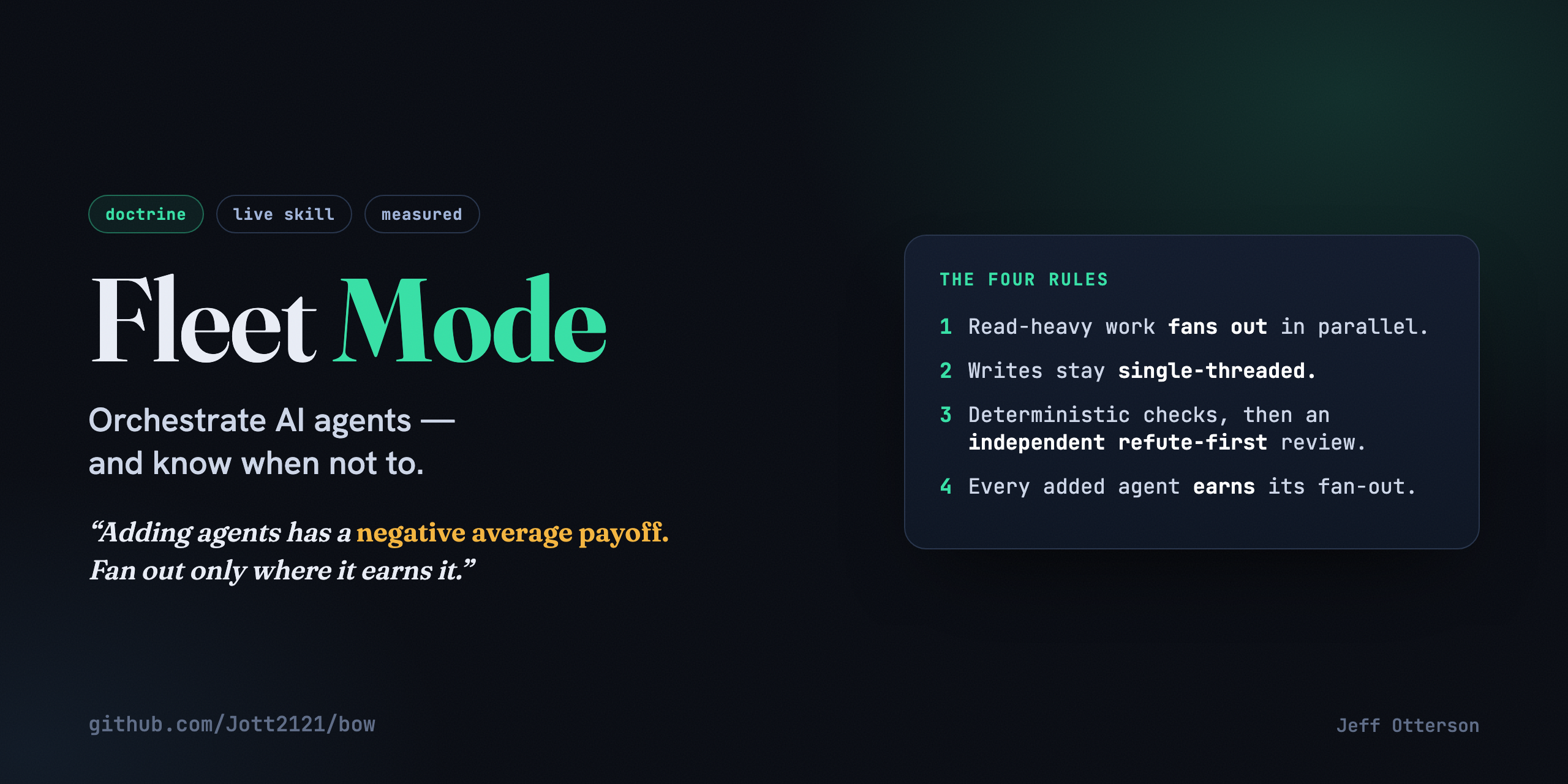
Most "multi-agent" advice assumes more agents is better. It usually isn't. Fleet Mode is the opposite stance, run as a live Claude Code skill: adding agents has a negative average payoff on most tasks, so you fan out only where it demonstrably earns it, and you keep the writes single-threaded and gated.
It's the operating mode behind bow (an autonomous all-Claude chief-of-staff agent) and the builds it ships.
🧩 One layer of a five-repo cost-governance stack for operating AI agents cost-efficiently; bow is the flagship that runs every layer in production.
The four rules
- Read-heavy work fans out. Research, codebase/PR review, multi-file audits: parallel subagents in clean contexts, each returning a condensed summary. This is the only thing fan-out is for.
- Writes stay single-threaded. One agent makes the edit. Never fan out to edit in parallel.
- Deterministic checks first, then an independent refute-first review. Tests/types/lint/build must pass with no model in the loop; then a separate clean-context reviewer tries to refute the work. No agent grades its own work. Fail closed.
- Every added agent earns its fan-out. Default to a single strong agent. More agents add intelligence (extra perspectives, verification), not parallel actions.
Plus the two non-negotiables: human-gate anything irreversible/MAJOR (push, deploy, send, real-money trade, mass-delete, new spend), and log an honest receipt of every kept/killed decision with the real number.

The gate (run in order)
- Classify stakes. trivial: light check, ship. non-trivial: full gate. irreversible: full gate plus human approval first.
- Decide fan-out (bias-to-NO). Single strong agent by default; fan out only for read-heavy, parallelizable work that exceeds one context window.
- Write single-threaded.
- QC gate. Deterministic checks, then an independent reviewer that tries to refute. Escalate high-stakes output to a different-model judge.
- Human-gate MAJOR items.
- Log a receipt.
Full operational spec: SKILL.md.
Dependencies
The skill references the superpowers:* skill family (for dispatching parallel agents and
requesting independent review). If superpowers skills are unavailable, substitute: fan-out
decisions manually, run tests before any model review, get a colleague to review independently.
The receipt script has zero dependencies (Python stdlib only).
Install (as a Claude Code skill)
git clone https://github.com/Jott2121/fleet-mode ~/.claude/skills/fleet-mode
Claude Code auto-discovers it. Invoke it (or let it auto-apply) on any non-trivial change. The receipt tool stands alone too:
python3 scripts/append_receipt.py \
  --task "add retry to uploader" --tried "exponential backoff" --verdict kept \
  --why "cut timeout errors to zero in a 200-run soak" --metric errors --value 0
Appends an append-only row to KILLLOG.md: the honest ledger of what you kept, killed, and why.
See KILLLOG.md for a sample of the format.
Why it exists
Evaluate without prejudice; adopt only on measured proof. Receipts over hype.
The multi-agent discourse is full of impressive-sounding fan-out diagrams that, measured, lose to a single careful agent. Fleet Mode is the discipline that keeps the wins (parallel reading, independent review, hard gates) and drops the cargo-culting (parallel writers, self-grading, unbounded agent swarms). It scales to the task, not to the hype.
License
MIT, copyright 2026 Jeff Otterson. See LICENSE.