
Zeno Mobile Runner
johnmikel/zeno-mobile-runner
Plano de controle móvel para agentes de IA verificarem o que constroem
Ver no GitHubMCP server que funciona como olhos e mãos para agentes de IA construindo apps móveis. Instala, lança e testa aplicações React Native, Expo, Flutter e nativas (Android/iOS), capturando screenshots, árvores UI semânticas e gerando traces reproduzíveis com evidência completa das execuções.
Instalação
npx convez-ai johnmikel/zeno-mobile-runner1 comando no terminal: detecta o formato do repositório (marketplace ou plugin avulso) e instala via Claude Code. Requer Node 18+ e o Claude Code instalado.
Métricas
Casos de uso
- Agentes de IA testando e validando builds de apps React Native/Expo
- CI/CD automatizado para apps Flutter e nativas com traces auditáveis
- Geração automática de testes a partir de sessões ao vivo de desenvolvimento
Veredito

Ferramenta especializada e bem arquitetada para fechar o loop de feedback entre agentes de IA e dispositivos móveis. Necessário conhecimento técnico sólido em mobile, mas resolve um problema real na automação de testes de apps complexos.
README
A tradução para o português deste README ainda está na fila.
Zeno Mobile Runner
The verification loop for AI coding agents building Expo, React Native, Flutter, and native Android/iOS apps.


Your coding agent can write mobile code, but it cannot see the phone. ZMR is its eyes and hands: a typed mobile control plane that installs and launches apps, observes the UI, taps and types, waits for the screen to settle, asserts state, and exports a replayable trace as proof. The runner does not embed an LLM. Agents stay outside and drive ZMR through MCP, JSON-RPC, CLI JSON, or JSON scenarios.
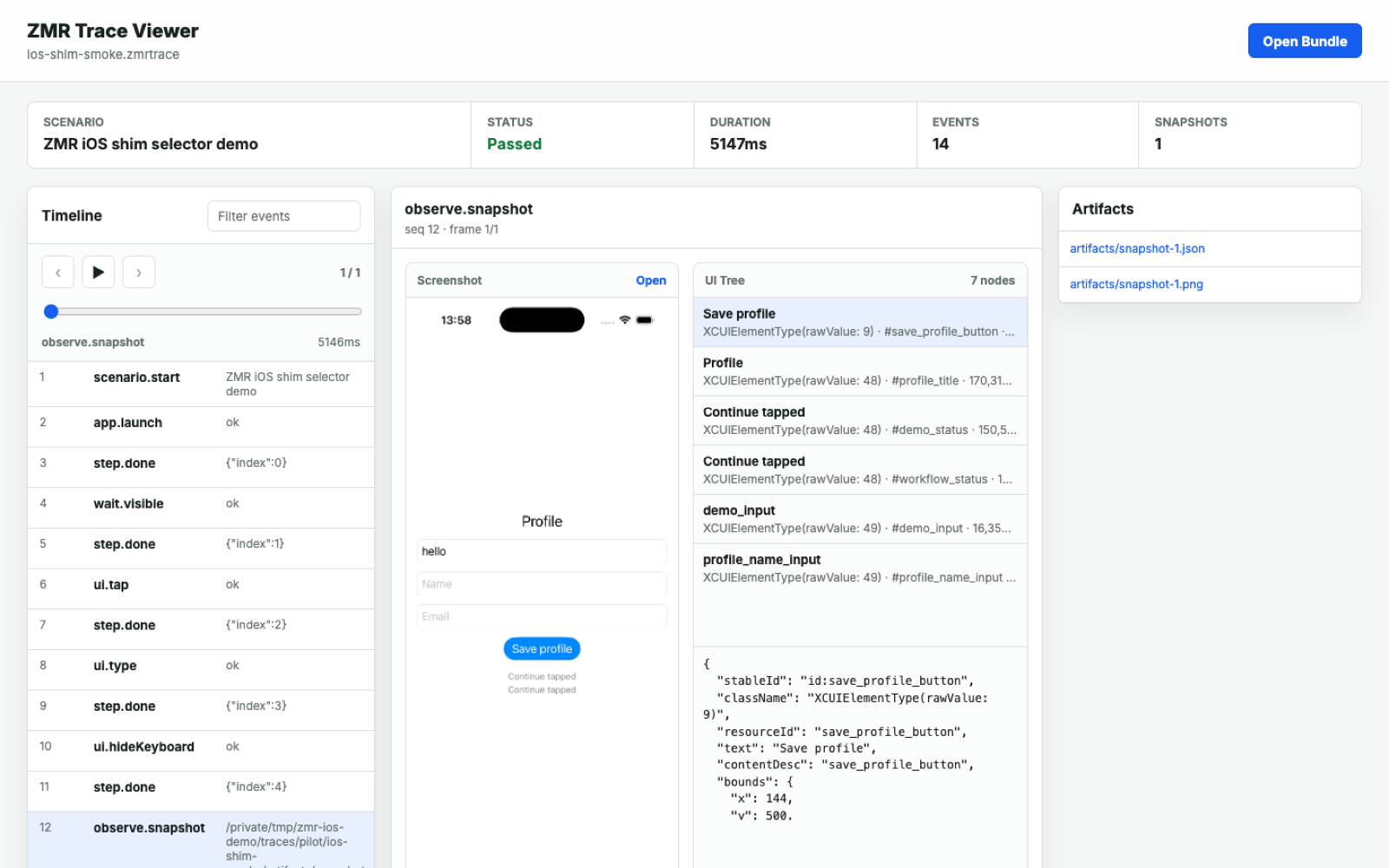
Why agents need this
- Agents can't verify what they can't observe. ZMR returns semantic UI trees with stable selectors, screenshots, and typed action results an agent can reason about — not raw pixels it has to guess at.
- Evidence, not vibes. Every session can write a deterministic trace: events, screenshots, UI hierarchies, timings, assertion results, HTML and JUnit reports, and a redacted shareable bundle.
- Tests fall out for free. After a live agent session,
zmr discoverturns the trace into a reviewable JSON scenario that replays in CI without an LLM in the loop.
How it works
flowchart LR
    A["AI coding agent<br/>Claude Code · Cursor · custom harness"]
    subgraph zmr["ZMR — one small Zig binary"]
        MCP["MCP server<br/><code>zmr mcp</code>"]
        RPC["JSON-RPC stdio/TCP<br/><code>zmr serve</code>"]
        CLI["CLI + JSON scenarios<br/><code>zmr run</code>"]
        CORE["Core engine<br/>selectors · waits · assertions<br/>scenario runner · trace writer"]
        MCP --> CORE
        RPC --> CORE
        CLI --> CORE
    end
    subgraph devices["Devices"]
        AND["Android emulator/device<br/>ADB · UI Automator · optional shim"]
        IOS["iOS simulator/device<br/>simctl · devicectl · XCTest shim"]
    end
    TRACE["Trace<br/>events.jsonl · screenshots · UI trees<br/>report.html · junit.xml · .zmrtrace"]
    A -- "MCP tools" --> MCP
    A -- "JSON-RPC" --> RPC
    A -- "CLI JSON" --> CLI
    CORE --> AND
    CORE --> IOS
    CORE --> TRACE
No app instrumentation is required on Android. iOS selector actions use an app-local XCTest shim that the wizard scaffolds. ZMR works below the JavaScript/Dart layer, so React Native, Expo, Flutter, and fully native apps are all driven the same way. See docs/frameworks.md.
Five-minute start
Inside a mobile app repo:
npm install --save-dev zeno-mobile-runner   # bun add --dev zeno-mobile-runner
npx zmr-wizard --app-id com.example.mobiletest --package-json
npx zmr doctor --strict --json --config .zmr/config.json
Hook it up to your coding agent (Claude Code shown; any MCP client works):
claude mcp add zmr -- npx zmr mcp --config .zmr/config.json --trace-dir traces/zmr-agent
Claude Code users can instead install the plugin, which bundles the MCP server and a mobile-testing skill:
/plugin marketplace add johnmikel/zeno-mobile-runner
/plugin install zmr@zmr-marketplace
Or in an .mcp.json / MCP client config:
{
  "mcpServers": {
    "zmr": {
      "command": "npx",
      "args": ["zmr", "mcp", "--config", ".zmr/config.json", "--trace-dir", "traces/zmr-agent"]
    }
  }
}
Then ask the agent to verify its own work: "launch the app, walk through onboarding, and show me the trace."
The agent verification loop
sequenceDiagram
    participant Agent as AI agent
    participant ZMR
    participant Device as Emulator / simulator
    Agent->>ZMR: semantic_snapshot
    ZMR->>Device: capture UI + screenshot
    ZMR-->>Agent: roles, stable selectors, bounds
    Agent->>ZMR: tap / type / swipe / open_link
    ZMR->>Device: execute + settle
    Agent->>ZMR: wait_visible / assert_visible
    ZMR-->>Agent: typed result + trace events
    Agent->>ZMR: trace_discover
    ZMR-->>Agent: reviewable replay scenario
    Agent->>ZMR: trace_export --redact
    ZMR-->>Agent: .zmrtrace evidence bundle
The MCP server exposes the full loop as mobile-native tools:
| Group | Tools |
|---|---|
| Observe | snapshot, semantic_snapshot |
| App lifecycle | install_app, launch_app, stop_app, clear_state, open_link |
| Act | tap, type, erase_text, hide_keyboard, swipe, press_back |
| Wait | wait_visible, wait_not_visible, wait_any, scroll_until_visible |
| Assert | assert_visible, assert_not_visible, assert_healthy |
| Evidence | trace_events, trace_explain, trace_discover, trace_explore, trace_export, scenario_validate |
The same surface is available over JSON-RPC for harnesses that embed ZMR
directly — see docs/protocol.md and
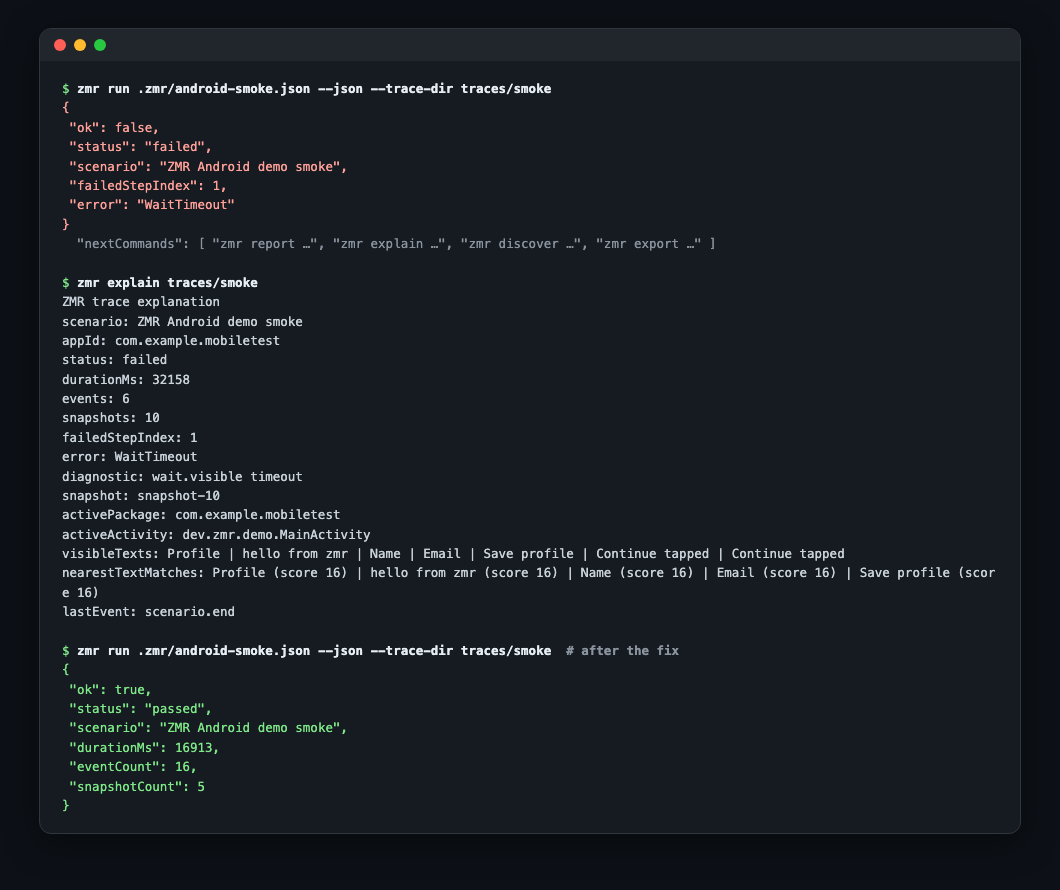
docs/ai-agents.md. When a run fails, zmr explain
diagnoses the trace for humans and agents alike:
Deterministic scenarios for CI
Scenarios are plain JSON — agents and build scripts generate, validate, and mutate them without a second DSL, and they replay in CI with no LLM cost:
{
  "name": "Login smoke",
  "appId": "com.example.mobiletest",
  "steps": [
    { "action": "clearState" },
    { "action": "launch" },
    { "action": "assertHealthy", "timeoutMs": 5000 },
    { "action": "tap", "selector": { "resourceId": "email" } },
    { "action": "typeText", "text": "user@example.com" },
    { "action": "tap", "selector": { "text": "Login" } },
    { "action": "waitVisible", "selector": { "text": "Welcome" }, "timeoutMs": 30000 }
  ]
}
zmr validate --json .zmr/login-smoke.json
zmr run .zmr/login-smoke.json --json --trace-dir traces/login-smoke
zmr report traces/login-smoke --out traces/login-smoke/report.html --junit traces/login-smoke/junit.xml
zmr export traces/login-smoke --out login-smoke-redacted.zmrtrace --redact
Traced zmr run --json responses include executable nextCommands so agents
can continue to reporting, explanation, discovery, or export without guessing.
Open any exported bundle in the static trace viewer — or
serve it and link straight to it with viewer/index.html?bundle=<url>.
For repeat-run reliability gates, p95 duration thresholds, baseline comparisons against your current E2E tool, and multi-device matrices, see docs/benchmarking.md and the public Benchmark Lab evidence.
Platform support
| Target | Status | Notes |
|---|---|---|
| Android emulator | Supported | ADB/UI Automator, optional Android shim, emulator lifecycle helpers |
| Android physical device | Supported | Requires ADB connection and app build/install surface |
| iOS simulator | Supported | simctl plus app-local XCTest/XCUIAutomation shim for native selector actions |
| iOS physical device | Supported, validate locally | devicectl lifecycle plus XCTest shim; pilot on your own app/device before relying on it in CI |
| Cloud device farms | Not included | ZMR focuses on local and self-managed device targets in this preview |
Slow CI hardware can extend the iOS shim cold-build timeout with
ZMR_IOS_SHIM_TIMEOUT_MS. Current release: 0.2.0 developer preview.
Protocol version: 2026-04-28.
Optional protocol clients
TypeScript and Python clients are the common starting points; Go, Rust, Swift,
and Kotlin reference clients embed the same JSON-RPC protocol from those
ecosystems. All are thin wrappers around zmr serve --transport stdio. See
docs/clients.md and
docs/client-installation.md.
Documentation
For agents
- docs/ai-agents.md: JSON-RPC and MCP agent workflows
- docs/agent-discovery.md: agent-led discovery,
zmr explore/discover/draft, and the trace-to-test loop - skills/zmr-mobile-testing/SKILL.md: reusable agent skill
For test authors
- docs/install.md: source, npm, Homebrew, and app setup
- docs/frameworks.md: React Native, Expo, Flutter, and native app guidance
- docs/scenario-authoring.md: selectors, waits, and scenario design
- docs/app-integration.md: app-side Android/iOS shims
- docs/expo-smoke.md: reproducible Expo and iOS smoke test
- docs/benchmarking.md: repeat-run gates, reports, device matrix, baselines
Reference
- FEATURES.md: complete feature list and limitations
- docs/protocol.md: JSON-RPC methods and schemas
- docs/trace-privacy.md: safe trace export
- docs/production-readiness.md: release, reliability, and agent-readiness gates
- docs/troubleshooting.md: common setup and runtime issues
- docs/benchmarks: public-safe benchmark evidence
License
MIT