
SysML Bridge — Authoring MBSE com Claude
joescohen/sysml-bridge
Pipeline determinístico corpus→SysML v2 com auditoria e validação gramatical
Ver no GitHubMCP server que transforma corpora de engenharia (planilhas de requisitos, matrizes N2, PDFs de specs) em modelos SysML v2 validados e renderizados em diagramas Cameo. Cada elemento carrega provenance rastreável até sua fonte original, eliminando fabricação de requisitos.
Instalação
npx convez-ai joescohen/sysml-bridge1 comando no terminal: detecta o formato do repositório (marketplace ou plugin avulso) e instala via Claude Code. Requer Node 18+ e o Claude Code instalado.
Métricas
Casos de uso
- Converter especificações técnicas e matrizes de interfaces em modelos MBSE estruturados
- Validar integridade de modelos SysML antes de importação em Cameo Enterprise Architecture
- Rastrear provenance de requisitos e interfaces até células de planilha específicas
- Renderizar diagramas IBD e BDD automaticamente a partir de corpora estruturados
Veredito

Solução especializada e rigorosa para engenharia de sistemas que prioriza auditabilidade e confiança sobre agilidade. Pipeline determinístico de Tier 1 sem API keys é robusto; camadas LLM de Tier 2 requerem aprovação humana explícita. Ideal para projetos Tier-1 críticos que precisam de provenance rastreável e validação em múltiplos gates.
README
A tradução para o português deste README ainda está na fila.
sysml-bridge
Corpus-grounded SysML v2 authoring with Claude — every element cited, every gate enforced.
sysml-bridge turns an engineering corpus — requirement spreadsheets, interface (N2) matrices,
specification PDFs — into a validated SysML v2 model, and renders it as Cameo-style diagrams. The
whole Tier-1 pipeline is deterministic and runs with no API key: pnpm demo goes corpus →
extract → build → audit → grammar-validate → render on the committed ANGARS corpus.
The trust story
Corpus-grounded. Every model element carries a provenanceSourceId pointing back to the
corpus row it came from — a requirement in a spreadsheet, an interface flow in an N2 matrix, a
line in a spec. This is the anti-fabrication contract: it was born from a real failure on
2026-06-09, when a hand-authored model quietly invented subsystems that were nowhere in the
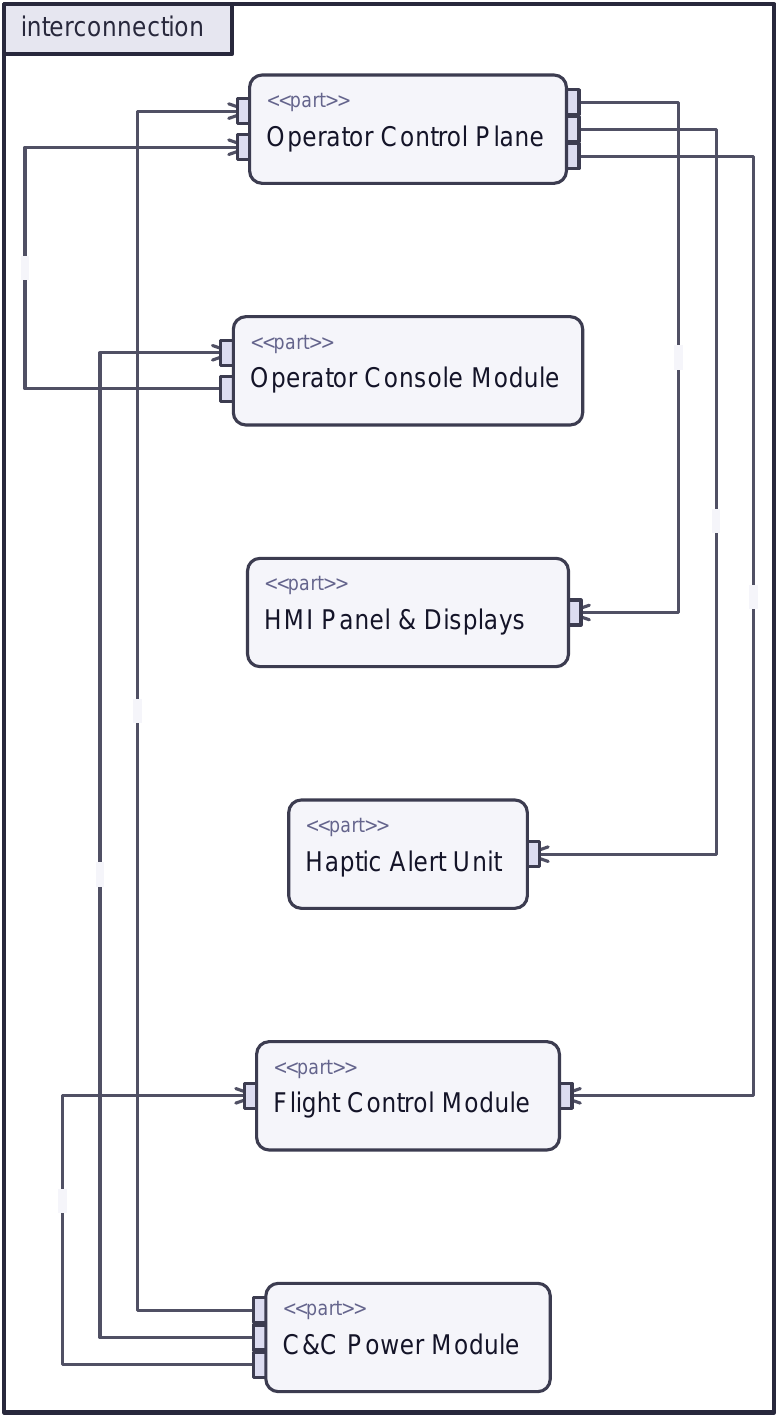
source. Nothing enters the model uncited. The Interconnection diagram above is the contract made
visible — each of its connection edges traces to a specific N2 spreadsheet cell (workbook, sheet,
row, cell).
Gate-validated. Generated models pass three gates, in order, and the pipeline stops on the first failure:
- Gate 1 — model audit. Provenance, relational, and fidelity checks over the built model
(
packages/gates). A findings list that isn't empty stops the build. - Gate 2 — grammar validator. The emitted
.sysmlis parsed by a committed ANTLR grammar validator (tools/sysml-validator). A non-zero exit means the file will not import — no claim that it does is permitted without a clean run on the exact file. - Gate 3 — Cameo import. The manual semantic epilogue: paste the validated
.sysmlinto Cameo Enterprise Architecture's Textual Editor and synchronize. The grammar validator checks syntax; Cameo is the binding semantic gate. Screenshots are the evidence — this step is not automated.
Each gate can fail, and each has been proven to fail against a known-bad input — a gate never shown to fail is not a gate you can trust.
Human-gated LLM layers. The LLM-assisted layers — prose ingest and inference — propose,
never write. Candidates arrive with citations and require an explicit human approval, made through
/mbse-approve, before they can enter the model. No code path writes an approval; a source-scanning
ratchet test fails if one ever does. See Tier 2 below. Tier-1
stays fully deterministic and needs no API key.
Gallery
Rendered by the DeciSym viewer fork directly from the validated .sysml, exported headless to
PDF and PNG. All five are regenerated by pnpm demo on every run.
Interconnection (IBD)
The C&C subsystem's six <<part>> blocks — Operator Control Plane, Operator Console Module, HMI
Panel & Displays, Haptic Alert Unit, Flight Control Module, C&C Power Module — wired by their
interconnections. Every connection edge comes from a row in the ANGARS N2 interface data, and
each carries provenance back to the exact spreadsheet cell it was read from.
General / subsystem (BDD)
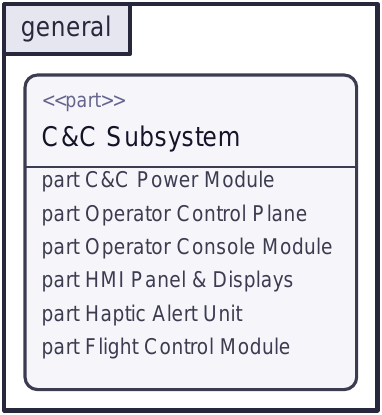
The C&C Subsystem definition with its six part properties — the block-definition view of the same decomposition shown structurally in the IBD.
General / operations (activity)
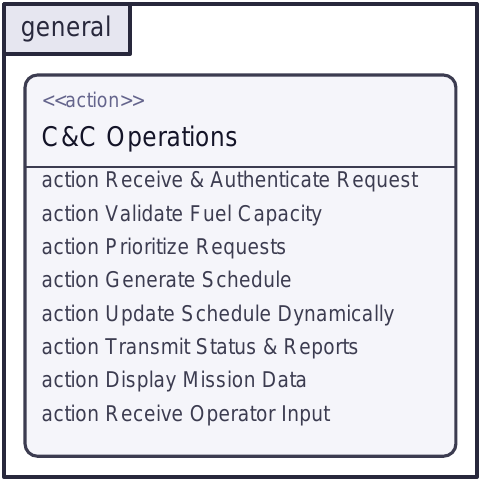
The C&C Operations action, decomposed into 15 corpus-grounded sub-actions (the F1.x scheduling and F8.x operator-interaction functions); the compartment view shows the first eight, from Receive & Authenticate Request to Receive Operator Input.
Requirements
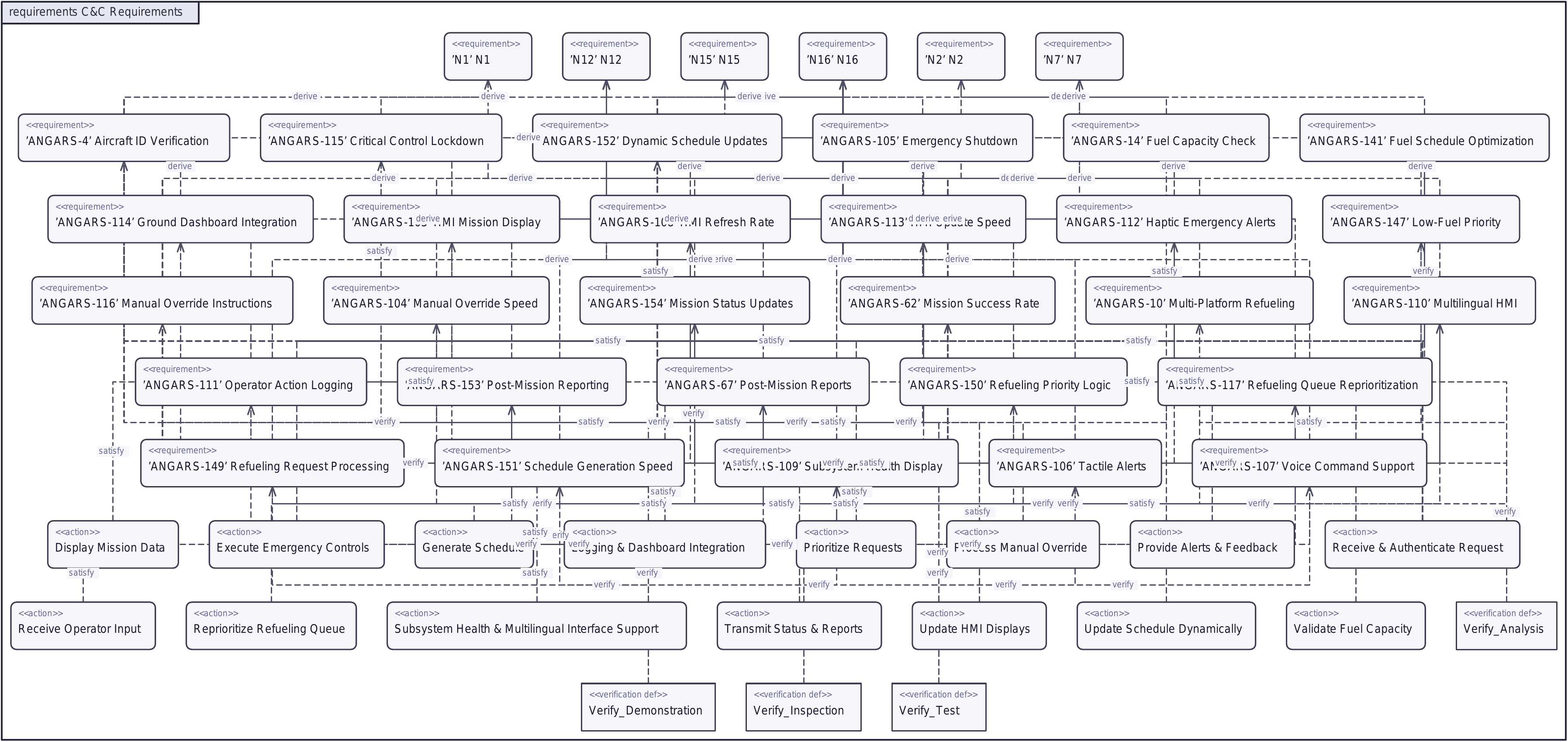
The C&C Requirements context: all 34 <<requirement>> usages — 6 stakeholder needs across the
top rank, the 28 system requirements below — laid out as a derive tree, each system requirement's
«deriveReqt» dependency pointing up to the stakeholder need it decomposes, with satisfy and
verify edges dropping to the realizing actions and verification cases. At ANGARS scale each
rank wraps into multiple sub-rows once it would exceed the canvas-width cap, so the diagram reads
as a compact block (≈3590×1699 px) rather than a single unreadable horizontal ribbon. Every
requirement and every edge traces back to a row in the ANGARS corpus.
Traceability
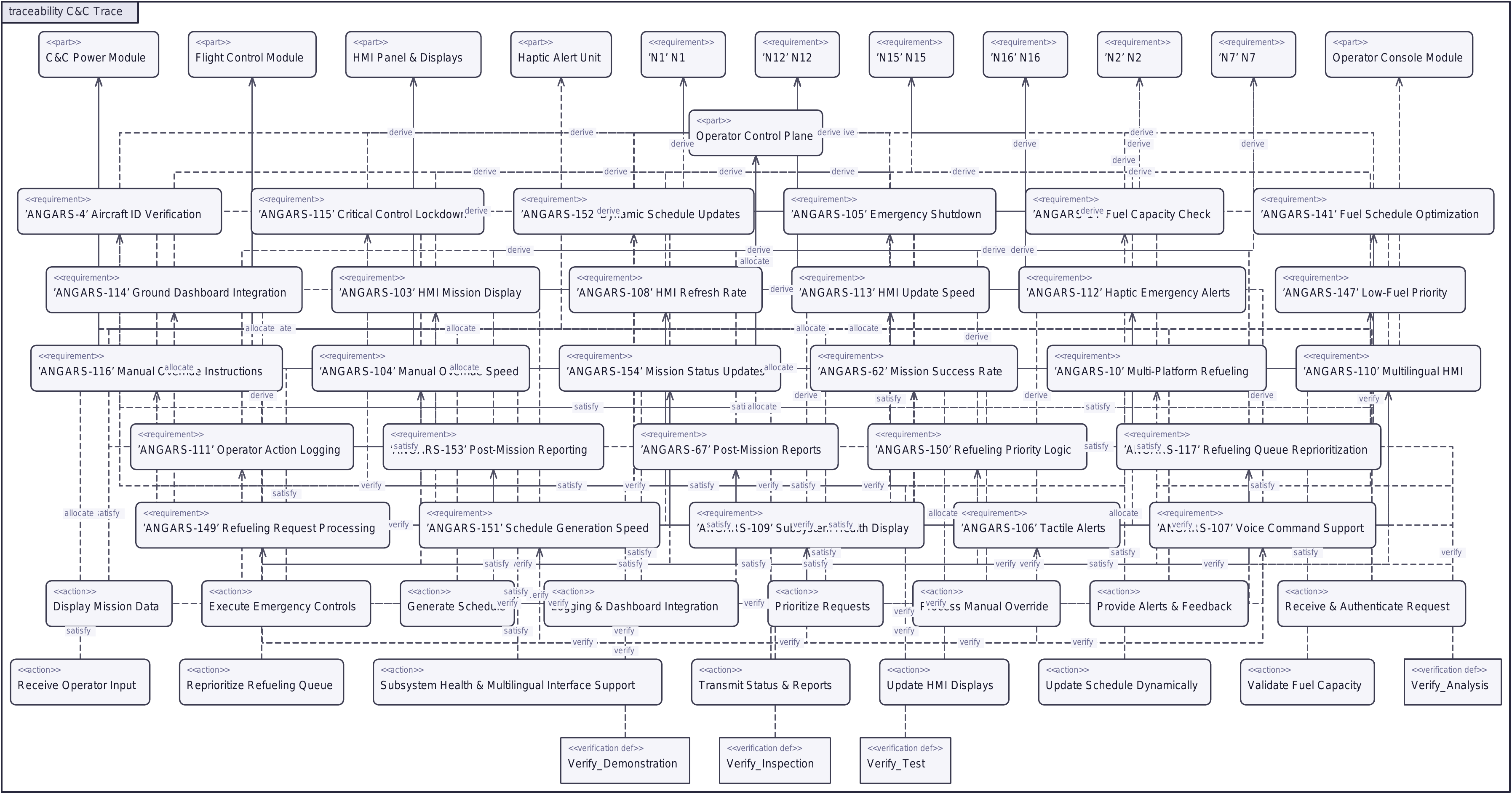
The C&C Trace context: the cross-pillar web joining all four pillars — stakeholder needs,
requirements, functions, and components — through 100 trace edges (derive / satisfy /
allocate / verify), layered top-down by rank, with each over-wide rank wrapped into
sub-rows so the web stays legible at README size (≈3590×1885 px) instead of stretching into a
16 000-px strip. Every edge is corpus-grounded: no relationship appears here that isn't backed
by a cell in the ANGARS interface, satisfy, or verification data.
Fidelity
The build re-derives the requirement-to-satisfaction trace and compares it to the reference C&C model:
28/28 trace pairs (100%) verified against the reference model, re-checked in CI on every push.
The baseline is a committed constant (examples/angars/fidelity-baseline.json), read by CI —
never hardcoded in the workflow. A drop below 100% is a failure to investigate, not a number to
lower. Alongside it, 714 unit tests (134 model + 154 sysml + 94 gates + 203 candidates + 124
mcp-server + 5 review-ui) run in CI, and the grammar validator ships with committed positive controls that
prove it rejects bad syntax.
Quick start
git clone https://github.com/joescohen/sysml-bridge.git
cd sysml-bridge
pnpm install
python3 -m venv .venv && .venv/bin/pip install -r tools/sysml-validator/requirements.txt
pnpm demo
pnpm demo runs the full Tier-1 pipeline — extract → build → Gate 1 → Gate 2 → render — and
writes outputs to examples/angars/out/. It is deterministic and needs no ANTHROPIC_API_KEY.
Prerequisites: Node 20+ and pnpm; Python 3 for the grammar validator (the venv above is a hard
requirement — a missing validator venv fails the demo rather than skipping the gate); Rust
toolchain 1.96 for the viewer (the render step builds it). pdftoppm (poppler-utils) is optional
and only needed to rasterize the PDF renders into PNGs.
Demo tiers
The repo is organized around four reviewer experiences, in increasing effort:
| Tier | Experience | Requires | Status |
|---|---|---|---|
| 0 — browse | This README as a gallery: rendered views, fidelity numbers, the trust story | nothing | ships now |
| 1 — run | pnpm demo: corpus → extract → build → Gate 1 → grammar validate → render, deterministic | Node + pnpm + Python | ships now |
| 2 — gates | Human-gated LLM layers: prose candidates with citations, propose/approve, seeded-defect run showing fabrication caught | ANTHROPIC_API_KEY (demo needs none) | ships now |
| 3 — drive | /mbse orchestrator live in Claude Code — the interview prop | Claude Code | ships now |
Tier 2 — human-gated LLM layers
Two LLM-assisted layers can add to the model: prose ingest reads specification PDFs for candidate
requirements, and inference proposes trace relationships. Both propose, never write. Each
candidate arrives with a citation, and it enters the model only through an explicit human approval
recorded by /mbse-approve — the code has no path that writes an approval, and a source-scanning
ratchet test fails if one is ever added. This is the anti-fabrication contract of the trust story
carried into the LLM tier: the four rules behind it are written up in
docs/gate-pattern.md.
The visible proof is the seeded-defect harness. pnpm demo:seeded plants three known defects with
fixed ids into a copy of the clean ANGARS build and shows each gate catch its own — a missing
provenance finding, a non-zero grammar-validator exit on a poisoned file, and an R4 def-operand
finding — alongside a clean control that must report zero errors. It runs in CI and needs no API
key. ANTHROPIC_API_KEY is required only for live candidate generation from a corpus; the demo
and the harness are deterministic without it.
Gap-driven weave passes
Once the model has a shape, the weaver closes completeness gaps in bounded passes. pnpm weave
runs one pass over a project and then stops for the human — it proposes, it never approves:
pnpm weave --project <dir>              # open a pass: audit → queue → propose → STOP
# ...review + approve the proposals in the review UI...
pnpm weave --project <dir> --close-pass # recompose → re-audit → record + convergence gate
A pass is audit → queue → propose → (human reviews) → recompose → re-audit → record:
audit()runs on the composed model. Each completeness finding is mapped to a targeted retrieval query by an explicit, unit-tested table:GATE02-unsatisfied→ a satisfy-family query from the requirement's name+text;GATE02-orphan→ an allocation-family query for the element;GATE02-uncovered-need→ a derive-family query. A finding with no query strategy is reported, never silently skipped.- A bounded targeted inference pass runs over only those queries (the budget cap and the per-query entity scope are logged — no silent caps). It enumerates cross-document candidates over the entity store and attributes each queued candidate back to the gap element it targets.
- Proposals land in the normal review queue (
<dir>/candidates/inference-candidates.json). The pass then stops.weavewrites no disposition — approving a proposal is a human act in the review UI, and a source-scan test fails if any weave code path ever calls an approval writer. --close-passrecomposes the model with whatever was approved, re-audits, and writes<dir>/passes/pass-NNN.json(sysml-foundry/pass-record@1) with six fields:auditBefore,queries,candidatesProposed,dispositionsApplied,auditAfter,warningsDelta.- Convergence is a hard gate. A closed pass must end with zero error-severity findings and may never end with more errors than it began — either violation is a non-zero exit. The completeness-warning delta per rule id is the soft signal: reported in the record, not gated, because a legitimately growing model creates new orphans and the record makes that trend inspectable instead of pretending monotonicity.
With no provider key the pass uses a deterministic mock provider, so the loop — and its
convergence gate — runs end-to-end in CI without a key; a key is needed only for model-authored
proposals. Set OPENROUTER_API_KEY to use GLM via OpenRouter (model from OPENROUTER_MODEL,
default z-ai/glm-5.2), or ANTHROPIC_API_KEY for Claude; OpenRouter takes precedence when both
are set.
Review UI
pnpm review
serves a local page for working the gate: the ANGARS candidate queue (319 prose candidates with
their citations, 133 inference proposals with premises and confidence) with a detail pane and
explicit approve/reject buttons. It writes the same disposition records as /mbse-approve —
literally the same writer functions, and an equivalence test proves an approval made in the UI
composes identically to one made through the skill (the content-addressed entry ids match). The
source-scanning ratchet covers the UI's write surface too: any new code path that writes an
approval fails the suite until reviewed.
Native engine
crates/ holds a Rust SysML v2 engine that treats the model text as the source of truth. Every
write generates canonical text, goes through one edit engine, and is parsed again before it is
saved. It has a resolver and semantic gates that go past grammar: they catch unresolved
references, duplicate requirement ids and open trace chains that a grammar check passes. It also
has an independent recogniser for the official OMG grammar and a 56-tool MCP server with dry runs,
revisions, baselines and undo. cargo test --workspace runs its 587 tests. See
docs/engine.md.
Layout
sysml-bridge/
├── crates/               # native SysML v2 engine: core, OMG grammar check, checker CLI, MCP server
├── packages/
│   ├── model/            # element/relationship types, FileStore, IR schema + composeIR
│   ├── sysml/            # model ↔ SysML v2 textual notation: serializer, parser, validator glue
│   ├── gates/            # Gate 1 audits: provenance, relational, fidelity
│   ├── candidates/       # human-gated LLM layers: prose ingest + inference (propose, never write)
│   ├── mcp-server/       # 11 MCP tools over the model store + lifecycle session tracker
│   ├── review-ui/        # local web page for the human gate (same writers as /mbse-approve)
│   └── skills/           # /mbse orchestrator + verb skills (drift-checked against the tools)
├── tools/
│   ├── sysml-validator/  # committed ANTLR grammar validator (Gate 2) + positive controls
│   └── viewer/           # DeciSym fork — reads .sysml, exports headless PDF/PNG
├── examples/angars/      # committed corpus, extracted IR, pipeline scripts, generated out/
├── docs/
│   ├── sysml-v2-reference/  # vendored SysML v2 grammar (.g4, MIT) + cheatsheet
│   └── gallery/             # committed render copies referenced by this README
└── .github/workflows/ci.yml
License
MIT — see LICENSE.