
Large Capital Project Management — Suite de Gestão de Projetos
jmeier1963/large_capital_project_management
Gestão ágil de grandes projetos de capital com IA, EVM e análise de risco
Ver no GitHubSkill e scaffolding para Claude Code focado em grandes projetos de capital (hidrogênio, infraestrutura, plataformas offshore). Combina cinco habilidades integradas: auditoria de definição de projeto, estimativa CAPEX por Monte Carlo, avaliação stage-gate, Earned Value Management (ANSI/EIA-748) e revisão de lições aprendidas. Inclui agents especializados, heurísticas calibradas e schemas estruturados para todo o ciclo de vida do projeto.
Instalação
npx convez-ai jmeier1963/large_capital_project_management1 comando no terminal: detecta o formato do repositório (marketplace ou plugin avulso) e instala via Claude Code. Requer Node 18+ e o Claude Code instalado.
Métricas
Casos de uso
- Auditoria de maturidade e definição de grandes projetos antes da aprovação financeira
- Estimativa parametrizada de CAPEX (P50/P90) com análise de incerteza por Monte Carlo
- Acompanhamento de execução com Earned Value Management e escalação automática de desvios
- Análise de contratos, cronograma e risco com agents especializados
- Captura e calibração de lições aprendidas para melhoria contínua entre projetos
Veredito

Ferramenta robuusta e bem arquitetada para gerentes de grandes projetos de capital. O conjunto de cinco skills cobre o ciclo completo com rigor metodológico (AACE, ANSI/EIA-748). Requer domínio técnico de finanças e gestão de projetos; não é ferramenta casual, mas decisória.
README
A tradução para o português deste README ainda está na fila.
Large Capital Project Management — Claude Code Scaffolding
A Claude Code skill and project scaffolding system for large capital projects (LCPs) such as hydrogen pipelines, offshore platforms, refineries, and infrastructure programmes. Combines structured data schemas, domain heuristics, specialist agents, and five skills covering the full project lifecycle:
| Skill | Lifecycle position | What it does |
|---|---|---|
systems-thinking | Pre-FID definition | Audits a project definition against 15 research-derived heuristics; maturity score, ranked gaps, omission flags |
budget-estimator | Pre-FID estimating | Parametric P50/P90 CAPEX via 10,000-iteration Monte Carlo, AACE-class calibrated |
gate-readiness | Every decision gate | Assembles and assesses the stage-gate evidence pack; READY / CONDITIONALLY READY / NOT READY |
evm | Execution | ANSI/EIA-748 Earned Value Management: 10 metrics, 3 EAC methods, 5 charts, automatic escalations |
lessons-learned | Close-out | Estimate-vs-actual review, variance attribution, heuristics calibration, SYS-mapped lessons register |
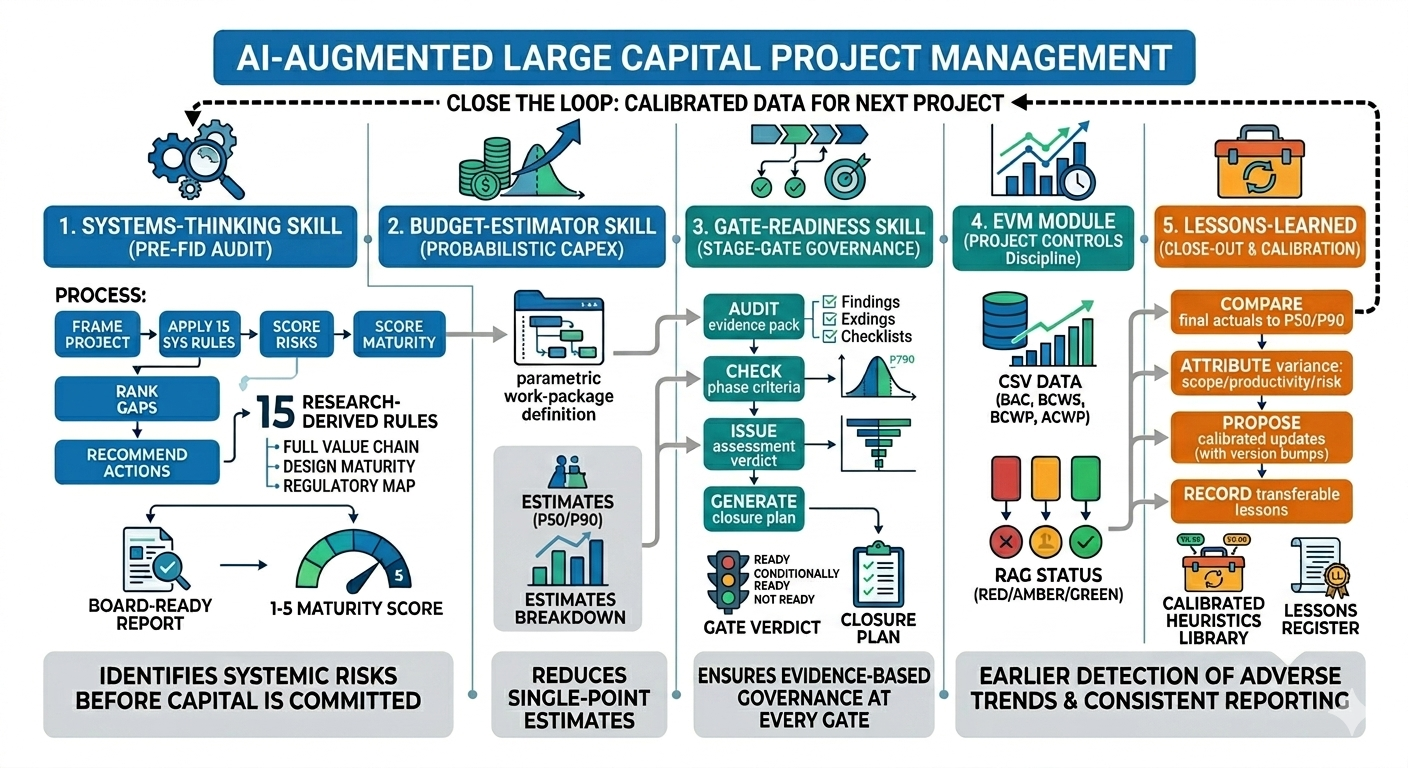
The full rationale, architecture, evaluation results, and investment case are
documented in the integrated concept paper:
concept-paper/large_capital_project_management_2026-06-12.md
(PDF).
Contents
.
├── evm/                         # EVM skill — install into Claude Code
│   ├── SKILL.md                 #   Behavioral instructions for Claude
│   ├── evm_calculator.py        #   Core Python engine (713 lines)
│   ├── requirements.txt         #   pandas, matplotlib, numpy
│   └── examples/
│
├── budget-estimator/            # Budget estimator skill — P50/P90 Monte Carlo
│   ├── SKILL.md                 #   Behavioral instructions for Claude
│   ├── budget_estimator.py      #   Parametric CAPEX engine with Monte Carlo
│   ├── requirements.txt         #   numpy, scipy, matplotlib, pyyaml, pandas
│   └── examples/
│       └── h2-pipeline-estimate.yaml   # H2-PIPE-DE-001 AACE Class 3 estimate
│       ├── h2-pipeline-snapshot.csv      # Single-period test data
│       └── h2-pipeline-timephased.csv    # Five-period trend test data
│
├── scaffolding/                 # Project-level Claude configuration templates
│   ├── CLAUDE.md                #   Domain rules, judgment rules, output standards
│   ├── .claude/rules/
│   │   ├── roles.md             #   Role taxonomy and addressing rules
│   │   ├── heuristics.md        #   Rules for applying heuristics
│   ├── agents/
│   │   ├── schedule-analyzer.md #   Schedule health and recovery agent
│   │   ├── contract-reviewer.md #   Contract extraction and CO assessment agent
│   │   └── risk-assessor.md     #   Risk register EMV and escalation agent
│   ├── heuristics/
│   │   ├── pipeline-cost.yaml   #   EUR/km installed cost by diameter and terrain
│   │   └── productivity-norms.yaml  # Labour productivity by discipline
│   ├── schemas/
│   │   ├── project-brief.schema.json
│   │   ├── contract.schema.json
│   │   └── risk-register.schema.json
│   └── templates/
│       └── project-brief.md     #   Blank project brief template
│
├── systems-thinking/            # Systems thinking audit skill
│   ├── SKILL.md                 #   Audit workflow + output template
│   ├── references/
│   │   └── sys-rules.md         #   Full criteria for all 15 SYS rules
│   ├── evals/
│   │   └── evals.json           #   3 test scenarios with assertions
│   └── systems-thinking.skill   #   Packaged .skill file for direct installation
│
├── gate-readiness/              # Stage-gate evidence pack skill
│   └── SKILL.md                 #   Gate evidence matrix + readiness assessment
│
├── lessons-learned/             # Close-out & heuristics calibration skill
│   └── SKILL.md                 #   Estimate-vs-actual, calibration, lessons register
│
├── concept-paper/               # Academic-practitioner paper
│   ├── large_capital_project_management_2026-06-12.md/.pdf   # Integrated concept paper
│   ├── pandoc-pdf-header.tex    #   LaTeX preamble for the PDF build
│   └── references/
│       ├── large_capital_project_management_execution_skill.md/.pdf
│       ├── large_capital_project_management_systems-thinking_skill.md/.pdf
│       └── systems-thinking-research-report-en.md
│
└── examples/
    └── H2-PIPE-DE-001/          # GreenArtery — 500 km H2 pipeline, Germany
        ├── project-brief.md
        └── 03-cost/
            ├── evm-snapshot-2026-05.csv
            └── evm-timephased.csv
Prerequisites
| Requirement | Version | Notes |
|---|---|---|
| Claude Code | Latest | CLI or IDE extension |
| Python | ≥ 3.9 | For the EVM calculator |
| pip | Any | To install Python dependencies |
Installation
1 — Install the skills into Claude Code
Copy the skill directories into your Claude Code skills folder:
# macOS / Linux
for s in evm budget-estimator systems-thinking gate-readiness lessons-learned; do
  cp -r $s/ ~/.claude/skills/$s/
done

# Windows (PowerShell)
"evm","budget-estimator","systems-thinking","gate-readiness","lessons-learned" |
  ForEach-Object { Copy-Item -Recurse $_ "$env:USERPROFILE\.claude\skills\$_" }
Install Python dependencies for the two computational skills:
pip install -r ~/.claude/skills/evm/requirements.txt
pip install -r ~/.claude/skills/budget-estimator/requirements.txt
That's it. Claude Code will discover the skills automatically on next launch
(it scans ~/.claude/skills/ for SKILL.md files). The gate-readiness and
lessons-learned skills are behavioural (markdown-only) and need no
dependencies.
2 — Set up a new project using the scaffolding
Create your project directory and copy the scaffolding templates:
mkdir -p my-project/{00-foundation,01-contracts,02-schedule,03-cost,04-resources,05-risk,06-engineering}
cp scaffolding/CLAUDE.md my-project/CLAUDE.md
cp -r scaffolding/.claude/ my-project/.claude/
cp -r scaffolding/heuristics/ my-project/heuristics/
cp -r scaffolding/schemas/ my-project/schemas/
cp scaffolding/templates/project-brief.md my-project/project-brief.md
Edit my-project/CLAUDE.md to adjust any project-specific judgment rules,
then open the project in Claude Code:
claude my-project/
Using the EVM Skill
Automatic activation
The skill activates automatically when you mention any of these in Claude Code:
"run EVM","earned value","CPI/SPI","EAC forecast""analyse project costs","cost performance report"- When you provide a CSV file with columns
bac,bcws_cum,bcwp_cum,acwp_cum
Manual invocation
In Claude Code, type:
Analyse the EVM data in examples/H2-PIPE-DE-001/03-cost/evm-snapshot-2026-05.csv
or reference the skill directly:
/evm examples/H2-PIPE-DE-001/03-cost/evm-timephased.csv
Run the calculator directly from the terminal
# Snapshot (single period)
python evm/evm_calculator.py examples/H2-PIPE-DE-001/03-cost/evm-snapshot-2026-05.csv

# Time-phased (multi-period — generates S-curve and trend charts)
python evm/evm_calculator.py examples/H2-PIPE-DE-001/03-cost/evm-timephased.csv --output /tmp/evm-report/
Import as a Python module
from evm.evm_calculator import run_evm_analysis

report = run_evm_analysis(
    csv_path="examples/H2-PIPE-DE-001/03-cost/evm-timephased.csv",
    output_dir="/tmp/my-report/"
)
print(report)
EVM Input CSV Format
Snapshot (one row per WBS element)
wbs_code,wbs_description,bac,bcws_cum,bcwp_cum,acwp_cum,period
WBS-1.1,Mainline Construction N,485000000,58200000,43650000,48000000,2026-05
WBS-1.2,Mainline Construction S,493000000,52000000,50000000,49500000,2026-05
WBS-2.0,Compression Stations,340000000,45000000,38000000,41500000,2026-05
Time-phased (multiple rows per WBS, one per period)
wbs_code,wbs_description,bac,period,bcws_cum,bcwp_cum,acwp_cum
WBS-1.1,Mainline Construction N,485000000,2026-01,5000000,4500000,4800000
WBS-1.1,Mainline Construction N,485000000,2026-02,12500000,9800000,10500000
WBS-1.1,Mainline Construction N,485000000,2026-03,24000000,18200000,19800000
All BCWS/BCWP/ACWP values must be cumulative (not period-only increments). The script auto-detects snapshot vs. time-phased format.
Required columns:
| Column | Type | Description |
|---|---|---|
wbs_code | string | WBS identifier |
wbs_description | string | Human-readable name |
bac | float | Budget at Completion (project currency) |
bcws_cum | float | Cumulative Planned Value (BCWS) |
bcwp_cum | float | Cumulative Earned Value (BCWP) |
acwp_cum | float | Cumulative Actual Cost (ACWP) |
period | string | (optional for snapshot) e.g. 2026-05 |
EVM Outputs
| File | Description |
|---|---|
evm-report.md | Full markdown report: executive summary, WBS table, 3 EAC methods, escalation flags |
01_s_curve.png | Cumulative BCWS/BCWP/ACWP S-curve (time-phased only) |
02_indices_trend.png | CPI & SPI trend with GREEN/AMBER/RED bands (time-phased only) |
03_wbs_variance.png | Cost Variance by WBS package (RAG-coloured horizontal bars) |
04_eac_comparison.png | BAC vs three EAC methods per package |
05_cpi_spi_quadrant.png | Four-quadrant performance map, bubble size ∝ BAC |
Metrics computed
| Metric | Formula | Interpretation |
|---|---|---|
| CV | BCWP − ACWP | Cost Variance (+ve = under budget) |
| SV | BCWP − BCWS | Schedule Variance (+ve = ahead) |
| CPI | BCWP / ACWP | Cost efficiency (>1 = under budget) |
| SPI | BCWP / BCWS | Schedule efficiency (>1 = ahead) |
| EAC (CPI) | BAC / CPI | Forecast assuming current efficiency |
| EAC (Composite) | ACWP + (BAC−BCWP) / (CPI×SPI) | Recommended for LCPs |
| EAC (Planned) | ACWP + (BAC−BCWP) | Optimistic — full recovery assumed |
| ETC | EAC − ACWP | Remaining spend to complete |
| VAC | BAC − EAC | Expected over/under at completion |
| TCPI | (BAC−BCWP) / (BAC−ACWP) | Required future efficiency; >1.10 = danger |
RAG thresholds
| Index | GREEN | AMBER | RED |
|---|---|---|---|
| CPI | ≥ 0.95 | 0.85–0.94 | < 0.85 |
| SPI | ≥ 0.95 | 0.85–0.94 | < 0.85 |
Escalation rules (automatic)
- CPI < 0.85 → Project Director notification
- SPI < 0.85 → Project Director notification
- SPI < 0.85 for 2 consecutive periods → written escalation memo required
- TCPI > 1.10 → re-baselining assessment recommended
Example Output — H2-PIPE-DE-001 (May 2026)
Running against the included time-phased example:
Project TOTAL (5 contracts, EUR 1,350.5M BAC)

  CPI  = 0.949  🟡 AMBER  — spending 5.3% more than earned
  SPI  = 0.855  🟡 AMBER  — 14.5% behind schedule in cost terms

  EAC (CPI):       EUR 1,422.5M  (+EUR  72M vs BAC)
  EAC (Composite): EUR 1,637.3M  (+EUR 287M vs BAC)  ← recommended
  EAC (Planned):   EUR 1,358.2M  (+EUR   8M vs BAC)  ← optimistic

  TCPI = 1.006  ✓  (recovery is still mathematically feasible)

  ⚠️  WBS-1.1 (Mainline North): SPI = 0.750 🔴 RED
      Pipe delivery delay driving schedule underperformance.
      If SPI remains below 0.85 in June reporting: Project Director
      escalation memo is mandatory.
Using the Budget Estimator Skill
The budget-estimator skill generates AACE-classified parametric CAPEX estimates with P50 (central estimate) and P90 (risk-adjusted ceiling) values from a 10,000-iteration Monte Carlo simulation. It is designed for the pre-FID window: after concept screening but before the engineering definition required for a bottom-up takeoff.
Unlike a single-point estimate, P50/P90 output makes the range of uncertainty explicit. The estimate class (1–5) sets the accuracy bounds:
| AACE Class | Phase | Accuracy | Contingency basis |
|---|---|---|---|
| 5 | Concept screening | −20% / +50% | Screening-level decisions |
| 4 | Pre-FEED | −15% / +30% | Budget placeholder |
| 3 | FEED completion | −10% / +20% | FID preparation |
| 2 | Detailed design | −5% / +15% | Contract award basis |
| 1 | Definitive | −3% / +10% | Final account / claims |
The Monte Carlo engine samples each work package using a triangular distribution (low = P10 bound, base = central estimate, high = P90 bound) and sums 10,000 independent draws. The resulting cost distribution captures both the central outcome and the tail risk. Contingency is reported as P90 − P50 — sized by the actual shape of the distribution, not a flat percentage.
A sensitivity tornado chart ranks work packages by Spearman rank correlation with total CAPEX across all iterations, showing exactly which elements drive the P90 and where additional engineering definition would most reduce uncertainty.
Automatic activation
The skill activates when you mention any of the following in Claude Code:
"estimate CAPEX","budget estimate","P50/P90""what will this project cost","probabilistic estimate","Monte Carlo"- When you provide a YAML file with a
work_packages:key
Run from a YAML estimate file
python budget-estimator/budget_estimator.py \
  budget-estimator/examples/h2-pipeline-estimate.yaml \
  --output /tmp/my-estimate/
Quick parametric estimate (no YAML needed)
python budget-estimator/budget_estimator.py \
  --type pipeline \
  --length-km 500 \
  --diameter DN400 \
  --terrain rolling_rural \
  --compression-mw 80 \
  --aace-class 3 \
  --output /tmp/quick-estimate/
Example output — H2-PIPE-DE-001 (AACE Class 3)
GreenArtery — North Sea H2 Transmission Pipeline
  AACE Class 3 Estimate
  P10 = EUR 1,748M
  P50 = EUR 1,833M  (planning basis)
  P90 = EUR 1,930M  (risk-adjusted ceiling)
  Contingency (P90-P50) = EUR 97M (5.3%)
Budget Estimator Outputs
| File | Description |
|---|---|
estimate-report.md | Full markdown report: P10/P50/P90, work-package breakdown, AACE class, contingency |
01_cost_distribution.png | CAPEX distribution histogram from 10,000 Monte Carlo iterations |
02_tornado_chart.png | Sensitivity analysis — top cost drivers ranked by contribution to P90–P10 spread |
03_wbs_breakdown.png | P50 vs P90 range per work package |
YAML estimate file format
project:
  name: "My Project"
  aace_class: 3         # 1=definitive, 3=FEED, 5=conceptual

work_packages:
  - id: WBS-1.0
    description: "Mainline Pipeline (500 km, DN400)"
    method: parametric  # uses pipeline-cost heuristics
    params:
      length_km: 500
      diameter: DN400
      terrain: rolling_rural  # flat_agricultural | gently_rolling | mountainous_or_rock
      h2_service: true
      compression_mw: 0
      block_valves: 12
      include_owner_costs: false   # set true if no separate owner-cost WP

  - id: WBS-2.0
    description: "Compression Stations"
    method: direct       # direct cost entry with uncertainty range
    base_cost_eur: 340_000_000
    uncertainty_pct: 0.20
    downside_pct: 0.05
Using the Systems-Thinking Skill
The systems-thinking skill audits a project definition, status report, or FID pack against fifteen heuristics derived from megaproject failure research (Crossrail, Olkiluoto 3, NHS NPfIT, Longannet CCS, Vogtle, Big Dig, and eleven further cases). It produces a board-ready report covering every heuristic, a maturity score on a 1–5 scale, and a ranked gap list expressed in a standardised omission vocabulary — making outputs directly comparable across projects.
Evaluation across three test scenarios showed a 100% assertion pass rate with the skill versus 41% without (+59 percentage points). The skill adds consistent structure and vocabulary, not domain knowledge: unaided Claude correctly identifies material risks, but each run invents a different framework, making cross-project comparison impossible.
Installing the Systems-Thinking Skill
# Option A — copy the skill directory
cp -r systems-thinking/ ~/.claude/skills/systems-thinking/

# Option B — install the packaged .skill file
# (requires skill-creator: python3 -m scripts.install_skill systems-thinking/systems-thinking.skill)
Automatic activation
The skill activates when you mention any of the following in Claude Code:
"systems thinking audit","SYS audit","megaproject risk review""check this project for blind spots","check for systemic risks""what could go wrong with this project?"- Sharing a project document before a board approval, FID, or stage-gate review
- Any context where a project director or supervisory board member needs to stress-test a project definition
What input to provide
The skill works from any project documentation available — project brief, business case, FID pack, programme update, or stage-gate submission. Where specific information is absent, the relevant rule is rated ABSENT and the corresponding omission flag is raised. Absence of evidence is itself a finding.
Output structure
| Section | Content |
|---|---|
| Project Overview | Type, phase, decision gate, audience |
| Overall Maturity Score | X/5 with one-sentence characterisation |
| SYS Rule Assessment | All 15 rules rated PRESENT / PARTIAL / ABSENT with findings |
| Critical Gaps (ranked) | Top 3–5 gaps ordered by impact and reversibility |
| Recommended Next Actions | Gap → tool → owner → output → timeframe |
| Omission Flags | Exact vocabulary flags for automated portfolio screening |
| Board Guidance Note | Plain-language summary for non-technical board members |
Maturity scale
| Score | Meaning |
|---|---|
| 1 | Asset-centric only — full chain, regulation, and integration not addressed |
| 2 | Partial chain with major gaps — typical early-stage definition |
| 3 | Structured approach, incomplete evidence — framework present but thin |
| 4 | Mature definition with minor gaps — most rules evidenced |
| 5 | Fully integrated — chain, interfaces, regulation, operations, and exit complete |
Most pre-FID project definitions score 2–3.
The fifteen SYS rules
| Rule | Addresses |
|---|---|
| SYS-01 | Full value chain — upstream, asset, downstream, operations, exit |
| SYS-02 | Second and third-order effects |
| SYS-03 | Regulatory map (permits, levies, liability, subsidies) before FID |
| SYS-04 | Design-maturity threshold before construction commitment |
| SYS-05 | Interface ownership and maturity evidence |
| SYS-06 | Risk-adjusted estimate (P50/P80) alongside point estimate |
| SYS-07 | Outside view / reference class forecasting before sponsor view |
| SYS-08 | Integration phase planned as its own megaproject |
| SYS-09 | Supply-chain and workforce readiness |
| SYS-10 | Stakeholders as system components (social licence) |
| SYS-11 | Business case stress-tested under policy, price, and demand scenarios |
| SYS-12 | Kill criteria explicitly defined |
| SYS-13 | Operations and maintenance in scope of project definition |
| SYS-14 | FOAK treated as a learning programme, not a repeat delivery |
| SYS-15 | Cluster and platform questions escalated to portfolio level |
Full rule criteria (PRESENT / PARTIAL / ABSENT) are in
systems-thinking/references/sys-rules.md.
Follow-on tools
Three Claude Code marketplace skills are recommended as follow-ons for the most common gap types:
| Gap type | Skill | Example use |
|---|---|---|
| SYS-11 fragile business case | what-if-oracle | Carbon price ±50%, demand −20%, rates +200bp |
| SYS-03 regulatory gaps | perplexity-search | Finnish YVA permit, CCS transport classification |
| SYS-07 no outside view | literature-review | IPA benchmarks, GAO cost guide, NAO optimism-bias data |
Research basis
The 15 SYS rules are grounded in analysis of fifteen major projects with authoritative public post-mortems. The five recurring systemic blindspots are:
- Legal-regulatory non-integration (Longannet CCS, Pascua-Lama)
- Build-before-design-freeze (Olkiluoto 3, Flamanville 3, Vogtle, Sydney Opera House)
- Late integration economics (Crossrail, NHS NPfIT)
- Physical-social coupling (Hallandsås Tunnel, Pascua-Lama)
- Governance fragmentation (Scottish Parliament, Big Dig, Crossrail)
Full analysis in concept-paper/large_capital_project_management_2026-06-12.md
(Section 3) and concept-paper/references/systems-thinking-research-report-en.md.
Using the Gate-Readiness Skill
The gate-readiness skill assembles and assesses the evidence pack for a decision gate (Concept → Pre-FEED, Pre-FEED → FEED, FEED → FID, execution re-baseline, Closeout). It does not re-perform analysis — it checks that the artifacts the other skills produce actually exist, are current, and meet the phase-appropriate standard, then issues a READY / CONDITIONALLY READY / NOT READY assessment with a closure plan for every deficiency.
Automatic activation
"gate readiness","gate review","stage gate","FID readiness""are we ready for FID?","assemble the gate pack","gate evidence pack"
What it checks (FEED → FID example)
| Evidence item | Required standard |
|---|---|
| Systems-thinking audit | Maturity ≥ 3, all omission flags dispositioned |
| P50/P90 estimate | AACE Class 3 or better, < 90 days old |
| Regulatory map | All items with owner and status |
| Interface register | Named owner per interface |
| Risk register | Schema-valid, EMV and mitigation owners |
| Kill criteria | Explicitly documented |
| Outside view | Reference class comparison on cost and schedule |
A budget request below the estimate's P50, or an open omission flag carried
across two gates, is an automatic finding. The full per-gate evidence matrix
is in gate-readiness/SKILL.md.
Using the Lessons-Learned Skill
The lessons-learned skill closes the institutional learning loop at project or
work-package close-out. It compares final actuals against the original P50/P90
estimate, attributes the variance (scope change vs productivity vs materialised
risks vs escalation), and proposes versioned updates to the heuristics/*.yaml
benchmark library — as an explicit YAML diff for human review, never an
automatic write. Lessons are recorded in a standardised register mapped to the
15 SYS rules, and the skill reports whether the gaps flagged in the original
pre-FID audit actually materialised.
Automatic activation
"lessons learned","close-out review","post-project review""estimate vs actual","calibrate heuristics","how good was our estimate?"
Outputs
| Section | Content |
|---|---|
| Estimate accuracy | Actual vs P50/P90 per work package, position in the distribution |
| Variance attribution | Scope / productivity / risk / escalation / residual |
| Calibration proposal | YAML diff with version bump and provenance update |
| Lessons register | LL entries with root cause, SYS-rule mapping, actionable recommendation |
| Audit feedback | Did the pre-FID omission flags materialise? Any candidate new pattern? |
How the Skills Interconnect
systems-thinking ──SYS-06 gap──▶ budget-estimator ──P50/P90──▶ evm (EAC benchmark)
        │                              │                          │
        └────── audit + flags ─────────┴──── estimate ────────────┴── EVM report
                                       │
                                gate-readiness  ◀── evidence pack at every gate
                                       │
                               lessons-learned  ◀── actuals at close-out
                                       │
                          heuristics/*.yaml calibration ──▶ next project's estimate
Scaffolding — Project Structure
Recommended directory layout for a new project
my-project/
├── CLAUDE.md                    ← copy from scaffolding/, customise
├── .claude/rules/               ← copy from scaffolding/
├── heuristics/                  ← copy from scaffolding/, adjust to your region
├── schemas/                     ← copy from scaffolding/
│
├── project-brief.md             ← fill from templates/project-brief.md
│
├── 00-foundation/
│   ├── basis-of-design.md
│   ├── FID-package-summary.md
│   └── regulatory-approvals.md
│
├── 01-contracts/
│   ├── contracts-register.csv   ← validate against schemas/contract.schema.json
│   └── change-orders/
│
├── 02-schedule/
│   ├── milestones.csv           ← columns: milestone_id, description, planned_date,
│   └── schedule-risk-analysis.md     forecast_date, actual_date, critical_path, owner
│
├── 03-cost/
│   ├── evm-timephased.csv       ← append one period per month
│   ├── wbs.csv
│   └── evm-output/              ← written by the EVM skill
│
├── 04-resources/
│   ├── org-chart.md
│   └── resource-matrix.csv
│
├── 05-risk/
│   ├── risk-register.csv        ← validate against schemas/risk-register.schema.json
│   └── hazop-summary.md
│
└── 06-engineering/
    ├── linepipe-spec.md
    └── material-take-off.csv
Agents
Three specialist sub-agents are included in scaffolding/agents/. Copy them to
your project's .claude/agents/ directory so Claude Code can invoke them:
cp -r scaffolding/agents/ my-project/.claude/agents/
| Agent | Activates on | Output |
|---|---|---|
schedule-analyzer | "schedule analysis", "SPI", milestone slip | Schedule health report + recovery options |
contract-reviewer | Contract PDF or "change order", "claim" | Structured commercial summary, flagged clauses |
risk-assessor | "risk review", "EMV", monthly cycle | Top-10 risk digest, escalation flags |
Heuristics
heuristics/pipeline-cost.yaml contains parametric cost benchmarks for
onshore hydrogen pipelines in Germany / Western Europe, with:
- Installed cost per km by diameter (DN300–DN600)
- Terrain adjustment factors
- H2 service material premiums
- Contingency ranges by estimate class
heuristics/productivity-norms.yaml contains labour productivity norms for
pipeline welding, civil excavation, mechanical erection, and electrical work.
Both files carry source:, valid_range:, and version: fields. Claude will
always cite these when applying the numbers.
Monthly Workflow
-
At reporting cutoff — append a new period row for each WBS element to
03-cost/evm-timephased.csv -
Run EVM — open Claude Code in the project directory and type:
Generate the monthly EVM reportClaude will find
evm-timephased.csv, run the skill, display the report, show all charts, and highlight any escalation flags. -
Update milestones — update
02-schedule/milestones.csvwith new forecast dates; type"schedule analysis"to invoke the schedule-analyzer agent. -
Review risks — type
"risk review"to invoke the risk-assessor agent. It will identify any new risks needing entry and flag materialised risks for cost register update. -
Assemble report deck — use the
pptxskill (if installed) to build the monthly progress presentation from the EVM report and chart files. -
At decision gates — type
"gate readiness"to assemble and assess the evidence pack before any stage-gate or re-baselining decision. -
At package or project completion — type
"lessons learned"to run the close-out review and generate the heuristics calibration proposal.
Standards Referenced
- ANSI/EIA-748 — Earned Value Management Systems
- PMI Practice Standard for EVM, 3rd Edition
- AACE RP 89R-03 — Forensic Schedule Analysis
- AACE TCM Framework — Total Cost Management
- ASME B31.12 — Hydrogen Piping and Pipelines
- API 5L — Specification for Line Pipe
- DVGW G 463 — German hydrogen pipeline requirements
- IPA Benchmarking Database — Cost and productivity norms
Extending the Scaffolding
Add a new heuristic
Create a YAML file in heuristics/ with the mandatory metadata header:
# heuristics/compression-station-cost.yaml
# Source: [cite your source]
# Valid for: [scope, region, conditions]
# Accuracy: ±xx% (AACE Class x equivalent)
# Version: 1.0 | Updated: YYYY-MM
Then reference it in scaffolding/.claude/rules/heuristics.md.
Add a new agent
Create a markdown file in .claude/agents/ following the pattern in
scaffolding/agents/. The frontmatter description: field is what Claude
uses to decide when to invoke the agent — make it specific and include
trigger phrases.
Add a new schema
Add a JSON Schema file to schemas/. Reference it in CLAUDE.md to tell
Claude when to validate data against it.
Contributing
Issues and pull requests are welcome. Areas where contributions are most useful:
- Heuristics for other geographies (North America, APAC, Middle East)
- Additional industry sectors (offshore, mining, data centres)
- Additional agent definitions (HSE incident tracker, procurement tracker)
- Integration examples with Primavera P6 XER export files
License
MIT