
apap-mcp-poc
JayDS22/apap-mcp-poc
POC: Shared service layer refactor for APAP/MCP server
Instalação
npx convez-ai JayDS22/apap-mcp-poc1 comando no terminal: detecta o formato do repositório (marketplace ou plugin avulso) e instala via Claude Code. Requer Node 18+ e o Claude Code instalado.
Métricas
README
A tradução para o português deste README ainda está na fila.
APAP/MCP Server POC: Shared Service Layer Refactor
Accord Project | Idea #4 -- Hardening the APAP/MCP Server
This is a working proof-of-concept for the core architectural change proposed in my GSoC application: eliminating the internal HTTP loop in the APAP Reference Implementation's MCP handler by introducing a shared service layer that both MCP tools and REST routes consume directly.
Author: Jay Guwalani -- Research Scientist @ University of Maryland, College Park GitHub | jguwalan@umd.edu
APAP contributions to date: Issue #152, PR #153, PR #154, PR #155, Issue #143 comment
Demo
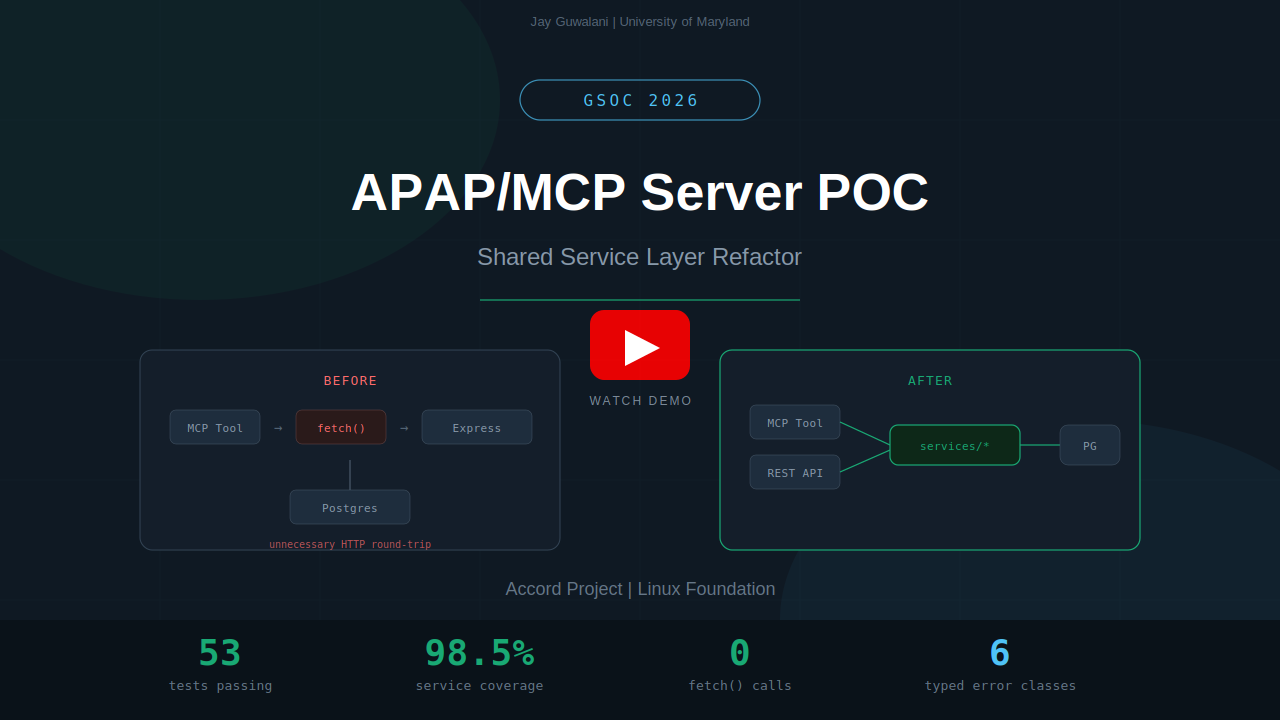
The Problem
Every MCP tool call in the current RI takes an unnecessary HTTP round-trip through the full Express stack to reach a database sitting in the same process:
MCP Tool -> makeApiRequest() -> fetch('http://localhost:9000/...') -> Express -> Handler -> Drizzle -> Postgres
The makeApiRequest() helper in handlers/mcp.ts is effectively calling itself over the network. On top of that, error handling is all bare strings (throw new Error('Failed to load template')) with no distinction between a 404, a 400, or a 500.
I ran into the same architecture at Bridgestone where five specialized agents were routing through an internal REST gateway to reach a shared Postgres instance. The fix was identical: pull the business logic into a shared service layer and let each transport call it directly.
The Fix
flowchart LR
    MCP[MCP Tool] --> SVC[services/agreementService.ts]
    REST[REST API] --> SVC
    SVC --> DRIZZLE[Drizzle] --> PG[(Postgres)]
One function. Two consumers. No HTTP loop. Bug fixes propagate to both protocols automatically.
Project Structure
src/
  config.ts                 Zod-validated env vars, fail-fast on startup
  index.ts                  Server entry, wires Express + MCP transports + health check

  db/
    schema.ts               Drizzle schema (mirrors APAP RI exactly)
    client.ts               Connection pool factory with DI for tests

  services/
    errors.ts               Typed error hierarchy (6 classes replacing bare strings)
    templateService.ts      Template CRUD via Drizzle
    agreementService.ts     Agreement CRUD + convert + trigger
    index.ts                Barrel export

  handlers/
    mcp.ts                  MCP tool/resource registration (SSE + StreamableHTTP)

  routes/
    api.ts                  REST router, same service imports as MCP

  middleware/
    logging.ts              Pino structured logging, request-id correlation
    healthz.ts              /healthz for Docker readiness probes
Invariants that make this work:
- Every service function takes
dbas its first parameter (testable without Postgres) - Services return typed results, never raw HTTP responses
- Services throw
ServiceErrorsubclasses, never bare strings - Services import nothing from Express or the MCP SDK
Quick Start
Docker (30 seconds):
git clone https://github.com/JayDS22/apap-mcp-poc.git
cd apap-mcp-poc
docker compose up
Local (requires Postgres running):
cp .env_example .env        # edit credentials if needed
npm install
npx drizzle-kit push
npm run dev
Either way, you get:
APAP MCP POC server listening on http://0.0.0.0:9000
  REST API:       http://0.0.0.0:9000/capabilities
  MCP SSE:        http://0.0.0.0:9000/sse
  MCP Streamable: POST http://0.0.0.0:9000/mcp
  Health:         http://0.0.0.0:9000/healthz
End-to-End Walkthrough
Once the server is running, walk through the full lifecycle:
# Health check
curl http://localhost:9000/healthz
# {"status":"ok","timestamp":"2026-03-28T..."}

# Capabilities (matches APAP RI format)
curl http://localhost:9000/capabilities
# ["TEMPLATE_MANAGE","AGREEMENT_MANAGE","SHARED_MODEL_MANAGE","AGREEMENT_CONVERT_HTML"]

# Create a template
curl -s -X POST http://localhost:9000/templates \
  -H 'Content-Type: application/json' \
  -d '{
    "uri": "resource:org.accordproject.protocol@1.0.0.Template#latedelivery",
    "author": "dan",
    "displayName": "Late Delivery and Penalty",
    "version": "1.0.0",
    "description": "Penalties for late delivery of goods",
    "license": "Apache-2.0",
    "keywords": ["late", "delivery", "penalty"],
    "metadata": {"$class": "org.accordproject.protocol@1.0.0.TemplateMetadata", "runtime": "typescript", "template": "clause", "cicero": "0.25.x"},
    "templateModel": {"$class": "org.accordproject.protocol@1.0.0.TemplateModel", "typeName": "LatePenaltyClause", "model": {"ctoFiles": []}},
    "text": {"templateMark": "Late Delivery and Penalty clause text..."}
  }'

# Create an agreement referencing the template
curl -s -X POST http://localhost:9000/agreements \
  -H 'Content-Type: application/json' \
  -d '{
    "uri": "apap://agreement-demo1",
    "data": {"$class": "io.clause.latedeliveryandpenalty@0.1.0.TemplateModel", "forceMajeure": false, "penaltyPercentage": 10.5, "capPercentage": 55, "clauseId": "demo-1"},
    "template": "resource:org.accordproject.protocol@1.0.0.Template#latedelivery",
    "agreementStatus": "DRAFT"
  }'

# Convert to markdown
curl http://localhost:9000/agreements/1/convert/markdown

# Convert to HTML (open in browser)
curl http://localhost:9000/agreements/1/convert/html -o /tmp/agreement.html && open /tmp/agreement.html

# Trigger agreement logic
curl -s -X POST http://localhost:9000/agreements/1/trigger \
  -H 'Content-Type: application/json' \
  -d '{"$class":"io.clause.latedeliveryandpenalty@0.1.0.LateDeliveryAndPenaltyRequest","forceMajeure":false,"goodsValue":1000}'

# Structured error handling -- typed error, not a bare string
curl http://localhost:9000/agreements/9999
# {"error":{"code":"AGREEMENT_NOT_FOUND","message":"Agreement not found: 9999","details":{"identifier":9999}}}
MCP Inspector
npx @modelcontextprotocol/inspector
# Open http://127.0.0.1:6274
# Select SSE transport, URL: http://localhost:9000/sse
# Browse Resources, call Tools (getAgreement, convert-agreement-to-format, trigger-agreement)
Tests
npm test                  # 53 tests + coverage
npm run test:unit         # 44 unit tests (mocked DB, no Postgres)
npm run test:integration  # 9 integration tests (real Express, mock DB)
npm run typecheck         # TypeScript strict mode
Service layer coverage: 98.69% statements / 92.3% branches / 100% functions. errors.ts and templateService.ts are at 100% across the board.
Error Handling
The RI throws new Error('Failed to load template') on every failure path. This POC replaces those with typed errors carrying machine-readable codes, HTTP status mappings, and structured details:
| Error Class | HTTP | Code | When |
|---|---|---|---|
TemplateNotFoundError | 404 | TEMPLATE_NOT_FOUND | Template ID/URI not found |
AgreementNotFoundError | 404 | AGREEMENT_NOT_FOUND | Agreement ID not found |
AgreementConversionError | 500 | AGREEMENT_CONVERSION_FAILED | Rendering fails |
InvalidPayloadError | 400 | INVALID_PAYLOAD | Trigger payload not valid JSON |
TemplateDuplicateError | 409 | TEMPLATE_DUPLICATE | URI uniqueness violation |
ValidationError | 422 | VALIDATION_ERROR | Schema validation failure |
The MCP handler and REST router each have their own catch block that maps ServiceError into the right response shape for their protocol. Anything that is not a ServiceError is treated as a genuine 500.
GSoC Timeline Mapping
| Weeks | Phase | What This POC Covers |
|---|---|---|
| 1-4 | Service Layer + Error Types | src/services/ -- full CRUD, convert, trigger, 6 error classes |
| 5-8 | Testing Infrastructure | __tests__/ -- unit + integration across both MCP transports |
| 9-10 | CI/CD | .github/workflows/ci.yml + Docker Compose |
| 11-12 | Observability + Docs | Pino logging, health checks, this README |
Phases 3-4 of the proposal (OpenAPI validation, load testing, contributor docs) build directly on top of this foundation.
Prior Art
I have shipped this exact shared-service-layer pattern twice in production:
Bridgestone (2022-2024): Five specialized agents (analytics, trip data, driver safety, fleet performance, crash analysis) routing through an internal REST gateway to Postgres. Refactored to shared services, cut P95 latency by 40%, and brought the system under test coverage for the first time in its lifecycle.
Aya Healthcare (2025): LangGraph multi-agent pipeline with 5+ agents (screening, skill assessment, matching, scheduling, FAQ) sharing a Postgres backend through typed service functions over OCI/AWS. Same pattern, same DI approach for testability.
Links
- APAP Repository -- upstream codebase this POC refactors
- Accord Project
- GSoC 2026 Ideas -- Idea #4
- MCP Protocol Specification
License
Apache-2.0